Showing posts with label Business Support Services. Show all posts

Thursday, March 1, 2018

How to mitigate construction in your downtown

Nur Asri is an Associate at Larisa Ortiz Associates

Downtowns and cities around the country are undergoing rapid physical transformations whether due to re-investment or adaptation to technological advancements. However, during the process of transformation, roads and sidewalks are often torn up and diverted, street furniture and public spaces are re-designed and replaced and the shopping environment is essentially disrupted.

Regardless of the length of time in which the disruptions occurs (two months or a whole year), customer traffic for retail businesses will be affected because downtowns appear to be less accessible by car and even more difficult to navigate on foot. Furthermore, construction often occurs during the day (and during peak visitation times!) and can be loud and dusty, resulting in an overall unpleasant shopping experience.

Downtown businesses associations and storeowners across the country are adopting a variety of strategies to mitigate the impacts of construction on their operations, sales and visitation.

Here are some steps that you can take to maintain business vitality during your downtown transformation: 

‘Still Open for Business’ Signage
These signs help increase visibility of stores to pedestrians and vehicles passing through your downtown. Customers often assume businesses are closed during construction and are therefore quick to make the decision to drive past and go somewhere else altogether so it is crucial that accurate information is relayed to customers through these signs. Include the names of businesses that are open and directions to any alternate business access, and make sure the signs are placed at key intersections and entry points to your downtown. Some cities have also gotten really creative with their signs:


In Arlington, MA, Capitol Square Business Association plays around with the regular text found on construction signs.

In the City of North Bend, where roads were being torn up for an infrastructure project to bury utility lines and replace the sidewalks and street trees, sign spinners were hired to sing, dance, and do cartwheels while holding out signs that say ‘Downtown Business are Open!’

Signs, however, are only one part of the solution. There are many more steps that need to be taken to ensure that downtown businesses aren’t severely impacted by the process of transformation.

Marketing/ Promotion
Many business associations have dedicated resources to organizing district-wide marketing campaigns to educate customers about construction work and businesses that still need their support during this time.

Pre- Construction
In Madison WI, marketing efforts began two years before construction occurred in order to inform locals that stores and restaurants would remain open throughout the process. The guerilla campaign was extensive and consisted of yard signs, community newsletters, local media coverage and even a Facebook page.

During Construction 

The Myrtle Avenue Brooklyn Partnership launched an ‘Eat Drink Shop [HERE]’ Campaign. The Partnership rolled out bright yellow signs and handouts that list all of the businesses that were open during construction. 


Meanwhile, in Bangor, Maine, (and also downtown Coral Gables) happy hour events ensured that customers were still coming downtown after dark despite the facelift it was undergoing. Bars affected by the construction zone participated in the ‘Hard Hat Happy Hours’ events, which took place weekly. Customers who attended were then rewarded with highly coveted downtown parking passes and gift certificates to local businesses to drive return visits. Similarly, many other downtowns have also handed out coupon books to entice customers to continue shopping thru the construction period.

Valet parking
When convenient on-street parking spaces are temporarily lost to construction activity, customers may be less than willing to patronize downtown stores if they have to park in parking garages/lots located farther away from the retail core. Every effort should be made to ease the driving customer’s journey (especially if the majority of your downtown customers are arriving by car!) and this might include a valet service.

In Birmingham, MI, where construction through the city center is expected to take about 4-5 years, the city’s promotional arm Birmingham Shopping District is planning to provide valet service that would allow customers to drive to the edge of the construction site to drop off their cars before hitting the rest of the downtown on foot.

Painted fences/barriers
Finally, there are creative ways to turn construction fencing and barriers into public art. Back in 2012, we featured Alliance for Downtown New York’s RE:Construction program. Since then many more downtowns and cities have also turned to art as a way to mask the eyesore of construction. In 2013, the Downtown Ithaca Alliance put out a call for artists to adopt 8x4 plywood panels that were put up as fencing around the reconstruction of the Commons public space. Selected artists were invited to paint directly on to the panels that stayed up throughout the construction period.

In downtown Seattle, WA mural artists and artist-teams have created 200-foot long murals now on view on the Civic Square construction fence. The site will be home to a mixed-use, high-rise tower and open space that will complete the city's Civic Center Campus.

While the above strategies aim to ease the impact of construction for customers, there are also steps that need to be taken to mitigate the impact on business operations.


Loading/Unloading
Even without the complications of construction downtown, loading and unloading of delivery trucks is already a common issue faced by business owners. Without a well-thought out contingency plan, your downtown may face heavy congestion as a result of trucks double-parking on narrow side streets.

To avoid this, pre-planned alternative delivery routes must be identified for affected drivers and relayed early on so that staff are alerted to the change of procedures. In addition, detour signs must be posted clearly to guide delivery drivers. Where possible, alleyways may be re-purposed for loading/unloading during construction phase.

Low-interest loans
With larger-scale construction projects, many cities such as Portland, OR and Salt Lake City, UT have set precedents for dedicating resources to offer low-interest loans to affected businesses. Salt Lake City’s Economic Development Office, for example, established a revolving loan program and set aside funding for light rail construction mitigation up to $20,000 at 3% interest per applicant. Successful applicants simply had to be within one block of construction and be able to demonstrate how they were being impacted.

Finally, with additional financial and technical assistance, business owners might even consider implementing another method to reach customers if they don’t already have one. Starting online delivery services can certainly nudge customers who are unable or unwilling to navigate through construction to continue to support downtown businesses.

Make sure your downtown transformation works for you
The menu of strategies offered here cost lots of time and money to plan and implement. (Note: Birmingham Shopping District set aside $100,000 just to carry out a promotional campaign including free valet parking and shopping coupons). Depending on the capacity and resources of your downtown, and also the scale of construction happening, you may elect strategies that work best for your businesses.

Most importantly, ensure that you start planning early and work very closely with local merchants to ensure their buy-in and support for your elected strategies.

Friday, September 29, 2017

Farmers Market as Downtown Revitalization Tool

Nur Asri is an associate at Larisa Ortiz Associates

Fall is upon us and for LOA that means the work on a second round of New York State Downtown Revitalization Initiatives is set to begin. In the past year, our work has brought us to smaller, more rural towns upstate and around the country and with that, came many visits to local farmers markets. Farmers markets, or “multi-stall markets at which farmer-producers sell agricultural products directly to the general public at a central/ fixed location” are not a new phenomenon. In fact, marketplaces have been a key economic, cultural, and social component of villages, towns, and cities for thousands of years. Today, smaller downtowns, are seeing a resurgence of farmers markets as economic revitalization tools, particularly in areas with existing agricultural assets. In this post, we discuss the potential benefits that can be reaped from a downtown farmers market and actions that can be taken to ensure the most effective implementation of one.


Farmers markets are community porches
Many of the farmers markets we have observed in our work, whether intended or not, have evolved into the “front porch” of the community and function as key gathering places. Residents and visitors from various walks of life convene at the market through a common interest for fresh, local produce resulting in unique social interactions.

Morganton Farmers Market at the retail core. Photo: LOA
In some cases, farmers markets have also been key in activating formerly underutilized spaces downtown and turning these into active public spaces. From old warehouses to underused parking lots and vacant land, farmers markets have the power to activate these spaces by introducing a new public use and attracting new users of the space.


In Morganton, NC, for example, hosts a mini farmers market every Wednesday in the warm months on a field that was simply sitting vacant by the retail core of the downtown. Meanwhile, in Springfield, OR, a year-round farmers market is hosted in a former church property that was purchased and refurbished with a 3,000 SF event space.

Farmers markets promote health and wellness
The seasonal freshness of fruits and vegetables sold at farmers markets, the in-built nutritional value of goods sold, and the direct linkage made between food producers and consumers, makes the markets fitting platforms for health promotion and nutrition education.  In addition, consumers around the world are also gaining a new appreciation for and connection to their food producers, so farmers markets are the much-needed platforms to further grow support for local food systems.

In addition, farmers markets that offer SNAP programs also expand low-income households’ access to healthy foods, ensuring that all local residents are able to reap benefits from the healthy offerings at the markets and raising nutritional levels among low-income households. Additional free programming such as cooking and nutrition classes offered at farmers markets can often expand the accessibility of healthy local produce by educating those households that are unfamiliar with preparing fresh, wholesome meals.

Now, for the economic benefits.

Farmers markets are visitor attractions
Farmers markets are also great downtown anchors that attract hoards of residents and tourists for hours weekly. Naturally, this raises foot traffic that may otherwise be lacking in smaller downtowns. In Springfield, OR, for example, the famers market attracted an estimated 30,000 people and more than 40 regular vendors in its first year of opening alone.

In a smaller, rural downtown, this regular stream of pedestrian traffic to the farmers market translates to foot traffic into neighboring stores and restaurants, especially when the farmers markets are held on weekends and customers dwell times are more flexible.


Farmers markets add to downtown retail mix
With more traditional farmers markets that host fresh produce and specialty food vendors, these markets essentially act as the local grocery store. In more rural parts of the country where the grocery store is typically a big box Walmart or Wegmans or Food Lion that requires driving 15 minutes outside of downtown, the farmers market can be a solution to bridging a hyperlocal retail gap.  Its location, typically in a downtown parking lot, means that it is far more convenient for residents in the area to grab a carton of milk or spare eggs. Not to mention, the freshness of pastries and bread sold at the farmers market compared to the large grocery store.

As consumer preferences shift, even grocery stores are replacing their aisles with even more fresh, local produce and organic goods – goods that are already filling the wooden crates at farmers markets. In 2008, local food sales were estimated to be close to $5 billion and farmers markets are naturally aligned to leverage the growth in this demand (if it's not already being met!).

Farmers markets function as business incubators and accelerators
From Farmers Market vendor to.....
Finally, and most importantly, farmers markets cut the middlemen who typically distribute farmers’ and artisans’ goods, therefore raising profit margins for the producers. The markets also act as business incubators by providing the opportunities for producers and makers to first test products directly with consumers and get real time feedback thru product samples – all at a much, much lower cost than either setting up a storefront or selling online. The Fresh Friday Farmers Market in Allentown, PA, for example, has provided increased business opportunities for local farms and food businesses proliferating in the LeHigh Valley.
...Storefront! This is Cedar Rapids Whiskey Sauce Co. in Ely

Upon finessing and growing the demand for their products and services, many farmers market vendors have then grown big enough to be able to set up brick-and-mortar stores downtown. For downtowns that lost retail tenants in the last economic downturn, this business incubation function of farmers markets may be ideal to helping fill those storefront spaces. For example, in Richmond, VA, a vacant storefront that was formerly occupied by a bakery was recently bought over by a pastry chef who sells pastries and baked goods at the local St Stephens Farmers Market. Although the owner will essentially be replacing goods that were already on offer by the previous tenant, the farmers market start has enabled her to refine her merchandise selection based on early consumer feedback.

Other examples of farmers market vendors that have moved on to brick-and-mortar include Blacksauce Kitchen that made its start at the JFX Farmers' Market in Baltimore before recently opening a shop that serves customers one day a week. In Iowa, Cedar Rapids Whiskey Sauce Co last year opened a shop on Dows Street in small downtown Ely after making its start at local farmers' markets and several HyVee grocery store locations.


How to ensure farmers markets really become downtown revitalization tools:
Unfortunately, not all farmers markets have been powerful downtown revitalization tools. There are a number of steps that need to be taken to ensuring that the benefits we discussed above can be achieved.

Site your farmers market in or near your retail core
Geneseo, NY Farmers Market off Main Street by local theater.
Firstly, the location of the farmers market is crucial to driving spillover foot traffic from the market to downtown storefronts. If the market isn’t located in the retail core of downtown, shoppers are unlikely to stop by adjacent storefronts after perusing the market. In Morganton, NC, for instance, before introducing a mini market on Wednesdays on an empty field at the retail core, hosted its weekly farmers market 0.5 mile away, far away enough (given the hotter climate and elevations) that customers passing through the farmers market would have to get in a car before being able to get to downtown. And we all know, once your customer gets in the car, they’re as good as lost. The farmers market wasn’t quite an anchor for downtown businesses until it was introduced right smack in the retail core.

Locating farmers markets in the retail core will be especially crucial for downtowns that have residential uses located at the retail core or within walking distance of downtown. Having direct and easy access to a large residential shopping demand is crucial to the success of vendors, and of course if vendors succeed, they are likely to return to sell goods, maintaining the critical mass of vendors needed to attract customers and ensuring overall sustainability of the farmers markets.

Provide supportive transportation infrastructure
City of Palo Alto installed bike racks on the
street used for weekly farmers market.
If your downtown is dense and walkable and the bulk of your customers are residents who already live in the vicinity, then supportive infrastructure to help customers get to the farmers market might include wide sidewalks, pedestrian crossings, wayfinding signage, bike lanes and bike parking facilities, and bus stops.

On the other hand, if your downtown is small and much more rural with most customers only able to arrive by car, then convenient and well-maintained parking lots should also be made available to support a “park once” downtown for customers and vendors to visit the farmers market and other businesses all at once without having to worry about moving their cars.

Complement the market with programming
Portland, OR Market Music event showcases local acts.
Educational community programs and local music acts are some activities that accompany farmers markets across the country and these are great ways to further engage local residents and visitors that pass through. The best way to find out what types of programs the local community needs is to simply carry out an intercept consumer survey.

At the same time, programs should also be organized to help vendors grow their business and following. The Neighborhood Economic Development Corporation in Springfield, OR, organizer of the downtown farmers market is an owner of properties downtown. Once vendors at the market reach a stage of expansion that requires a larger and more regular storefront, NEDCO is able to rent spaces it owns at lower rates to support these businesses.

Operate the market during accessible hours
Depending on the downtown and the number of major employers in the area, it may be effective to hold farmers markets on weekdays. In such cases, vendors may leverage the existing daytime worker market demand during lunchtime. On the other hand, if the weekday daytime population downtown doesn’t exist, then a weekend market would make more sense. 


Actively brand and market
Strong local campaigns to bring awareness to and promote the farmers market are crucial to establishing a new downtown anchor. In Livingston County, NY, (where we’re about to embark on a Countywide Commercial District Assessment), a Find It In Livingston campaign encourages shoppers to seek local produce and goods by actively announcing where and when downtown farmers markets happen on the county economic development website. The Charles City Downtown Farmers Market similarly participates in the ‘Buy Fresh, Buy Local’ campaign, a comprehensive marketing program for farmers selling directly to consumers, restaurants, grocery stores and other institutions.


Ensure strong administrative capacity
As with all downtown economic revitalization initiatives, administrative capacity and resources are required to sustain farmers markets. In addition to support from the City, buy-in from local residents is essential to carrying out a successful market. While the City is able to support the market in procuring a vacant site or supplying sanitation facilities and power, support from local businesses and individuals will ensure sustained customer traffic and vendor participation.

The non-economic and economic benefits of farmers markets might tempt you to implement one downtown. However, they must not be assumed to be simple revitalization tools. Farmers markets are complex efforts that often require the cooperation of a wide range of stakeholders (existing business owners, residents, community leaders), thoughtful planning, extensive programming and marketing, and of course funding! Who knows what this second round of funding from New York State will bring to the downtowns we’ll be working with this Fall but we will be keeping a look out for those farmers markets and keeping our eyes peeled for what works for them!

If you already have a farmers market downtown and are looking to assess its impact, take a look at this economic impact study of the farmers market in Downtown El Paso: http://downtownelpaso.com/economic-ripples-felt-from-downtown-artist-and-farmers-market/

Wednesday, May 10, 2017

Fake News - Retail is not dead!

This past weekend we had the privilege of attending the National Planning Conference at the Javits Center here in New York City. There were over 600 sessions, discussions, and mobile workshops on topics ranging from retail and downtown revitalization to short term rentals and agricultural tourism. A theme that seemed to permeate many of these discussions was one of continued strength and adaptations in brick-and-mortar retail. City officials, architects, market consultants, and planners at various panels resoundingly agreed that retail was not dead in their communities, or in communities they were working for, and that there are still steps to take to support its growth. We've all read the recent reports on large national retailers like Macy's pulling back on storefronts and abandoning suburban shopping malls. However, this calamitous picture being painted in the media of retail's impending doom seems to be clouding the realities on the ground. As Steve Dwoskin, Vice President of Callison RTKL, aptly said in his session on The Reality of Planning for Retail, "It's Fake News".

Retail Trends
There are so many ways that retailers today are adapting to changing consumer trends and habits in order to sustain growth. At the same session, Kate Coburn a partner at HR&A, explained the importance of understanding the changing shopper demographics across the country and using that to retail's advantage. Millennials, as many of us know, currently make up the biggest proportion of the population with over 92 million of them here in the U.S. This group, combined with the growing Generation X-ers, are the shoppers that retailers need to watch and adapt accordingly to. More importantly, there is also a growing Hispanic and Asian population here in America that needs to be accounted for in retail market strategies and downtown retail tenant mix. Not to forget the high rates of urbanization that are also forcing retailers to rethink configurations of properties, store formats, and partnerships.

Here are some ways in which retailers, downtown organizations, and developers are adapting to these dynamic consumer trends:

  1. Reconfiguring properties from single purpose malls to mixed use developments in more urban and transit-served areas
  2. Changing store sizes and formats to fit downtown main streets rather than suburbs
  3. Repositioning and retenanting resulting in many developments shifting reliance on department store anchors to entertainment and dining anchors
  4. Focusing on experiential retail as a result of growing e-commerce competition
  5. Targeting localized tenants that cater to diverse demographics in different localities
  6. Using multimedia strategies and moving from traditional media to social media advertising

Ikea was an example of a retailer that has been seen to adapt to its changing consumer habits. Its original 400,000 SF model has since been shrunk to 100,000 SF stores in order to be able to fit into more urban places. Its aim was to "bring the Ikea home furnishing range and expertise closer to customers" who lived in urbanized areas. Although these smaller formats are not able to carry full product rangescustomers are still able to order from the Ikea online range for collection at dedicated collection points of smaller format stores - similar to Target's fulfillment centers that we wrote about last week. It's important to acknowledge, however, that furniture is one of few retail categories that has fortunately been less vulnerable to e-commerce. Make-up/ cosmetics, services like hairdressers and laundromats, and restaurants are some other categories that continue to thrive despite the growing shift toward online shopping because they all require in-store product experience and demonstrations before consumers are able to make purchases. Likewise, local businesses that offer authentic experiences are becoming most valuable in today's retail climate. 

What cities can do to create a supportive system for all types of retail to thrive

  1. Provide appropriate spaces for retail
    • Cities can often provide tax incentives to landlords and property owners so that they may renovate and provide viable retail spaces. In our work, we 've often seen downtowns struggle with high ground floor vacancy rates and yet long lists of potential tenants. This is often the case because tenants and small businesses do not have the capital to rehabilitate and fix up the vacant spaces in order to make them viable for business
  2. Be strategic about co-tenancies
    • A block-by-block tenanting strategy should be developed by merchants associations or downtown organizations in order to effectively cater to communities living in surrounding neighborhoods and also to increase retail diversity
    • Curating retail mix can only be effective when property owners are involved in the strategizing. However, this often requires that cities provide financial incentives for them to be active in such discussions.
  3. Grow customer base close to retail corridors
    • Provide diverse housing options that meet full range of household incomes needed to support a variety of retail
    • Encourage flexible spaces of employment (office and manufacturing) near retail corridors that encourage strong daytime worker populations with a range of income and interests
  4. Right-size parking and vehicular areas
    • With the increasing use of shared car services like Uber and Lyft, and with retail moving to urban places, parking requirements no longer hold the same weight as they did. Retailers in urban areas are instead seeing the need for drop-off areas more so than large swathes of parking. Some downtowns are even revisiting parking requirements for retail uses given the changing environment.
Ways to support small businesses through zoning
More specifically, zoning can be an effective tool in supporting the growth of retailers and small businesses. A panel discussion opened by Arista Strungys, Firm Principal at Camiros, Ltd, dived into some tried and tested zoning modifications and tools that have lowered barriers to entry for businesses. The session cautioned municipalities about out-of-date use structures that were often the biggest barriers to small businesses thriving downtown. According to the panel, building flexibility into zoning and land use ordinances is key to supporting small businesses, including retail. This flexibility can be achieved by establishing a generic use approach rather than specific use approach and also tailoring uses to different districts. The former encourages readability of the ordinance by eliminating pages and pages of descriptions that outline every specific use allowed. Instead of listing retail categories such as 'Clothing Stores' or 'Book Stores', the ordinance simply says 'Retail Goods Establishments' to build in flexibility for allowed uses. Tailoring uses to districts, on the other hand, is best represented in a 'Uses Matrix' like the one below. This approach also encourages readability of the ordinance and eliminates the cumulative structure of traditional ordinances.
Eastern Neighborhoods Zoning Guide - Sample Use Matrix

Finally, monitoring new types of uses is also key to being flexible for businesses. Robert Azar, Deputy Director of the Department of Planning and Development for the City of Providence, Rhode Island showed how his City was encouraging small businesses by introducing newer use types in the ordinance including Residential-Commercial/ Residential-Professional uses that encourages live-work spaces downtown. By doing so, the City is using these new permitted types as a calling card for itself - inviting newer types of businesses downtown such as micro craft breweries and specialty food producers and retailers.

For all the news articles and media bombardment of brick-and-mortar retail declining, there is also a strong movement at local levels to grow retail in dense, urban areas through a myriad of financial and regulatory tools. If your town or city is also doing something innovative to adapt to the changing retail trends and consumer habits, let us know! Get in touch at info@larisaortizassociates.com

Monday, February 6, 2017

Retail Incubator Models and Downtown Revitalization: Understanding the Options


Many corridors across the country struggle to retain and attract viable retailers. In the same way, establishing a retail business in a downtown corridor is a capital and knowledge intensive endeavor. This post introduces different retail incubator models and explores how they can bridge the gap between empty storefronts and aspiring entrepreneurs.

Retail incubators are a specialized type of business incubator. Just as business incubators nurture the development of new businesses (tech, manufacturing, etc.), retail incubators provide critical assistance to retailers in their early start-up phase. This assistance encompasses multiple aspects of opening and running a business that range from coaching, access to capital and physical space to marketing and networking connections. A key aspect of a retail incubators that many groups excited with the concept fail to grasp is that an incubator is not simply a building with many stores, but it is a program of targeted services. In fact, retail incubators can be of various types and structures, including space-based models and program-based models.

Space-based retail incubators allow retailers to occupy small spaces within a larger facility that shares a number of services (think of the typical flea-market) at reduced rents. In this model vendors benefit from the proximity to other vendors (potential for increased foot traffic) as well as shared cost of typical operating expenses (utilities, etc). Also, the close proximity to other vendors allows the exchange of ideas and lessons among them and thus boosting collective learning and innovation. In this model, however, technical assistance to individual businesses is not the emphasis since space-based incubator facilities tend to house a mix of new and established retailers.

In fact,this type of retail incubator has been often established by property owners and developers to fill vacancies with innovative and creative retailers and generate interest in these properties and even in the neighborhoods they are located. For example, Shops @ MoDiv, a collection of tiny spaces housed in a historical building in downtown Grand Rapids was created Rockford Construction with the intent to incubate businesses that once established in the downtown facility will want to stay in the area and generate additional demand for other retail spaces downtown.

Shops @ MoDiv, a space-based retail incubator in downtown Grand Rapids, MI


Rockford Construction decided to experiment with the retail incubator concept when the developer could not attract tenants to fill the first floor of a historic downtown building during the 2008 recession.  Modeled after successful retail incubators in Ann Arbor and Portland, the developed created Shops @ MoDiv to be an innovative and flexible space mixing both start-ups and established retailers in an open and integrated floor-plan. The incubator contains ten retail spaces ranging from 100 to 1,000 square feet and leases range from six-months to five years. Tenants include boutiques, an apothecary that sells remedies and spices, artists selling their work, a bakery, and even a brewery.

It is important to note that for a real estate developer to build small spaces that require multiple tenants can be risky and not worth their investment, especially when compared to building a typical commercial building for a few tenants. In fact, Shops @ MoDiv were originated due to the lack of traditional larger tenants to lease the space. This is where a developer can potentially partner with a reliable public or nonprofit entity to take the lease and handle the work of filling all the incubator spaces. Such a partnership can mitigate the risks to the developer and help to activate the streetscape in the corridor while helping small businesses to get the exposure and experience needed to get established.

Another type of retail incubator is the program-based model. In this model, businesses are incubated in their permanent location rather than in a smaller space in a shared venue where it will outgrow. Thus, a key component here is that businesses are incubated to be able to stay where they were established. The rationale is that the location of a business is a key component of its success and that incubating a businesses at its permanent location right from the start-up phase will give new entrepreneurs a stronger understanding of the location, its local customer base and neighborhood dynamics and as a consequence enhance the business ties to the community and increase its chances of success.

A well-known example the Downtown Kalamazoo Inc. (DKI) Retail Incubation Program. Established in 2009 when downtown Kalamazoo, MI struggled to attract retailers, DKI spearheaded its creation enabled by a state legislation that allowed local Downtown Development Authorities to create, operate and fund retail businesses incubators. The program is managed by DKI’s Business Recruitment and Retention Committee and provide the following support to retail start-ups willing to open downtown:
  • Eighteen months of subsidized rent, incrementally reduced from a maximum of 50% or up to $830 monthly
  • Training in Merchandise Managements, Marketing, Human Resources, Financial Management and Customer Service
  •  Mentoring from a successful downtown business

In exchange, the program required participants the following:
  •   Attend all the training sessions
  •  Hire a bookkeeper or CPA approved by the program
  • Provide sales, inventory and expense information to allow tracking of success
  •  Keep the business open for 6 days a week or 50 hours a week

In four years the street-level vacancy rate in Kalamzoo’s downtown dropped from 20 to 2 percent. As the program filled key locations with new retail concepts, business attitudes towards downtown changed. In fact, similar programs followed suit throughout the country and are still active today, primarily led by downtown organizations focused improving downtowns’ vibrancy and overall business environment.

Regardless of the model, a retail incubator can never completely eliminate the challenges of operating a business. Many stores open and many will close. There is not a single blueprint for downtown revitalization. But for corridors struggling to attract established retailers like national chains, the retail incubator model might be an option to bring vibrancy and economic activity to the area while providing opportunity for local entrepreneurs who already understand the characteristics and demand of the local market. As with any downtown revitalization initiative, having an organization with the capacity and commitment to lead the effort is a priority.

For further information and resources on business and retail incubators, check out the National Business Incubation Association (NBIA) website.


References:

National Business Incubation Association, Tips for Developers, www.2.nbia.org/resource_library/tips_dev.index.php

University of North Carolina Community and Economic Development Program Blog, Retail Incubators and Main Street Revitalization, ced.sog.unc.edu/retail-incubators-and-main-street-revitalization, August 2016

Downtown Idea Exchange, First store opens under retail incubation program enabled by state legislation, www.DowntownDevelopment.com, 2013


Monday, June 20, 2016

On-Line Selling - an Option for Smaller Businesses?

Image source: www.forbes.com/sites/samsungbusiness/2015/02/09/

It wasn't long ago that many predicted the death of the brick-and-mortar store at the hand of the on-line retailer. However, recent research conducted by the International Council of Shopping Centers (ICSC) finds that the relationship between on-line retail and physical stores is becoming more intertwined. In fact, retailers with robust "omni-channel" strategies, i.e. those backed by physical stores in addition to on-line platforms, generated the most on-line sales. As the report points out, physical stores are still central to the whole enterprise, but they are increasingly used in conjunction with other product delivery methods and serve to enhance retailers image in their trade area.

Housingworks, a New York based non-profit that operates a small chain of thrift stores,
has set up a dedicated on-line auction platform. 

Large retailers continue to expand their omni-channel retail presence in a variety of ways including ‘buy online and pick up/return to the store’ features that are increasingly popular. But the ability to omni-channel is no longer limited to deep pocketed big businesses. In this post we explore options available to smaller retailers who want to offer customers multiple ways to buy their goods, including from the comfort of their own homes.

While the decision to sell on-line is one made by the retailer, commercial district practitioners can help their businesses by informing them of their options for selling on-line and helping market and promote those businesses that already have on-line sales platforms.

Option #1: Creating a dedicated website 
While selling on a dedicated website requires a higher investment of time and resources, it can be a worthwhile effort that allows for a greater level of control and branding by the retailer. Below are some of the most popular platforms being used today. 

Wordpress - WordPress is a well-known and very user-friendly platform that allows small businesses to set up a great looking website in a very short time, as well as customize it to suit their needs without detailed programming knowledge. The standard payment option with this is PayPal. Going through PayPal requires a bit of extra effort on the part of the shopper, so those looking to sell quickly could check out plugin options like WooCommerce or Selz at an additional cost.

Wix - is a cloud-based web development platform that allows small businesses to create web sites and mobile sites through the use of online drag and drop tools. Their beautiful templates are customized for a variety of business types (from eating establishment to beauty salons, among many others) which include particular features that are useful for each business type (for example, restaurant templates come with online ordering and reservation options). The platform includes some interesting features such as text and writing help from professional writers for the website content, and the inclusion of video backgrounds in the website.

A nice looking template for a coffee shop website from Wix

Bigcommerce is a little different from Wix and Wordpress as it consists of a comprehensive ecommerce solution for small businesses that integrates multiple points of sales (POS). This means that besides creating a website and selling from it, Bigcommerce offers a platform for merchants to also sell through social media (on their Facebook page, on Pinterest, etc.), as well as on their physical stores or in fairs, pop ups or markets. Some interesting features include the analytic reports which give business owners insights of sales trends, and a customer profile section that allows business to learn about their customers and shopping habits.

Square Market -  similarly to Bigcommerce, Square Market consists of a comprehensive ecommerce solution to sell online, which can be through the business own website or with third party e-commerce sites, as well as in physical stores, fairs and markets. The platform is also customized for particular business types and includes beautiful but limited template options. Its analytic reports are a great feature as its ability to integrate inventory control between online and offline sales.

Shopifyis  quickly becoming one of the most popular ecommerce platforms in the market. Similarly to Bigcommerce and Square Market, it consists of a multi-channel commerce platform designed for small and medium-sized businesses. Merchants use the software to design, set up and manage their stores across multiple sales channels, including web, mobile, social media, marketplaces, brick-and-mortar locations and pop-up shops.
Leif is a retail website powered by Shopify

Option #2: Using an Existing Online Platform

On-line marketplaces are popular plug-and-play options with many retailers. Below are some of the most popular options.

Amazon - The most visited on-line marketplace selling products from chain stores and international sellers. Includes bulk-listing and reporting tools and ability to have fulfillment handled by Amazon for an additional cost.

Ebay -  a shopping and online auction that allows businesses to sell a broad variety of goods and services worldwide.  It is the second most visited on-line marketplace after Amazon. In addition to its auction-style sales, the website has expanded to include "Buy It Now" shopping. The website is free to use for buyers, but sellers are charged fees for listing items and again when those items are sold.

Etsy Another very popular marketplace, Etsy focuses exclusively on handmade products and offers retailers an on-line platform that has significant reach. International sellers allowed. Includes shopping cart and image library.


Etsy's product display offers multiple filters that optimize product search and make navigation extremely easy.


Bonanza -  An increasingly popular marketplace, Bonanza sells new and used products mostly from popular brands. Includes photo-editing tools, image library, batch editor, and more. The website and searching tools are less attractive and user-friendly than the more famous online marketplaces.

Storenvy - An on-line marketplace focused on indie brands. Includes inventory and order tracking, visitor stats, mobile friendly component, and image library. Free to open, but extras, like domain support, promo codes, and more will cost various fees. The website is very user-friendly, but its search filter options are quite limited, which makes finding specific products inconvenient for shoppers.

OpenSky - Another online marketplace focused on indie brands. It includes simple management tools, unlimited product listings, and mobile optimization. Extremely user-friendly with several filters that optimize product search and display.

It is worth noting that these options are not mutually exclusive - businesses can have both a dedicated website and offer their products on Esty, Ebay or any other marketplace seller. Selling in multiple places can open business up to consumers that local merchants may have never reached otherwise. Establishing an on-line presence is also a great marketing strategy and may also help boost foot traffic and sales at physical stores (and in your district).

While the time requirements of running a small business may make it difficult for some merchants to consider selling on-line, commercial district practitioners can play an instrumental role in encouraging and providing information for merchants who might be willing to take the next step. 
Patricia Voltolini, PhD is a Senior Associate at Larisa Ortiz Associates. 

Tuesday, December 1, 2015

News Roundup: The Importance of Commercial Density, Combating Crime Proactively, Reinventing MLK, Bank Local, The Misappropriation of ED Incentives

Commercial or Residential Density: Which is Most Important?
Urban Kchoze presents a detailed analysis of the relationship between commercial density and residential density to uncover which promotes walkability more. Spoiler alert: commercial density. They also incorporate an interesting new metric, "farthest commercial use."


This design guide's prescription is to be proactive not reactive to crime. Good design and maintenance of the public space prevents crime from even happening. The alternative - NOT suggested - is to react to crime by adding more measures that further label the area as a target of crime.  


City Lab looks at the reinvention of the more than 900 street and thoroughfares named after the late Martin Luther King Jr.

Eat Local...Buy Local...Now there is Bank Local. According to the article, banks with more than $100B in assets accounted for 27% of small business lending while those with $10B or fewer assets accounted for 54% - demonstrating that small and ostensibly local banks support and finance local and small businesses.
Website capture of local banks near Jackson Heights.
This piece discusses incentive programs and how many states wanted to help small businesses, but the majority of incentives went to large corporations. According to their research, large companies captured between 80 and 96 percent of these small business incentives.


Tuesday, December 23, 2014

Mobile Marketing: Are your businesses on the map?

Customers are increasingly using on-line platforms to find local businesses in real time. I know I do it all the time.  Just the other night I was out with a friend and we had planned to meet at a restaurant in Soho. When we got there it was packed. What did we do? On a cold winters night in New York there was only one option. We stood in the heated vestibule and searched Yelp for an alternative. We found a great restaurant with a two block walk that had good reviews, a decent price range, and no wait. We liked it so much that we will undoubtedly go back. And honestly, I can't even tell you the name of the first place we tried. Clearly, Yelp helped at least one business gain a customer they otherwise would never have seen.

On-line profiles definitely help, yet most businesses do very little to manage them. In 2013, the Boston Consulting Group surveyed 4,800 local businesses and found that those businesses that claimed their FREE Yelp profile reported "incremental revenues of $8,000 annually". This is not paid advertising, mind you. Yet only 15% of small business owners know that they can get a free Yelp profile, and only 11% claimed it.

Below is a quick summary of some of the most popular on-line platforms and some basic instructions on how to use them. In each case, the instructions are somewhat similar, a business goes to the search engine and verifies their identify. They are given an account and go easily go about managing their identity. In some cases you as a commercial district manager can actively help (for example, a business using Google can add you as a "Manager"), in others, only the business owner can verify and manage their on-line identity.

Keeping with the Soho theme, I went ahead and tested business listings for Soho using four listing engines...

Bing "Venue" Maps
Bing is increasingly creating opportunities for "venue" maps. They started in 2010 by adding maps of malls, but it seems that more and more commercial districts are getting into the business. Check out the image below for a map of Soho with nearly every business listed. If you roll over the map, the businesses are linked back to a profile that includes the company website and hours of operation. When you compare it to the Google map below, it is clearly easier to navigate and understand. The map has the look and feel of a mall directory. How commercial districts can get onto Bing is not quite clear...but we have a request in to find out and will share with you when we know.


Google Maps
Google is the 6th most popular mobile app, and the first most popular mapping engine in the world, so getting businesses on the Google map should be a no brainer.

Direct your business owners to http://www.google.com/business/#befound to get started. Once a business has claimed an add, they can do things like set up a Google Adwords campaign much more easily. Remind them that additional managers can be added under Settings>Managers.

You should also know that you can list your commercial district management entity to the Google Map directory as well. Your district entity can then take the lead on setting up Adwords campaign for the entire district, which can be used to market events and actitivies as well. We worked with a community a few years ago on a restaurant marketing campaign that used Google Adwords and we were thrilled that it resulted in significant increased sales for participating local businesses.

Yelp
What sets Yelp apart is really its rating and filtering function. The site gets over 100 million unique click a month so clearly something is working. Like on Google, the first step is to Claim and Verify your Business (https://biz.yelp.com/claiming)

It should be noted that many businesses loathe Yelp. The issue here is that some businesses think that Yelp unfairly filters positive reviews (in an effort to prevent an owner from soliciting reviews from customers) and therefore highlights negative reviews. Not sure where I stand on that, but the truth is that a Yelp listing can drive traffic. Business owners can help increase the number of reviews - and good business will undoubtedly receive more positive reviews than negative ones - by adding badges to their websites or putting "Find us on Yelp" signs in the window or on the front counter.

FourSquare
With 45 million registered users (up from 30 million in January 2013), FourSquare is a force to be reckoned with (although not nearly as popular as Facebook or Twitter as a social networking app). Business looking to claim their profile can do so at: http://business.foursquare.com/


Wednesday, March 5, 2014

Why you can't afford to ignore the trend towards bicycle friendly business districts.

What do Austin, San Franscisco, Portland, Chicago and Washington D.C. have in common? Why, an expanding network of bike lanes, of course! Expanding the transportation options and improving access to commercial districts is gaining steam, and here at the Commercial District Advisor we are generally pleased with this trend. Creating and maintaining a network of bike infrastructure is one critically important way to help local businesses. But the issue is not always so clear cut in some places, and implementing interventions that may change the business environment for long standing businesses needs to be managed carefully. For many businesses whose customers historically arrive by car, the lack of immediately accessible and visible car parking, not to mention the challenges of managing deliveries when a bike lane takes us the space immediately in front of a store, are a legitimate concerns for some businesses. If  existing customers find it less convenient to patronize a store, and the business has not yet started attracting new customers, there will be inevitable growing pains. 

The fight in New York's Upper West side, where a 6' protected bike lane was installed after facing resistance from the local Community Board, is indicative of what happens in many cities. The owner of a local lingerie shop, in business for 17 years, said "It's one more piece of space it's taking up, people are not riding their bikes to go shopping." ("Business Owners Dish on Columbus Ave Bike Lanes: From 'Love it' to 'It Sucks'", West Side Rag, 1/8/13). A number of studies by bike advocacy groups suggest otherwise. They have found that local businesses do in fact benefit from customers who arrive on bike, but it can take a little while to change shopping habits. For some businesses whose offerings and clientele include older, long-time residents, the changes can be a little tougher to manage. In fact, much of the argument on the Upper West side was split by an age demographic. A blogger for Streetsblog who was covering the Community Board debate wrote "I was at this meeting, and was struck by the age divide: older people against a bike lane...and younger people in favor." But as the blogger noted, the changes have also created a safer pedestrian environment, which benefits those who do not ride bikes as well. 

Perhaps most significantly for our purposes, and the reason why on the whole bike lanes are great for commercial districts, is because they are just plain good for business. A recent study issued on bike lanes found that "in growing urban communities, protected bike lane networks encourage more people to ride bikes for everyday trips. And when people use bikes for errands, they're the ideal kind of retail customers: regulars. They stop by often and spend as much or more per month as people who arrive in cars." (For the full report, click here: "Protected Bike Lanes Mean Business: How 21st Century Transportation Networks Help New Urban Economies Boom"). Business owners sometimes express concern that bike riders don't spend as much per shopping trip, but studies show that they spend more total and return more frequently than the customer who arrives by car. In San Francisco, the study found that bike lanes and wider sidewalks on Valencia Street improved business for 66% of businesses. 4% indicated it hurt sales. 
From: Protected Bike Lanes Mean Business

One very important and less mentioned benefit of bike lanes and bike infrastructure (and one that we trumpet quite regularly) is the ability to draw more customers from a slightly larger trade area. This is our primary reason for supporting this effort. Enlarging a district's primary trade area - the geographic area from which 60- 80% of a district's customers come from - is a great strategy for helping businesses grow sales. In walkable urban communities, it is not uncommon for someone to walk 10-minutes, or about 1/2 mile at a leisurely pace, to patronize a local business. A 10-minute bike ride on the other hand pulls people from a 1.5 radius (again, assuming a leisurely pace). We ran the numbers for the neighborhood surrounding our office here in Jackson Heights, Queens and the results were astounding. The difference in trade area was the difference between 67,789 potential customers and 366,564 potential customers. Wow. 

Source: ESRI, Census 2010. Based on a radius drawn from 78-27 37th Avenue, Jackson Heights, NY
So while change can be a difficult pill to swallow from some businesses, the implications of installing and maintaining a robust bike infrastructure cannot and should not be overlooked as a vital tool in the commercial district managers toolbox. 

Friday, August 2, 2013

Pittsburgh Neighborhood Unveils Strategies Aimed at Drawing Tourists to Local Businesses

The best part of my job is seeing recommendations come to life - and this week I got that in abundance! For the past two years, our firm has been working with LISC MetroEdge on a program called Corridors of Retail Excellence (CORE). The program is special because it requires close collaboration with a local community organization in the design and execution of strategic corridor improvements. Once a number of strategies are selected, the program will fund up to $30k+ towards a series of short-term, catalytic projects. What makes this program even more unique is that during the course of the program, a dedicated "scribe" (i.e journalist) chronicles the outcomes with news articles (see previous post on the scribe program) that are then posted on the program's website and widely distributed to local media outlets. After testing the program in Richmond Virginia and Rhode Island with HUD Section 4 monies, a full-blown pilot program was funded by PNC and six selected corridors in three cities were selected (Philadelphia, Pittsburgh and Chicago). I am fortunate to have had to opportunity to lead three programs in the neighborhoods of Lawrenceville and Mount Washington in Pittsburgh, and East Girard/Fishtown in Philadelphia.

Yesterday was the press event for Mount Washington, a community in Pittsburgh that is renown for its amazing view of the City, accessed by funicular cars that crawl up the side of a steep incline. When our team visited Mount Washington over 18 months ago, our discussions with our on-the-ground partners Mount Washington CDC centered around the fact that 1.5 million visitors visit annually for the view, but few walk down the streets and patronize local businesses. The reasons are myriad, from the bend in the street that makes it hard for visitors to see what is down the street, to the lack of an inspiring retail mix that offers limited reasons to wander. As we spent the day on our diagnostic tour speaking with business and property owners, it became clear that there were a few fairly low-cost, high impact activities that might help turn the tide. Additionally, we recongized the need to measure the impact of our work (a critical but often overlooked element of commercial revitalization) and began collecting baseline metrics, in this case pedestrian counts, that would allow us to measure the impact of our efforts over time. The program recommendations included a mix of immediate activities, including vertical "blade" signs for some of the businesses that would cue visitors to business activity down the street. We also proposed a printed business directory and an online interactive smartphone application that would allow locals and visitors alike to find and patronize local businesses. Finally, in a effort to improve tenant mix over the long term, MetroEdge analysis was used to develop a comprehensive retail attraction package that will be part of a comprehensive retail attraction effort led by MWCDC. Here are some fun pics from the event and some of the fantastic local coverage that the project has received, coverage that served multiple purposes, including raising the profile of the local businesses and driving additional traffic down the street. I'll be excited to share the results of our second round of pedestrian counts at the end of the summer! 
Vincent Deandrea of Deandrea Designs in front of his new sign. Vincent has already noted an increase in foot traffic since the signs were installed. 

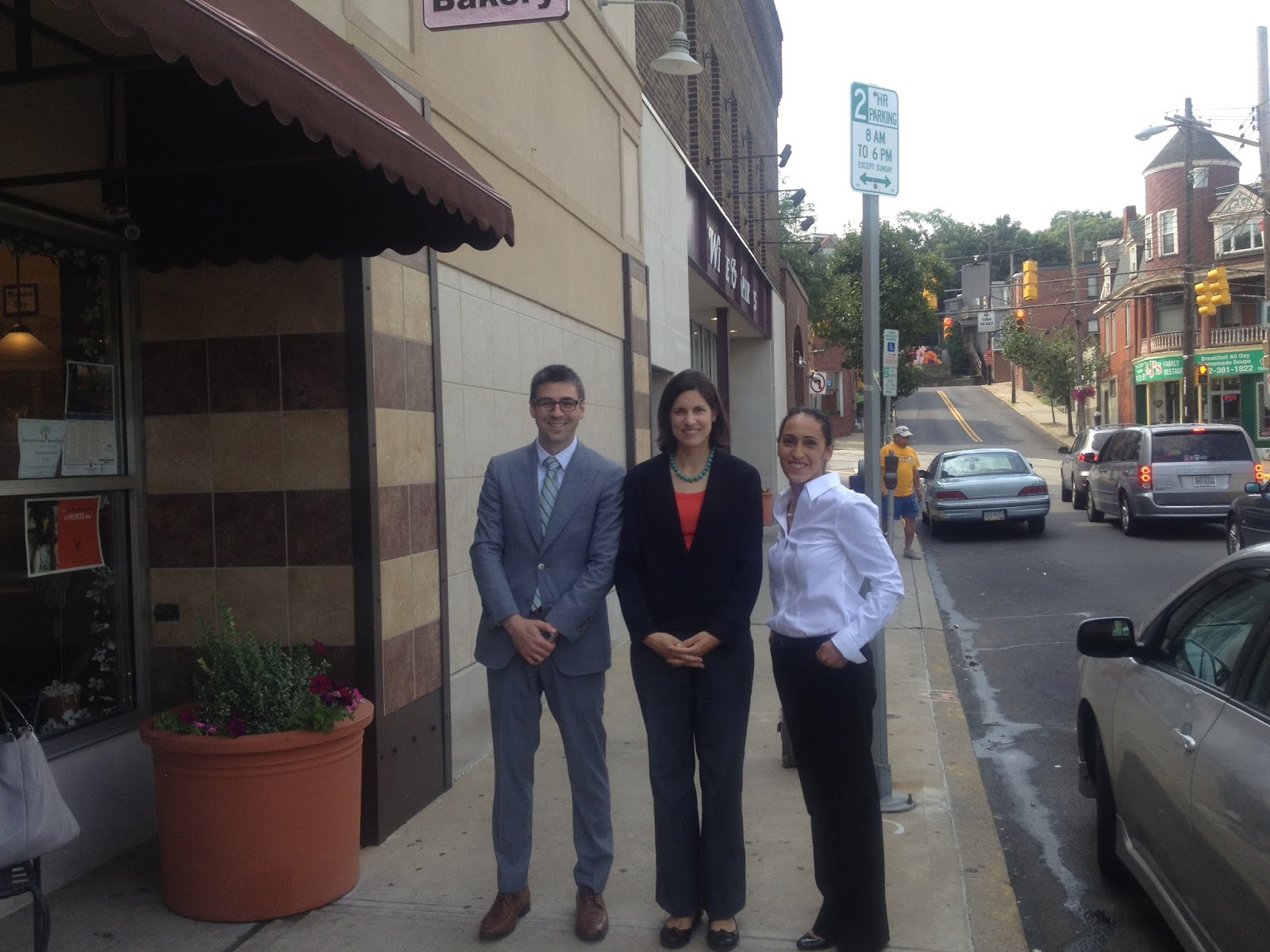
It takes a team!! For nearly two years, I have worked closely with Jason Kambitsis (right), Executive Director of Mount Washington CDC and Sarah Dielman-Perry (center) of PPND. It was great to celebrate with them! Yes, that's me on the right. :)

The retail recruitment package was incredibly creative and included these lux boxes with individual cards outlining key assets in the community, as well as a wooden USB drive with data included. In addition, nearly 7,000 district directories will be distributed at local businesses - these directories are also tucked in to the marketing package and help to communicate to new businesses the extent to which they receive free marketing if they locate to the district.

Vickie Pisowicz, owner of Grandview Bakery in front of her sign. These signs also include an international icon in a nod to the many non-English speaking visitors that travel to Pittsburgh every year. 


Wednesday, June 19, 2013

Does Bike Infrastructure Help Local Businesses?

Bicyclists on Valencia Street in
San Francisco are a common sight
With the inaugural run of NYC CitiBike well underway, Nicole Leighton, LOA's newest staff member, takes a look at how bike lanes and other bike infrastructure can help drive retail sales for local businesses. 

By Nicole Leighton

I recently returned from a trip back to my home city of San Francisco. While I’m there I typically bike much, much more than I do in New York. I bike almost daily to do errands, go shopping, and meet up with friends or family. While much of this difference can be attributed to New York’s comprehensive subway and bus system that usually makes it the most convenient choice, another main reason I love biking so much is San Francisco's welcoming bicycling environment. The City offers cyclists the infrastructure and the culture that make cycling fun, easy and convenient. While NYC has been adding tons of great improvements to its bicycle infrastructure, the culture has some catching up to do with SF.
Having worked at LOA for many months now, I couldn't help but apply a retail lens to my cycling habits. Every time I ride my bike somewhere, I end up spending money—sometimes planned, often not. Sometimes I ride my bike to go grocery shopping, while other times I’ll just take my bike out to enjoy the weather, and end up stopping at a store with inviting window displays. I knew I knew I couldn't be the only one who does this, and found a few studies that reinforce the linkages between cycling and spending habits.

One study in 2003 surveyed 27 businesses randomly chosen along Valencia Street in San Francisco, a corridor that I often frequent. After bike lanes had been added to the street, 37.0% of respondents said sales were better and none said sales were worse. Of respondents, 55.6% reported a positive effect on area residents shopping locally, and 44.4% reported an increase in new customers coming from outside the neighborhood. A similar study was released more recently by NYC DOT, which studied the effect of the protected bike lanes on local businesses in the Chelsea neighborhood. The study reported an up to 49% increase in retail sales for locally-based businesses on 9th Avenue from 23rd to 31st Streets--compared to a borough-wide average of 3% for the same period!

Anecdotally, I know that walking or biking by stores makes people much more likely to shop on a whim than when in a car (or on the train). Especially with the launch of the bike share system here in NYC, it will be increasingly important for commercial corridors to consider all modes of transportation and users of the street when creating an inviting shopping environment, including cyclists. This doesn’t only mean bike lanes, it can also include smaller amenities like bike racks or perks like discounts to customers with helmets. (Tip: anyone can suggest a location for NYC DOT to add a free bike rack here.) With the launch of Citi Bike, I’m really hopeful that an increase in bikes on the road will create a more prevalent and welcoming biking experience here in my second home city.

Sources:

  • Emily Drennen, 2003. “Economic Effects of Traffic Calming on Urban Small Businesses,” Department of Public Administration, San Francisco State University.
  • NYC DOT, 2012. “Measuring the Street: New Metrics for 21st Century Streets”

Nicole Leighton is a recent graduate of Barnard College with a degree in Urban Studies. She has been with LOA since Sept. of 2012 and currently serves as a Summer Associate.