Showing posts with label ICSC. Show all posts

Wednesday, August 9, 2017

FREE Resource! Tips to Make Your P3 Pavilion Journey at ICSC Deal Making a Success


If you missed last week’s ICSC webinar on strategies for Public-Private-Partnership (P3) success at Deal Making events, no problem! A recording is available HERE. This is a great FREE resource for public and non-profit entities considering participating in Deal Making but not sure where or how to begin. 

And for those hoping to do more than just walk the floor, another good opportunity to consider are the ICSC P3 Pavilions that allow public and non-profit partners to maintain a low-cost, turnkey kiosk and have a physical presence on the trade show floor. These kiosks are part of a branded area dedicated solely to P3 public and non-profit partners. The goal is to use this area to raise awareness among all of ICSC members about the P3 effort and to help participating communities find interested partners, retailers and developers.

If you are thinking about attending ICSC, be sure to check out the webinar and consider snagging a kiosk early as they do go quickly. P3 Pavilions will be featured at five upcoming events. 
  • Chicago Deal Making, September 27 – 28 | Chicago, IL
  • Western Conference & Deal Making, October 2 – 4 | Los Angeles, CA
  • Canadian Convention, October 2 – 4 | Toronto, ON
  • Texas Conference & Deal Making, November 8 – 10 | Dallas, TX
  • New York Deal Making, December 6 – 7 | New York, NY
The webinar has more information on how to apply. And if LOA can be of help as you prepare for Deal Making, please let us know!

Thursday, June 30, 2016

Retail Recruitment 101 Webinar

Are you struggling to meet your goals to attract development or redevelopment opportunities to your community? 

ICSC (International Council of Shopping Centers) & IDA (International Downtown Association) experts will be on hand to give tips and strategies to connect with success. 

This webinar will cover who to meet, where to be and what to do to make your community more business ready for retail real estate.


Join the webinar, July 26th at 2:00 PM EDT.
Register HERE


Wednesday, December 9, 2015

Five highlights and lessons learned from another successful ICSC Deal Making trade show...

This year's New York ICSC Deal Making just finished, and it was a jam packed two days with lots of great conversations and new relationships forged for both us and our clients.The real work of follow up begins now! I learn something new everytime I attend (nearly seven years and counting!) and this year was no different. So here is my run down of what I took away from the show...

A rebranded P3 Retail Program! As the ICSC Eastern Division Co-Chair for the now rebranded P3 Retail Program (P3 stands for "Public Private Partnerships"), it was a thrill to see the launch in action. The ICSC team, including Cynthia Stewart, Michael Cowden and Jazmen Johnson had videographers ready to go. They had some of their members conduct interviews with ICSC members about their experiences and insight. I'll be very excited to see the final results when it is all done. I was interviewed, and also had the chance to interview Keith Sellars of the Washington D.C. Economic Partnership as well as Mary Reda and Jim Diego of Greater Jamaica Development Corporation. I really enjoyed hearing their insights and learning from their experiences.

Prep work is what it takes to have a great outcome. This year, we we thrilled to work closely on ICSC prep for a large community development corporation here in one of New York's largest outer Borough downtown districts. While the team has been attending ICSC for over five years, they were looking to refocus and refine their efforts and asked us to help. We began by defining their merchandising strategy based on consumer market data and existing business mix. We used this data-driven approach to identify "like districts" that shared similar demographics and retailers. We then combed those districts to identify retailers who were already located in similar markets and with similar co-tenants, but not yet in the district. We also had to make sure that these prospects could be accommodated in available spaces within the district, based an opportunity site list we developed with the client, and that they were the right price points and "lifestyle" fit for the area.  Finally, we did research into whether those prospects were growing in the region. Once we drilled down on prospects that made the final cut, we worked with our client to identify contacts for each - that included who they already knew, who we knew through our industry relationships, and who we could find through our access to the ICSC database and Deal Making attendance list. Once that happened, the client was ready to make calls and set up appointments at the show. 

Getting a booth or kiosk can make a difference. 
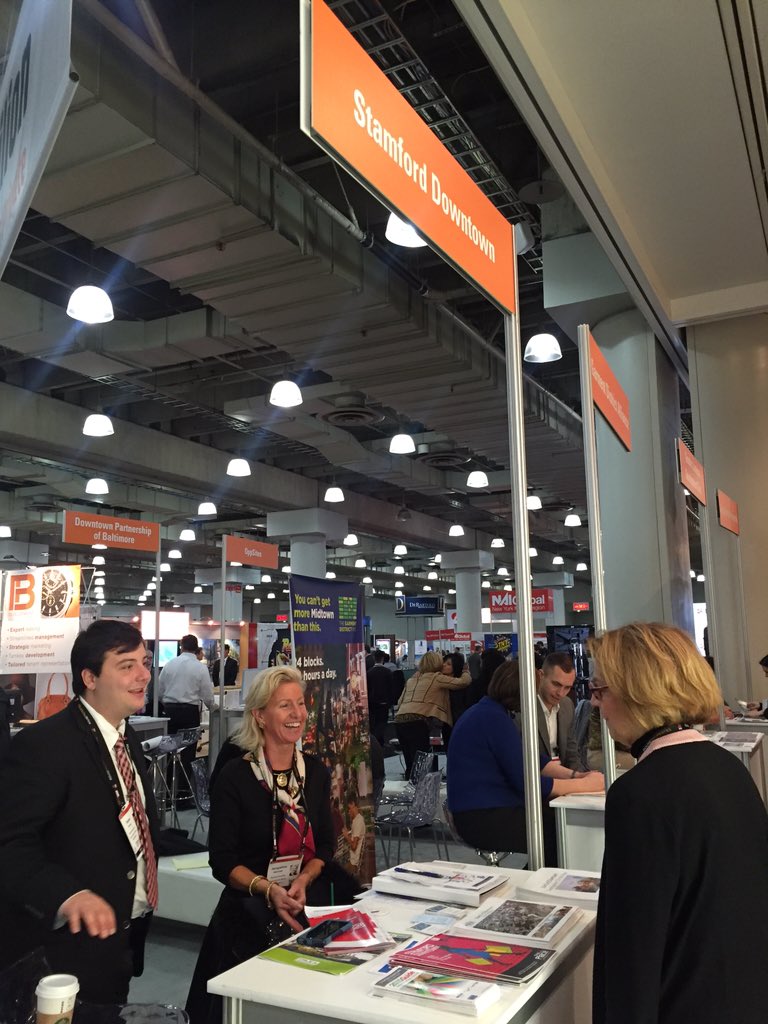
This year ICSC made a concerted effort to enlist more non-profit and public municipalities with a discount entry option. I was proud to have been a part of that as Chair of the Municipalities subcommittee that helped plan this part of the show. Our client had never taken a kiosk before and this year they did, and I am happy to say that they raved about the experience. Being able to have a home base, conduct meetings in the shared P3 Pavilion retail space, and chat with drop ins made a real difference for them, and they plan to do it again next year. It is important to note that they made sure to man the booth at all times - and also had staff walking around attending meetings. Another thing to keep in mind is that this strategy needs to be part of a comprehensive approach to the show. Don't think that you can get a booth and people will automatically come to you. The location of the P3 pavilion at the New York show was pretty good. In Vegas however, the Cities of the World pavilion, as it is branded, is in a much more out of the way location. Some cities and non-profit orgs decide to take booths closer to the action, but at greater expense. Everything is a trade off.

On that note I enjoyed my conversation with Keith Sellers of the Washington DC Economic Partnership. They have been attending ICSC for over a decade, and graduated from a shared booth with a utility company to a 5,000+ sf booth in underwritten in part by the local developers. Their approach is so incredibly strategic and thoughtful, and I enjoyed hearing Keith talk about how far they had come.

Embedded image permalink

Social media DURING the show is important. You have to treat your booth or kiosk as a might a retail store. If you don't market it, you are missing opportunities to connect with potential customers. Same goes for a trade show. The good news is that ICSC helps with this. They had a hashtag (#NYnDM) and twitter handle (@ICSC) and would retweet things that were tweeted their way. We made sure to utilize this marketing support and it was a great way to drive traffic to the P3 pavilion and to individual booths.

A marketing brochure may not be the right approach for your district. To support our client's outreach, part of our task included developing new marketing material for them. In the past, their typical marketing strategy was a multi-page brochure with lots of words and tables of data. We knew from our work in the industry that marketing strategies are changing quickly, and that the multi-page brochure, while still making the rounds, can be hard to share digitally and doesn't always come across the same way when viewed on a computer. So we made a suggestion to do something a little different but much more in line with where the industry is going when it comes to marketing retail and site opportunities. Increasingly, developers and brokers are creating marketing decks - basically short slide shows that can be printed and distributed, but are more likely to be viewed  and distributed digitally. They rely less on verbage (that very few read anyway) and more on great info graphics to make a case. They are more straightforward to understand, can be used to tell a story, easier to refine, and easier mix and match on demand. Our client carried these around in bound booklets for reference, and then told the contacts they made that they would forward them the material after the conference. This strategy is a great way to continue contact and an excuse to follow up afterwards - which is the key to success. What I also found was that the decks were a good aide in keeping the presenter on message. And after the pitch, but during the meeting, they were easier to use. You could quickly go back to any slide that communicates the point you want to reinforce.


Overall I was so happy with the outcomes for the ICSC P3 effort as well as for our clients. We live tweeted quite a bit, so follow us @cdavisor if you want to keep up.

Here are some more pics for fun. 
Embedded image permalink
I felt like Oprah interviewing Mary Reda and Jim Diego at the #P3retail booth!
Embedded image permalink
Baltimore Downtown Partnership has a great location. 
Embedded image permalink
Being interviewed by Cindy Stewart of ICSC, together with Jason Claunch of Catalyst Commercial 

Tuesday, October 13, 2015

P3 (Public-Private Partnership) PAVILION

We are excited to share this opportunity with folks in the field....

Every December the International Council of Shopping Centers puts on the NY National Deal Making Conference.

We have always found the event a great way for public or non-profit entities to market retail investment opportunities and to build valuable relationships in the field.

Some cities/non-profits choose to walk the floor, while others invest in a booth as an effective part of a retail and real estate marketing campaign. Either way, participation is incredibly valuable to those looking to build relationships and make deals. This year we are thrilled that ICSC will be providing a few ways to get in the door at an affordable rate.

On a first come, first serve basis, ICSC is offering discounted entry for a limited number of applicants, as well as low-cost, turn-key kiosks as part of the new P3 Pavilion (P3 stands for "Public-Private Partnerships").

The P3 Pavilion kiosks are a nice turn-key solution for municipalities and/or non-profit entities who want to have an exhibit space without too much hassle. The Pavilion will feature 10 kiosks under a unified branded pavilion that is exclusively for use by cities, counties, economic development agencies and non-profit main street, downtown or economic development corporations, agencies or associations (including BIDs and BIAs).

Pavilion package includes:
  • One (1) kiosk 
  • Two (2) stools 
  • Company ID Sign 
  • One (1) wastebasket 
  • Two (2) staff badges  
Package Cost: Member Rate: $500

If you are interested in the kiosks, you can download the application HERE. For those interested in the discount, you can apply by filling out an application HERE.

Thursday, October 1, 2015

The IDA Conference is in full swing...and we are sharing our insights!

This years annual conference of the International Downtown Association promises to be a good one. The energy is palpable - and it is always connect with old friends and make new ones. We will be sharing insights and tweeting throughout the conference, so be sure to follow us on twitter! @cdadvisor #IDASF

I was particularly excited to co-present a session sponsored by the International Council of Shopping Centers (ICSC) with David Greensfelder, of Greensfelder Commercial Realty. His firm is the preferred developer for CVS in the SF region and he was chock full of great insight into what drives the decision making of commodities retailers like grocery stores and drug stores. I really enjoyed seeing what goes on "inside the box" of these retailers, most of whom use sophisticated, data driven retail site selection strategies. I did not know, for example, that CVS site maps the incidence of AIDS cases in neighborhoods to determine the strength of a particular SF site. From a business perspective, this makes sense because it is one strong indicator of market potential.

David made no apologies, telling the crowd "retail doesn't want to go in space just because it's there, it's got to be a good location that makes sense."  For public sector officials and urban planners this is an important message. One example he shared from a downtown mixed-use project he developed demonstrated the importance of flexibility in use restrictions. In the example David showed, his project allowed for flexibility in ground floor uses - including shared office space and housing that could be turned into retail at a later date. The project next to his did not - it had traditional retail spaces on the ground floor. While his project has no vacancy on the ground floor, the project next to his was continually vacant. In this weak market context, requiring ground floor retail in an effort to activate the street clearly backfired. As a City Planning Commissioner for the City of New York, I am increasingly aware of how zoning regulations play a role in either supporting or undermining truly successful retail environments, so I particularly appreciated this example.

Another major take away was the role that even minor inconveniences play in site selection. I have always known that coffee shops like to be on the "inbound" side of the street for instance. That is the side of the street that accommodates the traffic (automobile, pedestrian or otherwise) of people who are going to work. David mentioned again and again and again the importance of accessibility and convenience. He had us close our eyes and imagine sitting behind the wheel of a car that is low on gas. Do we make a left hand turn across two lanes of traffic on the way to work (and keep in mind we are already running late), or do we keep on driving on fumes to find a gas station on the right side of the street? Nearly everyone, myself included, indicated they would keep driving on fumes. The power of accessibility and convenience is a powerful message that those of us in the public sector - if we can create a district that is easy to get into and out of, easy to find through wayfinding and signage, easy and comfortable to get to not just by driving, but by biking and walking, we have helped create the conditions for successful retail, and made our districts a little more attractive to the retailers looking for good locations.

With that, I'm off to the IDA Board Meeting! I look forward to the rest of the conference and to sharing more of our insights from sessions!

Thursday, September 10, 2015

Why should the public/non-profit sectors attend an ICSC Deal Making?

As a planner and consultant with a focus on downtown retail environments, I have always found membership in the International Council of Shopping Centers (ICSC) of incredible value. Over the years I have used the network, training and professional development available through ICSC to gain great insight into how and why shoppers behave the way they do, and these insights have been invaluable to me in understanding how and why some downtown's function well as retail districts, and why others don't.

My understanding of the value of ICSC has only deepened as I have participated as a volunteer leader with ICSC's Alliance Program. The program is an effort to support and enhance public-private partnership, or "P3 Retail" efforts. The need for increased understanding between the public, private and non-profit sectors is indisputable. The retail real estate industry is increasingly looking towards urban sites - and those sites are frequently encumbered or more difficult to assemble. They are also often mired in political challenges, require negotiations, gap financing and incentives, not to mention permitting and approvals that demand public sector understanding of what retail needs to be successful. This is why I am such an advocate for greater public sector engagement in ICSC.

As the New York  Eastern Division Co-Chair for the ICSC Alliance Program, and as Chair of the New York Deal Making Municipalities Sub-Committee, I have been working with an amazing group of ICSC colleagues to develop more robust programming for public and non-profit sector industry professionals, beginning with the ICSC New York National Deal Making forum in December 2015. See below for a short clip on why Deal Making is what one participant calls "a prerequisite for anybody who is doing business in the retail real estate arena." I couldn't agree more with that statement.


I will also be posting information about upcoming ICSC educational webinars for public/non-profit sector professionals so please be sure to check back for more info. (Psst...if you sign up for our free newsletter on this page, you'll get a quarterly update on all things related to downtown retail in your inbox!).

Thanks all - we'll keep you posted as events get scheduled!

- Larisa

Friday, September 27, 2013

Landlords find ways to help independent tenants succeed

Great piece on how developers and landlords are trying to help independent retailers. Although focused on shopping center owners, these tips are useful for commercial district managers. Be sure to check out the video link at the bottom of this post as well. For original article please click here. SCT Newswire

*****

Landlords are always on the lookout for independent retailers who show both passion and commitment. But the next Gaps and J. Crews of the world need to be just as careful about the landlords they choose to work with, said experts at SCT Live’s “Independent Chains Need a Hand” event, in Atlanta last week.

If the landlord is laser-focused on rent and seems uninterested in the prospective tenant’s business model or target customer, it is a huge red flag, said Christopher M. Conlan, executive vice president and COO of Acadia Realty Trust. “You have to know if the landlord is too rent-driven,” he said. “It is incumbent upon tenants to do this investigation.”

And that’s because in today’s post-recession environment, the landlord might well need to go the extra mile to support the retailer in a variety of ways, said Lyle E.T. Darnall, managing director of the Southeast for Columbia, S.C.-based Edens. Darnall described how his firm works extensively with newcomer tenants to help them find signage vendors, say, or design and merchandise their storefronts. “You’ve got to make sure the space is right for them,” he said. “They lack build-out expertise.”

Why not simply stick with the low-risk credit and universal brand-recognition of national chains? These retailers are critical, of course, but locally owned shops can help the center forge deeper connections with shoppers, said Andrea Kenney, vice president of retail agency leasing at Jones Lang LaSalle. “Each property has its own personality, and independents understand that personality,” she said. “They’re a recognizable face in the community.”


The panel included entrepreneurs Cici Coffee, founder of Natural Body Spa (nine locations in Atlanta and 14 in the Southeast); Amanda Hair of Bob Steele Salon (three salons in metro Atlanta), and Kathryn Poe, owner of the Mary Mojo Boutique in Mt. Pleasant, S.C. They each described challenges and lessons learned as independent retailers. An English major in college with no formal business experience, Poe recalled starting out in 2006 with a boutique space that was both too large and too expensive. “I didn’t even know you could negotiate the lease,” she said, laughing.

Coffee emphasized the importance of looking beyond the demographic data on the page to truly understand the psychographics of prospective sites. Noting the stiff competition of the discounters, Hair described how her salon now focuses exclusively on products not sold by the likes of Walmart or Target. All the experts on the panel emphasized the importance of personalized service in today’s marketplace. “There’s no substitute for unique customer service,” Conlan said, “and independent retailers are the best at it.”


Thursday, September 26, 2013

Professional Development Opportunity: "Identifying and Attracting the Appropriate Retailers and Developers"


I am very excited to be partnering with the International Council of Shopping Centers (ICSC) to offer an advanced retail leasing training at the upcoming International Downtown Association World Congress in New York (Oct. 6 - 9). The session is nearly sold out so be sure to register if you haven't already. Pre-Conference sessions are available to conference attendees and can be added your conference package when you register. Advance registration for the conference is closed, but you can register on-site. For more information click here.

Here is a session description. Hope to see you there!

*****

Identifying and Attracting the Appropriate Retailers and Developers
Date: Sunday, October 6
Location: Marriott Marquis, Jolson Room, 9th Floor, 1535 Broadway, New York, NY 10036
Time: 9:00 a.m. –12:00 p.m.

What does it take to get your community on a retailer's radar? What do retailers, both big and small, want to see before making investment decisions? This pre-conference workshop presents valuable information on how to assess the needs and desires of retailers and how to approach them; what consumer demographics should be highlighted; and what incentives and subsidies are likely to sweeten the deal and get them to sign on. Case studies will be presented of successful municipal retail attraction programs that have sparked investment at both the downtown and neighborhood levels.

You’ll also learn how to work collaboratively with your property owners and brokerage community to improve retail mix; what amenities help make your community more attractive to retailers, such as access, parking, lighting, safety, highway and road access, and retail competition; and practical tools and tips for getting the most out of retail trade shows and identifying regional or independent retailers that might be harder to find.

Attendees will each receive a complimentary ICSC textbook to accompany the course material: Retail Development Through Public-Private Partnerships, by David G. Wallace.

Presenters:
Larisa Ortiz, Principal, Larisa Ortiz Associates
Cynthia Stewart, Director, Community Relations, ICSC

Monday, August 26, 2013

UPDATE: REINSTATED - SEPT. 19, A CONVERSATION WITH MIRIAM HARRIS, NYCEDC SVP OF REAL ESTATE,

Seward Park Mixed-Use Development will transform more than six acres of underutilized land and transform them into a vibrant mixed-use development. Miriam Harris will speak about this and other projects. 
Update - Miriam cancelled briefly to accommodate a mayoral press event...which was then cancelled...so we are back on! Come join us for what promises to be a great conversation with fantastic networking!

****

As co-chair of the New York ICSC Alliance Committee, I am pleased to announce a conversation with Miriam Harris, Senior Vice President of Real Estate Transactions at the New York City Economic Development Corporation (NYEDC). NYEDC is New York City’s lead agency for public-private real estate development projects in all five boroughs of the City. As Senior Vice President at EDC, Ms. Harris has a keen understanding of what it takes to successfully partner with the City to bring a project from concept to completion. She is currently responsible for over 25 active projects including the 62 acre Willets Point Project in Queens, the 1.5 million square foot Seward Park mixed-use project on the lower east side of Manhattan and the 2 million square foot Cornell-Tech campus on Roosevelt Island.

The breakfast event will be held at ICSC Global Headquarters, 1221 Avenue of the Americas on Sept. 19th. Pre-registration is required to ensure you do not have problems with security. Seating is also limited, so please register ASAP. Registration fees: Members, $20; Non-Members, $35. Click here to register.

The ICSC Alliance Program is a program of the International Council of Shopping Centers (ICSC), the international trade association for the commercial retail estate industry. Alliance Programs are wonderful opportunities to network, share experiences and exchange ideas with commercial real estate professionals from both the private and public sectors. Needless to say...bring business cards!

If you want to know more, or to get involved in planning ICSC events such as these, please feel free to contact me at lortiz@larisaortizassociates.com.


Tuesday, April 9, 2013

Struggling to get retailers to pay attention? Consider producing an annual research report.


Most national retailers make decisions based on their own market research. And these days, market data is easy to come by - retailers and investors have market data at their disposal within minutes. Most begin by looking at traditional indicators such as number of people, number of households, median income and trade area. If your community is coming up short on any of those indicators, you have your work cut out for you.

But don’t despair, there are opportunities to influence retail site selection and control the narrative. Many retailers are interested in urban markets but don’t have enough information to make a compelling case. A 2008 study by the International Council of Shopping Centers and Social Compact found that retailers want, but struggle with finding information on daytime population, pedestrian traffic, consumer preferences, and neighborhood change as defined by anticipated development. In the absence of a dedicated downtown advocate, that case never gets made and investment gets made elsewhere. But fortunately, this is where a Business Improvement District (or Chamber, CDC, City, etc) can be particularly useful.

Increasingly, BIDs have begun to embrace their role as an information resource. Center City Philadelphia has a particularly robust reporting program. Their annual “State of Center City Report” even has its own webpage, and the report is positioned as a tool for investors with an emphasis on providing valuable – and hard(er) to obtain – information on employment trends (including employee wages and growth rates) and residential housing development.

Another good example is Downtown Portland’s “Business Census& Survey” , commissioned by Greater Portland’s Chamber of Commerce. This simplified version accomplishes a similar goal, sharing information about local employment trends and also incorporates findings from an annual survey of business owners and managers. What I particularly like is that the report functions in part as a report card, allowing downtown leaders to tweak public and private sector improvements on an annual basis. This level of transparency and accountability is a powerful response to many BID critics – it helps to keep everyone honest and ensures that BID assessments are having a positive impact.

These reports also position the downtown organization or chamber not as a competitor to the private sector, but rather as a valuable resource to property owners. Having information that people want helps open doors and builds relationships and partnerships. So instead of brokers, for example, seeing you as competition (sadly, this is more common than you think) they will look to you as a valuable partner in their investment decisions – decisions that will ultimately direct and shape the future of your community.  

Friday, March 15, 2013

ICSC repost: "Cities hungrier than ever for retail development"


I stumbled upon this great little write up in today's email edition of Shopping Center's Today, a publication of the International Council of Shopping Centers. I thought I would re-post in its entirety because it speaks so well to the growing role of the public sector in retail leasing initiatives  As the ICSC Alliance Co-Chair for New York, I have also noticed an uptick in public sector interest in retail recruitment. I'll be at ICSC REcon this year and plan to keep an eye out for this trend. I'll also be live tweeting from sessions and from the trade show flow. You can find me on twitter at @cdadvisor. In the meantime, enjoy this interesting - and quite relevant - read!

Best, Larisa

***

Hundreds of municipalities are emerging from the economic meltdown only to struggle with slimmer budgets in the face of closed stores and spending-shy residents. Little wonder that economic development officials are in pursuit of new retail blood to compensate, flocking to ICSC meetings and other deal-making venues in record numbers. “Municipalities are putting more emphasis on retail recruitment today because they know they need quality of place to make their communities more vibrant,” said Lacy Beasley, a municipalities consultant in the Nashville, Tenn., office of retail-advisory firm The Shopping Center Group. “They see it not only as a very necessary tax generator, but as a foundation for community growth.”
The municipalities section at RECon 2013 — titled the Cities of the World Pavilion — will play host to a record number of exhibitors this year, coming to hold a sort of international retailer “casting call.” This is the kind of thing that cities need to be doing, says Beasley. “Especially with retail being the fastest-changing and most dynamic of the sectors,” she said. She would know, having worked with 42 towns across four states, helping to enhance their retail rosters — and their tax rolls. Rural areas have been hit particularly hard by store closures and online retail, she says, and they need brick-and-mortar retail to help recover tax revenue.

Successful retail recruitment spurs other community improvements, argues Keith Sellars, CEO of the Washington, D.C. Economic Partnership. “With the job market hit so heavily, cities are also looking to retail as a source of job creation,” Sellars said. “Retail positions are great entry-level jobs for citizens who may not have acquired other skill sets yet.” The D.C. Partnership has become an annual fixture at RECon and is looking this year to build on the momentum of February’s ICSC Mid-Atlantic Idea Exchange, where its representatives juggled 45 meetings. Competition for retail has grown acute, Sellars says. Recruiters “have definitely upped their game, so we really need to be prepared when we meet brokers and developers to give them value for their time,” he said.

Cities have seen a marked increase in the formation of public-private partnerships to grease deals in recent years. “Retailers’ margins have been squeezed, and they’re looking to municipalities to help them out,” said Beasley. But cities that want to grow their retail tax base need to create a business-friendly environment first, she says. “They need to understand the demand versus the constraints they have put on retailers,” said Beasley. If restrictions are too difficult, retailers may decide to relocate down the road in some other municipality, she says. “Cities that show a progressive effort toward planning development will ultimately increase their sales tax and their property values as part of a strong, overall gain in revenue,” she said. “It’s a delicate balance.”

Source: Shopping Centers Today, March 15, 2013, Vol. 18, No.11