Showing posts with label Implementation Strategies. Show all posts

Monday, May 28, 2018

Asset Driven Revitalization Strategies at Play in Newark's South Ward


Beth Israel Medical Center is centrally located in Newark's South Ward
and is seeking strategies to support improved corridor conditions. 
Economic development, particularly in lower-income communities, is frequently fraught with challenges that quickly connect to a complex set of social issues. Such was the case during a recent site visit to the South Ward of Newark, where LOA is developing an economic development strategy for the Bergen-Lyons-Clinton (BLC) Partnership, so named for the three principle streets where our efforts will be focused. It should come as no surprise that during focus groups with residents, as well as conversations with city officials, merchants and anchor institutions, the conversation quickly turned to public safety concerns, high rates of unemployment, drugs, homelessness and prostitution. One might assume these issues are beyond the scope of an economic development and small business strategy, but they clearly relate to the quality of the business environment and the ability of local businesses to survive and thrive under challenging conditions. While physical improvements to public realm, a mainstay of many corridor strategies, are important, they are wholly insufficient in this context.
A former bank located at a prominent intersection was recently purchased by investors who are interested in rehabbing the building. Will the BLC Partnership be able to influence the owners decisions regarding who leases the space? What carrots can be used to encourage the investor to turn this eyesore into a point of pride for the community?
The work is being funded in part by RWJ Barnabus, a regional health care service provider and operator of Beth Israel Hospital, located in the South Ward. The hospital is an anchor with a deep interest in addressing the holistic needs of the local community. We were thrilled to use this planning opportunity to explore how RWJ, together with LISC Newark, can marshal resources and advance advocacy for improvements that go beyond the look and feel of the corridor.

In many ways, our mission was one of identifying assets – many yet untapped – that could be put towards the complex challenges at hand. Early discoveries included a local church with surplus land on the main corridor and a desire to put it to work in service of community youth; LISC, a community development intermediary with deep expertise in affordable housing development and finance; Beth Israel, a hospital with a keen interest in a deeper level of community engagement; property owners willing to engage the BLC Partnership in discussions about development plans; and a public administration with a desire to see economic development activity spread more evenly across the City. These were all signs of starting points, opportunities to develop a comprehensive asset driven community development strategy that leans heavily on a set of place-based interests and resources, all unique to this particular neighborhood at this particular point in time.
An abandoned building located along Bergen Street
and controlled by the local Baptist Church.
Is this a development site with potential? 
These conversations were merely a starting point. As our work progresses, we look forward to a deeper exploration of solutions that get at the root of the challenges facing small businesses and the communities they serve. 

Larisa Ortiz is Principal of LOA. 

Tuesday, January 9, 2018

Introducing the "Strengthening Commercial Districts" Series - A Guide to Downtown Wayfinding

LOA presents “Strengthening Commercial Districts” a new series of publications that aims to highlight key actions and interventions for successful commercial revitalization. LOA works closely with municipalities and local community organizations to diagnose existing conditions and develop comprehensive and creative strategies to improve the downtown business environment.

In this first part, we take a closer look at wayfinding and signage as a key public realm redevelopment strategy to improve downtown visibility and accessibility. The guide provides a brief overview of what wayfinding systems are, their importance to commercial districts, and how downtown managers may begin to implement this strategy in their local communities. The guide also offers visuals of best practices for various types of signage so that readers are able to easily understand and implement effective wayfinding systems in their own communities.


It is important to note, however, that although physical signs are crucial for visitors to orient and navigate themselves once they have arrived, the experience of downtown really begins online. Most customers are going online to research products, services, and travel destinations before doing anything or going anywhere. In our guide, find out how you can adapt your downtown wayfinding system to ensure it is comprehensive and remains relevant in this digital age.

To find out more, download the full guide here.  

Tuesday, September 26, 2017

Prospecting White Elephants: Some Thoughts on Pop-Up Brokers

Dan McCombie is a research associate at Larisa Ortiz Associates

Last week I read an article by Matthew Flamm in Crain’s Business where he talked about the rise of a class of real-estate brokers specializing in pop-ups for vacant spaces. This struck me as an interesting development since we have several entries on the blog discussing how vacant retail storefronts—otherwise known as White Elephants—can have detrimental effects on the health of neighborhood downtowns. My understanding is there are two main reasons for this.

First is that it results in shorter shopping trips. A blank storefront can be an uninviting visual eyesore that discourages foot traffic. Perhaps it’s located in the middle of a corridor in such a way as it feels like it segments it into two unrelated districts.

Second is that it reduces the number of shoppers visiting the district. A hole in the tenant mix reduces retail density, creating one less reason why a shopper might think to make a trip. Maybe a coffee shop closes down next to a bookstore, and this prompts people to patronize the bookstore less.

Source: Thisopenspace.com

There are plenty of other reasons too. Vacancies are obviously an issue for landlords because they represent lost revenue with potential snowball effects. Imagine the impact when a large mall anchor like Nordstrom or Macy’s decides to close up shop. Once it’s out, it’s only a matter of time before the smaller in-line stores see their sales diminish and also start disappearing. It’s an extreme example but demonstrates why vacancies are problematic, and also why some landlords might consider subsidizing certain tenants or encouraging pop-ups to retain a healthy tenant mix.

So the presence of pop-up brokers sounds good, right? In effect, they provide a real service to commercial corridors by rounding up all the White Elephants into a directory and curating them to prospective retail tenants. These tenants can be small start-ups looking to test the market, e-commerce retailers looking to transition into brick-and-mortar, or more well-established brands who are looking for an experiential pop-up opportunity to engage their customers in new ways. And whether or not you believe we’re in the middle of “retail Armageddon,” it’s a creative solution for the growing number of vacancies in neighborhoods like SoHo where the perception is this trend will only continue.

Available vacancies clustered in lower Manhattan
Source: Thisopenspace.com

And these brokers have managed to turn it into a process as seamless as booking a hotel room or an uberPOOL. In past posts we’ve advocated that commercial district managers take on the task of populating vacant spaces; but now we’re seeing a quintessentially private sector solution which is fast, easy, and done on an app in minutes. And that has given me pause….


…It feels a bit inaccurate to say this is a solution for ailing districts and long-vacant spaces in search of a tenant. Perhaps it’s true that was part of the initial inspiration, but now it sounds like it’s becoming a high growth industry unto itself. I think Matthew Flamm’s use of Airbnb as the residential analog to these new companies is appropriate. My initial understanding of Airbnb is that it was just another component of the growing gig economy and a way for cash-strapped Millennials to make a few extra bucks off their couch, their car, their whatever it may be. But now I understand it can be an agent for speculation too—like when the gap between a rent or mortgage payment and the going rate on Airbnb becomes too great for people to turn down. I’m not taking issue with anybody who might purchase a condo with the express intention of having it listed on Airbnb as an investment, but I am expressing caution about companies that see an advantage in maintaining a steady supply of vacant storefronts, or landlords that believe they can make a better profit through punctuated short-term rentals. It feels like profiteering off the White Elephants.


Downtown revitalization is not in the mission statement of these pop-up brokers. One explicitly states on its website that prospective tenants should be wary of inquiring after un-vetted spaces precisely because they’re probably “situated in low footfall area[s]” or have “zero potential for retail or brand marketing.” The assertion suggests their portfolio doesn’t include spaces that are unattractive, but is rather a professionally curated assortment of opportunities in a pay-to-play scenario. Again, I’m not decrying a company’s attempts to distance itself from the competition, but trying to make the distinction between a company providing a service to an individual client and a district manager looking out for the health of the larger district. That being said, the potential for dynamic shopping and unexpected retail under this pop-up model sounds fun. And I’ve read many broker success stories about clients who turned a successful short-term rental into a long term lease agreement.   
  
Most of these pop-up brokers are active in dense urbanized areas. If you’re a commercial district manager in a town of less than 20K, it might be a minute before you see a private pop-up broker looking for vacant spaces, and so this screed is probably for naught. And if you’re a district manager in a large city or a neighborhood like SoHo, the troubling number of vacancy rates may warrant a larger discussion about rental rates in that district, and whether “retail Armageddon” is a legitimate characterization, or if it’s more likely a self-inflicted wound and one that can be addressed through some retooling (to which I recommend reading Larisa’s latest post).


To summarize it all up, I think the development of pop-up brokers is an incredibly interesting phenomenon. Are they solving the vacancy problem caused by structural changes happening in retail? Or are they profiting off the presence of White Elephants? No reason why it can’t be both. If Airbnb and the changing state of retail provide any sort of indication, we can be sure they’ll be around a while yet. I believe that's a good thing if at the end of the day it means less vacant storefronts.    


Past blog posts that explore vacancies and pop-ups:

Friday, June 9, 2017

Managing Homelessness Downtown

Our recent experience working with downtowns in the state of New York and in North Carolina this past year has brought to our attention a spike in stakeholder concerns over homelessness downtown. The homeless population is often referred to as the people who “lack a fixed, regular, and adequate nighttime residence". In downtowns, the homeless are often seen occupying public or private places that are not designed to be regular sleeping accommodation including parking lots and garages, storefront stoops, transit stations, vacant buildings/ lots etc. In addition to this group, there are also the homeless who live in substandard buildings that lack sanitation, cooking facilities or heat, who are often disregarded.

Trend

Seeing the rising concern over homelessness in our own projects led us to dig a little deeper into the trends happening elsewhere. As it turns out, homelessness is indeed spiking in cities all across the country, and particularly in downtowns. In San Diego, for example, tent cities have begun proliferating downtown near freeway on-ramps and commercial districts and homeless service centers. On a recent trip to Seattle, WA, I witnessed the same trend occurring under the on-ramp to I-90 by the CenturyLink Field and Chinatown District.

A myriad of factors contribute to the rising homeless population downtown but many leaders are increasingly placing blame on criminal justice reforms, which have downgraded some felonies to misdemeanors and therefore keeping some people out of prison or drug treatment and instead leaving them on the streets.

The more popular reason for the rise in homelessness downtown, however, remains the increasing cost of rents and disappearance of residential hotels. As more people look to live in convenient and vibrant downtowns across the nation, the high demand for downtown apartments and houses is slowly driving prices up for all housing stock. Meanwhile, homeless advocates are also pointing to the significant loss of single-room occupancy units, or SROs, as a key factor in the homelessness crisis. Many SRO units that still remain are unfortunately uninviting and unaffordable.

Why do homeless people gather downtown?

While those who can afford to live in downtowns are moving to these areas for comfort, convenience, and entertainment, homeless individuals on the other hand are coming in droves because downtown is often the best place to seek day service centers, social service centers, and basic amenities such as bathrooms and water fountains.  Downtown is also the place where homeless folks can get a meal, a shower or a shelter bed – resources that often cannot be found elsewhere.

During a stakeholder interview for our work in Middletown (NY), Director of the Thrall Library, Matt Pfisterer informed us that the homeless population there was particularly active around the library because they needed bathroom access in the day when they were not in shelters. Later in the afternoon, he reports, the homeless crowd migrates towards the soup kitchens and other downtown homeless service centers as they start to compete for safe and comfortable night time lodging. The Thrall Library, as do many other libraries across the nation, does its best to accommodate this group by ensuring bathrooms are monitored and maintained constantly throughout the day by staff and personnel to ensure that all library users can continue to use the bathrooms hassle-free.

Issues

Bathroom lines and litter are hardly issues when it comes to dealing with homelessness downtown. Many cities are facing harder problems such as drug use in public, rise in reported theft, and overall, a perceived lack of safety amongst residents and visitors. This overall unwelcoming atmosphere is not only discouraging some from living and investing in downtown, but also discouraging customers from shopping and visiting downtown. In our experience, we have heard from business owners and property owners that homelessness downtown has negatively impacted foot traffic and in turn, sales. In some cases, the homeless population has been driven to spend nights on storefront stoops and use back alleys as latrines, giving store employees additional work in the morning when they return to open and operate businesses.

Lower patronage downtown has even resulted in businesses closing in Portland, OR. A dance studio in downtown Portland, OR experienced dwindling class attendance from out-of-towners who felt scared walking to and from parking lots and dance class in the evenings as a result of the spike in the homeless population there.

Management Solutions

Whether perceived or real, this lack of safety experienced downtown can be managed by downtown organizations. The first step in managing homelessness downtown is counting, keeping track, and being aware of the current situation. After all, you cannot manage what you don’t know.  By keeping count of your homeless population, you will be able to determine the actual size and scope of the issue and at the same time identify hot spots with high concentrations of homeless folks and their peak visiting times during the day.

A common way to count the population is to use the ‘point-in-time’ method. This method requires that the count take place on one day every year across the city or downtown and therefore provides a Point-In-Time snapshot of the homeless population. This can be conducted by public or private sector volunteers including, of course, the downtown organization. This information can then even be registered with the US Department of Housing and Urban Development to become a part of a nationwide database for understanding homelessness across the country and will be required to be considered for federal funding to combat homelessness.

The limitation with this method, however, is that volunteers counting are only limited to what they can see by eye. In essence, they count the number of homeless people seen in cars, and on foot and if there are those who are hidden in tents, an assumption is made that there are two people per tent and may therefore be undercounting. Keeping a consistent counting method throughout the months and years is crucial for comparing data over time accurately and as long as this limitation is recognized, downtown organizations will be able to make informed decisions.

Downtown San Diego Partnership takes counting a step further by organizing a monthly survey instead of an annual one. Homeless outreach workers with the Downtown Partnership cover 275 city blocks between midnight and 5 a.m. on the last Thursday of every month and they have been counting since 2012. This has enabled them to see changes year-on-year and the data has helped the Partnership determine what actions need to be taken to manage the spike in homelessness and also to determine factors that may be affecting the numbers.

Taking Action

There are a number of actions that can be taken by downtowns to manage their homeless populations depending on size and scope.

First, developing a Vulnerability Index has been critical to many downtowns and cities in order for them to identify and prioritize the homeless population on the streets that should qualify for housing. A Vulnerability Index typically measures length of homelessness and mortality risk and is a practical application—a person-to-person survey—that is “revolutionizing the speed at which … chronically homeless population is placed into permanent housing”.

In some cities, non profits are stepping forward to create diverse housing stocks for the formerly homeless and low-income residents. Mixed-income permanent supportive housing is becoming a popular strategy to house the homeless population in larger cities such as DC and NYC.Often these buildings also feature community spaces such as rooftop terraces, gardens, lounges, gyms and laundry rooms that help the residents get out and engage with neighbors – a holistic environment for recovery from homelessness or any other dire situation.

While providing housing stock may be a longer term strategy, other short to medium-term strategies are also in place in many downtowns across the country. Libraries, as mentioned earlier, are becoming top community spaces that support the homeless population. The DC public library, for example, now provides an innovative outreach program for the homeless since its first hire of a Health and Human Services Coordinator. A Knight Foundation grant in 2015 enabled DC Public library to create an online interface of health and human services data  and train librarians in homelessness outreach so that when homeless folks come up to a librarian, he/she is able to direct them to the right service providers and give the correct referrals. This is a simple yet essential tool for supporting homeless folks and getting them back on track.

In other instances, business improvement districts have partnered with existing homeless-serving organizations to carry out supportive programs. In Los Angeles, CA, Downtown Center Business Improvement District  funds homeless outreach teams to contact, interview and assist homeless people living in the west side of downtown. Over $255,000 has been funneled from the BID to two social services agencies in order to hire staff to do this outreach work. PATH, or People Assisting the Homeless, is one of the organizations that provides services, including street outreach, shelter and housing construction. Chrysalis, a skid row program, then provides job preparation and temporary work experience, and also has been tasked with picking up litter in areas heavily-trafficked by homeless folks. In the first year of funding from the BID, outreach workers completed 196 assessments, and placed 36 people in permanent housing and enrolled 56 in PATH’s housing services.
Downtown San Diego Partnership, on the other hand, has set up a Clean and Safe Program and DowntownDC BID partnered with the city government and 20 local service providers in order to facilitate various efforts to end homelessness. This includes a partnership with Pathways to Housing DC that has deployed a 4-person, clinically-based outreach team that provides street-level intervention to move individuals beyond homelessness to independence. In addition, DowntownDC BID’s Safety/ Hospitality and Maintenance employees have 12 specially-trained members, known as the Homeless Outreach Service Team (HOST), who work closely with the Pathways to Housing DC Team and are trained to recognize and engage individuals with mental and addiction challenges. The smallest yet most impactful effort made by DowntownDC BID, however, remains the brown bag discussions that help educate the public on homelessness and raise awareness.

Installing public bathrooms is another potential strategy that might mitigate instances of public urination/ defecation. Although not all instances of this offence is carried out by the homeless, the compassionate approach rather than law enforcement approach has been widely praised by residents of the city of Denver, CO, where a pilot program of mobile public restrooms was established last year. These mobile facilities cost $12,000 per month to lease and are cleaned nightly and rotated regularly to different locations. Public bathrooms are basic amenities that should be made available to all users of downtown.
Given that vacant lots are often targeted for homeless camps to set up, downtown organizations may mitigate the situation by requiring or ensuring that private property owners have reliable property management companies in place to monitor compliance with zoning codes.

Finally, as downtown organizations plan ahead the annual schedule of events, they might start thinking about organizing events in partnership with homeless groups and shelters to accelerate and coordinate the move-in process. These processes normally take 60 days to happen but can be expedited in a single all-day event that serves as both outreach to homeless folks and also one that raises awareness amongst the general public.

Take a Comprehensive Approach

Overall, it is important to acknowledge that ignoring the homeless population downtown will not make it go away. A comprehensive approach must be taken by downtowns, in partnership with city, state or even federal agencies, and nonprofits and local community groups. Addressing the full range of issues faced by the homeless including housing/shelter, employment services, meals, and rehabilitation is crucial to managing the problem. It is also important to remember to count and measure the scale and scope of the issue first before taking any mitigating steps. This ensures that the response or strategies implemented directly serve those in need rather than simply blanket the problem.


Monday, January 23, 2017

Macy's stores are closing. Now what?! Eight strategies for downtown practitioners facing new retail realities

Macy's recent announcement that it will close approximately 100 stores over the next few years came on the heels of announcements that Sears and K Mart will close 150 more stores (they closed 78 stores last year). Other stores like Kohl's posted disappointing holiday results. These general merchandise anchors have struggled in recent years to remain profitable, and the closures are intended to focus their resources on more profitable stores. So what do these trends mean for Main Street? We think the news offers challenges and opportunities for downtown business districts. Here are a few ways we think our downtown communities will be affected in the coming years...

More competitive leasing environment. With more and more SF on the market, malls in lackluster markets will struggle to lease space, and in some cases they will be competing for retailers who might also be considering a downtown retail space. This means that you have to be more aggressive in your leasing efforts, and get better at communicating the value add of a downtown location. You should ask yourself a few questions. Are your downtown vacancies easily found on on-line listing services? If not, are you working actively with your property owners to ensure their properties are listed and available for easy viewing? Do you maintain demographic and market data for retailers who are considering your market? There are a myriad of ways - some that require more investment than others - to ensure your district's vacancies are on a retailers radar. But either way, supporting retail leasing efforts will take some concerted effort and investment. On that note, don't forget to downtown our book, "Improving Tenant Mix: A Guide for Commercial District Practitioners" for free from ICSC's website for ways to take a more hands on approach to your district's leasing efforts. 

Omni-channel retailing will become more and more the norm as mainstream retailers invest in their on-line presence. Main Street retailers will need to find a way to follow suit. Yet asking small retailers to carve out resources for a robust on-line presence is a lot to ask many of them. As a result, communities and BIDs may have to step up their efforts to educate businesses on the strategies the tools they have available to them to ensure survival. Many businesses, particularly those that make their own products, may not be aware that they can sell on platforms like Amazon, Zappo's or Rue La La. We recently met a business owner who gave us the skinny on her on-line selling strategy, telling us she had abandoned Amazon because their requirements were "too much of a pain", but that she has had a great experience with Zappo's. This kind of intelligence will be useful to share with your local business community. And for those interested in selling directly to customers through an on-line platform, there are more and more options for them out there. (Read our recent post "On-Line Selling - An Option for Smaller Businesses" for more info.)
A retail website powered by Shopify, one of a number
of  on-line platforms that makes on-line selling
accessible to small businesses.

Programming and creative usage of public space (i.e "place based strategies") will increase. Commercial districts, like malls, are increasingly trying to offer distinctive experiences that cannot be found so easily on-line. Cooking demos, craft classes, exercise classes, etc. will all become more critical to engaging with customers. In downtown, that means activating and programming public space in a way that will drive downtown visitation. Consider the Meatpacking District's free outdoor yoga program. They teamed up with a local store to offer programs on the street during the summer. This is a great way to highlight a local business while also bringing activity to open spaces. These activities also reinforce a well thought out strategic position for this market based on the segment of the businesses that are there - a place where young, active people congregate. We love it.

The Meatpacking District BID in NYC
sponsors "Downward Dog Yoga Days" in the Summer
in partnership with a local business. 

Food will continue to drive leasing in many downtown environments. When food is in the mix, shoppers increase their dwell time, which increases the amount of money they are likely to spend in the district. A panel on Urban Retailing at last year's ICSC Recon emphasized this trend. Restoration Hardware Executive David Stanchak was on hand to discuss RH's recently opened new store in Downtown Chicago that includes a food operation - The RH Chicago Three Arts Club Cafe. According to Stanchak, "for every dollar we do on food-and-beverage sales, we're generating $2 on increased gallery sales."  The good news is that downtown environments already do food quite well, but will need to begin to find better synergies between food and shopping. In some communities, the hours that retailers are open do not necessarily overlap with the hours that restaurants are open, which diminishes opportunities for cross-patronage. Correcting this misalignment, perhaps through a well-promoted once a month late night effort could help address this issue. That said, care should be taken not to overtax small business owners who often have limited staff capacity to do this on a regular basis. Promoting the event sufficiently, and to the right customer audience, is key to ensuring the success of late night shopping strategies.
The 3 Arts Club Cafe, a food concept within
Restoration Hardware's new downtown Chicago location.

Food kiosks, food trucks, and seasonal food offerings will also continue to grow. Some communities might not be able to support a full time bricks-and-mortar food retailer, but can instead focus on developing a temporary set of offerings that may be associated with an event. We are working in a community in Long Island right now that has a small municipal beach. Last year they started a very successful food truck and movie night. It probably shouldn't come as a surprise that they sold many, many more beach passes over previous years - adding to the town coffers while also building community. These investments clearly also pay dividends.
Downtown Raleigh BID puts on the Food Truck Rodeo
over a weekend in the early Spring with more than 50 food trucks. 

Leasing to specialty businesses will rise. The downtown environment has an element of authenticity and interest that makes is a great place for some of these more interesting retail concepts. In some cases, lower rents and a lower hurdle to entry make downtown storefronts an enticing alternative to malls. Consider Muse Paintbar in Providence, RI, a business that bills itself as "the premier art and wine experience". Located on Main Street in a historic building, Muse Paintbar offers a wide array of classes for adults and families too.


Property owners and merchants will request higher transparency around BID spending. In the mall world, payments by retailers to cover common area maintenance (CAM) are critical to ensuring shared spaces are well maintained. The International Council of Shopping Centers recently posited that 2017 will see a more "widespread effort by retail tenants...to rein in or set limits on CAM costs." We believe that the same economic forces driving retailers to second guess CAM charges are not limited to businesses that lease storefronts in malls. As many of you know, in a downtown environment, the equivalent of CAM charges are BID assessments, which in a similar manner to CAM charges are obligatory contributions by property owners and/or merchants that support the enhanced maintenance of shared public spaces and help to advance long term district improvements. While getting a BID off the ground may become more challenging as businesses and property owners double down on keeping costs down, we do believe that existing BIDs will have to make sure their members understand the value they are getting for their investment. This means getting much better at bench-marking impact with measurement tools like pedestrian counts. And while BID members may balk at increasing BID budgets, doing away with these additional charges is not an option either. As one analyst indicated, it "costs money to create experience". And given how important experience is going to be to shoppers in the future, downtown's with BIDs are going to be better positioned to weather competition from on-line retailers than those that don't have the resources to program and maintain the downtown environment. 

Retailers, especially at the high end, are open to thinking outside of the box and customizing their stores to unique urban spaces. According to Richard Johnson, a senior real estate specialist who spoke at Recon in May, urban locations are appealing despite the higher costs, "“There is always a lot more cost, and we do more work for urban locations,” he said. “You want to give your best face to your best clients, and urban does that. The goal is to create something unique that has our customers coming back time and time again.” 

Overall, we think downtown is well positioned to compete in the coming years. As people look for authentic experiences, the kind of things that simply cannot be done on-line, we are confident that many downtown's can and will rise to the challenge.

Tuesday, April 5, 2016

What comes after streetscape improvements? One Caribbean island tries to figure out what's next for its centuries old historic district.

Last week I had the opportunity to tour the Ciudad Colonial, or the "colonial city" of Santo Domingo, the capital of the Dominican Republic. The tour was led by the Inter American Development Bank (IDB), one of the leading funders of downtown revitalization throughout Latin America. I was thrilled to be back in my element. Almost twenty years ago I spent a year traveling around the world as a Watson Fellow (quite honestly the best gig I have ever had!). I puddle jumped my way through thirteen countries to study downtown revitalization as it was being practiced in Spain and former Spanish colonies. Yet despite all of my travels, this was my first visit to Santo Domingo.

The downtown is of modest size - 9,000 residents - and is about 5 km square. As one of the first Spanish colonial outposts in the New World, the city follows the Law of the Indies. These were the planning ordinances that the Spanish Crown set for its colonies. These laws were themselves modeled on Roman planning practices that were developed during the expansion of the Roman Empire in Europe.

I was thrilled to see the effort to revitalize the City Center taking shape. The effort has received significant support from the IDB and according to my guides, almost $30 million dollars has been invested in streetscape improvements intended to both beautify and make the very narrow colonial streets safer for pedestrians. The improvements were quite impressive and certainly have made an impact on the street.


But challenges remain. As the IDB team and local stakeholders look to graduate their efforts from capital and physical improvements, the road ahead can be rocky. Capital funding is generally easier to secure than the resources - both human and financial - that are often critical to keeping up the momentum.  Now that the streets are in great shape, the work of getting people there, and ensuring that the offerings of housing, hospitality, culture, retail and entertainment keep them there as either visitors, businesses or residents, is the next step. 

In thinking this through, I am reminded of the "Retail Ready" Hierarchy that we speak about at LOA quite frequently. 

"Retail Ready" Hierarchy


The first step involves "who" is going to get things done. The individuals, organizations and institutions who lead and execute the effort. The second phase involves focusing on the fundamentals, making sure the physical environment is comfortable, clean, accessible and safe. While you never really move on from Phase II - maintaining improvements over time is as important as getting them constructed int he first place - you need some of the basics in place before moving on to the advanced stages of revitalization. Phase III is about building the customer base through a variety of methods. For some communities, it can mean increasing the number of residents who form the basis of stable market demand. In a district like the Ciudad Colonial, with a 70% upper vacancy rate, repopulating the downtown is one potential strategy. These residents subsequently become a stable source of demand that support local businesses through the ups and downs of tourism. In communities whose economies are driven by tourism, there is the additional need to ensure that visitors have enough to see and do, from retail offerings, to events and activities, to make a stay worthwhile. These offerings need to be simultaneously marketed through thoughtful promotion and innovative partnerships that help attract visitors to the district - and ensure they stay as long as possible.   

Nearly 18 years ago I wrote about this strategy in Habitat Debate, a United Nations publication, in a piece entitled "Rehabilitating Historic Districts through Public-Private Partnerships" (which amazing can still be found on-line!). The premise of those findings still hold. In both Santiago, Chile and Quito, Ecuador, non-profit or public-private partnerships were first formed to improve the physical environment, attract investment and development new housing - i.e. grow the customer base - for downtown goods and services. Both efforts have had great success and have been lauded as models for other Latin American countries. These lessons have clearly made it to Santo Domingo and it will be exciting to see what happens next!

Here are a few pics from my visit...enjoy!


Thank you to my wonderful hosts! And to my son for being rather patient as him mom takes him on urban planning tours. 
A quaint residential block in the historic district
Tourists can rent bicycles for an easy ride around town. 
Paseo Conde is the main pedestrian corridor. 
Directional Signage/Maps for tourists dot the Paseo El Conde

The IDB is funding some development projects that promise to bring more people to the district.
The building clad in black scaffolding is one such project. 

Thursday, November 5, 2015

Six basic principles for building thriving commercial districts in low-income communities

Our most recent projects have taken us to Bridgeport and Trenton, two former industrial powerhouses, both now struggling with the impact of industrial displacement, poverty and population decline. Yet there remain residents in these communities for whom improvements are critical to life outcomes. And in our opinion, we really don’t have much time to waste. As Nathaniel Hendren, Harvard Economist and founder of The Equality of Opportunity Project was quoted in a recent New York Times piece, “where you grow up matters.” So simply put - and so true. His research has shown that for “every extra year a child spends in a better environment – as measured by the outcomes of children already living in that area” improvements to childhood outcomes can be demonstrated.

In our work we have found that addressing the corridor challenges of the lowest income communities means thinking more creatively about how to address anemic market conditions. So for practitioners working in these challenging and complicated environments, we share a few principles that we have come to deploy in our work....

1. Support the creation of community retail nodes – rather than dispersed retail. Businesses thrive in clusters, and the convenience of being able to patronize a few businesses at once will enhance the appeal of the district as a whole - benefiting all businesses by driving more traffic than each might on their own. 


This existing node of retail may not look like much,
but it serves the local community and is located at a well trafficked intersection. A district like this is in a better position to benefit from improvements than an area that is less visible and off the beaten path. 

2. Visibility, accessibility and convenience. Retail needs a good location to work. You can’t fabricate these fundamental market conditions if they don’t exist, so don’t try to create a district somewhere where the fundamentals aren’t in place. In some places, whether we like it or not, this means a place that can be easily accessed by car (with adequate parking). In other places, this means access to public transit, or an easy, direct walk by foot or bike. If you ignore this principle you are just setting yourself up for failure. So make sure you are working on retail concentrated in places that are accessible and receive plenty of visibility. Think busy intersections rather than sleepy side streets (even if those side streets once contained vibrant retail in days of yore). 

And sometimes minor, seemingly inconsequential barriers to access will hurt sales. Making your customers walk any further than they have to can result in them hopping right into their cars to find a parking spot somewhere where they won't have to walk. Sad but true. 

Great parking on one side. A great jazz club restaurant on the other. In between? A canal.
So all those folks leaving work in the evening are ten times less likely to do anything but jump in their car and go elsewhere. 


3. Consider businesses that do not depend as heavily on discretionary income, because if you don’t have enough residents with discretionary income right now, it might be awhile before you have enough to support new businesses. So instead think about uses that can be sustained through public funding or other income streams, such as publicly funded day care centers, urgent care clinics, non-profit service providers, educational or workforce training programs, etc. These kinds of businesses not only fill space, but they also generate traffic can result in the added benefit of creating enough demand to support a small amount of auxiliary businesses, from food related businesses – a pizza shop or deli – to a pharmacy or convenience store.

Increasingly urgent care facilities are taking over ground floor retail space.
These facilities can provide an extra level of medical service in communities that desperately need them. 
4. Build density – sometimes there is no way around it. In some communities, population figures are so anemic that the only adequate response is to build housing. This is where Community Development Corporations have excelled over the past few decades, using important financing tools like the Low Income Housing Tax Credit or Section 202. While these resources are unfortunately increasingly limited, they have proved critical in turning neighobrhoods around and in creating the market demand over time that can support small businesses.  

A vacant lot of Southern Boulevard in the South Bronx

The same vacant lot after local CDC WHEDCO developed the project into quality affordable housing.
5. Focus on the physical environment – focus on improvements to the physical environment that will address issues of safety. Think about graffiti clean up, street clean ups, vacant lot clean ups – these kinds of activities can help build neighborhood pride and in fact do have an impact on neighborhoods. Research funded by LISC, one of the nation's largest community development intermediaries, found that the impact of Philadelphia's vacant lot program had a positive impact on the sales of local businesses, real estate values in the district and shopper preference. A win-win all around. 

New Kensington CDC in Philadelphia was one of the early adopters of the vacant lot maintenance program, now called Philadelphia LandCare. At some point these lots may be developed, removing the "missing teeth" from the district. But for now the maintained lots have made a significant improvement along the corridor. 

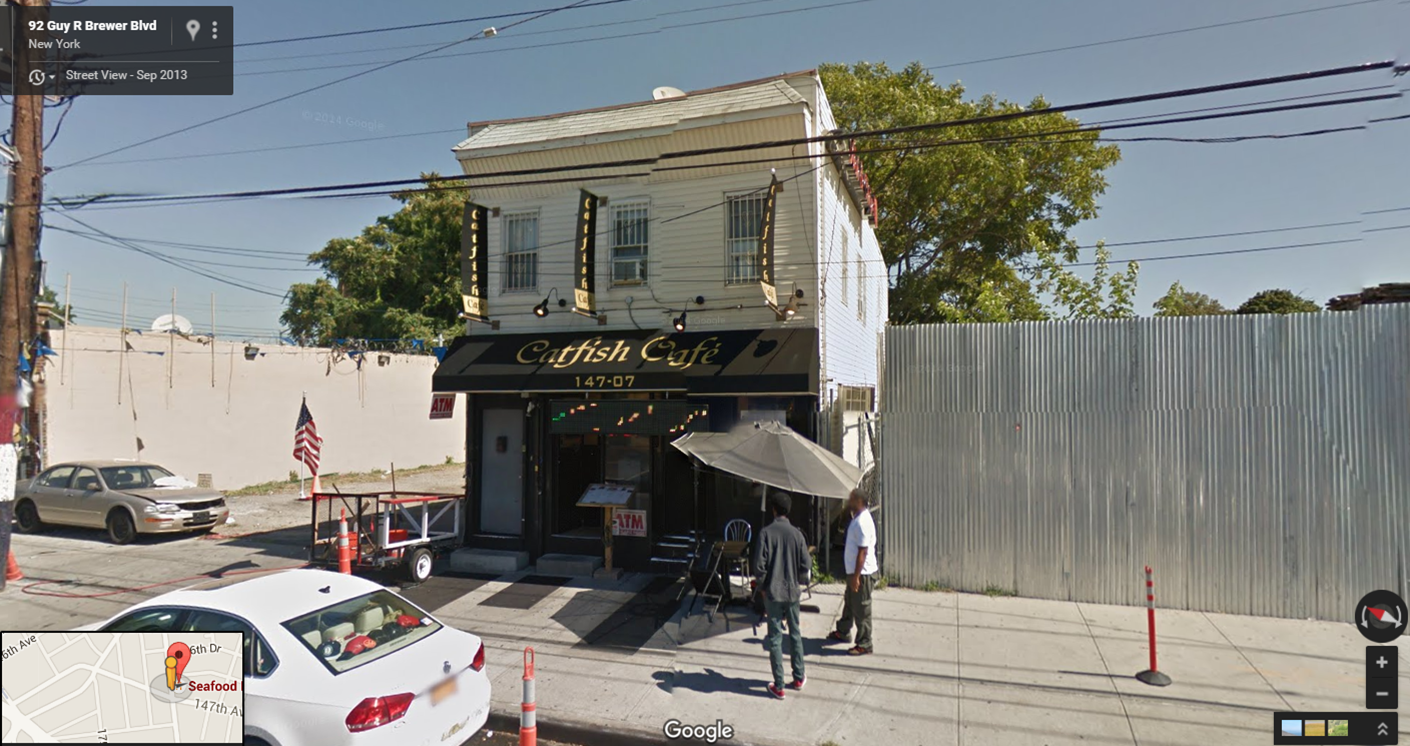
6. Focus on helping small businesses address public safety and visibility issues. Sometimes small investments in physical improvements, such as lighting or signage, can help existing businesses capture more market share. Moreover, these small investments can make a big difference in the perception of public safety. A transparent window, or well positioned lighting, can make a store that most didn't think twice about visiting more appealing. 

This seafood restaurant in a lower income community in Queens is doing lots of things right.
Transparent windows, outdoor seating, blade signs. 

The main take away is that a commercial district in a lower income community must find ways to ensure that every potential dollar that can be captured is in fact captured. There is little room for error. That means removing all possible hurdles that prevents customers from easily and conveniently patronizing local businesses. And in some cases, that means building the market to create more demand for retail - read new development. While that process can sometimes take a long time, with a strong road map and an understanding of the kind of market conditions necessary for business to thrive, I have seen time and again that neighborhoods can in fact change and improve, benefiting the residents that live there. 

Thursday, August 13, 2015

Top 10's Do and Don't when designing a retail attraction website


Executing a successful retail attraction program hinges on the details, and in particular the ability to communicate retail opportunities, build relationships, and maintain these connections overtime using consistent and regular outreach. That is why we often incorporate a heavy dose of feedback on an organization's "administrative capacity", i.e. the people, resources and tools necessary to get things done after a consultant engagement ends. One extremely important element of that strategy is a website (or other on-line presence - these days Facebook page is an increasingly popular alternative but one I'll speak to in another post).

So, with that in mind...here are a few do's and don'ts from our nearly 20 years of experience working in the field of commercial district management.
  1. DO have a dedicated landing page for retailers and investors interested in the district. It can be called any of the following: "Doing Business Downtown", "Do Business Here", "Bring you Business Here" - just so long as it is clear there is a dedicated spot to find information about your district. 
    In 2011 LOA worked with the Myrtle Avenue, Queens BID to develop marketing material, but found that the BID had an outdated website and no dedicated landing page for interested business owners. Their landing page now communicates front and center that they are an accessible and family-oriented community. No wonder that Carter's is a new tenant to the district! 
  2. DO use the website to tell your story and share your data. This is where people will land who have very little impression of your district. Use the opportunity to make a good first impression. This might include images, testimonials, icons, etc. that are visible right when you land on the page. 
    The Center City BID in Philly has taken their retail attraction efforts one step further and developed a dedicated website www.philadelphiaretail.com in collaboration with other partners. Michelle Shannon leads this effort on their behalf. 
  3. DO allow for the download of any retail attraction related materials that you have developed. Better yet, if people want to download your market data for free, have them sign up first before doing so This way you can add your real estate mailing list! On that note...
    Following LOA's engagement with the Myrtle Avenue Brooklyn BID (not to be confused with Myrtle Avenue Queens!), the BID launched a Quarterly Real Estate Report that is used to communicate the findings of their market study. All can be downloaded from their "Business Attraction" webpage
  4. DO use your website to build your real estate database. Be sure to provide an opportunity to sign up for real estate related emails (a newsletter, a quarterly real estate alert, etc) on the landing page. What is a real estate database? This should be a separate database of individuals who only want to hear about your real estate opportunities. These folks will include property owners, business owners, brokers, etc. They are not people who want to hear about your events and activities, in fact, if you do send them information on events and activities, they are likely to unsubscribe to your list. So bifurcate your list and be sure that anything you send this is useful, not spam. Oh - and don't tell them to sign up for a "newsletter"! Make the offer a bit more tempting by telling them the value of what they are signing up for. Consider asking them to "Sign up for up to date real estate information" or "Stay on top of district vacancies and real estate news by signing up here". 
  5. DO include testimonials from merchants. Testimonials are a great way to communicate retailer to retailer that a district is a good place to do business. 
    In 2013, LOA worked with the Seattle-Chinatown BID to develop a retail strategy. Their website and "Doing Business" brochure is a fantastic example of the use of testimonials. 
  6. DO take into account the power of images. Hire a professional to take shots of your district. This is especially important for communities that are looking to change perceptions of their district. Consider images of an iconic building or piece of public art. Or better yet, a new retailer who bucks the trend and has a fantastic storefront, or a long line of people waiting to get into a hot new restaurant. These tidbits can communicate quite a bit about what is happening in your district in the mere seconds it takes for a viewer to make a first impression. You know what they say...a picture is worth a thousand words. 
  7. DO consider including the logos of district businesses somewhere on your page - this could be on a map, or simply in a side bar. Logos are a great visual shortcut that helps cue retailers as to the kind of retail that is in  your district - and whether they would be successful or not. Because if they recognize a particular retailer and know they share similar customers, you have passed one threshold of within seconds of visiting your page. 
  8. DO share information about incentives and business resources that might be available (and that you can help them access!).
  9. DON'T assume people will visit your website. Brokers, property owners, retailers may stumble upon your website, but BIDs and commercial district management entities are not a particularly known quantity in the commercial real estate world, so they definitely aren't going out looking for your website, in case you were wondering. Therefore you must find ways to push your website into their realm, into their inboxes and through social media outlets. There are lots of ways to do this, but first and foremost is attending local real estate events and trade shows and collecting business cards. Use these cards to build your database and email folks regular communications materials (Did you just complete a market study - email the announcement and send a link to your website! Do you have new vacancies you want people to know about - email info about the listing and send them to your website! Is this sounding familiar?)
  10. DON'T let your real estate listings go stale!! Are your listings over three months old? That is an eternity in the retail leasing world. Stale listings are also the quickest way to ensure that someone will never return to your site again. Basically, you have just demonstrated your ability to waste a busy persons time...not a good first impression. One solution is to automatically provide monthly updates - with the month of the listings located in a prominent place on the material. Another is to simply avoid listing vacancies all together and include a phone and email address where they can reach out for more information on current listings. Not ideal, but much better than having them spend time looking at listings that are outdated. 

Thursday, July 30, 2015

Seaming a district back together, one mid-block crossing at a time

When our team visits commercial districts, one of the first things we look for is the convenience of access. Sometimes, the challenge in not related to the obvious - like parking - but instead comes in the form of a busy street that is hard to cross. So while the district may have a 40-60k sf of retail offerings, it is instead bifurcated and functions like two 20-30k sf shopping centers. The issue is that 30k of retail can only go so far in its ability to draw from a larger trade area. Shopping center developers can tell you, the more retail you offer, the more viable and attractive your retail center will be to customers. So a busy street that is very difficult to cross undermines sales for the entire district by preventing shoppers from patronizing multiple stores - and spending more money - per visit.

In a small New Jersey town where we are currently working, the two sides a single block commercial strip face this exact problem. Instead of functioning as a cohesive unit, the two sides function as two independent nodes of retail. What happens is that patrons park on one side, and then avoid crossing to the other because the busy street divides the district. If they do want to cross the street safely, they much walk to the end of the block, cross the street, and then walk back to the store they want to patronize. In this community, where the average age is creeping upwards, it simply isn't an option.
Jaywalking across a busy street is the way most people get from one side of this district to another. This puts the elderly and young people at a distinct disadvantage and creates an impediment to cross-shopping, which undermines the overall strength of the district. 

A simple technical solution is to install a mid-block crossing that provide a pedestrian refuge in the middle of the street, while also clearly signaling to motorists that they are to stop and allow pedestrians to cross.

Here are some examples that we like...enjoy!
A center refuge.
Clear pedestrian crossing signs and a painted treatment on the crossing are nice touches. 

The bump outs further reduce the distance from one side to the other and provide and added traffic calming mechanism that signals to drivers to SLOW DOWN. 

The landscaping could be improved, but I do like the stamped brick as a way to further signal that this section of street is part of a pedestrian environment.