Showing posts with label Social Media. Show all posts

Friday, February 2, 2018

The Age of the Selfie


Greetings from Austin Mural, TX. Photo: Yelp
Nur Asri is an Associate at Larisa Ortiz Associates.

Whether we care to admit or not, we’ve all taken one or been forced to take one. I'm talking about selfies. Selfies are digital self-portraits that began to really take off when smart phones became equipped with the forward-facing camera. The photos themselves haven’t radically changed retail or downtowns – believe me, people were taking self-portraits even when they had film cameras. However, when the digital self-portraits are uploaded to social media platforms and tagged and shared by users across the world, that’s when it starts to have an impact on the brand and identity of a retailer or an entire downtown.

The selfie is now a common tool that people – young and old – use to share their individual experiences with others and to self-brand. The marketing power of the selfie cannot be understated. A HTC survey in 2013 of more than 2,000 mobile phone users in the UK found that about 51% of the UK had taken a selfie, creating about 35 million photos every month. Although a greater share of those aged 18-24 had taken a selfie, almost a third of those aged 65 and older had also taken one, indicating that the selfie can work on a wide range of customer segments.

Just to understand the magnitude of selfie-taking, we took a look at the number of selfies taken on Instagram.

Sure, selfies are often criticized for being associated with vanity or narcissism but selfies are often the first and last step a customer takes in their purchasing journey. Selfies provide inspiration for those seeking to make purchases and selfies provide validation for those who have already bought products – it’s a near instant feedback loop for customers. Selfies have indeed increased sharing of product information and resulted in more educated and conscious consumers. Today, customers search for authentic peer recommendations for a range of products and even for travel decisions so information shared on social media has in many ways surpassed the influence of magazines and newspapers. A 2016 TopDeck Travel Survey in 2016 found that in choosing where to travel, 76% of Millennials surveyed said that friends’ recommendations…and social media came far ahead of travel-agent advice.

How are retailers making use of selfies?
Retailers in a wide range of categories have used selfies as a leverage to raise brand and product awareness, and also boost in-store traffic.
1. Drug stores/ Beauty
Interactive mirrors placed in UK drug store, Superdrug Beauty Studio, allow customers to experiment with hair colors virtually and take selfies after getting hair or make-up done. This helps the store’s customers to share the quality of services being offered in-store while also providing free marketing. To make the sharing of the selfie easier, the store features iPads that enable customers to send the selfie to Facebook or Twitter with the official campaign hashtag, #TreatYourSelfie.

2. Apparel
Many apparel stores from Victoria’s Secret to French Connection and Ted Baker have used selfies as part of their marketing campaigns. These stores encourage shoppers to take photos in-store by creating a perfect backdrop or setting for taking selfies. These include special installations, interactive selfie booths and attractive storefront displays. The stores then encourage shoppers to share the selfies on their personal Twitter and Instagram profiles using official campaign hashtags by providing incentives like free gifts for anyone that uploads the photo to social media or by displaying the selfies on a public screen or storefront window.

By displaying the selfies publicly, passersby became very engaged with the store. They were able to vote for favorite selfies using hand sensors and were then more likely to walk into the store.  


3. Food
Even with food, selfies can happen. The phenomenon known as foodstagramming is the act of taking photos of one’s food and posting them on social media. Restaurants are certainly taking advantage of it because it can be free advertising (depending on the photographer’s comments!).

How can downtowns use selfies?
Speaking of food, this week is Restaurant Week across New York City and sure enough many business improvement districts are using food selfies as a way to raise awareness of the district events and drive greater traffic to the restaurants in these areas post-event. Grand Street BID in Brooklyn, for example, is offering foodstagrammers a chance to win $50 to their favorite Grand Street Restaurant if they upload a picture of their Restaurant Week meal with the hashtag #DineOnGrand and tag the BID in the photos.  

Beyond food selfies, commercial districts can also use iconic art and signage and interactive sculptures to encourage selfies by visitors and to reinforce their identities. In the past, we’ve featured the I Amsterdam sign as one example of a way that signage can drive popular images posted on social media. Many other downtowns have driven high visitation rates with iconic selfie spots. Here are some examples:

In Austin, murals across the city have become destinations in themselves and visitors are taking selfies in front of them and sharing images on social media with hashtags #Austin #ATX

In San Diego, the gateway signage to the Gaslamp Quarter has also become very iconic as a selfie spot for visitors to the area.

Creating a selfie moment in your downtown, like in a retail store, can do wonders in attracting more visitors and customers. The rapid sharing and outsourcing of opinions amongst consumers today can either make or break your downtown so make sure you provide positive moments for visitors to snap a quick and pretty selfie.

How to create a successful selfie moment downtown

First, remember to create a backdrop for the selfie to happen. This means good lighting, mirrors and attractive or significant art. Holiday lighting displays are often great backdrops, as are large sculptures, murals and gateway signs. The backdrop should also reflect the identity and brand of the downtown in order for the retweets and sharing of social media posts to be fully effective in driving interest and traffic to your downtown.

Second, make uploading the selfie easy. While stores and retailers can easily provide ipads and devices to customers, downtowns should instead think about providing free public wifi. From personal experience, I’m always more likely to upload and share content when I can easily get online. If I’m not able to instantly upload images after taking them, I’m likely to forget doing so later.

Third, provide incentives for visitors to take the selfies. With some visitors, you’ll need to nudge. Offer a chance to win a shopping trip or discounts at downtown stores if someone takes a selfie in the area and uploads it to social media. Featuring selfies taken downtown on outdoor advertisements and interactive platforms may also nudge some visitors to take photos. It’s always fun to see a photo you’ve taken up on a public platform!

Finally, make sure you aggregate the selfies and build your downtown brand through a common hashtag or downtown social media account that visitors can tag in their posts. This can help you drive traffic to your downtown website or even directly downtown! Make sure everyone on social media ‘liking’ or ‘retweeting’ posts is able to connect the selfie to your downtown.

Thursday, September 21, 2017

Technology in Retail

Nur Asri is an associate at Larisa Ortiz Associates.

As we continue to move forward in this digital age, consumers are expecting simpler and seamless processes at home, at work, and at the retail store. As a result, retailers are making significant investments in technology in- stores to meet these consumer demands for a connected and convenient shopping experience. Here are some ways that retailers and brands are using technology to enhance consumer experience but also personalize marketing, improve logistics and customer service in brick-and-mortar stores.

1. Data Integration: Understanding consumer preferences, personalized marketing

Connecting data from smart appliances, mobile phones and other portable devices to digital systems helps businesses understand how customers actually use products and services, and which ones are preferred. To take advantage of this data and metrics, retailers can begin using devices to facilitate a more seamless retail experience in the store, and at home, to integrate products and services.
Retailers can use “customer genomes” to create highly personalized offers, promotions and experiences.

Source: Let's Talk Payments.Com
Macy’s and Apple are using in-store beacons to provide personalized offers directly to customers via mobile devices. House of Fraser, another department store in the UK, inserted beacons into mannequins for a proximity marketing campaign. When shoppers download an app and browse in- store, they receive information about the clothes on display. In other bigger retail stores, in-store shopper tracking systems have been installed to pinpoint a customer’s location. Retailers can then send targeted messages to customers (via smartphones) about nearby items.

Hugo Boss Heat Sensor in Regent Street store.
Source: Bloomberg
In London UK, Hugo Boss uses heat sensors to track customer traffic in its clothing stores, which helps store managers organize priority merchandise in high-traffic areas.

Monsoon Accessorize uses multichannel data sources from in-store and online customers to deliver unique personalized offers via emailed receipts. Similarly, UK department store John Lewis is partnering with an omnichannel personalization company to customize product recommendations for each individual shopper.

Walmart Media Exchange is using data collected from store sales, social-media platforms and third parties to supplement data from its Savings Catcher loyalty program. From the data, Walmart plans to create customer segments, and eventually individual customer profiles, to make better offers, as well as to improve targeted marketing.

2. Building brand/ product awareness: Educating consumers on what’s available on offer, sharing products through social media

Photo: Fashion Network.Com
Sephora has installed display screens showing latest trends, make-up tutorials, and new Made in Sephora exclusive offerings updated by theme each month. The screen greets customers as they enter the store, much like a mall directory screen. In addition, Sephora also has Beauty Boards. These are physical social media platforms to like a look, tag products used and share with the Sephora beauty community. Finally, Sephora’s snapchat geofilters feature highlighted products in-store and are designed to engage everyone within a mile of a store.

3. Product Testing: Allowing consumers to test products digitally or via augmented reality

Again, at Sephora, the Beauty Hub is a virtual look book which provides a catalog of beauty inspiration while the Virtual Artist service enables customers to test looks on an iPad or connected mirror. Developed with Pantone, the Color Profile application helps choose the right foundation shade with almost scientific precision. Recommendations are then made from all the complexion products available at in-store.  

Marie Claire’s pop-up store in NYC SoHo, called “The Next Big Thing Concept Shop”  has dressing rooms with interactive mirrors from Oak Labs that recommend accessories for outfits being worn. Similarly, Clarins beauty stores now feature Sensor Mirror Pro virtual skincare mirrors developed by MemoMi to educate consumers about their skin types so they are able to select the most suitable skincare products.
Photo: Connected-store.Com


Finally, fashion retailer Uniqlo has also piloted a “Magic Mirror” technology from Sharp that allows customers to virtually change the colors of clothing they’re trying on while standing in front of the mirror.

Photo: Ikea
Even when consumers aren’t physically in stores, they are now able to test products thanks to advanced technology. Ikea will soon enable shoppers to virtually test drive merchandise before making a purchase via an augmented reality app called Ikea Place. The app will allow customers to virtually place any Ikea furniture in any space and share the images with friends. The app will automatically scale furniture with 98% accuracy. This enables customers to experience how light and shadows will render on furniture within the space, and is intended to make buying decisions easier and inspire customers ahead of purchasing products. Other furniture retailers such as Wayfair and Ashley Furniture are similarly preparing to launch such initiatives with their products and brand.


Ashley Furniture will take technology a step further and feature in-store virtual reality tech bars that will combine a guided iPad-based space configuration experience with VR headset visualization, allowing shoppers to design and visualize their own homes.

4. Payment Processing: Easy and seamless payment methods

With a smartphone in every pocket and imaging technologies now available for scanning products, faster alternative checkout methods will continue to grow across the retail industry, predicts Tony Rodriguez, CTO of digital identification solutions provider Digimarc.

Self-service checkouts have gotten more sophisticated in grocery stores and moved into other retail sub-segments, such as home improvement, fashion and electronics stores. Tesco, a grocery store in the UK for example, is testing a high-speed checkout solution that automatically scans products placed on conveyor belts. The system can process up to three customers at a time.

Apple Pay at Whole Foods. Photo: Eric Risberg
Integrated mobile apps and “contactless” mobile payments now also enable visitors to make seamless cashless transactions, supported by MasterCard and Apple Pay, from anywhere within the store, including via fitting room mirrors. The Sephora store at Newbury Street, Boston, for example, has no cash registers because staff associates can process payments digitally, on their phones from anywhere on the floor of the store.


Since Apple’s launch of its Apple Pay solution, retailers including Staples and Whole Foods have announced plans to accept Apple Pay at their retail locations, adding to an impressive list of other major brands such as Bank of America, Disney and McDonald’s.

5. Customer service: Efficient appointment bookings, improve staff efficiency, deliveries

Many stores now enable customers to use an integrated mobile app to book one-on-one appointments with fashion stylists, and sign up for a variety of in-store events and activities. Neiman Marcus, for example, has already piloted this at their pop-up store in SoHo.

To free up store employees’ time, Lowe’s has also begun rolling out customer-helping robots into the aisles of 11 stores in the San Francisco Bay Area. Lowe’s Innovation Labs unit worked with Silicon Valley start-up Fellow Robots on the LoweBot. The robots allow store associates to devote their attention to customers that need more thoughtful advice and personalized service. Likewise, Safeway grocery store helps customers locate stock and obtain product information through its Just for U service app. The app also goes a step further by helping shoppers create and sort their shopping list by store aisles.

Wearables, or ‘smart glasses and other connected devices intended to be worn on the body’, are another productivity booster. Tesco distribution center workers wear armbands that track the goods they are gathering. The band also assigns tasks to the wearer, forecasts task completion time, and quantifies precise movements among the facility’s shelving and loading bays.


The advancement of such technology amongst retailers will serve to deliver a seamless shopping experience for customers. However, even with all of these gadgets, customers still walk into brick-and-mortar stores to get the personable experience of getting expert advice from a staff person who’s tried and tested products for themselves. From 2015 report on Navigating the New Digital Divide, Deloitte noted that “one in three customers still prefer to consult store associates for assistance when selecting and validating products.” Retailers must therefore adapt and learn to balance both the human experience and technological convenience in stores to attract consumers in the digital age. 

Tuesday, September 19, 2017

The Social Media Story

Nur Asri is an associate at Larisa Ortiz Associates

According to retail strategist and consultant, Steve Dennis, “The most disruptive force in retail is not e-commerce but the fact that most customer journeys start in a digital channel.”

This past weekend I started my own journey to finding a perfect, new cardigan for the season online. It started at 9am on Saturday morning when I turned my phone on, checked my emails and opened the daily mail from Madewell – a women’s apparel retailer I’ve grown to trust and love. The email featured a beautiful cardigan for the Fall (just what I was looking for) and after a click, I was led directly to the product page on Madewell’s main site. After 5-10 minutes scrolling through images, checking sizes and comparing products available on the site, I wasn’t quite sold yet on the cardigan so I switched channels and browsed my Instagram feed instead. Lo and behold, one of my targeted ads turned out to be that very cardigan I had been browsing from Madewell. This time, it was being worn by a ‘regular person’ in a beautiful setting – it looked just like any other content on my Instagram feed, I barely even noticed it was an ad until I accidentally single-tapped the photo to reveal tags of the product name and price. The next day, I ventured into Manhattan to purchase said cardigan at the nearest store in SoHo. This omnichannel retail journey of mine wasn’t the first, and probably won’t be the last. In fact, according to a November 2013 survey of US digital shoppers by consulting firm Accenture, I’m not alone. 78% of respondents to the survey reported “webrooming,” or researching online before heading to a store to make a purchase.
Source: Accenture, 2013

Researching online, as demonstrated in my experience, often includes perusing social media posts by various brands and retailers. Today, roughly 2% of all e-commerce traffic in the United States now comes from social networks and continues to grow. Many of us younger consumers who are tapped into various social media channels are hence driving the rapidly growing social media influencer marketing strategy amongst retailers who want to capture as much attention as possible online. In a single year, brands are spending over $1 billion on marketing via Instagram influencers alone (Mediakix, 2017).

The history of influencer marketing can be traced back to a 1940 study entitled “The People’s Choice” by Lazarsfeld & Katz. Although the study analyzed political communication, it found that the majority of people are influenced by secondhand information and by opinion leaders. Fast-forward to 2017, people are increasingly being influenced by ‘regular people’ who have gained celebrity status or built a brand and following on social media channels such as Facebook, Twitter, Instagram and Snapchat. These people are more popularly known as social media influencers.

An influencer is: “A third party who significantly shapes the customer’s purchasing decision” (Brown & Hayes, 2008) and “has a greater than average reach or impact in a relevant marketplace” (Word of Mouth Marketing Association Handbook).” From cardigan to vacation destinations, consumers are turning to influencers and their product reviews and endorsements before committing to making a purchase online or in-store.

These influencers often have credibility in a specific subject area – hiking gear, street fashion, interior design, photography – and have built a brand and following around their personalities, interests and skill sets. Their unique and trusted voices enable them to engage large, targeted audiences – the sweet marketing spot for retailers grappling to adapt to the digital age. Engaging social media influencers, however, doesn’t necessarily result in sales activity. Twitter, for example, only drove 12% of social and email generated e-commerce revenue in the fourth quarter of 2014 and only 30% of Pinterest users made online purchases after browsing Pinterest content. However, this may change as social media channels continue to introduce new call-to-action features and direct-response imperatives like “Shop Now” buttons for products and “Sign Up” buttons for services.


Social media influencers, however, have proven to be most successful at building brand awareness and trust. In fact, 92% of consumers trust an influencer more than an advertisement or traditional celebrity endorsement, according to Musefind, a social media marketing company, and 49% of consumers looked for purchase guidance from social media influencers last year. Many consumers place their trust in these influencers specifically because they are not tied directly to retailers or brands.
Source: Musefind, 2016

Of course, social media influence works differently on consumers by retail category. Some purchasing journeys are more highly influenced by the digital than others and can be more critical at different points within a single journey.

Source: Deloitte, 2015

In a 2015 study by Deloitte, consumers shopping for baby and toddler, electronics, and furniture and home furnishings products turned out to be most heavily influenced by social media during their shopping journey, while grocery customers were least influenced by digital overall. Critical interaction points started from the beginning of a consumer’s journey, during the ‘finding inspiration’ and ‘researching products’ phases, till midpoint when consumers are ready to select products for purchase.
Source: Deloitte, 2015

For the apparel retail category, the critical point for digital interaction appeared to be in the beginning of the consumer’s journey. With such a wide selection of products, over 15 percent of apparel shoppers are unaware of the product until they see a brand or retailer’s digital advertisement or communication that makes them want to buy the item, compared to an average of only nine percent across other categories. (Remember that Madewell email notifying me of the new Fall season cardigan and also the targeted Madewell Instagram ad?)

In a famous example, Lord & Taylor, designer clothing department store, proved the power of social media influencer marketing by getting 50 influencers to put on the same dress, photograph themselves in the dress, and then post the photos on social media. Within three days, Lord & Taylor sold out of the dress but more importantly, the retailer built awareness around the brand’s new collection, which resulted in a halo effect on other products in the same line.

Regardless of the varying magnitudes of impact that social media influencers have on consumers, they continue to be a strong marketing force for brands and retailers. Retailers should seek new ways to influence the influencers through their marketing campaigns or build partnerships and creative collaborations with these influencers, in order to achieve greater brand authenticity and trust amongst consumers. 

Tuesday, December 23, 2014

Mobile Marketing: Are your businesses on the map?

Customers are increasingly using on-line platforms to find local businesses in real time. I know I do it all the time.  Just the other night I was out with a friend and we had planned to meet at a restaurant in Soho. When we got there it was packed. What did we do? On a cold winters night in New York there was only one option. We stood in the heated vestibule and searched Yelp for an alternative. We found a great restaurant with a two block walk that had good reviews, a decent price range, and no wait. We liked it so much that we will undoubtedly go back. And honestly, I can't even tell you the name of the first place we tried. Clearly, Yelp helped at least one business gain a customer they otherwise would never have seen.

On-line profiles definitely help, yet most businesses do very little to manage them. In 2013, the Boston Consulting Group surveyed 4,800 local businesses and found that those businesses that claimed their FREE Yelp profile reported "incremental revenues of $8,000 annually". This is not paid advertising, mind you. Yet only 15% of small business owners know that they can get a free Yelp profile, and only 11% claimed it.

Below is a quick summary of some of the most popular on-line platforms and some basic instructions on how to use them. In each case, the instructions are somewhat similar, a business goes to the search engine and verifies their identify. They are given an account and go easily go about managing their identity. In some cases you as a commercial district manager can actively help (for example, a business using Google can add you as a "Manager"), in others, only the business owner can verify and manage their on-line identity.

Keeping with the Soho theme, I went ahead and tested business listings for Soho using four listing engines...

Bing "Venue" Maps
Bing is increasingly creating opportunities for "venue" maps. They started in 2010 by adding maps of malls, but it seems that more and more commercial districts are getting into the business. Check out the image below for a map of Soho with nearly every business listed. If you roll over the map, the businesses are linked back to a profile that includes the company website and hours of operation. When you compare it to the Google map below, it is clearly easier to navigate and understand. The map has the look and feel of a mall directory. How commercial districts can get onto Bing is not quite clear...but we have a request in to find out and will share with you when we know.


Google Maps
Google is the 6th most popular mobile app, and the first most popular mapping engine in the world, so getting businesses on the Google map should be a no brainer.

Direct your business owners to http://www.google.com/business/#befound to get started. Once a business has claimed an add, they can do things like set up a Google Adwords campaign much more easily. Remind them that additional managers can be added under Settings>Managers.

You should also know that you can list your commercial district management entity to the Google Map directory as well. Your district entity can then take the lead on setting up Adwords campaign for the entire district, which can be used to market events and actitivies as well. We worked with a community a few years ago on a restaurant marketing campaign that used Google Adwords and we were thrilled that it resulted in significant increased sales for participating local businesses.

Yelp
What sets Yelp apart is really its rating and filtering function. The site gets over 100 million unique click a month so clearly something is working. Like on Google, the first step is to Claim and Verify your Business (https://biz.yelp.com/claiming)

It should be noted that many businesses loathe Yelp. The issue here is that some businesses think that Yelp unfairly filters positive reviews (in an effort to prevent an owner from soliciting reviews from customers) and therefore highlights negative reviews. Not sure where I stand on that, but the truth is that a Yelp listing can drive traffic. Business owners can help increase the number of reviews - and good business will undoubtedly receive more positive reviews than negative ones - by adding badges to their websites or putting "Find us on Yelp" signs in the window or on the front counter.

FourSquare
With 45 million registered users (up from 30 million in January 2013), FourSquare is a force to be reckoned with (although not nearly as popular as Facebook or Twitter as a social networking app). Business looking to claim their profile can do so at: http://business.foursquare.com/


Tuesday, October 7, 2014

The shoppers of tomorrow are here today. How do you capture them?

This month’s “Shopping Centers Today” explores how teens and young adults – a growing and important customer segment – are changing the way malls and by extension, traditional commercial districts need to respond to keep them as shoppers. (“The Young and the Restless”, Sept. 2014, SCT)
American Apparel is a popular teen retailer


So what has caused this recent concern? A look at the teen-focused apparel category – including the many Mandy’s and Rainbow’s that dot the urban landscape – shows that these retailers have had a few soft years. In response, Forest City Enterprises, one of the nation’s leading owners, developers and managers of commercial property, went ahead and tackled this issue by conducting research into the shopping habits and preferences of the teen market. What they found offers both good news and bad for both malls and commercial districts alike.

The Good
  • Physical presence still matters. Unlike the rest of us, younger shoppers have time to kill. 71% of expenditures by those between 13 and 17 occur in brick-and-mortar stores. 
  • While they are shopping, they like to socialize. Proximity of food options, cafes, etc. can help make a place a destination. Westfield Malls in London have socialization spaces that encourage teens to linger, including couches, coffee table, etc. Free concerts are another way to create an experience. Westfield offers free concerns Thursday through Sunday to drive traffic to their malls. Forest City has offered concert tickets to shoppers. 
  • The ubiquity of smartphone and on-line shopping options allow teens to browse on-line, but the good news is they still like to buy in the store. This is called “pre-shopping”. 
The Challenges
  • Teens are shopping less frequently – before the recession, teens went on roughly 40 shopping trips per year. Today that number has dropped to 30 per year. 
  • The teen jobless rate is 22% - and as a result teens are frugal and price-sensitive. They respond well to sales and discounts, so it is important to offer promotions to motive this group to shop. Forest City malls incorporate the Facebook and Twitter Feeds of many of the national brands in their malls. 
What Can you Do?
Mall managers are increasingly looking to offer the following to attract the teen market...
  • Offer an experience. Make sure you offer activities – from live music to farmer’s markets that provide more than just shopping. 
  • Offer a comfortable “third place” – a comfortable place to socialize that is not home or school. To this end, the café is an important offering. Other options include landscaped outdoor areas with benches and tables. 
  • Offer discounts. Sidewalk sales events and in-store promotions (connected to school opening, for instance) can be a good way to get these price sensitive customers in the door. 
  • Engage shoppers with social media. According to ICSC, the top three sites for teens are Instagram (30%), Twitter (27%) and Facebook (23%). Connect with any stores in your district that have their own feeds. 
These are simple, yet effective ways to ensure your teens are having the kind of experiences that keep them coming back to your district.

Friday, February 28, 2014

Help 'em Yelp it! Six ways to help small business owners make the most of Yelp

According to a recent Fox Business news article small business fail to understand the importance of on-line reviews, and I might agree. But what can you, as a commercial district manager, do to help? (For a link to the article, click here: “Survey: Small Businesses Underestimating Online Reviews" )

What is “On-Line Optimization”?
This is a term we coined a few years ago while working with the New Rochelle Business Improvement District (see “Putting Your District’s Best Foot Forward” ). It simply refers to a process by which a 
Many small businesses use review sites like Yelp
and Foursquare as marketing tools.
Your business should be doing the same.
commercial district manager can actively help local businesses build a positive online presence that generates additional customers and sales. While Google is by far one of the most important search engines, Yelp is nearly as important for small businesses looking for exposure. With an average of 120 million MONTHLY unique visitors, and one of the most downloaded review apps in the nation, being on Yelp assures a business that they will be seen when someone is looking for a place to go, whether on their mobile phone or at their desktop.

But commercial district managers face some challenges in harnessing Yelp as a tool, in part because businesses need to claim ownership of their Yelp page to do basic things, like make sure the business profile is complete, including the name and category of business, detailed contact information, links to website and a menu (if a restaurant). In some communities, mom and pops don’t even have email addresses…so asking them to manage an on-line presence can be near impossible.

That said, many businesses owners do know the power of the internet, but just don’t know where to start. The good news is that you can do something to help them. Below are a few waysyou can play an effective role as an intermediary to help your local businesses use Yelp to attract customers. 

1. Make sure their business pages have great photos. This is really important. People REALLY like photos. In fact, research shows that people are more likely to visit a restaurant or store for the first time if they can check it out first. Consider hiring a professional photographer to take attractive pictures of your district and local businesses. If restaurants are included, be sure to take photos of a variety of dishes. Fortunately, anyone can upload photos to a business page so this is something that you do directly on behalf of your businesses.

2. Building awareness of a business’s Yelp page with check inserts, stickers and tent cards. Did you know that only 13% of businesses owners are approaching customers about posting reviews online? While Yelp actively discourages soliciting reviews and will downgrade reviews that they perceive as solicited, they do encourage businesses to let customers know they are on Yelp. Consider printing small index cards for your businesses that they can include with the bill that say something like, “Hey, check us out on Yelp!” with a link to the business listing. With this you are creating awareness that the business is listed, which in turn will help them get reviews.

You might also consider printing transparent stickers and giving them to local businesses who have a presence on Yelp. These “Find us on Yelp” stickers are different than the “People love us on Yelp” stickers (which are issued twice a year based on having a greater than 3.5 star rating from a certain number of reviews). You can also have table tent cards printed, this might be a better alternative for a business that wants to put this on their counter or by the register. “Find us on Yelp” signs and tent cards can be found on the Yelp Flicker stream

3. Making sure your restaurants have their menus on Yelp. Help your restaurants by making sure their menu and price list is displayed on the businesses page. Send a copy of your current menu directly to Yelp via their contact form. You could also consider having your photographer takes a picture of a menu page for you to post as an image.

4. Unfortunately, sometimes it just comes down to better management. Ultimately, reviews are a reflection of the level business goods and quality of service they provide. The reviews – both good and bad – offer important feedback that an owner ignores at their peril. Don’t let your business owners rationalize away negative reviews and low ratings. If they do, they are killing their own business. According to a study by Michale Luca, a professor at Harvard Business School, there is a correlation between high Yelp rankings and revenues. There is a 5-9% jump in revenues for every star in a review. Considered another way, every loss of a star means loss of revenue. So if worse comes to worse you'll need to do some direct business technical assistance. Which leads us to the next suggestion...

5. Hold a business seminar about managing on-line listings. Since most of what a business needs to do is manage their own page, consider inviting a specialist to offer a workshop to your business owners. A few things they should cover include:
  • How to “claim” your Yelp business page. It is free and allows the businesses to make sure their business information is up to date and allows them to add photos (which you can do too) and respond publically to reviews (although they should do this very cautiously as it can easily backfire if not handled correctly)
  • How to respond (or not) to negative reviews. 
  • An overview of the various business platforms that exist that allow business owners to manage multiple social media sites, including Locu by Go Daddy (Costs range from $4.49/month to $26.99/month) and Singleplatform by Constant (Pricing is $79/month). 
  • The impact of reviews on sales
6. And finally...measure the impact of your effort! Why? Because you are in the business of showing that an investment in your effort and the work of your organization is an investment in a business's bottom line. The straighter the line you can draw between your efforts and a business' sales, the better poised you will be to ask for and receive more resources that have an even greater impact. In this case, you will want to know whether your businesses are seeing an uptick in sales as a result of your efforts. You can do that by surveying them within a month of the effort taking off. And then an a bi-annual or annual basis thereafter. Another option is to ask them for their Yelp metrics. Every business that claims their Yelp page has the ability to track metrics, including the number of monthly visitors and user views to their page. See if participating businesses will share this information with you for your records. Better yet, require it as a condition for helping them.


Monday, August 19, 2013

Can Commercial Districts play the Social Media game?


It is not uncommon to see social media handled poorly by business improvement district organizations. I follow lots of twitter accounts and facebook pages, and I often see posts related to the organization or staff, but little that might compel customer visits...the real reason the organization is in business to begin with! When using social media, it's always helpful to remember exactly who your audience is and what value add you are offering them. Your twitter feed should not be about promoting your work (like anything, there are some exceptions of course), it should primarily be about promoting the businesses and the activities you sponsor that are intended to drive visitation to your district. There is a fine distinction here that makes all the difference.

As many of you know, I often look to what the Shopping Center Industry is doing to cull ideas. The way I see it, if Shopping Centers spend their resources testing ideas to attract shoppers to their stores - we might as well learn something from it and save the hassle of having to reinvent the wheel. To that end, the August issue of Shopping Centers Today had a great feature on the changing role of social media and offered two innovative ways that shopping centers have leveraged “followers” online...see below and enjoy! 

Growing your twitter with "Follow Friday's"
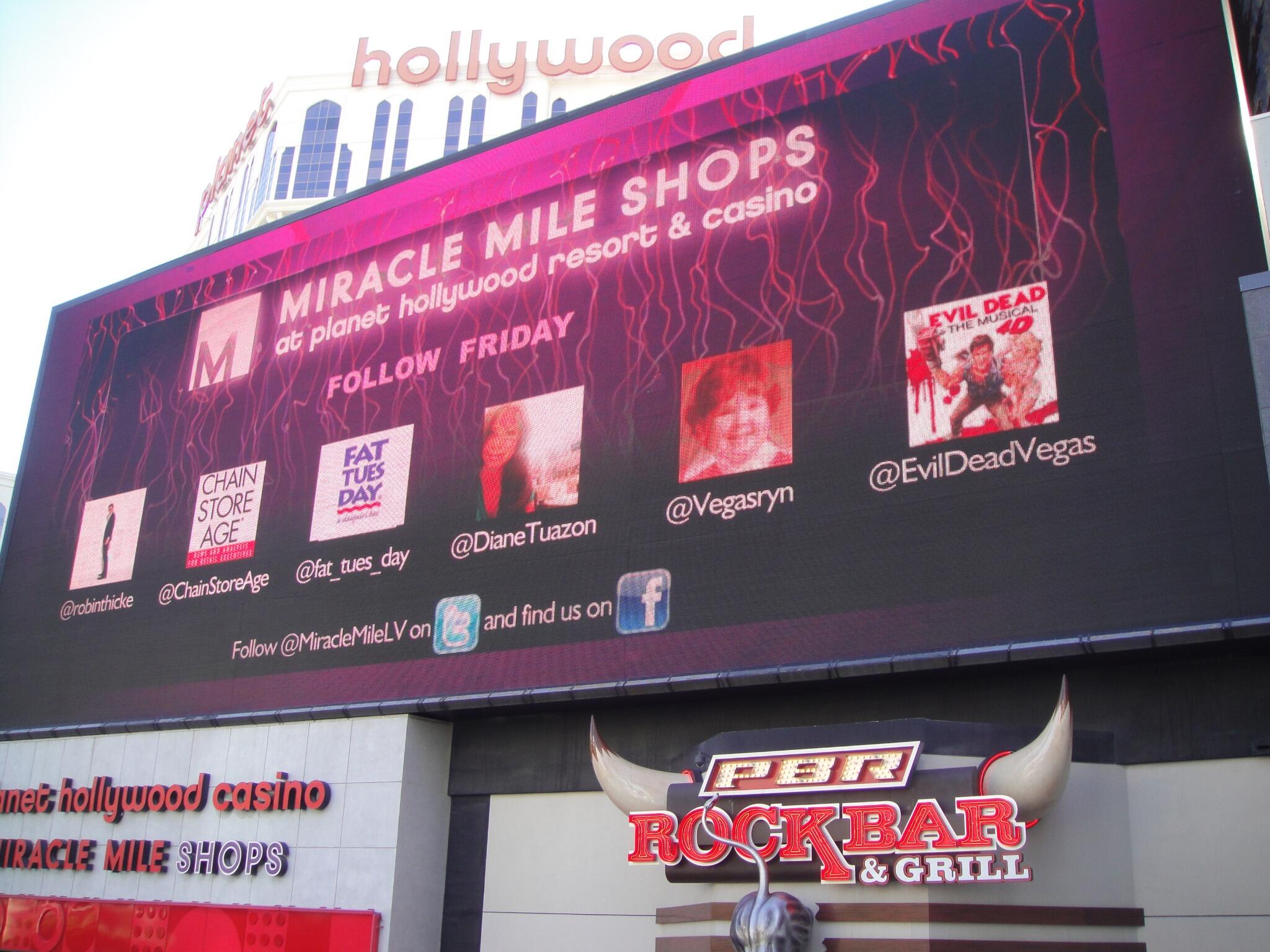
Miracle Mile Follow Friday Billboard
The Miracle Mile Shops in Las Vegas hosts “Follow Fridays,” during which the Twitter profiles six randomly chosen followers of the Miracle Mile’s Twitter handle are displayed on the mall’s LED screens on the Las Vegas Strip. Every Friday, @MiracleMileLV sees an increase in Twitter followers inspired by the opportunity to see their name on the big screen. In less than a year since its inception, the “Follow Friday” campaign has helped the Miracle Mile shops gain 64% more Twitter followers and 51% more Facebook fans.

Get in on the Competition Trend..."Love It of Lose It" Campaign
Vancouver mall Metropolis at Metrotown’s “Love It or Lose It” campaign encourage people to upload pictures of themselves in different outfits to the mall’s Facebook page, where other fans could vote on which people’s outfits they like best—and worst.   At the end of the four-week campaign, users with the most “love it” votes received mall gift cards for a shopping spree, while users with the most “lose it” votes also received mall gift cards for a shopping spree—and a free hair makeover and style consultation. Shoppers were not the only winners—Metropolis at Metrotown’s Facebook page drew 10,500 visits, 41,000 page views, and the fan base grew by 17%.


Summer Associate Nicole Leighton contributed to this article.

Tuesday, July 2, 2013

When Census Data Doesn't Cut It: 5 (Fun) Alternative Sources for Understanding Neighborhood Change

When you work in neighborhoods undergoing significant, rapid change, it helps to get a little creative with your research and data sources, especially as we move further away from the last census.

Here are some of our favorite (and fun!) tools that we use to understand what’s been happening in the communities where we work. Let us know in the comments what tools you use to understand neighborhood change.

Tracking Buzz

Yelp Wordmap
Yelp’s new Wordmap (launched yesterday!) shows density of keywords used in Yelp reviews around different cities. These maps are helpful in understanding characteristics and mix of local businesses, and the consumers in each of these neighborhoods. They may also prove useful if you’re searching for prospective retailers to bring to your community, or for businesses that are considering expanding into new markets.

They also reveal some subtle differences in clientele (Williamsburg has a density of Hipster businesses, while Park Slope and Prospect Heights are more appealing to Yuppies) and regional differences (Yelpers like to eat/review Biscuits in Portland, OR, Hoagies in Philadelphia, Dim Sum in San Francisco, Poutine in Toronto, and Bacon just about everywhere.) We hope they’ll add in a timeline feature so we can see how these clusters change over time!

Yelp Reviews that Mention "Hipster" in NYC


Google Trends
Google Trends allows you to see how, when, and how often people have been Googling different terms (since 2005). We use this to evaluate any “buzz” around a neighborhood, and to see how communities stack up against one another in terms of search popularity. See below how NYC’s five boroughs have trended over the past eight years.

(Just for fun - try putting in different parks and beaches to see how the trend lines change with the seasons.)

Understanding New Customers

LOA Lifestyle Matrix
Inspired by retail guru John Williams approach to tenant mix analysis, we’ve created the LOA Lifestyle Matrix that we use to plot both customers (using psychographic data) and retailers in a particular commercial district by Income/Price and Lifestyle. By overlaying these two data points, we can visualize fairly quickly how well stores in a particular place are meeting the needs of their community, and what consumers want (do they want an expensive trendy store like Opening Ceremony, or one that is trendy but inexpensive like Rainbow? Is this a J. Crew shopping district or a Talbot’s kind of market?). We can then identify any mismatch between offerings and customers, and use that insight to both attract the right mix of new retail, while also helping retailers adapt to neighborhood change. Even if you don’t have access to psychographic data, try creating your own matrix with census data, Yelp reviews, and other free sources.


Impact of Transit on Neighborhood Change

Annual Subway Ridership
So much of urban development is influenced by access and proximity to transit. In New York, the MTA collects annual ridership by station. Using this data, we can see where the most significant increases in ridership are happening, which can help us understand where new activity and investment is taking place and project what neighborhoods might be next.

Tracking Recent Investment and Growth

Property Shark Maps: Home Price Changes by Neighborhood (2012 vs 2004)

Property Shark maps the change in price per square foot of residential properties by neighborhood. This helps to illustrate where new investments are being made, and what neighborhoods are struggling, stagnant or soaring.

Brooklyn Price/ SqFt Changes 2012 vs 2004

Top 10 Mistakes District Managers Make

1. Staying in the office
Relationships grease the wheels of successful commercial district management. If you don't go out and meet your business owners, property owners and customers, how in the world can you serve them? How will you know how to deploy your resources most effectively to address the concerns that they have?

2. Trying to be everything to everyone
If your district were a car, what kind of car would you be? A trendy mini coop or a practical Toyota Sentry? You need to think of your district like a brand and focus your energies on delivering to your target customer - the kind of customer that makes up 80% of your base. In some cases that target customer is somewhat trendy and young, but in others that target customer is a family with young kids who is not likely going out drinking and dancing on a weekly basis. Embrace your customer and find better ways to meet their needs. Don't try to be something that you aren't.

3. Performance benchmarks? What performance benchmarks?
Failure to measure performance undermines your long term ability to leverage resources and convince naysayers of the impact of your efforts. The more you can communicate tangible improvements in your district, the more you can advocate for additional resources. Start small, show impact, win more converts...get bigger, show more impact, win more converts...it's a cycle that can repeat itself infinitely.

4. Failure to cultivate local media friends
You may be doing a wonderful job - but if nobody knows it, you've got a problem on your hands. You are a sitting duck for those who oppose your activities and are in a position to undermine your support at every level.

5. Events that undermine, or fail to generate, retail sales
I once worked with a district that held most of its events at a very nice park...two blocks from the main retail district. Not only that, but the events were held when most stores were closed. I'm not sure how this helped the downtown merchants, in fact I'm pretty sure that it didn't.

6. Mailing list? List-serve? What are those?
The most powerful contribution that you can make as a district manager is to sell your district to shoppers. In order to do that effectively you need to cultivate lists. You need to make sure you have an excellent database of shoppers and then you need to use that list effectively. These days that means not just email, but social media including Facebook and Twitter.

7. District identity crisis. Lack of a consistent brand. 
This goes along with "trying to be everything to everyone", you just can't. One major pet peeve of mine is a district that brands itself and a good place to "eat, work and play". That may be be true, but what distinguishes that from any other place.

8. A crappy, crappy website. 
Consider your website your digital business card. If you handed someone a business card that was torn, dirty and with misspellings, would you expect someone to call you for business? Outdated market information about your district, difficulty finding who to contact for more information, failure to manage and post news and information about events and activities...all of these make a website irrelevant. Unfortunately, if a crappy website is not getting much traffic,this is precisely what makes district managers think that websites don't need to be any good, because really, who's looking? It's a self-fulling prophecy.

9. Social media usage that misses the mark
The right social media strategy depends on your district identify and your customer base. You don't need to tweet extensively if your district is a convenience district where folks come to get milk and a bagel on Saturdays. But if you are a nightlife or restaurant destination, popular with younger people, building a twitter following and tweeting information about special events, time sensitive sales, and activities might be the way to go. Think of your social media strategy as a way to reach your customer - before you invest time and energy in a strategy, understand your customer and how they get information. In one community we work in, a large international population with young children makes Twitter and Facebook less important, instead we recommended that the BID partner with a local school and send notices home with school children about family-oriented events, activities and sales at local children's stores. This can be a win-win for everyone.

10. Poor PR
If a tree falls in a forest, does it make a sound? Too often great work goes under the radar, which ultimately undermines local district promotional efforts. Good PR includes maintaining communication and sharing your successes, because success breeds success. For example, ribbon cuttings are a great way to generate PR, and also to communicate to other potential tenant prospects that your district is a great place to start a business.

I'm sure there are many more...feel free to share!


Friday, August 17, 2012

Small businesses and the digital divide

A few years ago I was doing work in a New Jersey commercial district known for its community of mostly immigrant small business owners. The local economic development corporation had spent at least a year convincing one particular local restaurant owner that he needed to computerize - until then you would catch him pulling out wads of hundred dollar bills whenever he had to pay a vendor. Not only did the failure to maintain proper accounting controls likely affect his profit margin, making it more difficult to manage costs, it had another significant downside. When the business owner wanted to renovate and approached a local bank for a loan, he was soundly rejected. Without proof of income, banks were unwilling to lend to the business owner for a much needed renovation and expansion. Not only was his business growth stymied, the renovations would have turned a trash-filled empty lot into nice outdoor dining. This improvement would have signaled a real change for the district - and perhaps helped other businesses as well.

A new report out by the Center for an Urban Future entitled "Smarter Small Businesses" confirms the depth of this problem - one that is particularly acute many lower-income, minority communities. While nearly 9 out of 10 respondents report having a computer, as many as one in five low- to moderate-income proprietors did not. Getting bank loans is one thing, but the failure to embrace technology is hurting these proprietors in ways that they may not even understand. As more and more people look to the internet for shopping, dining and entertainment recommendations, the failure to have a website, or to engage with social media in strategic ways means missed opportunities to grow a clientele. What can commercial district practitioners do to reverse this trend? Here are a few ideas culled from the report as well as my own experience:

  • Greater education is key. Connect with resource providers who can offer classes in the basics, like Quickbooks or marketing through social media. For commercial districts with large non-english speaking populations, see if its possible to offer instruction in the languages spoken by local business owners. Get these providers to come to your district to offer these classes - making attendance for busy business owners a bit easier. 
  • Offer access to direct technical assistance. Considering hiring a professional technology consultant to help businesses develop and maintain basic websites, or to set up accounting in Quickbooks. As the report notes, not every business needs a website, but for many district businesses a website will help draw customers. Some businesses can by-pass a traditional website entirely and just go for a Facebook page...an increasingly popular option. 
  • If your businesses don't have an on-line presence, create one for them. Use your district website. Make sure you have a district directory where their businesses are listed. If you have a twitter feed, offer to tweet their specials or sales to your followers.
  • Support peer-to-peer networking among your local businesses. Host mixers and invite speakers to meetings and breakfasts. Business owners are more likely to adopt tools if they see their peers using them. 
I encourage everyone to read this report - it is chock full of good data and insights, and many of you will likely find the stories and anecdotes extremely familiar.