Showing posts with label Tourism. Show all posts

Friday, February 2, 2018

The Age of the Selfie


Greetings from Austin Mural, TX. Photo: Yelp
Nur Asri is an Associate at Larisa Ortiz Associates.

Whether we care to admit or not, we’ve all taken one or been forced to take one. I'm talking about selfies. Selfies are digital self-portraits that began to really take off when smart phones became equipped with the forward-facing camera. The photos themselves haven’t radically changed retail or downtowns – believe me, people were taking self-portraits even when they had film cameras. However, when the digital self-portraits are uploaded to social media platforms and tagged and shared by users across the world, that’s when it starts to have an impact on the brand and identity of a retailer or an entire downtown.

The selfie is now a common tool that people – young and old – use to share their individual experiences with others and to self-brand. The marketing power of the selfie cannot be understated. A HTC survey in 2013 of more than 2,000 mobile phone users in the UK found that about 51% of the UK had taken a selfie, creating about 35 million photos every month. Although a greater share of those aged 18-24 had taken a selfie, almost a third of those aged 65 and older had also taken one, indicating that the selfie can work on a wide range of customer segments.

Just to understand the magnitude of selfie-taking, we took a look at the number of selfies taken on Instagram.

Sure, selfies are often criticized for being associated with vanity or narcissism but selfies are often the first and last step a customer takes in their purchasing journey. Selfies provide inspiration for those seeking to make purchases and selfies provide validation for those who have already bought products – it’s a near instant feedback loop for customers. Selfies have indeed increased sharing of product information and resulted in more educated and conscious consumers. Today, customers search for authentic peer recommendations for a range of products and even for travel decisions so information shared on social media has in many ways surpassed the influence of magazines and newspapers. A 2016 TopDeck Travel Survey in 2016 found that in choosing where to travel, 76% of Millennials surveyed said that friends’ recommendations…and social media came far ahead of travel-agent advice.

How are retailers making use of selfies?
Retailers in a wide range of categories have used selfies as a leverage to raise brand and product awareness, and also boost in-store traffic.
1. Drug stores/ Beauty
Interactive mirrors placed in UK drug store, Superdrug Beauty Studio, allow customers to experiment with hair colors virtually and take selfies after getting hair or make-up done. This helps the store’s customers to share the quality of services being offered in-store while also providing free marketing. To make the sharing of the selfie easier, the store features iPads that enable customers to send the selfie to Facebook or Twitter with the official campaign hashtag, #TreatYourSelfie.

2. Apparel
Many apparel stores from Victoria’s Secret to French Connection and Ted Baker have used selfies as part of their marketing campaigns. These stores encourage shoppers to take photos in-store by creating a perfect backdrop or setting for taking selfies. These include special installations, interactive selfie booths and attractive storefront displays. The stores then encourage shoppers to share the selfies on their personal Twitter and Instagram profiles using official campaign hashtags by providing incentives like free gifts for anyone that uploads the photo to social media or by displaying the selfies on a public screen or storefront window.

By displaying the selfies publicly, passersby became very engaged with the store. They were able to vote for favorite selfies using hand sensors and were then more likely to walk into the store.  


3. Food
Even with food, selfies can happen. The phenomenon known as foodstagramming is the act of taking photos of one’s food and posting them on social media. Restaurants are certainly taking advantage of it because it can be free advertising (depending on the photographer’s comments!).

How can downtowns use selfies?
Speaking of food, this week is Restaurant Week across New York City and sure enough many business improvement districts are using food selfies as a way to raise awareness of the district events and drive greater traffic to the restaurants in these areas post-event. Grand Street BID in Brooklyn, for example, is offering foodstagrammers a chance to win $50 to their favorite Grand Street Restaurant if they upload a picture of their Restaurant Week meal with the hashtag #DineOnGrand and tag the BID in the photos.  

Beyond food selfies, commercial districts can also use iconic art and signage and interactive sculptures to encourage selfies by visitors and to reinforce their identities. In the past, we’ve featured the I Amsterdam sign as one example of a way that signage can drive popular images posted on social media. Many other downtowns have driven high visitation rates with iconic selfie spots. Here are some examples:

In Austin, murals across the city have become destinations in themselves and visitors are taking selfies in front of them and sharing images on social media with hashtags #Austin #ATX

In San Diego, the gateway signage to the Gaslamp Quarter has also become very iconic as a selfie spot for visitors to the area.

Creating a selfie moment in your downtown, like in a retail store, can do wonders in attracting more visitors and customers. The rapid sharing and outsourcing of opinions amongst consumers today can either make or break your downtown so make sure you provide positive moments for visitors to snap a quick and pretty selfie.

How to create a successful selfie moment downtown

First, remember to create a backdrop for the selfie to happen. This means good lighting, mirrors and attractive or significant art. Holiday lighting displays are often great backdrops, as are large sculptures, murals and gateway signs. The backdrop should also reflect the identity and brand of the downtown in order for the retweets and sharing of social media posts to be fully effective in driving interest and traffic to your downtown.

Second, make uploading the selfie easy. While stores and retailers can easily provide ipads and devices to customers, downtowns should instead think about providing free public wifi. From personal experience, I’m always more likely to upload and share content when I can easily get online. If I’m not able to instantly upload images after taking them, I’m likely to forget doing so later.

Third, provide incentives for visitors to take the selfies. With some visitors, you’ll need to nudge. Offer a chance to win a shopping trip or discounts at downtown stores if someone takes a selfie in the area and uploads it to social media. Featuring selfies taken downtown on outdoor advertisements and interactive platforms may also nudge some visitors to take photos. It’s always fun to see a photo you’ve taken up on a public platform!

Finally, make sure you aggregate the selfies and build your downtown brand through a common hashtag or downtown social media account that visitors can tag in their posts. This can help you drive traffic to your downtown website or even directly downtown! Make sure everyone on social media ‘liking’ or ‘retweeting’ posts is able to connect the selfie to your downtown.

Wednesday, December 7, 2016

When City Signs Become an Iconic Destination

If you were asked to think of the most recognizable street-level city sign, most people would probably say the "I amsterdam" sign comes to mind. And for good reason.

As David Hornstein of Eye for Travel puts it, "The I Amsterdam sculpture elegantly captures the information of place in a meaningful way. By being able to touch, climb and photograph the sculpture tourists can literally touch and feel the brand, something that usually is very abstract and intangible. This brings the brand to life and makes it fun to interact with." In fact, I Amsterdam is not only a sign but also an intereactive sculpture. I myself am guilty of climbing on and taking pictures in the sculpture. It was a tangible memory.

The I Amsterdam sculpture is one of the images most posted on social media including Instagram, Facebook, YouTube, Flickr, etc. Because the world is globally integrated with social media, the city of Amsterdam is globally marketed for free. The I Amsterdam sculpture is a destination in itself that attracts people to the neighborhood and who end up visiting the shops, cafes, museums, and activities nearby.

Through the installation of one of these sculptural signs a city or commercial district can easily boost city pride, tourism, iconocism and promote activity and engagement- especially if the word(s) have integrated meaning to the city or word play. It can serve as an anchor to the surrounding district and become a meeting point easily identifiable and fun.


Lafayette, Louisiana for example, through their Creativity Everywhere project, produced a giant "LAFAYETTE". This one is interesting because it is interactive as well as iconic and pride inducing because it encourages people to create the "Y" in the middle.

Obviously not every city can adopt the same signage strategy as this could cause a lose of uniqueness, charm, and individuality of the city or district. However, as cities and districts continue to create strategic marketing plans, the addition of a city sign to the scene may become a an integral branding component that reflects each city's identity and reinforces its brand.

Here are some additional city signs from around the world:
"Only Lyon" sign found in Lyon, France
OY or YO sign, found in Brooklyn Bridge Park
"Mexico 68" Olympic sign
Central District, Mexico City

Friday, December 2, 2016

Winter Light Festivals: Inspiring Examples


It is that time of the year when downtowns and commercial districts put up their holiday lights. Many districts, however, go beyond the typical Christmas lights. In an increasing number of cities across the world, large-scale light installations that blend art and technology are making their mark, lighting up the night of downtowns and neighborhood commercial districts. Many of these light festivals include interactive elements that turn spectators into participants, while others include live music, performances, street food and a variety of community events. Light festivals are also tourism magnets, attracting locals and out-of-towners alike to waterfronts, historic districts, and other neighborhoods on dark winter nights or during other periods when tourist activity may be low. Below are some inspiring examples.

Amsterdam Light Festival

From December until January Amsterdam lights up for the annual Amsterdam Light Festival. Over 35 artworks from international artists, designers and architects find their way alongside two different exhibition routes: ‘Water Colors’, the boat route and ‘Illuminate’, the walking route. Organized and managed by a public-private partnership between the municipality, the cultural sector and numerous businesses, its Board includes representatives from the cultural sector and various businesses in Amsterdam.

The festival offers a stage to light artists from all over the world to present their work in Amsterdam for two months and stimulates them to push their own boundaries and innovate. A jury selects the artworks that will become part of the festival.  In 2016 about 1800 artists from 93 different countries were interested in participating in the festival, of which 35 concepts were selected.

Luci d'Artista, Turin

Since 1998, the city of Turin, Italy, hosts the ‘Luci d’Artista’ a series of light installations that combine art and technology to illuminate the city’s streets and piazzas during the holidays. Since its first edition, the event became a point of reference for Italian contemporary artists to showcase their work and has attracted an increasing number of local and international visitors.


Nabana no Sato Winter Illuminations, Japan

From November to March, Nabana no Sato is one of the largest light festivals in Japan. There are various attractions including a huge field transformed into a sea of lights below an animated light show, light tunnels and an observation deck that lifts visitors high above the park where they can get a bird's eye view of the lights.

Pittsburgh Light Up Night

Light Up Night is a festival in Pittsburgh held during the winter holiday season. Many retailers in downtown Pittsburgh remain open late, and street vendors and other concessionaires sell food and give away hot beverages, treats and promotional items. The city is decorated with Christmas lights, trees and other holiday decorations. On Light Up Night, the skyscrapers and buildings in and around downtown keep their lights on throughout the night, lending to the name. According to local news, over 200,000 people attend the festivities.


San Antonio River Walk Holiday Lights
During the holidays the historic streets and famous River Walk of San Antonio, TX, are illuminated with millions of decorative lights, which are part of a number of lighting events including the Ford Holiday River Parade (the event that kicks off the holidays as thousands of lights illuminate the River Walk and decorated floats wind through the river in one of the country's only nighttime river parades), the Ford Fiesta de las Luminarias (visitors of all ages  stroll along the banks of the San Antonio River guided by more than 6,000 luminarias. These warmly glowing candles in sand-filled bags line the walkways to symbolically mark the "lighting of the way" for the Holy Family), among other events that together attract thousands of visitors to the city every holiday season.

Rochester, MI, Bright Light Show

For the past eleven holiday seasons the buildings of downtown Rochester, MI, have their entire facades covered with over one million points of LED lights to create The Big, Bright Light Show. The Big, Bright Light Show is typically held in conjunction with the Lagniappe festival. Created for downtown merchants to celebrate the holiday season, Lagniappe comes from the Creole word meaning "a little something extra" and retailers provide discounts and giveaways to their customers.

Tuesday, August 23, 2016

EMERGING IDEAS IN COMMUNITY TOURISM PLANNING

This is the final in a three-part series exploring ways communities are playing a greater role in planning and developing their tourism industries. Guest blogger Joe Bly is a former documentary producer and writer, going beyond film and television to tell stories of social and urban progress.

Platforms like Airbnb that facilitate short term rental (STR) can make any property owner a proprietor in their local tourism industry.  City governments across the country are responding largely with regulations and restrictions on private, short term rentals. 

Is there a municipality doing the opposite – embracing, supporting, or even helping coordinate short term rental as part of economic and tourism development or community tourism planning?

I know a couple that lives in Cambridge, MA, just across the river from Boston.  But they are not there right now.  They are driving in a minivan with their four, yes four, children under the age of ten, and they’ve been travelling all summer.  They can take the time because they are both public school teachers, off for the summer.  But they can’t go home – they rented it out by days and weeks for the entire summer on Airbnb.

Each year they pack away their household to move out and convert their home into a rental.  Their freewheeling, vagabond season is half vacation, half job.  The longer they can stay out of their home, the more money they can salt away in savings.  It’s not about a greater vision of building community-based lodging capacity in Cambridge, nor upending chain hotels; just the gumption of one family to pay for their four, yes four, children to go to college.

The vast majority of hosts on Airbnb, VRBO, or any of the sites that facilitate short-term rental are doing so as individuals, trying to turn extra rooming space into income.  This is why there has been such a groundswell, seen all over the world – 640,000 Airbnb hosts in 57,000 cities - precisely because its driven by individual entrepreneurism. 

But there are collateral benefits of STR, beyond the individual host.  Airbnb has recently been making great strides in public relations to research and publish figures articulating in several ways the local economic benefit that Airbnb facilitates.  Their findings claim that Airbnb generates hundreds of millions of dollars in rental and tourism spending in major cities, Airbnb guests stay longer on average than hotel guests, and therefore end up spending more money locally.  Additionally, and most interestingly, Airbnb brings guests and spending to neighborhoods off the beaten path that normally don’t benefit from tourism.

That sounds great!  Town planners everywhere must be leaping to figure out how to support this boon.  Cambridge Office of Tourism must be trying to figure out how to coordinate with my friends?  Well, much more independent research will be needed to verify the accuracy of Airbnb’s calculations, as well as to understand the impact on the entire lodging and tourism sector.  And it gets more complicated from there – certain Airbnb activity bumps up against existing commercial regulation and town codes.

So the STR PR effort has gone into industry wide advocacy.  In 2013, Airbnb, HomeAway, and TripAdvisor together set up and funded their own advocacy group, The Short Term Rental Advocacy Center.  Their mission seems to be to promote favorable research and publicity like above, and also to stay abreast of the avalanche of state laws and municipal codes that are being altered every day as each town and jurisdiction reacts to the surge in short term rental trends.

The Short Term Rental Advocacy Center Website


The STRAC website and any stroll through the public minutes of town planning meetings reveals that most locales are scrambling to beef up regulations and restrictions to private and short term rental in an attempt to stave off the most rampant abuses of unregulated commerce and the worst side effects of pocking neighborhoods with crash-pads and party houses.  Therefore, STRAC will also trumpet legislative victories, and examples of city and court decisions that protect owners’ rights.  I asked STRAC is they knew of any towns that were somehow incorporating Airbnb activity into their economic development strategies.  A spokesperson, pointed me to Galveston, TX one of their favorite STR-friendly cities.  Why?  The official tourism website lets you search vacation rentals and one of the only city regulations is that hosts must provide a card to guests about noise ordinances.

Hands off, yes, but more laissez faire than coordinated.

There is another model, the closest thing I could find to local government facilitating Airbnb activity and doing so in a way that can direct some of the benefit towards shared community resources. 

Ithaca, NY

In June of this year, Tompkins County, home to the town of Ithaca and Cornell University, became the first in the state to strike a very interesting arrangement with Airbnb – the collection and payment of the local room tax.  Tompkins county has for many years required the estimated 170 Airbnb hosts to pay a 3% occupancy tax on the rental fee, the same as hotels and bed and breakfasts.  However, this created a huge compliance headache.  Individuals, far more often than businesses, were not aware of the requirements or how to charge the fee, and even less equipped to calculate their personal tax implications and how much they owed the county.  Then it fell on the county government to try to collect owed taxes from residents.  In the new deal, Airbnb will automatically add the tax to any rental in Tompkins County, and will be responsible for remitting it directly to the County. 
‎Tompkins County Planning Department, Tourism Program Director Tom Knight, emphasizes that the agreement was in essence about solving a compliance issue in a way that now guarantees 100% payment.  A 2014 report estimated that Airbnb rentals in the county that year amounted to perhaps 1 million dollars in revenue –possibly representing approximately $30,000 in room tax.  A majority of the total occupancy taxes will continue to be put towards promoting tourism to the region and investing in tourism infrastructure.  Knipe is careful to point out that the program is new and will need to be studied to assess if more coordination with Airbnb or its hosts will become part of the long range strategic plan. http://www.ithaca.com/news/county-get-airbnb-to-pay-percent-room-tax/article_15ebf396-38a4-11e6-afea-63e5811cd9d7.html

Downtown Ithaca

Related Tompkins County tourism statistics:
-          Over 900,000 visitors annually, one of the highest in upstate New York
-          Over $2 million per year collected in occupancy taxes and invested in tourism
-          Estimated 10,000 annual room nights through Airbnb
-          Airbnb room tax represents roughly 1 – 1.5% to that budget
-          More cities upstate are looking into similar arrangements

Are Tompkins County’s 10,000 Airbnb room nights actually adding net tourists, or siphoning 10,000 nights from the local hotels and BnBs?  That’s the subject of another blog.  What’s interesting to this series’ theme of community tourism planning is the role that Airbnb and similar platforms could play. 

Already there is the power to bring more residents into participatory roles in their tourism industry.  They become more involved.  And they are easily connected.  We describe the peer-to-peer structures in terms like “members” and “communities”.  Particularly for locales with little lodging industry, Airbnb could be an essential part of tapping existing lodging capacity that is closer to the community and can be utilized quickly and with little investment. With input from the community, city codes supportive of STR could be updated.

Tourist attractions and events could coordinate with Airbnb hosts – for example, if there were an upcoming festival, promotion efforts could be shared with Airbnb hosts, so that they are abreast of every opportunity and can adapt their own marketing.

Airbnb guests as a community could coordinate with the business community so that information on local restaurants, retail, and attractions could be provided to Airbnb guests the way that is standard at hotels and motels.

Airbnb can cooperate in a tax programs similar to that in Tompkins County
The Tompkins County model serves as a starting point for town and tourism planners, especially cities of lesser means, to regulate yes, but also coordinate with and harness that energy and revenue in ways that involve more of the community in the planning, and create more shared benefit.


Wednesday, July 27, 2016

Emerging Ideas in Community Tourism Planning - Part 2


This is the second in a three-part series exploring ways communities are playing a greater role in planning and developing their tourism industries. Guest blogger Joe Bly is a former documentary producer and writer, going beyond film and television to tell stories of social and urban progress.

Before the drama of the Olympic games in Rio de Janeiro can begin on August 5th, and the Paralympics in September, another drama has to conclude:  preparing the city to host one of the biggest and highest profile events on the planet.  Of course, when selected in 2009, Rio was already a premier tourist destination, with tourism revenue representing 67% of the city’s GDP.  It hosted about 1 and a half million foreign tourists that year, a third of those for a single event, Carnival. 

But since then, Brazil has spent almost $12 billion upgrading nearly every level of infrastructure required to host the games.  That’s not just for specialized sports facilities and team dormitories.  The city has struggled to completely revamp its train and subway systems, water and waste management systems, and amid controversy, relocate entire residential neighborhoods.  This to host what is essentially a single, unique visitor attraction.  And every effort is stalked by questions of what is the ultimate benefit, and for whom. 

Here is where we can draw parallels and lessons for any location scaling up tourism capacity.  Even at the other end of the spectrum, a locale with little or no tourism infrastructure or resources, the issues of effective capacity building and community benefit remain the same.  So what does launching a tourism industry from scratch look like?

Community-Based Tourism

Community-based tourism (CBT) is a model in which often remote communities host visitors in the homes of residents and provide access to their unique attraction and cultural events.  The most familiar form is ecotourism.  2800 miles northwest of Rio, the Manaus region of the Amazon is home to numerous community-based ecotourism projects.  There is little tourism infrastructure deep in the jungle, but trekkers can homestay with local families, hire guides and riverboat excursions and buy local foods and handicrafts.  The cultural access is as unique an offering as the setting.  Most programs are planned and administered entirely by local residents with training and guidance provided by the government or NGOs.  The emphasis is on creating direct and sustainable economic benefit for local residents and enhancing their autonomy, while requiring little capital.  This approach to tourism is found in nearly every developing country in the world.
Yet CBT in this form is virtually nonexistent in the United States.  Could this approach be adapted to locales here that wish to develop a tourism industry where none existed before.  I found one rare example in a very small community that shares a communally held resource as exceptional as any Olympics – a cultural heritage of quilting. 

Tourist economy built by hand – Gee’s Bend, Alabama

In the heart of Alabama, there is a bow in the Alabama River wrapping around the area of Gee’s Bend so as to almost make it an island, nearly inaccessible, but for one road and a ferry.  It is a very rural home to about 200 mostly African American residents.  What puts it on the map is a long history of exquisite quilts made by generations of Gee’s Benders.  These quilts have hung in museums and art galleries, and have sold for as much as $20,000.  But Gee’s Bend had almost no ability to accommodate visitors interested in quilting and local heritage; there was little coordinated marketplace where quilts could be found, no eateries or overnight lodging, and no related cultural or historical programming.  Development grants from the Ford Foundation and tremendous assistance from groups like Sustainable Rural Regenerative Enterprises for Families (SURREF), and Auburn University, have allowed Gee’s Bend to decide collectively how to develop a community based tourism industry, physically and in expertise.

The Gee's Bend Quilt Mural Trail 


The highlights:

The Gee’s Bend town of Boykin already had a quilting collective established during the Civil Rights movement that met and worked in a community building.  This collective and building has been developed into the hub of quilt visiting, serving as a shop, museum, information center, and classroom.

An organized quilting trail and maps now help guide visitors through the area. Quilters offer overnight stays in their own homes. Staffing is local.  Marketing, sales, tours, visitor services, retail are all staffed by trained local residents.


The Gee’s Bend area now has a café, renovated guest houses, a calendar of events, and is promoted regionally and statewide.  Through community-based planning and implementation, residents are able to capture more of the economic benefits, while preserving and promoting a unique heritage.  The takeaways could apply to any locale in the US starting from scratch, and maybe even Rio.  CBT emphasizes collective decisions about how a community exploits its communal resources, and as in Gee’s Bend, every development has to maximize benefit.  More than just raise tourism revenue, any effort or investment has to cultivate ability and entrepreneurship within the community, adding mutually supportive, interlocking pieces of capacity.  I can think of no better metaphor than a quilt.

The Gee's Bend Quilting Collective in Boykin, AL

It has never been easier for a community, lacking any accommodations, to market themselves and host visitors from anywhere within their own homes – now that Airbnb and short term rentals are almost instantly ubiquitous.  Yet we do not yet see widespread community-based tourism facilitated by Airbnb.  What’s missing - the coordination.  My next post asks ‘Is any locality or community coordinating short term rental as a tourism development strategy?’

Tuesday, July 19, 2016

Emerging Ideas in Community Tourism Planning

This is the first in a three-part series exploring ways communities are playing a greater role in planning and developing their tourism industries. Guest blogger Joe Bly is a former documentary producer and writer, going beyond film and television to tell stories of social and urban progress.
Community Tourism Planning in Hood River, Oregon, has benefited downtown through increased economic activity
As we are arriving at a tourism or vacation travel destination, what often goes by in a blur, at first, is the community that surrounds it.  Other times, unique neighborhoods themselves are the destination, and we’re alert to every nuance.
In either case, we eventually leave with lasting impressions, whether we realize it or not, that are rooted in the relationship between the attraction and the supporting community.  Did we feel welcomed as visitors?  Were the residents and the area benefitting broadly from tourism, or was all the business captured by a single attraction?  Did we feel exploited by a “tourist trap”, or did we go unnoticed, our getaway about being able to pretend for a little while that we lived there ourselves?  How do we feel about tourists in our own town?
Increasingly, attention is being paid to the relationship between the community and its tourism industry.  Community Tourism Planning is a planning approach that recognizes the contributions of the host community:

  • Local residents are the owners, operators, and workers of the tourism base.
  • Communities are the source of the culture or character that attracts visitors, the “flavor”.
  • More than ever, residents are literally the hosts, using Airbnb or other means of private short term rental to physically host visitors in their own homes.


Therefore, Community Tourism Planning, or Community Tourism Development, encourages greater input and determination from a community in the strategic planning of local and regional tourism, in order to:
  • Ensure that tourism plans are aligned with overall community values and goals. 
  • Create a collaborative partnership between residents, businesses, resources, and planning authorities.
  • Work with communities to balance the positive and negative effects of tourism
  • Ensure that the whole community is the ultimate beneficiary of sustainable tourism activity.

Municipal governments, visitors bureaus, and tourism development groups find that communities involved in planning remain active participants and are also supportive of initiatives, regulations, or changes to policy needed to pursue the collective mission.  As tourism becomes more diverse in its offerings, spread out geographically, and democratized by attractions and visitors interacting on social media, community tourism planning will be a way for planning authorities to continue to provide leadership and coordinate their goals.
The University of Minnesota Extension has created a community tourism development project that publishes resource material articulating guidance particularly well.
In many ways, the process is similar to other kinds of cultural or business development assessment and planning.  The quality of community engagement is the key factor to success.

Inventory – The Community Identifies its Tourism Assets

Hood River Fruit Loop Map
The Hood River Valley of Oregon has long been a center of apple, pear, and cherry farming.  It is also situated in the scenic Columbia River Gorge.  When the area’s agribusiness base began to fade in the 1990s, communities focused on what they felt were their two most valuable assets:  local food products and scenic environs.  From this inventory, Hood River County growers associations and state development grants created a wildly successful agritourism zone known as The Fruit Loop.  The Fruit Loop is now a 35 mile road route guiding visitors to farms, farm stands, and wineries of the Columbia River Gorge.  The Hood River Chamber of Commerce Visitor Council publishes maps and coordinates a calendar of events to bring tourists to harvest and blossom festivals year-round.  In 2014, approximately 125,000 visitors spent almost $88 million dollars in this rural county.  The Fruit Loop has become a model for inclusive and sustainable food tourism because its development is anchored in what the community believes it does best (http://hoodriverfruitloop.com/)
Mt. View's Fruit Stand, open each harvest season from July through November, is the not-so-hidden treasure of the Hood River County Fruit Loop 

Participants - Harness Community Initiative and Identity

Washington D.C.’s Neighborhood Heritage Trails are official walking tours of the District’s historic neighborhoods, illuminated with historical markers, signs, photographs, and audio tour guides.  Cultural Tourism DC is the nonprofit group that coordinates the funding and technical assistance to implement the tour routes – but the historic themes, research, and planning are articulated and conducted by the neighborhoods themselves.  Prospective communities submit proposals for routes and points of interest.  If selected by Cultural Tourism DC’s committee, they receive funding to organize and conduct their own historical research and receive guidance in assessing and developing the neighborhood’s capacity to support a permanent tour offering (transportation, available public restrooms, businesses on the route are informed and can answer questions).  Enticing visitors to explore, eat, and shop “beyond the monuments”, the tours become economic boons to neighborhoods further away from D.C.’s most iconic landmarks.  But the benefits also go beyond financial.  Supporting communities in their own heritage tourism development stimulates a conversation, taps the knowledge and memory of life-long residents, and fosters a sense of neighborhood identity.  The program now boasts 17 distinct heritage trails on historic themes from art history to civil rights (http://www.culturaltourismdc.org/portal/neighborhood-heritage-trails).

Knowledge partner case studies of developing neighborhood cultural tourism include:
Future posts in this series will take a closer look at issues related to community tourism planning. 
Community Based Tourism:  CBT is a tourism development model that relies entirely on the host residents and resources where little or no tourism infrastructure or authority exists.  At the moment, this kind of thinking is applied to very poor or isolated communities possessing a unique attraction, like a village in Tanzania that hosts wildlife tours.  Couldn’t these same principles be applied to any locale here in the U.S. with a natural or cultural attraction, but few resources to develop them?
Airbnb as economic development plan:  Platforms that facilitate short term rental make any property owner a participant in their local tourism industry.  Municipal governments across the country are responding largely with regulations and restrictions on private short term rentals.  Is there a municipality doing the opposite – embracing, supporting, or even helping coordinate short term rental as part of economic and tourism development?
These and other stories from where the rubber meets the road, or the comfortable street shoe meets the walking tour. 
joe bly

Tuesday, April 5, 2016

What comes after streetscape improvements? One Caribbean island tries to figure out what's next for its centuries old historic district.

Last week I had the opportunity to tour the Ciudad Colonial, or the "colonial city" of Santo Domingo, the capital of the Dominican Republic. The tour was led by the Inter American Development Bank (IDB), one of the leading funders of downtown revitalization throughout Latin America. I was thrilled to be back in my element. Almost twenty years ago I spent a year traveling around the world as a Watson Fellow (quite honestly the best gig I have ever had!). I puddle jumped my way through thirteen countries to study downtown revitalization as it was being practiced in Spain and former Spanish colonies. Yet despite all of my travels, this was my first visit to Santo Domingo.

The downtown is of modest size - 9,000 residents - and is about 5 km square. As one of the first Spanish colonial outposts in the New World, the city follows the Law of the Indies. These were the planning ordinances that the Spanish Crown set for its colonies. These laws were themselves modeled on Roman planning practices that were developed during the expansion of the Roman Empire in Europe.

I was thrilled to see the effort to revitalize the City Center taking shape. The effort has received significant support from the IDB and according to my guides, almost $30 million dollars has been invested in streetscape improvements intended to both beautify and make the very narrow colonial streets safer for pedestrians. The improvements were quite impressive and certainly have made an impact on the street.


But challenges remain. As the IDB team and local stakeholders look to graduate their efforts from capital and physical improvements, the road ahead can be rocky. Capital funding is generally easier to secure than the resources - both human and financial - that are often critical to keeping up the momentum.  Now that the streets are in great shape, the work of getting people there, and ensuring that the offerings of housing, hospitality, culture, retail and entertainment keep them there as either visitors, businesses or residents, is the next step. 

In thinking this through, I am reminded of the "Retail Ready" Hierarchy that we speak about at LOA quite frequently. 

"Retail Ready" Hierarchy


The first step involves "who" is going to get things done. The individuals, organizations and institutions who lead and execute the effort. The second phase involves focusing on the fundamentals, making sure the physical environment is comfortable, clean, accessible and safe. While you never really move on from Phase II - maintaining improvements over time is as important as getting them constructed int he first place - you need some of the basics in place before moving on to the advanced stages of revitalization. Phase III is about building the customer base through a variety of methods. For some communities, it can mean increasing the number of residents who form the basis of stable market demand. In a district like the Ciudad Colonial, with a 70% upper vacancy rate, repopulating the downtown is one potential strategy. These residents subsequently become a stable source of demand that support local businesses through the ups and downs of tourism. In communities whose economies are driven by tourism, there is the additional need to ensure that visitors have enough to see and do, from retail offerings, to events and activities, to make a stay worthwhile. These offerings need to be simultaneously marketed through thoughtful promotion and innovative partnerships that help attract visitors to the district - and ensure they stay as long as possible.   

Nearly 18 years ago I wrote about this strategy in Habitat Debate, a United Nations publication, in a piece entitled "Rehabilitating Historic Districts through Public-Private Partnerships" (which amazing can still be found on-line!). The premise of those findings still hold. In both Santiago, Chile and Quito, Ecuador, non-profit or public-private partnerships were first formed to improve the physical environment, attract investment and development new housing - i.e. grow the customer base - for downtown goods and services. Both efforts have had great success and have been lauded as models for other Latin American countries. These lessons have clearly made it to Santo Domingo and it will be exciting to see what happens next!

Here are a few pics from my visit...enjoy!


Thank you to my wonderful hosts! And to my son for being rather patient as him mom takes him on urban planning tours. 
A quaint residential block in the historic district
Tourists can rent bicycles for an easy ride around town. 
Paseo Conde is the main pedestrian corridor. 
Directional Signage/Maps for tourists dot the Paseo El Conde

The IDB is funding some development projects that promise to bring more people to the district.
The building clad in black scaffolding is one such project. 

Tuesday, July 8, 2014

Create Vibrant Nighttime Destinations with Evening Markets

The setting sun throws a golden light on the street as people wander from vendor to vendor, sipping wine, trying new foods and purchasing goods from local merchants. This market will continue well into the the night and include musical entertainment, arts displays and even more food.

The night market, an age old tradition in South East Asian countries where dark nights provided relief from the excessive heat of daytime, are gaining popularity throughout the United States. Traditionally focused around food, the night market offers people a place to gather, eat, drink, and interact without being confined to a bar. Night markets also take advantage of the urban environment, often happening on streets and sidewalks, as well as plazas and vacant lots. They can help add life to areas of town that are either generally less busy, or those that see a sharp decline in street traffic after business hours.

626 Night Market Image source: laweekly.com
Los Angeles, Philadelphia and Nashville are all home to successful night markets. In LA, the 626 Night Market started in 2012 in Pasadena,  has since moved its main location to the San Anita Racetrack expanded to include two more sites in Costa Mesa and downtown LA. The 626 Night Market was modeled after those in Tawian, where creator Jonny Hwang was born. As quoted in KCNETLink article, Hwang sees the markets as a place for community and a place to bring cultures together.


Nightmarket Philadelphia Image source: Philly Homegrown
In Philadelphia, the Food Trust's Nightmarket Philadelphia serves other purposes. Created by the Food Trust non-profit, an organization who's mission is to ensure that everyone has access to affordable, nutritious food and information to make healthy decisions, the night market travels from neighborhood to neighborhood throughout the city. According to PA Senator Bob Casey the night market has helped reinvigorate Philadelphia's neighborhoods while providing jobs to hundreds of local residents.

Image source: Nashville Farmer's Market Facebook
On the third Friday of every month the Nashville Farmers' Market hosts a nighttime event that includes restaurants, farmers, arts, crafts and more for visitors to explore. The events usually have live musical entertainment as well as vendors both housed in and visiting the market. Different from other night markets, the Nashville Farmers' Market has a permanent location that includes a farm and sheds, market house, kitchen and flea market area that is open 362 days a year, rain or shine.


Night markets create a new and exciting environment for residents and visitors to interact while sampling a city's local food and merchandise, they can help create strong sense of place and energize a sleepy or worn down neighborhood by bringing a vibrant event to city streets.

Melanie Truhn is a full time graduate student in Pratt Institute's City and Regional Master's Program. When she's not biking around Brooklyn she can found in Prospect Park with her pups.

Friday, February 21, 2014

Round Up: Low Cost, High Impact Tools to Address Common Issues

You don't need a big budget to make a noticeable impact in your commercial district. Here are a few tools that are easy and inexpensive to buy/download/DIY that help to address common problems.

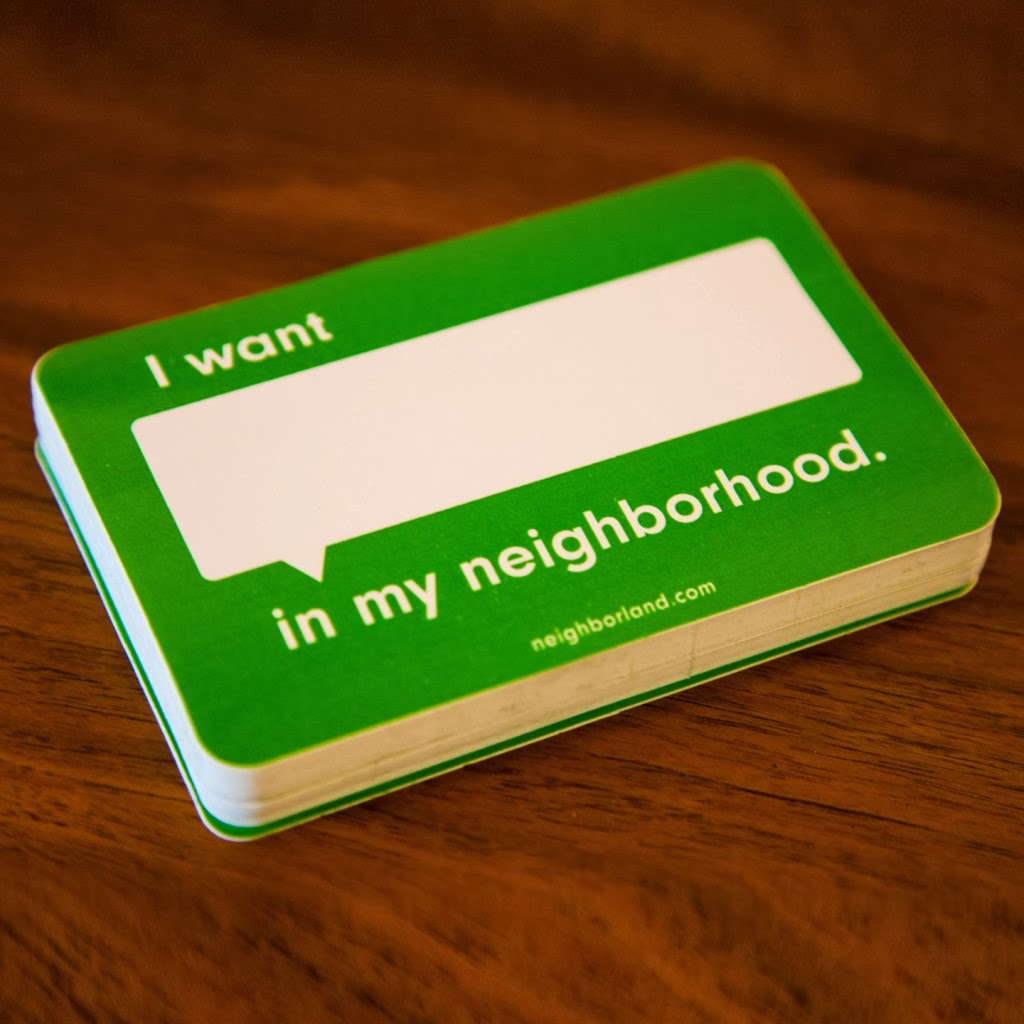
The problem: There's a vacant storefront or lot that has become an eyesore OR You want to solicit community input for a new development, or retail attraction program, but aren't sure how.

The solutionNeighborland's "I want _ in my neighborhood" stickers, or templates for mobile whiteboards to collect input in public space. Buy the stickers from their website ($0.35/each) and team up with the owner of a vacant site. It will draw attention to the space (a plus for the owner) and give you/potential retailers a sense of what people in the neighborhood want.


The problem: You have so many great attractions and amenities in your district, but not everyone knows about them, or how to get from one to the next.

The solution: Walk Your City's Sign Builder lets you design your own wayfinding system to make your community more walkable, and help visitors get from place to place. Using their online system - you design it, they print it, you install it.


The problem: You have empty tree pits, a vacant lot, or other spaces that could use a little greening.

The solution:Guerrilla Gardening.org shows you where to buy and how to make your own seed bombs to green your district or beautify vacant sites.


The problem: You've got some underutilized spaces that could be great - if only people had a reason to be in them.

The solution: Red Swing Project hangs swings in public spaces to "inspire playfulness" around the world. Download the free how-to manual on the website to make your own swing.

The problem: You want to do so many fun projects and you don't know where to start.
The solution: Betterblock.org has information on projects that communities are doing all over the country - from temporary bike lanes to pop-up stores, as well as a series of questions to help focus your efforts when planning how you are going to make a better block.


Author Kristen Wilke is a Project Manager at Larisa Ortiz Associates.