Showing posts with label Planning. Show all posts

Friday, June 9, 2017

Managing Homelessness Downtown

Our recent experience working with downtowns in the state of New York and in North Carolina this past year has brought to our attention a spike in stakeholder concerns over homelessness downtown. The homeless population is often referred to as the people who “lack a fixed, regular, and adequate nighttime residence". In downtowns, the homeless are often seen occupying public or private places that are not designed to be regular sleeping accommodation including parking lots and garages, storefront stoops, transit stations, vacant buildings/ lots etc. In addition to this group, there are also the homeless who live in substandard buildings that lack sanitation, cooking facilities or heat, who are often disregarded.

Trend

Seeing the rising concern over homelessness in our own projects led us to dig a little deeper into the trends happening elsewhere. As it turns out, homelessness is indeed spiking in cities all across the country, and particularly in downtowns. In San Diego, for example, tent cities have begun proliferating downtown near freeway on-ramps and commercial districts and homeless service centers. On a recent trip to Seattle, WA, I witnessed the same trend occurring under the on-ramp to I-90 by the CenturyLink Field and Chinatown District.

A myriad of factors contribute to the rising homeless population downtown but many leaders are increasingly placing blame on criminal justice reforms, which have downgraded some felonies to misdemeanors and therefore keeping some people out of prison or drug treatment and instead leaving them on the streets.

The more popular reason for the rise in homelessness downtown, however, remains the increasing cost of rents and disappearance of residential hotels. As more people look to live in convenient and vibrant downtowns across the nation, the high demand for downtown apartments and houses is slowly driving prices up for all housing stock. Meanwhile, homeless advocates are also pointing to the significant loss of single-room occupancy units, or SROs, as a key factor in the homelessness crisis. Many SRO units that still remain are unfortunately uninviting and unaffordable.

Why do homeless people gather downtown?

While those who can afford to live in downtowns are moving to these areas for comfort, convenience, and entertainment, homeless individuals on the other hand are coming in droves because downtown is often the best place to seek day service centers, social service centers, and basic amenities such as bathrooms and water fountains.  Downtown is also the place where homeless folks can get a meal, a shower or a shelter bed – resources that often cannot be found elsewhere.

During a stakeholder interview for our work in Middletown (NY), Director of the Thrall Library, Matt Pfisterer informed us that the homeless population there was particularly active around the library because they needed bathroom access in the day when they were not in shelters. Later in the afternoon, he reports, the homeless crowd migrates towards the soup kitchens and other downtown homeless service centers as they start to compete for safe and comfortable night time lodging. The Thrall Library, as do many other libraries across the nation, does its best to accommodate this group by ensuring bathrooms are monitored and maintained constantly throughout the day by staff and personnel to ensure that all library users can continue to use the bathrooms hassle-free.

Issues

Bathroom lines and litter are hardly issues when it comes to dealing with homelessness downtown. Many cities are facing harder problems such as drug use in public, rise in reported theft, and overall, a perceived lack of safety amongst residents and visitors. This overall unwelcoming atmosphere is not only discouraging some from living and investing in downtown, but also discouraging customers from shopping and visiting downtown. In our experience, we have heard from business owners and property owners that homelessness downtown has negatively impacted foot traffic and in turn, sales. In some cases, the homeless population has been driven to spend nights on storefront stoops and use back alleys as latrines, giving store employees additional work in the morning when they return to open and operate businesses.

Lower patronage downtown has even resulted in businesses closing in Portland, OR. A dance studio in downtown Portland, OR experienced dwindling class attendance from out-of-towners who felt scared walking to and from parking lots and dance class in the evenings as a result of the spike in the homeless population there.

Management Solutions

Whether perceived or real, this lack of safety experienced downtown can be managed by downtown organizations. The first step in managing homelessness downtown is counting, keeping track, and being aware of the current situation. After all, you cannot manage what you don’t know.  By keeping count of your homeless population, you will be able to determine the actual size and scope of the issue and at the same time identify hot spots with high concentrations of homeless folks and their peak visiting times during the day.

A common way to count the population is to use the ‘point-in-time’ method. This method requires that the count take place on one day every year across the city or downtown and therefore provides a Point-In-Time snapshot of the homeless population. This can be conducted by public or private sector volunteers including, of course, the downtown organization. This information can then even be registered with the US Department of Housing and Urban Development to become a part of a nationwide database for understanding homelessness across the country and will be required to be considered for federal funding to combat homelessness.

The limitation with this method, however, is that volunteers counting are only limited to what they can see by eye. In essence, they count the number of homeless people seen in cars, and on foot and if there are those who are hidden in tents, an assumption is made that there are two people per tent and may therefore be undercounting. Keeping a consistent counting method throughout the months and years is crucial for comparing data over time accurately and as long as this limitation is recognized, downtown organizations will be able to make informed decisions.

Downtown San Diego Partnership takes counting a step further by organizing a monthly survey instead of an annual one. Homeless outreach workers with the Downtown Partnership cover 275 city blocks between midnight and 5 a.m. on the last Thursday of every month and they have been counting since 2012. This has enabled them to see changes year-on-year and the data has helped the Partnership determine what actions need to be taken to manage the spike in homelessness and also to determine factors that may be affecting the numbers.

Taking Action

There are a number of actions that can be taken by downtowns to manage their homeless populations depending on size and scope.

First, developing a Vulnerability Index has been critical to many downtowns and cities in order for them to identify and prioritize the homeless population on the streets that should qualify for housing. A Vulnerability Index typically measures length of homelessness and mortality risk and is a practical application—a person-to-person survey—that is “revolutionizing the speed at which … chronically homeless population is placed into permanent housing”.

In some cities, non profits are stepping forward to create diverse housing stocks for the formerly homeless and low-income residents. Mixed-income permanent supportive housing is becoming a popular strategy to house the homeless population in larger cities such as DC and NYC.Often these buildings also feature community spaces such as rooftop terraces, gardens, lounges, gyms and laundry rooms that help the residents get out and engage with neighbors – a holistic environment for recovery from homelessness or any other dire situation.

While providing housing stock may be a longer term strategy, other short to medium-term strategies are also in place in many downtowns across the country. Libraries, as mentioned earlier, are becoming top community spaces that support the homeless population. The DC public library, for example, now provides an innovative outreach program for the homeless since its first hire of a Health and Human Services Coordinator. A Knight Foundation grant in 2015 enabled DC Public library to create an online interface of health and human services data  and train librarians in homelessness outreach so that when homeless folks come up to a librarian, he/she is able to direct them to the right service providers and give the correct referrals. This is a simple yet essential tool for supporting homeless folks and getting them back on track.

In other instances, business improvement districts have partnered with existing homeless-serving organizations to carry out supportive programs. In Los Angeles, CA, Downtown Center Business Improvement District  funds homeless outreach teams to contact, interview and assist homeless people living in the west side of downtown. Over $255,000 has been funneled from the BID to two social services agencies in order to hire staff to do this outreach work. PATH, or People Assisting the Homeless, is one of the organizations that provides services, including street outreach, shelter and housing construction. Chrysalis, a skid row program, then provides job preparation and temporary work experience, and also has been tasked with picking up litter in areas heavily-trafficked by homeless folks. In the first year of funding from the BID, outreach workers completed 196 assessments, and placed 36 people in permanent housing and enrolled 56 in PATH’s housing services.
Downtown San Diego Partnership, on the other hand, has set up a Clean and Safe Program and DowntownDC BID partnered with the city government and 20 local service providers in order to facilitate various efforts to end homelessness. This includes a partnership with Pathways to Housing DC that has deployed a 4-person, clinically-based outreach team that provides street-level intervention to move individuals beyond homelessness to independence. In addition, DowntownDC BID’s Safety/ Hospitality and Maintenance employees have 12 specially-trained members, known as the Homeless Outreach Service Team (HOST), who work closely with the Pathways to Housing DC Team and are trained to recognize and engage individuals with mental and addiction challenges. The smallest yet most impactful effort made by DowntownDC BID, however, remains the brown bag discussions that help educate the public on homelessness and raise awareness.

Installing public bathrooms is another potential strategy that might mitigate instances of public urination/ defecation. Although not all instances of this offence is carried out by the homeless, the compassionate approach rather than law enforcement approach has been widely praised by residents of the city of Denver, CO, where a pilot program of mobile public restrooms was established last year. These mobile facilities cost $12,000 per month to lease and are cleaned nightly and rotated regularly to different locations. Public bathrooms are basic amenities that should be made available to all users of downtown.
Given that vacant lots are often targeted for homeless camps to set up, downtown organizations may mitigate the situation by requiring or ensuring that private property owners have reliable property management companies in place to monitor compliance with zoning codes.

Finally, as downtown organizations plan ahead the annual schedule of events, they might start thinking about organizing events in partnership with homeless groups and shelters to accelerate and coordinate the move-in process. These processes normally take 60 days to happen but can be expedited in a single all-day event that serves as both outreach to homeless folks and also one that raises awareness amongst the general public.

Take a Comprehensive Approach

Overall, it is important to acknowledge that ignoring the homeless population downtown will not make it go away. A comprehensive approach must be taken by downtowns, in partnership with city, state or even federal agencies, and nonprofits and local community groups. Addressing the full range of issues faced by the homeless including housing/shelter, employment services, meals, and rehabilitation is crucial to managing the problem. It is also important to remember to count and measure the scale and scope of the issue first before taking any mitigating steps. This ensures that the response or strategies implemented directly serve those in need rather than simply blanket the problem.


Friday, May 13, 2016

Let's start at the very beginning...how to make sure your economic development efforts don't fall flat

Why is it that some communities fail to advance their economic development goals while others do not? A new report out from Brookings entitled "Remaking Economic Development" highlights the challenges that communities face when they try to advance economic development initiatives. And perhaps more importantly, the report identifies key strategies to avoiding the perennial problem of the “plan on the shelf”. 

Defining an economic development agenda that surpasses election cycles and individual agendas is a tall order. But is it one we cannot shy away from. Funding for economic development at all levels is waning, and successful efforts now require the cobbling together of a variety of resources that often come attached to a set of institutional or individual agendas. This means that getting everyone on the same page and pointed in the same direction is increasingly critical to successful execution. Enter the convening agency – cities, non-profits, business improvement districts, etc. - these organizations will increasingly play an outsized role in leading these efforts in partnership with the private sector. 

Perhaps the most critical step in the planning process comes at the beginning, first by engaging participants and leaders and second by providing them with market and asset information they need to come to consensus around a set of viable strategies. With this lens in mind, we share our own thoughts on these two important fundamentals - and highlight our favorite quotes from the Brookings report that reinforce the value getting started on the right foot. 

Fundamental #1: Great planning and execution begins with a "Diagnostic" - an understanding of an area’s unique "Strategic Position" and "Market Assessment"
“Undertaking transformative economic change requires developing a sense of urgency and high visibility. That starts with an economic narrative grounded in hard data and clear-sighted assessment of the region’s competitive strengths and weaknesses”
We couldn't agree more. Successful planning means taking a cold hard look at your assets and how they can serve as a viable starting point for partnerships and investments. Why is this step so critical? Because it allows for smarter decision making around the allocation of limited resources. Consider the downtown that borders a major educational institution or hospital (Pittsburgh is a great model of how "eds and meds" can play a major role in revitalization). These anchors are significant assets who are in a good position to drive investment overtime. Engaging these partners begins with understanding their needs and interests.

Brookings argues that this asset assessment is predicated on the identification of industry clusters that form a “unique foundation of regional economies”. These clusters exist because of a set of conditions in your community and region. At LOA we call these conditions the "DNA of place". By identifying your community's unique strengths, as well as competitive needs, you are in a position to understand opportunities you have to differentiate yourself in the regional marketplace. This in turn informs the kinds of improvements and policies that serve as the basis of your economic development strategies.
“economic development is most effective—and cost-effective—when it focuses on improving the shared assets that support clusters and advanced industries, rather than providing subsidies”
The Diagnostic is where you take stock of the opportunities you have to build on existing assets, identify challenges that may stand in the way, and develop a deeper understanding of market dynamics and trends that will shape your policies. When we work with communities, the outcome of the Diagnostic is a “Strategic Positioning Statement” - a clear vision that communicates a vision deeply rooted in market reality, one that identifies strengths and serves to differentiate the community from its competitors. A strategic position for a commercial district or downtown, for instance, will clearly state not only the facts on the ground, things like consumer lifestyle, price point and tenant mix, but also a clear vision of what the community would like to be. This stage is critical, because a strategic positioning statement offers a “true north” for all the economic development initiatives to follow.
“Data can dispel illusions and overcome complacency. Lack of solid data and analytic capacity can stymie regions at this initial stage. Establishing a common economic narrative brings leaders and the community together to mobilize action.”
Sometimes the information that emerges from a Diagnostic is sobering. I recently worked with a community that was working on a master plan. I came in a bit late in the process and noted that the recommendations on the table included suggestions for retail in each of the five subdistricts identified in the plan. The problem was, the entire area - a few square miles - could only support enough demand for around 60,000 sf of retail - even in the best case scenario. Scattering small retail around a very large geographic area would do little to create the business density necessary for businesses to succeed.

Fundamental #2: There is no substitute for capacity and leadership at the outset 
“Regions that create high-level steering committees composed of corporate, political, and philanthropic leaders, joined with broadly representative community partners, are better positioned to succeed—and to survive inevitable transitions in leadership. Without visible champions, such as prominent co-chairs, to reinforce the sense of urgency and centrality, even well designed plans can founder or get lost amid other initiatives.”
The absence of capacity and leadership is often what kills many an economic development initiative. Consultants may provide expert insight and direction, but without diverse leadership among public and private sector partners, and a plan of action that is reflective of their input and commitment of time and resources, the plans more often than not up sitting on the proverbial shelf.
“leaders must start with the basics: a firm grasp of both the markets and the civics required, which equally under gird this economic development framework”
Once a market understanding is in place, a diverse group of leaders must be engaged and committed to defining the goals and strategies that emerge from the Diagnostic phase. Brookings recommends that the economic development planning process offer both long-term goals and shorter-term metrics for success. In the short-term, visible success is an important in building legitimacy for the effort. Funders and partners will see those early successes and come to the table with deeper confidence in the ability to execute on the larger vision and strategies that may be more complicated and resource intensive.
“put an end to the hero economy” 
I love this quote - it might just be my favorite in the report. I have found that while a single charismatic leader is a great thing to have, it does not replace the need for meaningful partnerships and resources above and beyond what any one individual can deliver. Ideally, the Diagnostic results in a collective agreement that includes clear cut set of goals that reflect a strong, market-informed strategic position for the community, as well as a set of initiatives linked to a set of clear expectations and deliverables by all parties.

Conclusion
At LOA, we work hard to help communities define their assets and understand their markets. Over the years we have found that our work and findings gain traction when they are part of planning processes that engage participants in active dialogue. This is not about a consultant team telling you what to do, but rather a consultant team that advises and engages in conversation about what strategies make the most sense based on both market information as well as what partners are willing to contribute in the form of time and resources to a set of mutually agreed upon economic development outcomes. We find that when our clients lead a participatory process, we end client engagements with much more confidence  in the outcomes that will emerge from the planning effort. 

But getting started on the right foot is easier said than done. In an economic environment that is increasingly complex, one defined not by political boundaries but by industry clusters and regions, there is no short cut to defining economic development strategies with long term staying power. 

Wednesday, February 17, 2016

What do "Emerging Trends in Real Estate" mean for the commercial district practitioner?

The Urban Land Institute (ULI) and PwC just released “Emerging Trends in Real Estate" 2016 and there are quite a few insights and takeaways for commercial district practitioners. These come in the form of market-based opportunities and threats that will need to be considered - and acted upon - in the coming years.

Here are a few of the findings, as well as some practical takeaways on the impacts and actions that might be necessary....

Opportunities continue to grow in secondary markets – what ULI calls “18-hour” cities. This is great news for many smaller downtown's looking for investment. These are places that still provide investors better upside opportunities, in part because the dense primary markets are already stiff with investor competition. 18-hour cities offer lower costs while maintaining some if not all of the excitement of 24-hour cities. A great competitive advantage is brewing here.

Takeaway: If you are in one of these “18-hour” cities, places like Nashville, Austin, Denver, San Diego…the time might be ripe to revisit your district with an eye towards redevelopment opportunities. Now is the time to find investors and developers who might be more receptive to your pitches.

For all the hoopla surrounding downtown development, suburbs are still a force to be reckoned with. The report suggests that it will only be a matter of time before millennials, many who have deferred starting families, will start heading out to the suburbs to raise families. While 37% of millennials indicate a preference for urban living, we all know how quickly these preferences change when people become parents. That might not be good news for cities that don't stay ahead of these changing preferences. 

Takeaway: Downtown – and its surrounding urban neighborhoods - need to start thinking about how to meet the needs of millennials as they graduate from roommates to partners and families. This will require thinking more holistically. How are the local schools – all the way from elementary to high school? Is the neighborhood safe? Is housing affordable and adequate? And how is the physical environment? Are there safe bike lanes for tots who are learning to bike – i.e. dedicated lanes rather than sharrows? Are sidewalks and crossings - and the whole pedestrian environment for that matter - safe for those ages “8 to 80”, as Gil Penalosa founder of 8 80 Cities, likes to say. Are there adequate playgrounds within walking distance of people’s apartments and homes? While the report didn't mention this explicitly, let's not forget the growing senior demographic. Are these easy places to walk to grab a bite to eat if driving is no longer an option. If not, get cracking!

Work lifestyle and expectations are changing – and this is good news for downtown and other similar urban environments. The growth in co-working spaces is growing as the “gig economy” heats up. Is your city up to meeting the demands of these businesses and the workers they bring? 

Take away: For those districts where real estate development is an opportunity - what is your downtown organization doing to remain attractive to this changing worker lifestyle? Can your organization become proactive in helping to re-position or reuse existing assets to make them more attractive to investors looking to develop this product type? Have you thought of a game plan for how you are going to meet the needs of this growing worker segment? In 2013, the Downtown Brooklyn Partnership, the parent organization that manages three Business Improvement Districts in downtown Brooklyn, NY, helped lead a study and strategic planning process called the Brooklyn Tech Triangle (check out their website and plan here). The effort brought together the public, non-profit and private sectors to ensure everyone was working from one playbook when it came to strategies and investments that would ensure that the area remained attractive to the tech employers - and by extension tech workers. 

Housing in short one word: affordable. The report suggests that the lack of affordable housing for a variety of incomes is especially problematic. Recent housing production has been skewed “toward the luxury end [and] a shortfall of supply in the mid-to-lower end of the residential market is putting upward pressure on pricing…exacerbating already severe affordability issues.” Simply put, the development of luxury product has far outpaced other housing types lately, and the limited supply of more affordable options is being acutely felt in many markets. Without housing for a variety of income ranges, ULI suggests that markets will stagnate a bit. How can a business survive if its workers cannot afford adequate housing or are relegated to a lifestyle that involves a 3-hour round trip commute? As ULI states, “developing improved housing options for everyone…is passing from the realm of “nice to do” to “must do.”  

Take away: Has your community sought to address issues of housing affordability? Do your housing incentives support the creation of affordable housing, for people from both low and moderate income bands? Does your downtown zoning framework outline a clear and transparent process for development, one that offers developers the ability to ascertain costs and development timeline with some degree of precision? 

Parking - we still don't know what the future holds, but hold on tight, because change is coming. The ULI report mentioned trends that are notable, including the decline in driver’s licenses among younger drivers, driver-less cars, car sharing that supports a reduction in car ownership, etc., all things that will change parking demand.

Takeaway: We still don't know what this means, and quite frankly in my opinion, our zoning framework is probably not prepared to accommodate these changes without significant alternations. Keep your eye on what cities of your ilk are doing as they respond to the changing dynamics of parking. 

Infrastructure investments are critical, but don't hold your breath for public money to solve the problem. The need to invest in downtown infrastructure has never been more acute. Deferred maintenance on things from the water supply and distribution, road and bridges, rail and public transportation access, etc. will be our undoing. The cities and downtowns that address these issues will retain a competitive advantage over those that don't. 

Takeaway: In light of this challenge, there may be a need - and opportunity - for BIDs to take on bonding for public improvements as a benefit to their constituents. But keep in mind - in some states BIDs are restricted from or have limits to the amount they can leverage towards bonds, so the enabling legislation for your individual state needs to be considered carefully. 

Food. Food. And more food. 
The trend towards food as an activity, food as a lifestyle choice continues, and downtowns are naturally occurring foodie destinations. The growing demand for interesting food offerings, especially from among those with more discretionary dollars in hand bodes well for downtowns. 

Takeaway: Is your city positioned to take advantage of this trend? Food destinations are usually places where food offerings are clustered. The experience of choosing a place to eat become almost as interesting as the meal itself. In some places these are called "restaurant rows", though food trucks are muscling in on restaurant territory in some places. Is your organization marketing your food options adequately through social media? Do your events give food establishments opportunities to introduce themselves to new customers? Have you found ways to add complimentary experiences - including street buskers, nice places to stroll after dinner...what I call ambient or impulse entertainment? Since most dining happens at night - what is the arrival experience? Is parking adequate and is it safe and comfortable to walk to and from a car? Can you encourage retailers to remain open later on some nights to give diners another thing to do before or after they eat? The list goes on...

Big banks are getting bigger, while small banks are specializing, and the guy in the middle will have to choose. What this means is that financing for smaller projects may become harder because they won't attract the big banks.

Takeaway – Don't despair, this means that regional banks will likely fill in the gap. Have you developed relationships with your local regional banks? Do you have access to – or can you create – dedicated lending tools to help promote development and investment in your district? Projects in the $20 million to $50 million range are what ULI suggests are the sweet spot for smaller investments. Have you looked at your district with an eye towards cultivating developers and projects – either new development or reuse – that meet this criteria?

Finding a way to incorporate these trends into downtown and commercial district strategic planning efforts will remain critical in the coming years. So good luck!

If you like this post, please sign up for our FREE quarterly newsletter by clicking here


Wednesday, April 8, 2015

“Edge Cities” Grow Up

The new Tysons Corner skyline gets an update with a residential tower.
In 1991, journalist Joel Garreau published his seminal book, Edge Cities, which described places like Tysons Corner, a former country cross roads that grew into the quintessential automobile-oriented suburban shopping center and office park surrounded by traditional suburban single family homes. Today, Tysons is one of many former riding the wave back towards mixed-use downtown's, according to Shopping Centers Today (“Living Above the Store”, SCT April 2015). This trend is being led by millennials and baby boomers who want urban places to live, work and shop. According to a 2014 Nielson Report , “Millennials are fueling an urban revolution looking for the vibrant, creative energy cities offering a mix of housing, shopping and offices right outside their doorstep.” In fact, 62% of millennials “prefer to live in mixed-use communities found in urban centers.”

Shopping mall developers are increasingly responding to this growing demand by growing the commensurate supply of mixed-use projects that include a residential component. Both Macerich and Simon Properties, two of the largest mall developers in the nation, are adding housing to projects in their portfolios. Macerich recently added a 430-unit residential tower to Tysons Corner mall and Simon is adding a 319-unit mid-rise luxury building at its Phipps Plaza Property in Atlanta. Simon has also added 232-units to its Southdale Center mall in Edina, Minnesota. Downtown's and urban places are clearly the inspiration for these former Edge cities.
Skyview Center and Skyview Parc in downtown
Flushing, Queens, a combined mall/apartment building 
But if you think this is just a suburban trend, think again. Downtown Flushing, Queens, NY is home to the Shops at Skyview Center a $1 billion dollar project that is home to an 800k mixed-use, multi-level shopping center with stores like BJ’s, Nike Clearance Store, Forever 21, Target and Nordstrom Rack. Above Skyview Center is Skyview Parc – a luxury apartment building that is luring an international crowd of buyers (many Chinese) to some of the area’s most pricey apartments (the average apartment sells for over $700k). The project also offers a four acre landscaped park on the roof of the mall with walking trails, playgrounds, a dog run and picnic tables. Nice place to live if you can afford it…

Sunday, October 19, 2014

As Baby Boomers age, are commercial districts poised to make a comeback?

The Shoppes of Avondale, Jacksonville, FL -
are walkable mixed use communities like these poised
to see an influx of Baby Boomer residents?
Is your downtown ready to take advantage of the downsizing Baby Boomer? Downtown Seattle, specifically the area surrounding Pike Place Market is one community seeing a growth in residential development fueled by aging Baby Boomers. In August of last year, the Wall Street Journal reported ("Hip, Urban, Middle Aged", WSJ, Aug. 2013) that a 34-unit condo with prices hovering over $1 million mostly went to Baby Boomers, many of whom were leaving their larger homes in suburban areas and heading to older, more walk-able urban neighborhoods. A recent study that LOA completed in Seattle found a similar trend - the projected Median HH Income growth rate in the downtown area over the next five years is 6.6% - significantly higher than that of Seattle as a whole, which is 4.39%. These "moneyed buyers [have] created a gold rush" according to Seattle realtor Dean Jones. In Denver, one resident quoted specifically mentioned the desire to "stop driving so much". The Washington Post went so far as to announce, "The kids gone, aging Baby Boomers opt for city life"(The Washington Post, July 2013)

This specific issue - what to do as Baby Boomers age and cannot drive - is increasingly fueling planning that must, by necessity, include downtown and mixed use districts. This week, the New York Times wrote about just this kind of retirement planning, "When Planning for Retirement, Consider Transportation", NYTimes, Oct. 2014. The couple profiled live in a San Diego neighborhood where "If you don't have a car, you're stranded". They are now exploring public transportation options that are weak at best, and are considered moving, but aren't quite ready to make the leap just yet. 

Another issue is the fact that transportation - specifically personal ownership of an automobile - eats up a huge percentage of income (25% according to the Federal Dept. of Transportation). As people age and move to fixed incomes, the need to reduce these costs become necessary, and the ability to live close to work, shopping, eating can reduce transportation costs to 9% of income.  

Moving to a more walk-able neighborhood seems like a great option as people age, but how do we reconcile the fact that, according to an AARP survey, 87% of people age 65 and older want to remain in their current communities? The good news is that the study found that this preference decreased with income.  ("Home and Community Preferences of the 45+ Population, AARP, Nov. 2010). 

Developers are also taking note. Toll Brothers, a home builder known more for their suburban tract housing than for their urban projects, has increasingly started developing in the urban core. Initially, they thought their projects would be filled with young people, but they sold a much larger than expected percentage to Baby Boomers. 

So it seems that yes, Boomers are creating a dynamic shift towards urban communities. Is your community seeing a similar demographic trend?


Friday, February 21, 2014

Round Up: Low Cost, High Impact Tools to Address Common Issues

You don't need a big budget to make a noticeable impact in your commercial district. Here are a few tools that are easy and inexpensive to buy/download/DIY that help to address common problems.

The problem: There's a vacant storefront or lot that has become an eyesore OR You want to solicit community input for a new development, or retail attraction program, but aren't sure how.

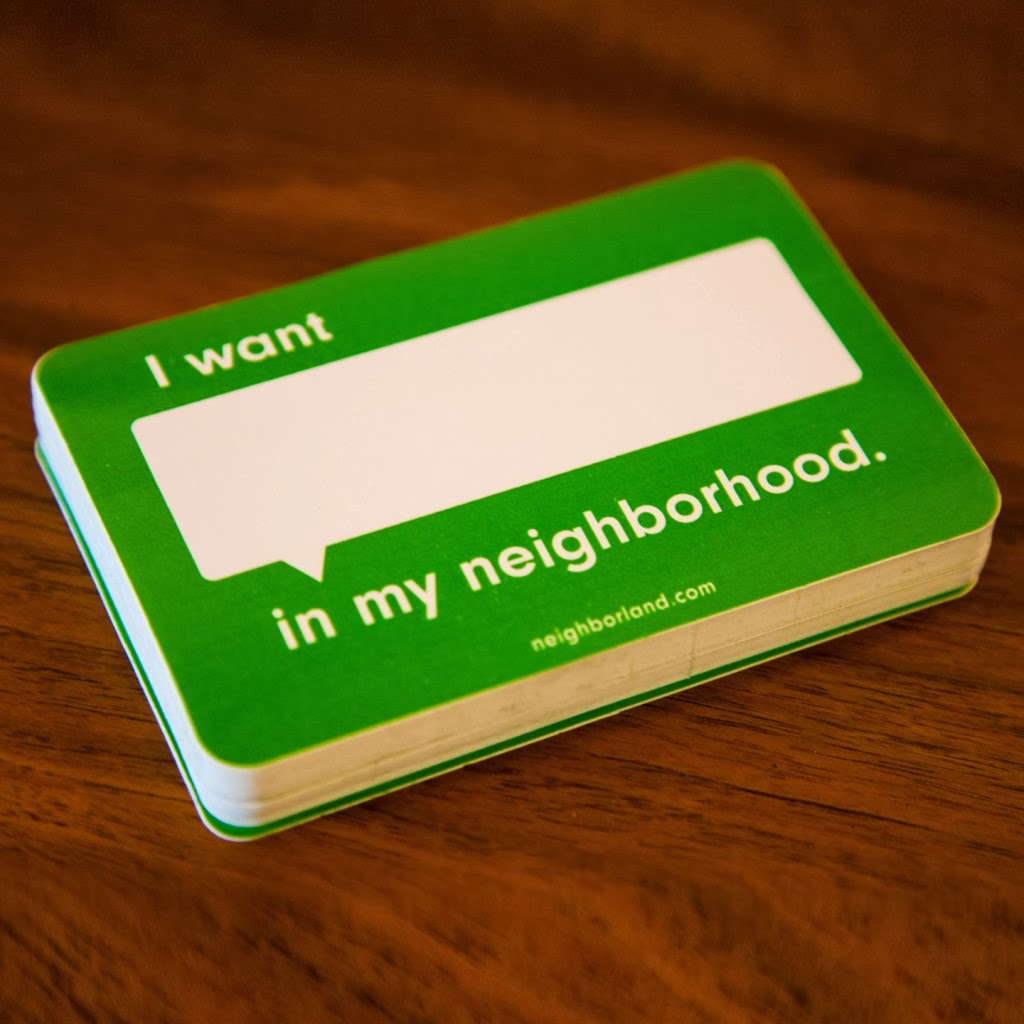
The solutionNeighborland's "I want _ in my neighborhood" stickers, or templates for mobile whiteboards to collect input in public space. Buy the stickers from their website ($0.35/each) and team up with the owner of a vacant site. It will draw attention to the space (a plus for the owner) and give you/potential retailers a sense of what people in the neighborhood want.


The problem: You have so many great attractions and amenities in your district, but not everyone knows about them, or how to get from one to the next.

The solution: Walk Your City's Sign Builder lets you design your own wayfinding system to make your community more walkable, and help visitors get from place to place. Using their online system - you design it, they print it, you install it.


The problem: You have empty tree pits, a vacant lot, or other spaces that could use a little greening.

The solution:Guerrilla Gardening.org shows you where to buy and how to make your own seed bombs to green your district or beautify vacant sites.


The problem: You've got some underutilized spaces that could be great - if only people had a reason to be in them.

The solution: Red Swing Project hangs swings in public spaces to "inspire playfulness" around the world. Download the free how-to manual on the website to make your own swing.

The problem: You want to do so many fun projects and you don't know where to start.
The solution: Betterblock.org has information on projects that communities are doing all over the country - from temporary bike lanes to pop-up stores, as well as a series of questions to help focus your efforts when planning how you are going to make a better block.


Author Kristen Wilke is a Project Manager at Larisa Ortiz Associates.

Tuesday, July 2, 2013

When Census Data Doesn't Cut It: 5 (Fun) Alternative Sources for Understanding Neighborhood Change

When you work in neighborhoods undergoing significant, rapid change, it helps to get a little creative with your research and data sources, especially as we move further away from the last census.

Here are some of our favorite (and fun!) tools that we use to understand what’s been happening in the communities where we work. Let us know in the comments what tools you use to understand neighborhood change.

Tracking Buzz

Yelp Wordmap
Yelp’s new Wordmap (launched yesterday!) shows density of keywords used in Yelp reviews around different cities. These maps are helpful in understanding characteristics and mix of local businesses, and the consumers in each of these neighborhoods. They may also prove useful if you’re searching for prospective retailers to bring to your community, or for businesses that are considering expanding into new markets.

They also reveal some subtle differences in clientele (Williamsburg has a density of Hipster businesses, while Park Slope and Prospect Heights are more appealing to Yuppies) and regional differences (Yelpers like to eat/review Biscuits in Portland, OR, Hoagies in Philadelphia, Dim Sum in San Francisco, Poutine in Toronto, and Bacon just about everywhere.) We hope they’ll add in a timeline feature so we can see how these clusters change over time!

Yelp Reviews that Mention "Hipster" in NYC


Google Trends
Google Trends allows you to see how, when, and how often people have been Googling different terms (since 2005). We use this to evaluate any “buzz” around a neighborhood, and to see how communities stack up against one another in terms of search popularity. See below how NYC’s five boroughs have trended over the past eight years.

(Just for fun - try putting in different parks and beaches to see how the trend lines change with the seasons.)

Understanding New Customers

LOA Lifestyle Matrix
Inspired by retail guru John Williams approach to tenant mix analysis, we’ve created the LOA Lifestyle Matrix that we use to plot both customers (using psychographic data) and retailers in a particular commercial district by Income/Price and Lifestyle. By overlaying these two data points, we can visualize fairly quickly how well stores in a particular place are meeting the needs of their community, and what consumers want (do they want an expensive trendy store like Opening Ceremony, or one that is trendy but inexpensive like Rainbow? Is this a J. Crew shopping district or a Talbot’s kind of market?). We can then identify any mismatch between offerings and customers, and use that insight to both attract the right mix of new retail, while also helping retailers adapt to neighborhood change. Even if you don’t have access to psychographic data, try creating your own matrix with census data, Yelp reviews, and other free sources.


Impact of Transit on Neighborhood Change

Annual Subway Ridership
So much of urban development is influenced by access and proximity to transit. In New York, the MTA collects annual ridership by station. Using this data, we can see where the most significant increases in ridership are happening, which can help us understand where new activity and investment is taking place and project what neighborhoods might be next.

Tracking Recent Investment and Growth

Property Shark Maps: Home Price Changes by Neighborhood (2012 vs 2004)

Property Shark maps the change in price per square foot of residential properties by neighborhood. This helps to illustrate where new investments are being made, and what neighborhoods are struggling, stagnant or soaring.

Brooklyn Price/ SqFt Changes 2012 vs 2004

Friday, February 3, 2012

From High Streets to Main Streets...reinvention required

A typical "high street" in England...
In England, "High Streets" are the equivalent of "Main Streets", and their problems are not so different from our own. Many are marred by significant vacancies, and the recent global economic downturn, coupled with fundamental changes in how people shop, has not helped. In a recent article in the U.K's Independent, Phil Wrigley, a prominent fashion retail executive called for the "reinvention" of high streets. He goes on to say that "retailing will never be the same again, but there is much to be gained from facing up to this fundamental, and irreversible, truth. In doing so, we might just create the space in which we can re-cast and revitalise our town centre communities."

Wrigley advocates for shrinking the commercial and retail square footage along high street, and turning these spaces into residential units. There is something to be said for this argument. In many urban areas, commercial zoning has not been updated in decades, and still operates under the assumption that downtown is the regional shopping hub of yesteryear. New commercial square footage, much of it in the form of enclosed malls and shopping centers, has replaced the need for all the commecial square footage that used to be necessary downtown. Yet many downtowns have failed to shrink their commercial districts in a thoughtful way. Instead, the dwindling number of stores are seperated by vacant storefronts - hurting the downtown's overall image and making it more difficult to attract new businesses. This is the "death spiral" that Phil Wrigley speaks. He suggests that a vacancy rate of 20-30% is the tipping point for vacancies that make it difficult for any community to recover from.

Wrigley's recommendations are an excellent strategy to prevent further demise of these districts. With more residentail housing comes more demand for retail and services...so perhaps the "death spiral" should instead be called the "opportunity for reinvention" spiral....

Wednesday, January 11, 2012

Why is it so important to resist the leap to action?

I am a planner by nature, so I often council clients to 'go slow to go fast'. But why is it so critical to take time to plan, to accurately diagnose a problem before leaping into action? This morning, my friend over at Bar Marco in Pittsburgh, co-owner Bobby Fry, wrote in a "Morning Meeting" email he sends to friends and colleagues about the important of taking the time to plan as he negotiates the trials and tribulations of opening a business. His email was a bit of an inspiration for this post....

Coincidentally, I also happen to be reading a book entitled "The Practice of Adaptive Leadership" co-authored by Alexander Grashow, a friend from college who is now head of Cambridge Leadership Associates. In it he describes the pressure that leaders feel to "Do something!" We have all felt it and seen it...communities so tired of planning they simply want to "Do something!"  But what happens if you don't take the time to think about your priorities? To actually step back and take a moment to DIAGNOSE a problem? Can you imagine if doctors treated patients before taking time to accurately diagnose the sickness? Would you trust a doctor who said "that lump is probably cancer, we don't need any tests or anything, let's just try chemo and see how it goes" Perhaps a morbid comparison, but an important one none the less.

As a consultant whose job it is to diagnose sick commercial districts, I often have clients who wonder why we can't just leap to action. In fact, one client I'm working with now (who shall remain nameless!) wants to leap ahead and bring in architects and transportation consultants to prepare a streetscape plan. This without having any discussions with the key downtown stakeholders and players, including local merchants, whose input is critical to ensuring this is the right direction for the downtown. Perhaps a streetscape plan IS a good idea, but the question needs to be asked, how does it fit into the bigger picture of the district vision? How might streetscape improvements address the underlying economic conditions that are making it difficult for businesses to survive and thrive? In fact, leaping ahead to streetscape improvements might be the nail in the coffin for businesses struggling to keep their doors open. Can you imagine what a street closure or sidewalk construction would do to struggling downtown businesses? The answer to that question is as horrible as a cancer diagnosis....the loss of a business owner's life savings, the loss of local jobs, the loss of businesses downtown....

Yet, I often find that my job is to council the client to resist the tendency to take action without first understanding the problem. I understand that sometimes it can be frustrating to wait - but the alternative can be a series of false starts that results in the loss of community interest and energy. Being able to gather all of the facts, conduct focus groups, interviews, surveys, market studies...all of that boring PLANNING...is so critical to making the RIGHT decisions that keep people from wasting vital energy and resources. At the end of the day, it's not planning that slows things down, it's the LACK of planning that derails efforts to move forward. People take action, see failed results, and then lack the energy to take action again. It's a perenial problem improperly attributed to the failure to planning.

Tuesday, July 19, 2011

Debate: Two Communities, Two Opposing Positions on Downtown Infrastructure Investment

CON: “I am not going to spend down our reserves especially in a time when we don’t know what the economy is going to bring.”

[Los Alamitos Puts the Brakes on Downtown Revitalization, Los Alamitos-SealBeach Patch, 7/19]
 
When funding gets cut for planning and outreach, downtown infrastructure projects can come to a grinding halt, as is the case in Los Alamitos, CA, where a concept design for a $2.5 million dollar downtown streetscape improvement project was recently put on hold.

We often say that planning is an excellent thing to do in a down economy, so that when the economy gets better and resources become available, projects are ready to go. But sometimes realpolitik intervenes and despite an organization's best efforts, finding the resources, even just for planning, can be a challenge.

PRO: “The city is getting significant value for our investment in terms of parking, public spaces, the future expansion for the museum”

[Proposal: Palm Springs to pay $43M in Desert Fashion Plaza mall project, Mydesert.com, 7/19]

In contrast to Los Alamitos, Palm Springs, CA is contemplating committing $11 million dollars for new street construction and parking facilities improvements (an additional $32 million will be held in escrow for other project related costs) as part of a revamping of a single-owner shopping center called Desert Fashion Plaza. Voters will be asked to approve a 1% sales tax increase. The City argues that the investment would result in $600,000 in additional property taxes annually.

MY TAKE:
I'm not quite sure that investment in a single-owner downtown shopping center is necessarily the best alternative, but I do find it interesting that these two communities lie on opposite ends of the investment spectrum, each conducting a very different calculus resulting in two different outcomes.

In most cases I do believe that failure to invest is shortsighted. But the cost-benefit analysis of any particularly investment must be measured accurately so that scarce resources can be allocated appropriately and with full disclosure. That said, without investment in downtown infrastructure and improvements to the public realm, a community can end up digging its downtown into a deeper and deeper hole of disinvestment that is difficult to crawl out of, even when the economy gets better. As the competition for scarce consumer dollars gets stiffer, competitive districts and more controlled shopping environments (like the mall), benefit as consumers choose places that  look and feel better. These alternative shopping venues are cleaner, safer, and managed in a way that better meets customers needs. The dangers of long-term disinvestment are very real, and ultimately affect the tax base, not to mention puts small businesses at risk over the long-run.

So here are my questions for our readers...is downtown investment the right thing to do in a down economy? And if so, under what conditions? And how do you sell this investment in a challenging political environment?

Wednesday, June 15, 2011

Do you know your 'district orientation'? If not, here's why it matters...

I am often called upon to help communities develop revitalization strategies for their downtowns - and the most common question I get asked is "how do we know what to do first?" What may have been the right set of first steps for one community, may not work in another, so it's sometimes hard to figure out how to prioritize your efforts and resources.

A professor from my days at MIT, Karl Seidman, is an author of a number of publications on urban commercial district revitalization strategies that offers a framework I find useful in my work. Karl starts by helping to unpack the question of “what kinds of intervention makes sense and when?” His field research on seven “urban” Main Street programs in three cities (Revitalizing Commerce for America's Cities) found that districts often fall into four ‘orientations’ depending on where each district is in its implementation efforts. If you can figure out your district orientation, you have a better chance of figuring out what kinds of activities you should take on first, second and third.

These orientations are useful because they help us avoid a far too common mistake made by practitioners: the tendency to apply known, familiar solutions to new challenges that require adaptive solutions. (For district managers in the Coro Neighborhood Leadership Program, this will sound very familiar!). What I mean is this - what typically happens is that a BID hires someone with a background in say, marketing, and all of a sudden all of the BID's activities are oriented towards marketing, whether or not these are right solutions to the problems at hand. Or the BID hires someone who really know real estate development, and lo and behold, all of the 'right' solutions for the district become about real estate. It is important to first take a step back and figure out what kind of district you are so that you can apply the right set of solutions to the challenges you face, rather than simply apply the only set of solutions you may be familiar with.

So with that, I offer Siedman’s framework below, with one exception - the addition of a ‘clean-and-safe-oriented district’. This additional category recognizes the critical contribution that neighborhood safety plays in neighborhood commercial district stabilization.

  • Development-oriented districts are areas in need of significant investment in physical improvements. There are often numerous vacant buildings and sites in need of development. Buildings and infrastructure have deteriorated overtime, and private investment is unlikely because few see opportunity for return without some form of public subsidy. Marketing and promotion cannot occur until the market is more stable and there is something of substance to market and promote.
  • Organization-oriented districts need help getting started. There is limited administrative capacity to take on any initiatives – and no established consensus around where to start or who will lead the initiative. These areas may have cultural or language barriers that make achieving consensus a challenge or they may suffer from ‘planning malaise’ or lack of leadership.
  • Promotion-oriented districts start from a position of relative strength. They may have clusters of strong existing businesses that are struggling to remain relevant in the face of neighborhood change. These districts need help growing the customer base, which may have changed or diminished over time. Retention-oriented districts often share many of the same attributes.
  • Retention-oriented districts typically have occupied buildings and few vacant sites. In these districts, the challenge is ensuring that the existing businesses benefit from development and escalating rents that often mark neighborhood change. These districts focus on providing resources and services to existing businesses. Promotion-oriented districts often share many of the same attributes.
  • Clean-and-safe-oriented districts struggle to manage the perception and/or reality of crime, which hurts local businesses in their efforts to attract customers. This challenge undermines nearly every effort to improve the district. Reducing crime and improving perceived safety is critical to neighborhood can often serves as the primary catalyst for change and engagement from residents and businesses alike.
So which district orientation are you??