Showing posts with label Urban Blight. Show all posts

Monday, February 26, 2018

Shipping Container Pop-ups: Best Practice or Best Forgotten?

Dan McCombie is a Research Associate at Larisa Ortiz Associates

I caught myself typing this into my google machine the other day:

“Are shipping containers still cool?”

This question has been on my mind as of late, given that the phenomenon of turning shipping containers into pop-ups for retail, exhibition space, offices, and even tiny homes, has been going on for quite some time now. Many people are no doubt familiar with the well renowned downtown Container Park in Las Vegas, constructed in 2013 as part of a huge reinvestment package spurred by the relocation of online retailer Zappos to the neighborhood. And I personally remember when back in 2011 my hometown of Christchurch (NZ) had its central city devastated by earthquake, spurring the city to create Re:Start to quickly breathe life back into the CBD. Are people still doing this? Is it still perceived as both a savvy marketing scheme and opportunity to catalyze revitalization? Or is the public starting to experience container-fatigue?

What’s the problem with containers?

Admittedly, there is a part of me that sometimes looks upon containers with disdain simply because they are so ubiquitous now. But I stumbled upon this quote from an article by John King in an article he wrote for SFGATE.com, wherein he waxes on the creation of “Proxy,” another container park constructed in 2011 in the Hayes Valley neighborhood of San Francisco:

“This isn’t about architecture so much as urban place making: you’re less aware of the structures than of the surroundings. The containers aren’t treated as sculptural elements, as is the case recently in other international cities. They’re content to add layers to the landscape, enlarging the Hayes Valley experience without making a fuss.”

Which I interpret to mean: “Calm down. Forget about the medium and consider the effect.”

And rightly so. I actually visited Proxy when I was last in San Francisco, when a couple of friends brought me to the beer garden there (Biergarten). Recalling that visit and doing some background research, I learned that Proxy was exactly as the name describes—a temporary placeholder until more permanent development could take place, much like Re:Start in Christchurch. The site on Octavia Street was originally an underutilized parking lot that the city sought to redevelop for affordable housing. However, the original plan was tabled with the advent of the economic recession. Rather than let the site lay vacant and an eyesore on the neighborhood, the city and the Mayor’s office bid the site out for a temporary and less costly installation, to which the designer/developer/operator Envelope A+D responded with their plan for a “flexible environment of food, art, culture, and retail within renovated shipping containers.” 

Although city codes lacked precedent for a “temporary” retail operation lasting more than 90 days (the project is due to expire in 2020), stakeholders were able to negotiate an agreement such that project became a reality. Now retail tenants include a mix of established brands and start-ups taking their first incremental step towards brick and mortars. In addition to retail offerings, the project hosts film screenings, art installations, and serves as a performance/event space creating a bonafide neighborhood gathering place.   

What have container parks like Proxy meant for retail?

Proxy bucks the trend in retail in the sense that in spite of its positive public reception and the relative success of its tenants, it plans to shutter in a couple of years. Why remove something that seems to be a success? Because it was always designed to be a stop-gap and of course the need to grow the supply of affordable housing in the Bay Area is still an acute need. But the lessons remain. What Proxy did well was create density in a vacant space. It was consciously conceived as a means to revitalize a previously blighted area, a parking lot that had also been the former site of a freeway. There were other things Proxy did well—curating the mix of tenants in a meaningful way and targeting operators that could feasibly make the jump to brick and mortars after a period of incubation. I also appreciate that the designers consciously eschewed the term “pop-up.” In a quote from Douglas Burnham, founder of Envelope A+D:

“We specifically don’t use the word ‘pop-up’ because it doesn’t really mean anything to us anymore…We think that a thoughtful insertion of compelling temporary uses can be an effective strategy to bring vibrancy to languishing parts of the city. There’s nothing trendy or faddish about this.”

Admittedly, one could argue it is a bit faddish to treat “pop-up” as a pejorative term. But I think this gets back to my main takeaway. Before you critique something for its popularity, it’s important to consider if and why it actually has staying power.

So…do containers have staying power?

As far as I’ve been able to tell, the containerization of our lives continues unabated. Large brands like Budlight, DSW, Puma, HBO, and HP are increasingly demanding container pop-ups for experiential retailing strategies while a growing number of companies are supplying both specialized and turnkey options. They range from Co-Working in a Box’s “PopBox”, Britten’s “BoxPop”, and Vacant’s mobile container truck, each providing a range of design and consultative services to help get businesses off the ground and engage customers in places they didn’t expect.

And let’s not miss the fact that a whole segment of companies have an identical model for indoor pop-ups. The shopping mall giant Macerich’s Pop-Up EXP program provides 100-300 SF of space with micro leases, and modular components. The difference here is we’re not talking about containers. Again—this suggests a larger trend with momentum and that the medium (containers) is really beside the point.

What’s on the horizon?

Some forward-thinking folks have gone so far as to envision containers as outparcels–parking lot satellites to larger retailers located inside shopping malls. For example, perhaps a Nordstrom anchoring a mall uses a container in the parking lot as a small fulfillment center so customers have the convenience of picking up their order on the fly without the full commitment of going inside. It’s no stretch of the imagination given the way e-commerce has pushed the industry towards more rapid and flexible retail with just-in-time delivery schedules. And what with autonomous vehicles ahead, these trends will surely continue into the foreseeable future.

Personally, I’m excited to see pop-ups and container villages keep building off of what has worked in the past. Invest Atlanta, the City of Atlanta’s Development Authority, approved $550K in funding to create an “MLK Innovation Village” built out of shipping containers in an empty parking lot adjacent to the H.E. Holmes MARTA station. The village will include an outdoor gathering space, retail, and at least nine offices with the intent that this “semi-temporary” project will be a catalyst for future transit oriented development in the area. It’s the same model as Proxy and Re:Start, but with a creative transit component that could give it possibly massive multiplier effects.

Which is all to say, I think we still have a lot of containers coming our way in the future.


And that’s quite alright with me.


Puma City
 Multiple Global Ports
Re:Start
Christchurch, NZ


Proxy
Hayes Valley neighborhood of SF

Container Park
Downtown Las Vegas 

Wednesday, November 9, 2016

Round Up: APA Awards, Blight Taxation, The Potential of Alleys, Temporary Renters, and Hot Dogs

Great Places in America: People's Choice
Not malls or strip centers, but American's have cast their vote for walkable commercial corridors to shop, district plazas to gather, and authentic neighborhoods to feel community. See the results in this year's APA people's choice.


D.C. Raises Taxes on Blighted Buildings
Blighted buildings plague many corridors and cities. The trend of blight property taxation continues to be a hot topic and a questionable driver of economic development. If it works in one city, can it be modeled in others? We will have to see.


Cities Start to See Potential in Alleys for Commercial Use
I had a great experience in Istanbul at an alleyway bar, which came to show that even overlooked alleys can serve a viable commercial purpose. Cities in the US are beginning to see this potential as well, adding availability and variety to the commercial mix. Learn more about what Downtown Pheonix is doing to activate their alleys. 


Freeman's Restaurant. Image: www.eateryrow.com
Are Commercial Renters Feeling Temporary Like Residents
As urban rents go up an increasing number of residents feel a sense of temporary status in the places they love to live. Are we seeing the same feelings in commercial renters?


Infographic: Charting America’s Hot Dog Obsession
I personally prefer taco trucks but Americans do love their hot dogs. Could commercial corridors benefit from these small purveyors of hot processed meats? They are a testament to pedestrian traffic and business clusters.


Tuesday, October 25, 2016

Round Up: Streets That Define America, Barcelona's Superblocks, Detroit's Food Incubators, Illuminating Blight

10 STREETS THAT DEFINE AMERICA
This Curbed article gives perspective to different characterizations a street can embody. Referring to their work Curbed says, "Four factors emerged as the dominant forces shaping our cities: Regeneration fueled by small businesses, new development and the changes that follow, alternative transportation options, and rich, if burdensome, cultural legacies."

Beautiful graphics, images, videos and storytelling in this piece!


What New York Can Learn From Barcelona’s ‘Superblocks’
Unlike New York's attempt to carve out public plazas in busy pedestrian corridors, Barcelona's plan to create "superblocks represents a more radical approach that fundamentally challenges the notion that streets even belong to cars."


FoodLab Detroit Is Baking Equity Into Detroit's Food Scene
Detroit has a growing food scene. Through funding and awareness, FoodLab Detroit created Detroit Kitchen Connect, "a network of shared kitchens in community centers and churches that double as incubator space" and "also provides low-income entrepreneurs of color access to the organization’s social and financial capital."


Illuminating Blight in Upstate New York
A temporary art installation in the three Capital Region cities calls for a solution to vacancy and abandonment by illuminating 100's of abandoned buildings to cast light on the topic of blight. "Breathing Lights" is funded by Bloomberg Philanthropies Public Art Challenge and hopes to draw "attention to the widespread issue of blight and calling for a tangible path to revitalization."

Thursday, November 5, 2015

Six basic principles for building thriving commercial districts in low-income communities

Our most recent projects have taken us to Bridgeport and Trenton, two former industrial powerhouses, both now struggling with the impact of industrial displacement, poverty and population decline. Yet there remain residents in these communities for whom improvements are critical to life outcomes. And in our opinion, we really don’t have much time to waste. As Nathaniel Hendren, Harvard Economist and founder of The Equality of Opportunity Project was quoted in a recent New York Times piece, “where you grow up matters.” So simply put - and so true. His research has shown that for “every extra year a child spends in a better environment – as measured by the outcomes of children already living in that area” improvements to childhood outcomes can be demonstrated.

In our work we have found that addressing the corridor challenges of the lowest income communities means thinking more creatively about how to address anemic market conditions. So for practitioners working in these challenging and complicated environments, we share a few principles that we have come to deploy in our work....

1. Support the creation of community retail nodes – rather than dispersed retail. Businesses thrive in clusters, and the convenience of being able to patronize a few businesses at once will enhance the appeal of the district as a whole - benefiting all businesses by driving more traffic than each might on their own. 


This existing node of retail may not look like much,
but it serves the local community and is located at a well trafficked intersection. A district like this is in a better position to benefit from improvements than an area that is less visible and off the beaten path. 

2. Visibility, accessibility and convenience. Retail needs a good location to work. You can’t fabricate these fundamental market conditions if they don’t exist, so don’t try to create a district somewhere where the fundamentals aren’t in place. In some places, whether we like it or not, this means a place that can be easily accessed by car (with adequate parking). In other places, this means access to public transit, or an easy, direct walk by foot or bike. If you ignore this principle you are just setting yourself up for failure. So make sure you are working on retail concentrated in places that are accessible and receive plenty of visibility. Think busy intersections rather than sleepy side streets (even if those side streets once contained vibrant retail in days of yore). 

And sometimes minor, seemingly inconsequential barriers to access will hurt sales. Making your customers walk any further than they have to can result in them hopping right into their cars to find a parking spot somewhere where they won't have to walk. Sad but true. 

Great parking on one side. A great jazz club restaurant on the other. In between? A canal.
So all those folks leaving work in the evening are ten times less likely to do anything but jump in their car and go elsewhere. 


3. Consider businesses that do not depend as heavily on discretionary income, because if you don’t have enough residents with discretionary income right now, it might be awhile before you have enough to support new businesses. So instead think about uses that can be sustained through public funding or other income streams, such as publicly funded day care centers, urgent care clinics, non-profit service providers, educational or workforce training programs, etc. These kinds of businesses not only fill space, but they also generate traffic can result in the added benefit of creating enough demand to support a small amount of auxiliary businesses, from food related businesses – a pizza shop or deli – to a pharmacy or convenience store.

Increasingly urgent care facilities are taking over ground floor retail space.
These facilities can provide an extra level of medical service in communities that desperately need them. 
4. Build density – sometimes there is no way around it. In some communities, population figures are so anemic that the only adequate response is to build housing. This is where Community Development Corporations have excelled over the past few decades, using important financing tools like the Low Income Housing Tax Credit or Section 202. While these resources are unfortunately increasingly limited, they have proved critical in turning neighobrhoods around and in creating the market demand over time that can support small businesses.  

A vacant lot of Southern Boulevard in the South Bronx

The same vacant lot after local CDC WHEDCO developed the project into quality affordable housing.
5. Focus on the physical environment – focus on improvements to the physical environment that will address issues of safety. Think about graffiti clean up, street clean ups, vacant lot clean ups – these kinds of activities can help build neighborhood pride and in fact do have an impact on neighborhoods. Research funded by LISC, one of the nation's largest community development intermediaries, found that the impact of Philadelphia's vacant lot program had a positive impact on the sales of local businesses, real estate values in the district and shopper preference. A win-win all around. 

New Kensington CDC in Philadelphia was one of the early adopters of the vacant lot maintenance program, now called Philadelphia LandCare. At some point these lots may be developed, removing the "missing teeth" from the district. But for now the maintained lots have made a significant improvement along the corridor. 

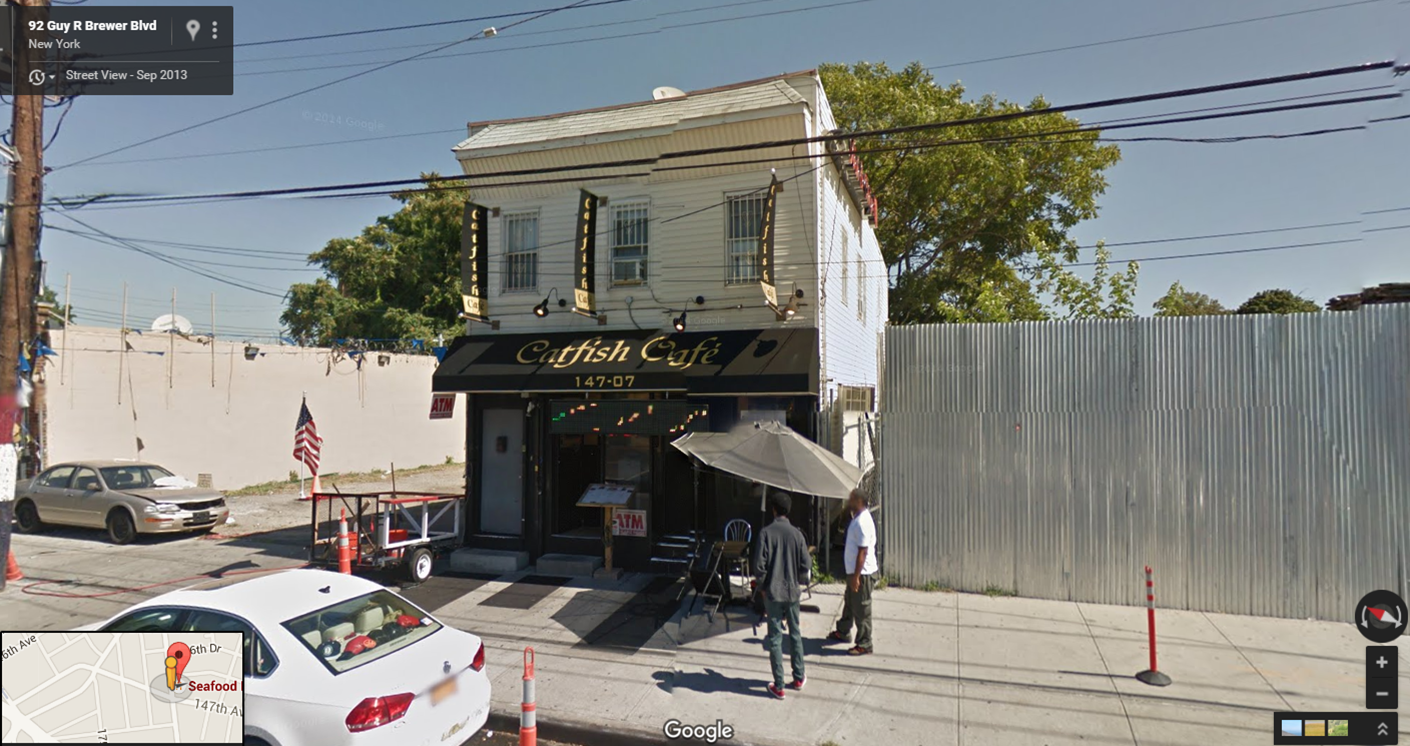
6. Focus on helping small businesses address public safety and visibility issues. Sometimes small investments in physical improvements, such as lighting or signage, can help existing businesses capture more market share. Moreover, these small investments can make a big difference in the perception of public safety. A transparent window, or well positioned lighting, can make a store that most didn't think twice about visiting more appealing. 

This seafood restaurant in a lower income community in Queens is doing lots of things right.
Transparent windows, outdoor seating, blade signs. 

The main take away is that a commercial district in a lower income community must find ways to ensure that every potential dollar that can be captured is in fact captured. There is little room for error. That means removing all possible hurdles that prevents customers from easily and conveniently patronizing local businesses. And in some cases, that means building the market to create more demand for retail - read new development. While that process can sometimes take a long time, with a strong road map and an understanding of the kind of market conditions necessary for business to thrive, I have seen time and again that neighborhoods can in fact change and improve, benefiting the residents that live there. 

Thursday, June 18, 2015

Commercial District News Round Up

What is Urban Decay? (And Why the Answer Matters)
Very interesting read regarding urban decay, how to define it, the legal battles over fighting urban decay, and how to resolve it.  This story mainly focuses on California and their development of urban decay laws that deal with environmental analysis for proposed projects, typically big box stores.
Image source: www.wifr.com/
Mall-centric no more: Aging suburb targeted for a sweeping makeover
An area in Fairfax, Virginia called Seven Corners, near Arlington, is being considered by city officials for a major overhaul that would include three new residential villages and roads over the next 40 years. The idea is to make a more livable environment, friendly to pedestrians, and oriented to nearby public transportation. The area used to be occupied by a mall, which is a question of our times, "How to retrofit former malls and surroundings to meet today's needs"?
Image source: Fairfax County Office of Community Revitalization
Are Cities Becoming Less Authentic?
In a quest to understand Millennials, Klaus Philipsen discusses the other most desirable attribute that Millennials seek: authenticity.  This desirable authenticity is also disappearing, as he documents, in many major American cities such as Baltimore and with it taking away important historical artifacts. Philipsen notes that in Baltimore this means that historically significant black sites are being replaced by Starbucks, Chipolte etc without sensitivity to the history and authentic fabric of the neighborhood.
Image source: sustainablecitiescollective.com
Detroit relights neighborhoods at blazing pace
The installation of nearly 40,000 LED streetlights, that are both brighter and more energy efficient than the previous lights, is expected to be completed by the end of July, about six months ahead of schedule.  Lights are going up in streets that have not had street lights for two decades in some cases. Statistics are already showing decreased burglaries, larcenies, vehicle theft and other property offenses - 18% decrease from the same time last year.
Image source: lighting-ledlight.com/
Meet the 606: Chicago's New Elevated Bikeway and Park
A time lapse video takes you through the new 606 in Chicago, an elevated bikeway and park similar to the highly popular High-Line in Manhattan.
Image source: www.the606.org

Wednesday, May 13, 2015

What does a burned out and looted CVS have to do with upward mobility?

The Baltimore riots came to be exemplified by a looted CVS 
I have been fascinated by the recent coverage of upward mobility in the New York Times ["In Climbing Income Ladder, Location Matters"]. This topic is of interest to me because our firm is often engaged in improving retail environments in under served urban communities. Consider the CVS that was looted during the recent Baltimore riots. Did you ever stop to wonder how long it took to attract a CVS pharmacy to that neighborhood? And do you think that CVS or any other retailer will be eager to return as things settle down, regardless of how much demand and need there might be? In the end, the politics of place matters quite a bit when it comes to improving the retail environment for local residents.

Neighborhood Environments Impact Outcomes
This is why I found the research that the NYTimes covered quite riveting. Two Harvard economists conducted a time series analysis on the impact of neighborhood environment on the outcomes of poor children. In short, they found that the neighborhood environment in which a child is raised is one of the most important determinants of income (by age 26). From the standpoint of a low-income family living in a low-income community and looking to meet the needs of their children TODAY, not tomorrow, the news is not good. Basically, the research suggests that mobility is the answer. Get the hell out, basically. But the authors acknowledge that this solution is not scalable, and I agree. Moving every family out of poverty stricken neighborhoods is not a long term solution. It’s a band aid fix for an intractable problem. The real problem is the quality of the neighborhood in which they live. Addressing that problem is where the future of public policy SHOULD be if we are truly interested in improving the outcomes of poor children over time.

So what kinds of neighborhoods produce better outcomes? If we can answer that question, we can begin to craft policy solutions that will support these conditions in low-income communities. The study found the following, places that had higher rates of upward mobility demonstrated five key characteristics:

- less segregation by income and race
- lower levels of income inequality
- better schools
- lower rates of violent crime, and
- a larger share of two-parent households

Policy Solutions?
According to the authors, “our findings provide support for policies that reduce segregation and concentrated poverty in cities (e.g., affordable housing subsidies or changes in zoning laws) as well as efforts to improve public schools.”

In the short term, we must, must, must find ways to do the following:
  • REDUCE the concentration of poverty and INCREASE racial diversity. This means encouraging economically integrated neighborhoods by combining efforts to attract higher-income families WITHOUT involuntarily displacing existing residents. That means building – yes, building – NEW housing. This in turn means that some communities will need to be rezoned for density. But while that happens, we must ensure that existing families have the opportunity to remain as a neighborhood improves. Some potential policies include strengthening landlord-tenant laws that prevent harassment of tenants, helping tenants with the right of first refusal and provide financing to enable them to buy their properties and stay in place, and providing incentives or loans to landlords that allow them to rehab their buildings in return for maintaining affordability. These are just some interesting ideas advanced by The Center for Community Progress.
  • Make these neighborhoods “communities of choice” by addressing the quality of schools, the quality of the physical environment, access and transportation to jobs, and the retail offerings and cultural amenities that make a neighborhood a compelling place to live. By doing that, we create an environment that is not only better for the people who live there, but is also attractive to people of all incomes and races who are necessary to ensure diversity.
  • Reduce violent crime. The impact of crime over time on the lives of children living in a community is significant. The study found that 20 years of exposure to high violent crime rates causes a reduction in average income. Not only that, but children get caught up in crime, paying a steep price through incarceration and shortened life span. Addressing crime is critical not just for people living in a community, but its common sense that crime has a strong negative impact on people’s residential decision making. Residential sorting – where people CHOOSE to live – is directly impacted by the crime rates in a particular neighborhood. So if we are trying to reduce poverty and encourage economic integration, we have to address crime too, otherwise those with a choice to move somewhere else will do so. 
While this is only the beginning of a conversation, I am extremely hopeful that this research will drive fact-based decision making and help change the dialogue public policy dialogue. 


Friday, May 1, 2015

Commercial District News Round Up

Your 'One New York' Cheat Sheet
Last week, New York City Mayor Bill DeBlasio released 'One New York' which is a plan to "preserve and enhance New York City’s role as a leading global city."  If you don't have the time to read this 332 page behemoth, this link gives you the quick run down.  What we personally found very exciting was the consideration given to the role that neighborhood business districts play in the health of the city and the quality of life of local residents.
Photo credit: Demetrius Freeman
Companies Trade Suburbs for City Life
Trend watch: a reversal from decades of company exodus to the suburbs, some companies are now looking at urban downtowns as the next frontier to growing their companies, as well as attracting and retaining a younger workforce that is renting more and drawn to more walkable communities. Expedia plans to move to downtown Seattle and likewise Motorola Mobility plans to head downtown Chicago.
Image source: Wall Street Journal | Image credit: Expedia
Asheville Just 'Happened' to Develop a Nice Downtown - Or Did It?
A long and slow process to rebuild downtown Asheville has produced great results, taking community involvement and optimism.  Its downtown was once barren in the 60's and 70's after the effects of a one-two punch - a highway through downtown and Asheville Mall. Check out the before and after pictures and process recounted by a long-term local.
Photo credit: Romantic Asheville
Heart of the Community program selects six new cities to receive placemaking grants
Non-profit organizations in six U.S. cities will receive Placemaking grants from Southwest Airlines to assist in renewing "underutilized public spaces."  The cities and spaces are:
  • Albuquerque, New Mexico: Civic Plaza
  • Ft. Myers, Florida: Lee County Regional Library
  • Jacksonville, Florida: Hemming Park
  • Milwaukee, Wisconsin: 4th & Wisconsin Area
  • Portland, Maine: Congress Square Park
  • St. Louis, Missouri: Strauss Park 

Image source: archinect.com/
Urban Blight Isn't Just Bad To Look At, It's Bad For Your Health
Not an extensive study but points to connection between urban blight and health, of note heart rate. Heart monitors were strapped to volunteers and monitored when they were in blighted areas versus greener open areas. The study coordinator is confident this study will lead to a larger study.