Showing posts with label Infrastructure. Show all posts

Friday, May 5, 2017

WAIT! Before you Build that Downtown Parking Structure


For any of you well versed in the concerns of downtown merchants, parking availability often looms large. It is rare that we do a downtown analysis where merchants don’t complain about parking. Over the years, many downtown communities have turned to structured parking as a solution to these real or perceived parking woes. Sometimes it has worked. Many times, it hasn’t. We are here to say please think twice before deploying this solution because structures are expensive, difficult to maintain adequately, and are not the panacea that merchants and others think they might be.

Most of these structured lots were developed over the past two decades as a well-intentioned response to competition from malls and shopping centers, with their seemingly endless oceans of free parking. Now that we have had some time to see whether some of these structured lots have had the desired impact, the analysis lays bare the challenges associated with developing, managing and maintaining these structures so that they remain an amenity, not a disincentive, to downtown shopping. Here are a few common pitfalls.

Parking garages sometimes exacerbate safety concerns, especially among infrequent downtown shoppers
Did you know that infrequent downtown visitors are 30-50% more likely than frequent visitors to feel insecure when using downtown parking structures?

The graffiti in this lot does not make users comfortable in this environment. 

In our work we have surveyed residents in communities with downtown structured parking and have found stark difference in how downtown parking structure are perceived by those who shop downtown versus those who don’t. Two New York suburban downtown communities where we have conducted surveys, one in Westchester County and another in Long Island, offer similar lessons. In both communities, non-shoppers (those who visit downtown less than once a month) were nearly twice as likely as shoppers (those who visit downtown more than once a month) to feel insecure when using downtown parking garages. Also, non-shoppers were about 30-40% more likely to feel insecure when using downtown surface parking lots. As downtown's struggle to attract and retain new shoppers, we need to understand and overcome the hurdles that keep people from coming downtown in the first place. And the parking garages in these downtown communities aren't doing us any favors. 

The other thing to keep in mind is that retailers know about these safety concerns and take them very seriously. In an industry where margins are increasingly affected by on-line shopping alternatives, even the slightest impediment to shopping undermines retail sales and makes it hard for businesses to make a profit.

Location matters
This one is simple. If the lot is not in the right location, don’t do it.  And by the “right” location I mean a spot immediately adjacent, or visible, to where the activity is. If that proves impossible, be absolutely sure that the path from parking structure to the “action” is well lit, nicely landscaped and feels safe for people to walk. In this case, it is the female customer that you have to keep in mind. I once had a very short conversation with a drugstore operator who looked at a site plan for a mixed-use affordable housing project with parking in the rear (done, of course, to maintain the street wall). The problem for the operator was that the parking did not provide a direct line of sight from someone’s parked car to the entrance of the drugstore, and two entrances was not an option for the operator given their prototypical layout. The CVS rep said point blank, my female customer wouldn't feel comfortable in that environment, so I can't even consider it. 

Not all landscaping is made equally. This passage from Main Street to a rear structured parking lot has
large bushes that might raise concerns - especially from a woman walking alone at night. 
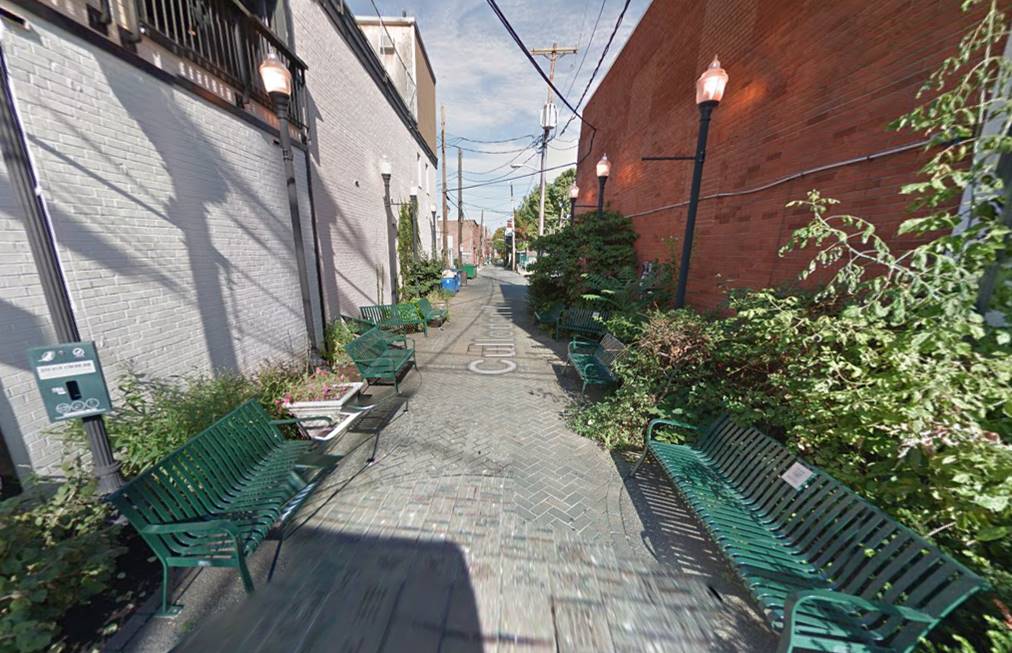
A passage to rear surface parking that is a bit more welcoming. There is lighting, the shrubs have been trimmed and do not allow from lurking, and the benches mean that on any given day people might be sitting offering "eyes on the street"/
This downtown structure in a small town in Puerto Rico is two long desolate blocks from the main Plaza. Most of the shopping activities occur on the other side of the Plaza, making this location not particularly appealing for shoppers who do not intend to spend alot of time downtown.  

The two walk block from the Parking Structure to the main Plaza offers pedestrians very little engagement. 

Maintenance and Operations matters
For those of you who have worked in the public sector, you know the deep dart secret of capital funding. It is much easier to get something built than to maintain it. Maintenance requires an annual budget appropriation. Getting a one time infusion of capital to build something is often a lot easier. Keeping the elevators in these structures running, removing graffiti, making sure payment is simple and not too confusing for the first time user, all requires keeping track of the structure and making regular investments in maintenance and operations. To address this issue, many communities have resorted to creating parking authorities that ensure that the revenue from the parking structure is plowed back into an organization that manages and maintains the structure. Unfortunately, many communities see the line item for maintenance as an easy thing to cut in lean times.

Infrequency of Use
While this is mostly anecdotal, the utilization rates of many of garages we have seen is often a lot lower than anticipated. We often see many, many vacant spaces when visiting downtown parking garages. The cost of building these spaces is typically a significant public commitment, so the waste is really palpable.

So when does downtown parking make sense?
Yet despite all these concerns, sometimes downtown parking structures do make a lot of sense. For example, when you have a downtown anchor, such as a theater that is attracting large numbers of people at the same time, structured parking located in the immediate vicinity of the theater can making the experience much more palpable to the theater goer. New York City’s Theater District heavily depends on structured parking options for the many theater-goers for whom public transportation options are inadequate (not to mention less appealing way to get home for the many who have traveled quite some distance in fancy clothing and high heels).

Attractive signage announces the walkways to the downtown
surface parking areas behind the Main Street in South Orange, NJ
Other alternatives include organizing and rationalizing downtown pocket parking lots. In South Orange, NJ the many small lots in downtown are managed by a parking entity. Moreover, connections to the small lots parking are visible from Main Street and maintained by the downtown BID. Another good example is Great Barrington, MA, where rear surface parking is comfortable, landscaped and walkable.

We’d love to hear more about your downtown solutions. Please share them with us at info@larisaortizassociates.com.


Wednesday, February 17, 2016

What do "Emerging Trends in Real Estate" mean for the commercial district practitioner?

The Urban Land Institute (ULI) and PwC just released “Emerging Trends in Real Estate" 2016 and there are quite a few insights and takeaways for commercial district practitioners. These come in the form of market-based opportunities and threats that will need to be considered - and acted upon - in the coming years.

Here are a few of the findings, as well as some practical takeaways on the impacts and actions that might be necessary....

Opportunities continue to grow in secondary markets – what ULI calls “18-hour” cities. This is great news for many smaller downtown's looking for investment. These are places that still provide investors better upside opportunities, in part because the dense primary markets are already stiff with investor competition. 18-hour cities offer lower costs while maintaining some if not all of the excitement of 24-hour cities. A great competitive advantage is brewing here.

Takeaway: If you are in one of these “18-hour” cities, places like Nashville, Austin, Denver, San Diego…the time might be ripe to revisit your district with an eye towards redevelopment opportunities. Now is the time to find investors and developers who might be more receptive to your pitches.

For all the hoopla surrounding downtown development, suburbs are still a force to be reckoned with. The report suggests that it will only be a matter of time before millennials, many who have deferred starting families, will start heading out to the suburbs to raise families. While 37% of millennials indicate a preference for urban living, we all know how quickly these preferences change when people become parents. That might not be good news for cities that don't stay ahead of these changing preferences. 

Takeaway: Downtown – and its surrounding urban neighborhoods - need to start thinking about how to meet the needs of millennials as they graduate from roommates to partners and families. This will require thinking more holistically. How are the local schools – all the way from elementary to high school? Is the neighborhood safe? Is housing affordable and adequate? And how is the physical environment? Are there safe bike lanes for tots who are learning to bike – i.e. dedicated lanes rather than sharrows? Are sidewalks and crossings - and the whole pedestrian environment for that matter - safe for those ages “8 to 80”, as Gil Penalosa founder of 8 80 Cities, likes to say. Are there adequate playgrounds within walking distance of people’s apartments and homes? While the report didn't mention this explicitly, let's not forget the growing senior demographic. Are these easy places to walk to grab a bite to eat if driving is no longer an option. If not, get cracking!

Work lifestyle and expectations are changing – and this is good news for downtown and other similar urban environments. The growth in co-working spaces is growing as the “gig economy” heats up. Is your city up to meeting the demands of these businesses and the workers they bring? 

Take away: For those districts where real estate development is an opportunity - what is your downtown organization doing to remain attractive to this changing worker lifestyle? Can your organization become proactive in helping to re-position or reuse existing assets to make them more attractive to investors looking to develop this product type? Have you thought of a game plan for how you are going to meet the needs of this growing worker segment? In 2013, the Downtown Brooklyn Partnership, the parent organization that manages three Business Improvement Districts in downtown Brooklyn, NY, helped lead a study and strategic planning process called the Brooklyn Tech Triangle (check out their website and plan here). The effort brought together the public, non-profit and private sectors to ensure everyone was working from one playbook when it came to strategies and investments that would ensure that the area remained attractive to the tech employers - and by extension tech workers. 

Housing in short one word: affordable. The report suggests that the lack of affordable housing for a variety of incomes is especially problematic. Recent housing production has been skewed “toward the luxury end [and] a shortfall of supply in the mid-to-lower end of the residential market is putting upward pressure on pricing…exacerbating already severe affordability issues.” Simply put, the development of luxury product has far outpaced other housing types lately, and the limited supply of more affordable options is being acutely felt in many markets. Without housing for a variety of income ranges, ULI suggests that markets will stagnate a bit. How can a business survive if its workers cannot afford adequate housing or are relegated to a lifestyle that involves a 3-hour round trip commute? As ULI states, “developing improved housing options for everyone…is passing from the realm of “nice to do” to “must do.”  

Take away: Has your community sought to address issues of housing affordability? Do your housing incentives support the creation of affordable housing, for people from both low and moderate income bands? Does your downtown zoning framework outline a clear and transparent process for development, one that offers developers the ability to ascertain costs and development timeline with some degree of precision? 

Parking - we still don't know what the future holds, but hold on tight, because change is coming. The ULI report mentioned trends that are notable, including the decline in driver’s licenses among younger drivers, driver-less cars, car sharing that supports a reduction in car ownership, etc., all things that will change parking demand.

Takeaway: We still don't know what this means, and quite frankly in my opinion, our zoning framework is probably not prepared to accommodate these changes without significant alternations. Keep your eye on what cities of your ilk are doing as they respond to the changing dynamics of parking. 

Infrastructure investments are critical, but don't hold your breath for public money to solve the problem. The need to invest in downtown infrastructure has never been more acute. Deferred maintenance on things from the water supply and distribution, road and bridges, rail and public transportation access, etc. will be our undoing. The cities and downtowns that address these issues will retain a competitive advantage over those that don't. 

Takeaway: In light of this challenge, there may be a need - and opportunity - for BIDs to take on bonding for public improvements as a benefit to their constituents. But keep in mind - in some states BIDs are restricted from or have limits to the amount they can leverage towards bonds, so the enabling legislation for your individual state needs to be considered carefully. 

Food. Food. And more food. 
The trend towards food as an activity, food as a lifestyle choice continues, and downtowns are naturally occurring foodie destinations. The growing demand for interesting food offerings, especially from among those with more discretionary dollars in hand bodes well for downtowns. 

Takeaway: Is your city positioned to take advantage of this trend? Food destinations are usually places where food offerings are clustered. The experience of choosing a place to eat become almost as interesting as the meal itself. In some places these are called "restaurant rows", though food trucks are muscling in on restaurant territory in some places. Is your organization marketing your food options adequately through social media? Do your events give food establishments opportunities to introduce themselves to new customers? Have you found ways to add complimentary experiences - including street buskers, nice places to stroll after dinner...what I call ambient or impulse entertainment? Since most dining happens at night - what is the arrival experience? Is parking adequate and is it safe and comfortable to walk to and from a car? Can you encourage retailers to remain open later on some nights to give diners another thing to do before or after they eat? The list goes on...

Big banks are getting bigger, while small banks are specializing, and the guy in the middle will have to choose. What this means is that financing for smaller projects may become harder because they won't attract the big banks.

Takeaway – Don't despair, this means that regional banks will likely fill in the gap. Have you developed relationships with your local regional banks? Do you have access to – or can you create – dedicated lending tools to help promote development and investment in your district? Projects in the $20 million to $50 million range are what ULI suggests are the sweet spot for smaller investments. Have you looked at your district with an eye towards cultivating developers and projects – either new development or reuse – that meet this criteria?

Finding a way to incorporate these trends into downtown and commercial district strategic planning efforts will remain critical in the coming years. So good luck!

If you like this post, please sign up for our FREE quarterly newsletter by clicking here. 


Tuesday, June 10, 2014

What you need to know about "Aging Improvement Districts"

By 2030, there will be about 72.1 million older persons, more than twice their number in 2000. That is an increase from 12.4% to 19% of the population. So, what does this mean for our business districts? And how do we ensure that these aging shoppers are welcome and able to visit and spend their discretionary dollars in local businesses. 

To be sure, the internet will play in increasing role in servicing this population. Ordering on-line and having retail goods delivered to your doorstep is not only convenient, it will certainly help more seniors remain in their homes for longer. But the experience of shopping, grabbing a bit to eat, visiting the local coffee shop, etc. will remain intrinsic to many people's lives. In my neighborhood in Jackson Heights, the local coffee shop is taken over once a month by a local senior's group. They chat, catch up and invite local politicians to join them during election season. It's a way for them to connect and remain active - and the coffee shop is more than happy to serve them. 

As our population ages, retailers cannot afford to ignore the reality of an aging population, particularly if 1 in 5 individuals will fall in that demographic by 2030. 

Fortunately, there is more and more information on age friendly business districts - but the main theme of much of the information is to remove accessibility barriers. A toolkit prepared in 2012 by the Office of the Mayor and City Council in New York is a good resource to begin to understand how we can make our districts more accessible to all shoppers, regardless of age. Click Here: "Creating an Age-Friendly NYC One Neighborhood at a Time"]. The report highlights some simple assessment tools that can help you determine the degree to which your community is accessible and walkable. 

The research also highlights some simple ideas that can help your businesses and your district better meet the needs of an aging population, including?

Encouraging more businesses to offer delivery, particularly grocery stores. In my community, the local grocery store automatically asks you at checkout if you want delivery. Many seniors make use of this option. 

Timing traffic signals to allow seniors to safety get across the street. A few years ago I did some work in a community in Long Island hoping to improve connections between downtown and the waterfront. These two areas were separated by a six-lane road. When we tried to cross, the "walk" signal gave us 20 seconds, barely enough time for a few able bodied people...and certainly not enough time for a slower senior citizen!

Removing high curbs to allow for improved wheelchair access. It amazes me that "improvement" projects continue to be designed in ways that do not comply with ADA requirements.  

Putting benches in place that allow seniors to rest during walks. In some communities, people are concerned about benches because they become places where homeless congregate. In the process, they have alienated seniors who need those benches. One answer is to allow local businesses to put out benches. That way these benches are informally monitored by the business owner. 


Simple ideas are sometimes the easiest and most impactful...

Thursday, May 15, 2014

Parklets: Reclaiming Parking Spaces for People


With Spring (finally) upon us, we are exploring ways that businesses and commercial districts can take advantage of the weather to attract shoppers, and to keep those shoppers on their corridors for longer.

Today, guest blogger Maria Chernaya discusses parklets. First, some highlights:
  •  A parklet converts a small parking space (usually two parking space lengths) into a publicly accessible open space.
  • Parklets are generally built on a platform (of non-permanent materials) on the pavement, and feature elements such as seating, trees, flowers, shrubs, and bike racks to reflect the unique character of the space.
  • They are designed, paid for, and maintained by a non-city entity (typically a business or property owner).
  • Baltimore Avenue, Philadelphia
  • Many cities require signage to be located at either end of the parklet so that a passerby is aware it is an open public space.

The History 
The “parklet” first emerged in San Francisco in 2005, when Rebar, a San Francisco art and design studio converted a single metered parking space into a temporary (two-hour) public park. Since then, cities across North America, including Montreal, Vancouver, New York City, and Philadelphia, have implemented parklets along their major commercial corridors.

The Benefits
Parallel Park, Vancouver, BC
Parklets offer numerous benefits to pedestrians. They create spaces to sit, relax, and linger and they beautify the street by creating a buffer between the street and sidewalk. 

Studies also point to the benefits of parklets for businesses. In 2010, the non-profit organization Great Streets SF conducted a study of the Divisadero Street Parklet, located in front of the Mojo Bicycle Café in San Francisco, and found that the number of pedestrians increased by 13 percent, particularly on weekday evenings. The study also found that many businesses have experienced revenue increases after the installation of a parklet, and in a few cases, created jobs as a result of increased demand. 

Do you have parklets in your commercial district? Tell us about them in the comments!

Guest Blogger Maria Chernaya is an urban planner based in Brooklyn.

Wednesday, March 5, 2014

Why you can't afford to ignore the trend towards bicycle friendly business districts.

What do Austin, San Franscisco, Portland, Chicago and Washington D.C. have in common? Why, an expanding network of bike lanes, of course! Expanding the transportation options and improving access to commercial districts is gaining steam, and here at the Commercial District Advisor we are generally pleased with this trend. Creating and maintaining a network of bike infrastructure is one critically important way to help local businesses. But the issue is not always so clear cut in some places, and implementing interventions that may change the business environment for long standing businesses needs to be managed carefully. For many businesses whose customers historically arrive by car, the lack of immediately accessible and visible car parking, not to mention the challenges of managing deliveries when a bike lane takes us the space immediately in front of a store, are a legitimate concerns for some businesses. If  existing customers find it less convenient to patronize a store, and the business has not yet started attracting new customers, there will be inevitable growing pains. 

The fight in New York's Upper West side, where a 6' protected bike lane was installed after facing resistance from the local Community Board, is indicative of what happens in many cities. The owner of a local lingerie shop, in business for 17 years, said "It's one more piece of space it's taking up, people are not riding their bikes to go shopping." ("Business Owners Dish on Columbus Ave Bike Lanes: From 'Love it' to 'It Sucks'", West Side Rag, 1/8/13). A number of studies by bike advocacy groups suggest otherwise. They have found that local businesses do in fact benefit from customers who arrive on bike, but it can take a little while to change shopping habits. For some businesses whose offerings and clientele include older, long-time residents, the changes can be a little tougher to manage. In fact, much of the argument on the Upper West side was split by an age demographic. A blogger for Streetsblog who was covering the Community Board debate wrote "I was at this meeting, and was struck by the age divide: older people against a bike lane...and younger people in favor." But as the blogger noted, the changes have also created a safer pedestrian environment, which benefits those who do not ride bikes as well. 

Perhaps most significantly for our purposes, and the reason why on the whole bike lanes are great for commercial districts, is because they are just plain good for business. A recent study issued on bike lanes found that "in growing urban communities, protected bike lane networks encourage more people to ride bikes for everyday trips. And when people use bikes for errands, they're the ideal kind of retail customers: regulars. They stop by often and spend as much or more per month as people who arrive in cars." (For the full report, click here: "Protected Bike Lanes Mean Business: How 21st Century Transportation Networks Help New Urban Economies Boom"). Business owners sometimes express concern that bike riders don't spend as much per shopping trip, but studies show that they spend more total and return more frequently than the customer who arrives by car. In San Francisco, the study found that bike lanes and wider sidewalks on Valencia Street improved business for 66% of businesses. 4% indicated it hurt sales. 
From: Protected Bike Lanes Mean Business

One very important and less mentioned benefit of bike lanes and bike infrastructure (and one that we trumpet quite regularly) is the ability to draw more customers from a slightly larger trade area. This is our primary reason for supporting this effort. Enlarging a district's primary trade area - the geographic area from which 60- 80% of a district's customers come from - is a great strategy for helping businesses grow sales. In walkable urban communities, it is not uncommon for someone to walk 10-minutes, or about 1/2 mile at a leisurely pace, to patronize a local business. A 10-minute bike ride on the other hand pulls people from a 1.5 radius (again, assuming a leisurely pace). We ran the numbers for the neighborhood surrounding our office here in Jackson Heights, Queens and the results were astounding. The difference in trade area was the difference between 67,789 potential customers and 366,564 potential customers. Wow. 

Source: ESRI, Census 2010. Based on a radius drawn from 78-27 37th Avenue, Jackson Heights, NY
So while change can be a difficult pill to swallow from some businesses, the implications of installing and maintaining a robust bike infrastructure cannot and should not be overlooked as a vital tool in the commercial district managers toolbox. 

Tuesday, March 4, 2014

BID Tips for Snow Removal

This winter has been a brutal one. Many businesses and commercial districts have struggled to keep up with snow removal. Contributor Chris Bernardo, Principal of Commercial District Services LLC, a provider of supplemental services to managers of outdoor public spaces, offers our readers a few valuable tips for dealing with these snowy challenges. 

As we enter the last few weeks of our most recent winter of discontent and the snow banks scattered around our commercial districts begin to decrease in size and fill the sewer drains with slush water and thawed pieces of litter and debris, it seems like a good time to look back and share some thoughts on snow management in commercial districts.

As cities struggle to maintain sufficient levels of police and sanitation services, most Business Improvement Districts (BIDs) have adopted programs that fund supplemental services to provide increased police/security patrols and sanitation/litter removal. In almost all cases, these supplemental services are superior to those that the public sector could provide given the available resources and City budgets that are already stretched to the limit.

Similar to Police and Sanitation services, many BIDs are finding that supplemental Snow Plowing and Snow Removal services are necessary in order to free up parking spots and to keep roadways from becoming too narrow. For those districts that find themselves faced with this option, there are some things to consider when planning out your snow removal strategy:

  • It’s important to determine if the main commercial strip can accommodate snow piles, if so, you may be able to simply plow the snow from the parking spaces into piles at the end of each block. If there is no room for snow piles or they create too much of a hazard, then it will be necessary to physically remove the snow from the district, which increases the cost and coordination needed.
  • Does your city prohibit parking on snow covered roadways? If not, you will need to coordinate an emergency “no-parking” strategy with the City, which needs to be planned for well in advance of the winter. It is advisable to draft a plan and distribute it to property owners and tenants at the beginning of the winter season so that they are prepared to move their vehicles, before being ticketed and towed. Not having a “no parking” plan in place can make or break a successful snow removal strategy. Getting the necessary approvals and coordinating the enforcement of prohibited parking can take longer than is practical. A solid “no parking” plan should include a local ordinance which identifies those specific streets within the BID where prohibited parking will be in effect, an MOU between the BID and local Police Department/Parking Authority stating the mutual commitment of each party to enforcing the ordinance and the understanding that Police personnel/power will need to be deployed in order to enforce the ordinance, ticket/tow vehicles and enforce traffic/street closures.
  • Where will the snow be placed once it is removed from the district? Carting snow is a slow process, a large dump truck with a 20 cubic yard roll-off can take a while to get from point a to b…if it takes 15 minutes to fill the truck and 45 minutes to transport the snow it’s gonna be a long night. It’s important to find a location in close proximity to the district, so that the least amount of time possible, is used to transport the snow.
  • Go big or not all…don’t make the mistake of underestimating the amount of snow that is actually on the street. A large loader is going to remove more snow in a shorter period of time than a Bobcat. In order to have the biggest impact possible for your stakeholders, consider using at least two large loaders and no less than four dump trucks.
  • Be ready to spend between $10K-$15k on an 8-10 hour session, overnight, on private snow removal services in order to have a sufficient impact on the district.
Hopefully the tips above will help you plan out the best possible snow removal program for your district!

Tuesday, February 4, 2014

Chattanooga Proves the Power of Economic Development Planning

Author Larisa Ortiz is Principal at Larisa Ortiz Associates. 

Great article today in the New York Times ("Fast Internet is Chattanooga's New Locomotive") on the power of “The Gig”, a city-owned high-speed fiber optic connection that is helping to transform downtown Chattanooga into a destination for high-tech firms. More than anything, it speaks to the power of economic development planning. When stimulus money was available in 2009, the City already had a plan in place with elements that needed funding. The impact of the investment on downtown was felt fairly quickly. “Since the fiber-optic network switched on four years ago, the signs of growth in Chattanooga are unmistakable. Former factory buildings on Main Street and Warehouse Row on Market Street have been converted to loft apartments, open-space offices, restaurants and shops. The city has welcomed a new population of computer programmers, entrepreneurs and investors. Lengthy sideburns and scruffy hipster beards — not the norm in eastern Tennessee — are de rigueur for the under-30 set.”

The River City Company, Chattanooga's economic development agency,
has also commissioned marketing material to help attract retailers downtown.
This piece was developed by Stevaker, a Chattanooga based graphic design firm. 

This is Why Economic Development Planning Matters
The high tech development plan was part of an economic development initiative that really took off when the city received a $111 million federal grant in 2009. While the stimulus money – and leveraged private investment was critical – without a ready to go plan in place it’s likely that those funds would have gone elsewhere.

Additional Economic Development Tactics Also Played a Role
If economic development is about creating a positive business environment. the City of Chattanooga seems to be ahead of the curve. But the high speed internet connection is not the only tool in the Chattanooga’s Economic Development toolbox. According to the Times the city has “cleaned its air, rebuilt its waterfront, added an aquarium and become a hub for arts in in eastern Tennessee.”

Another important component is that the network is municipally owned – a powerful commentary on the need for public investment in large infrastructure. (Although the article does state that Google is building similar networks in Kansas City - both MO and KC - and Austin, Texas)

The City has also leveraged partners in its efforts to spearhead the tech sector. One successful tactic is an entrepreneurial contest that came with a $100,000 prize by The Company Lab, a non-profit that conducts programs and events to support start ups and entrepreneurs in Chattanooga. The contest helps to raise the profile of Chattanooga among start ups – and the winner of the contest was Baynan, a firm that relocated to the City in 2013.

The economic renaissance that seems to be taking hold in Chattanooga is a powerful testament to the needs for thoughtful public investment - what I call "outside the store" investment - by the public sectors. It is also about being prepared so that when opportunities and investment opportunities arise, your community is prepared and ready to take advantage of them.

Additional Useful Links
The River City Company, Downtown Chattanooga's economic development agency has links to a number of studies they have commissioned. This site is geared toward the investor and real estate community.

Downtown Chattanooga's  website is a great place to go to find out about events and going's on. This site is geared toward the casual visitor who wants to know about events downtown, as well as folks who might be considering moving to Chattanooga. 


Tuesday, October 15, 2013

The roads (and trains) to downtown are crumbling

Yesterday’s Wall Street Journal chronicled the infrastructure challenges facing our cities and suburbs (“Slow Road to Recovery", WSJ, 10/14). This is a real problem for urban communities, as the majority of the aging infrastructure is located in our urban centers. As the article mentions, 42% of urban highways are congested. And it’s not just our highway infrastructure that is at risk, our mass transit infrastructure is also deteriorating with no major reinvestment in sight. New York may be an outlier in its dependence on mass transit – at least for an American city – but the challenges here are no less acute than elsewhere.

Why should transportation matter to those of us working to improve downtown and neighborhood commercial districts? Because commercial districts function first and foremost when they are convenient. This is why we often hear merchants say parking is critical. But the truth is, it is often less about parking than it is about plain old access. Businesses in dense urban communities often lack parking, but they are doing just fine thank you. As a visiting assistant professor at Pratt Institute, I often talk to my students about the importance of access. Whether by car, bike, bus, train or two legs, one of the things we can do to support commercial districts to ensure that are easy and convenient for people to visit, work and shop in. 

One particular issue that came up in the recent Mayoral primary here in New York was the long commute that many New Yorker's face. In fact, mayoral candidate Christine Quinn made a case for public policy that would, by the year 2023, ensure that no New Yorker commute more than an hour to and from work. In a city like New York, which is really a collection of cities, these distances matter. Young professionals priced out of Manhattan and increasingly Brooklyn – and whose jobs are downtown or in other boroughs – will increasingly choose other cities where life is just well, easier. In fact, a few years ago the City of Philadelphia built an entire marketing campaign around attracting these young professionals, calling on them to “Stop Paying Someone Else’s Mortgage”. They might as well have added, “decrease your commute by half and live in a decent apartment you can afford while you are at it!”
I guess public transportation access
to Philly has greatly improved.

I often joke with my friends in Brooklyn (I live in Queens) that they might as well live in Philadelphia, because sometimes that is how long it takes me to get there by public transit. By car, with no traffic (which as we now know is rare) the commute can easily be three times as long. The long commute also disproportionately affects lower income people – of the 750,000 commuters in New York who travel more than an hour a day, ¾ of them earn less than $35,000/year. The lost productivity, not to mention the incredible waste and pollution created by this congestion is a shame. When Quinn mentioned during the mayoral primaries that “our transportation infrastructure hasn’t kept pace” – she might as well have been talking about all major American cities.


One of the glimmers of hope, however, is the growing bicycle infrastructure that is being built. I recently wrote about a panel I attended at the International Downtown Association conference on “bike friendly business districts”. Improving access to our business districts by ensuring that biking is convenient and safe is probably one of the smartest moves we can make to support our local commercial districts - particularly in dense urban areas. That, and investing in our overall urban infrastructure before it undermines continued economic growth. 

Wednesday, June 19, 2013

Does Bike Infrastructure Help Local Businesses?

Bicyclists on Valencia Street in
San Francisco are a common sight
With the inaugural run of NYC CitiBike well underway, Nicole Leighton, LOA's newest staff member, takes a look at how bike lanes and other bike infrastructure can help drive retail sales for local businesses. 

By Nicole Leighton

I recently returned from a trip back to my home city of San Francisco. While I’m there I typically bike much, much more than I do in New York. I bike almost daily to do errands, go shopping, and meet up with friends or family. While much of this difference can be attributed to New York’s comprehensive subway and bus system that usually makes it the most convenient choice, another main reason I love biking so much is San Francisco's welcoming bicycling environment. The City offers cyclists the infrastructure and the culture that make cycling fun, easy and convenient. While NYC has been adding tons of great improvements to its bicycle infrastructure, the culture has some catching up to do with SF.
Having worked at LOA for many months now, I couldn't help but apply a retail lens to my cycling habits. Every time I ride my bike somewhere, I end up spending money—sometimes planned, often not. Sometimes I ride my bike to go grocery shopping, while other times I’ll just take my bike out to enjoy the weather, and end up stopping at a store with inviting window displays. I knew I knew I couldn't be the only one who does this, and found a few studies that reinforce the linkages between cycling and spending habits.

One study in 2003 surveyed 27 businesses randomly chosen along Valencia Street in San Francisco, a corridor that I often frequent. After bike lanes had been added to the street, 37.0% of respondents said sales were better and none said sales were worse. Of respondents, 55.6% reported a positive effect on area residents shopping locally, and 44.4% reported an increase in new customers coming from outside the neighborhood. A similar study was released more recently by NYC DOT, which studied the effect of the protected bike lanes on local businesses in the Chelsea neighborhood. The study reported an up to 49% increase in retail sales for locally-based businesses on 9th Avenue from 23rd to 31st Streets--compared to a borough-wide average of 3% for the same period!

Anecdotally, I know that walking or biking by stores makes people much more likely to shop on a whim than when in a car (or on the train). Especially with the launch of the bike share system here in NYC, it will be increasingly important for commercial corridors to consider all modes of transportation and users of the street when creating an inviting shopping environment, including cyclists. This doesn’t only mean bike lanes, it can also include smaller amenities like bike racks or perks like discounts to customers with helmets. (Tip: anyone can suggest a location for NYC DOT to add a free bike rack here.) With the launch of Citi Bike, I’m really hopeful that an increase in bikes on the road will create a more prevalent and welcoming biking experience here in my second home city.

Sources:

  • Emily Drennen, 2003. “Economic Effects of Traffic Calming on Urban Small Businesses,” Department of Public Administration, San Francisco State University.
  • NYC DOT, 2012. “Measuring the Street: New Metrics for 21st Century Streets”

Nicole Leighton is a recent graduate of Barnard College with a degree in Urban Studies. She has been with LOA since Sept. of 2012 and currently serves as a Summer Associate.

Thursday, April 4, 2013

Business Improvement District Helps Businesses Go Green

Would any of the businesses in your district elect to to participate in a rebate and incentive program that would lower their energy costs and pay for 70% of the cost of one-time improvements. Sounds like an incredible deal, right? How about if the cost savings could pay for themselves in less than a year? Anything after that is money in their pockets. You would think most companies would jump at the chance to put cash in their pocket in a fairly effortless and low-cost way. So why was the Con Edison power company in New York State struggling to get businesses to participate? Apparently cutting through the din of special offers and phone solicitations was (and remains) extremely difficult, especially when most business owners can smell a sale from a million miles away. There had to be a better way. 

The answer? Partner with the local Business Improvement District of course 
In New Rochelle, Con Ed found a partner in Ralph DiBart, Executive Director of the New Rochelle Business Improvement District. Ralph, a long-serving BID Director who had become a trusted partner and friend to local businesses. His participation was key to piercing through the clutter of sales pitches that so many of his business owners field on a daily basis. Having Ralph provide an introduction turned a cold call into something decidedly warmer. As one participant in the program said, "Given the BID’s track record of presenting downtown business with good programs I decided to go forward." 
Ralph DiBart, Executive Director of the
New Rochelle Business Improvement District

And the results speak for themselves. To date the program has resulted in nearly $100,000 in annual energy savings for participating local businesses. That is certainly not chump change. Not only that, but the ability to define the savings so tangibly helps reinforce the value of contributing to an effective Business Improvement District.

So how does the program work? 
The program created a partnership with Con Edison and NYSERDA and uses select contractors armed with rebates and incentives to encourage main street businesses to make energy efficiency upgrades.  

In an informative write-up, Dibart outlines the key elements that made the program a success: 


  • Start small and prove the value with respected local businesses – start by recruiting a handful of active business owners and use their results and experience as your “word of mouth” marketing.
  • Make it easy and manage the process for the business owner - usher the process through so that nothing gets complicated – from the energy evaluation, the installation, to the paperwork and follow-up.
  • Make it happen in person – A BID representative walks the energy assessment expert into each business with a personal, face-to-face introduction that makes all the difference.
Outcomes
Bryan Heaps, co-owner of Talner Jewelers in
New Rochelle, NY
Businesses are often surprised that energy savings don't have to come at the expense of ambiance  The days of ugly energy efficient lights are over. A local jewelry shop owner who had expressed concern that the lighting would affect the feel of the store, was pleasantly surprised when he saw the options. An added bonus was that the new lights threw off less heat, resulting in less need for air conditioning...and more savings! In the case of the jewelry store, the old bulbs created so much heat that the retailer had to run the AC twelve months a year, nine hours a day. The one-time improvements alone cut monthly costs for this retailer by $500 to $1000. Yes. That is monthly. 

These programs and incentives are not limited to New York - so run, don't walk to find out what your local electric company offers by way of energy efficiency incentives...and get moving to help your local businesses. This might just be one of the most tangible ways you can help their bottom line.  

For more information
For more profiles on participating businesses: http://www.unwasteny.org/biz/portraits
For more on the program and impact: 


Friday, January 25, 2013

Changing the World, One Step at a Time


What does it take to create community change?

People are threatened by change and will often resist new ideas, even good ones, if they are unsure of the outcome. Leading change means taking risks - but those risks don't need to be done all in one shot, in fact, it can sometimes be helpful to run experiments and test new concepts to start getting folks more comfortable with your new ideas. But keep in mind that testing means that sometimes things succeed...other times they fail. So one thing is for sure, you can't be afraid of failure...it can happen.

An aerial view of Putnam Triangle, in Brooklyn, NY
What does testing a concept look like in practice? A wonderful example of community change is the story of Putnam Plaza, a segment of street in Clinton Hill, Brooklyn that I've written about before. (see: "BID's efforts pay off for residents, businesses with street closure and block party"). Closing a street is no easy task, as Phil Kellog, Executive Director of the Fulton Area Business Alliance, and a Coro Neighborhood Leadership Alum, came to find out. Business owners are often concerned that a street closure will hurt business. The answer? A temporary closure that would allow the BID to test the concept. The street closure was coupled with programming, led by the BID, that drew pedestrian traffic to the area. Local business owners were pleasantly surprised by the increase in sales they experienced, and surprise, surprise they eventually came on board. Just this month the Department of Transportation approved the permanent closure of the Plaza. (see: DOT Approves a Permanent Putnam Triangle Plaza). Success!


Wednesday, June 13, 2012

Lesson Learned: The Most Common Streetscape Improvement Mistake

Streetscape improvements are a common and popular way to spruce up a retail district. Sidewalks, curbs, trees, landscaping, etc....the idea is that these improvements will result in a more attractive and welcoming environment for visitors, shoppers, and ultimately businesses. This kind of improvement is relatively easy. Infrastructure money can often be wrestled from Federal and State sources, and the visible improvements are always a favorite of local elected officials, who can often be counted on to contribute additional dollars. So what is wrong with this scenario? Win, win, right?

A new brick sidewalk in Kansas City, KA. Vacancies remain.
If only that were the case. Organizations intent on improving the downtown streetscape should heed this word of warning...avoid installing brick sidewalks and pavers. Communities are increasingly turning away from this once popular option, citing slip and fall lawsuits, on-going maintenance challenges, and increasingly the recognition that brick sidewalks are insignificant to the shopper experience. Consider Salem, MA, where they are actually pulling and paving the brick sidewalks that were installed in the 1990's after complaints from businesses ["Salem pulling, paving downtown brick crosswalks"]. Shoppers want a clean environment, and well maintained concrete sidewalks, for instance, are just as effective not to mention less expensive and easier to maintain. Now THAT is a win, win.