Showing posts with label Improving Tenant Mix. Show all posts

Tuesday, January 16, 2018

New Retail in 2018 - Changing Fashions and Impacts on Tenant Mix

Dan McCombie is a research associate at Larisa Ortiz Associates

I’ve been listening to the Loose Threads podcast lately and absolutely loving it. If you haven’t had a chance yet, I strongly recommend it. Though the topics skew towards apparel and fashion, the broader underpinnings of the conversations apply more generally to the current retail moment, exploring experiential retail, the growth of ecommerce, and the various ways stores are fragmenting and reconstituting themselves to meet changes in consumer tastes and preferences. The first episode I listened to was Episode 50, in which the host of the show, Richie Siegel, sits down with his former business partner, Charlie Giannetti, and they reflect upon lessons learned founding and running a NY-based menswear line, Gioventu.

What struck me most about their conversation was when Charlie explained how the genesis of the company in many ways had its foundations in the Garment Center.[1] While as a student at NYU, he used Photoshop to create a graphic design for a t-shirt. Without actually making a physical garment, he uploaded a mockup to Tumblr where it promptly went viral. Given its reception, he knew he was on to something:
“And so from that point I was in New York, skating around the garment district, trying to figure out how to actually produce a piece of clothing, and that was where it all started. I ended up making them, and made a Squarespace site, did a photoshoot on a disposable film camera, and we sold 100 pieces in like 3 hours, at $150 apiece for this T-shirt that no one had ever seen in real life.[2]                                                                                                                                  
This story strikes me because we’re always thinking about how to improve tenant mix in commercial districts. And inherent to that is the question of what type of tenants are going to be the most successful. Especially in the current retail environment, success parallels an ability to adapt. Whether that’s by leveraging new tech and social media, creating frequent iterations of products, or staying abreast of consumer trends. My belief is that to really flourish in these respects, it certainly helps to have access to an ecosystem of supporting actors and institutions, much like the Garment Center is for burgeoning apparel companies. Consider another example, presented by Outlier, a company described as the “darling of nerdy, direct-to-consumer technical menswear.”[3] In an interview with tech commentator and columnist Om Malik, co-founder Abe Burmeister tells a similar origin story:

“I rolled into the Garment District in New York, which is a like an ancient technology center — you know, the Silicon Valley of the 1900s or really late 1800s, when the sewing machine was invented. Ninety percent of the clothes in America used to come out of the Garment District, and so very few of them do now. It’s much smaller than it used to be, but there’s still a lot of life there….I started asking questions and eventually I developed a pair of pants that I thought were just better [than what else was available]. And because I knew a lot more about making websites than about making clothes, I thought, what happens if I put these things online? Will people buy ‘em? You know, like maybe that’ll work, and somehow it did. People started buying ‘em.”[4]
The reason I think these stories are important to our practice is because by understanding how companies are forming, how they leverage different skills (especially in regards to e-commerce and IOT), and how they perceive their role within the larger commercial environment, we can develop a better understanding of how to position commercial districts to attract them. I understand that these examples are limited to a very specialized and niche area of the retail industry and within a very specific urban context. But again, the larger question still stands: In what ways can access to an ecosystem of supporting actors and institutions, whether that be a concentration of complementary industries, college campuses, business incubators, civic organizations, what have you—create a pipeline that yields real growth in successful brick and mortars? If the Garment Center is a resource for companies like Outlier (a direct to consumer brand), how can it be leveraged so that it turns into more active storefronts in Midtown? I think there are a lot of different answers to this question, and I hope to see it continue to be discussed more as we travel deeper into 2018.

The Garment Center -1955 [5]
Richie Siegel, cofounder of Gioventu [6]


Outlier's "Shelter from the Storm" field jacket - 2017 [7] 


[1] For those unfamiliar, the Garment Center is located in Midtown Manhattan and is the fashion epicenter of both the New York and greater United States, home to the highest concentration of fashion-related retailers, wholesalers, manufacturers, and suppliers.

Thursday, October 5, 2017

What does Amazon's search for a new HQ mean for downtown?

Larisa Ortiz is Founder and Principal of Larisa Ortiz Associates

People are talking alot about Amazon today. If Wikipedia is to be believed, at least 118 cities in both Canada and the United States have expressed an interest in being the place where Amazon ends up putting its headquarters. The company's search, and more specifically their search criterion, has broader implications for what the next wave of business growth will require from our cities.

According to Citylab, the Amazon search is creating a "transit reckoning" for our cities. This is because Amazon has mentioned access to "rail, train, subway and bus routes" as among a few key site selection criterion. For many cities with limited mass transit options, this one requirement really puts a damper on their bid to bring Amazon to town. Atlanta, for example, seems to check all the boxes except for the unified transit system. When Atlanta officials took a look at the criterion, there was an call among many stakeholders for "real" solutions to the traffic congestion that plagues the City. Yet those solutions, as we all know, can only involve alternatives to the automobile. More cars and more roads won't help congestion, only transit of the "mass" kind can do that. Furthermore, mass transit without masses don't work - so density will be required. Cities looking to attract the businesses of the future would do well to heed this clarion call. Density and mass transit don't occur by happenstance. We need a few things to make this happen, including:

  • zoning codes that allow for higher densities as-of-right 
  • sufficient SF for the growth of commercial and/or industrial uses
  • meaningful funding for alternative modes of transit that get residents to and from their jobs easily and efficiently
  • investments walkable pedestrian environments and quality open space


In fact, some communities are already ahead of the curve on these issues, including the Brooklyn Tech Triangle, a planning effort led by three major stakeholders in downtown Brooklyn, New York: The Downtown Brooklyn Partnership, the Brooklyn Navy Yard and the DUMBO Improvement District. The plan sought to corral city investment towards improvements that would position downtown Brooklyn as a tech destination and ensure that the district included many of the amenities required by industry businesses. The plan included recommendations with significant emphasis on transportation (which is already the envy of many communities), improved waterfront connections (the City recently invested in an entire fleet of new ferry's and started a frequent and very popular ferry service), enhanced bike share, as well as connections to other growing tech destinations (such as Industry City in Sunset Park). The plan is a great starting point for other communities looking to pursue similar initiatives. In the end, this is all good news for transit connected, dense downtown environments. 


Tuesday, September 26, 2017

Prospecting White Elephants: Some Thoughts on Pop-Up Brokers

Dan McCombie is a research associate at Larisa Ortiz Associates

Last week I read an article by Matthew Flamm in Crain’s Business where he talked about the rise of a class of real-estate brokers specializing in pop-ups for vacant spaces. This struck me as an interesting development since we have several entries on the blog discussing how vacant retail storefronts—otherwise known as White Elephants—can have detrimental effects on the health of neighborhood downtowns. My understanding is there are two main reasons for this.

First is that it results in shorter shopping trips. A blank storefront can be an uninviting visual eyesore that discourages foot traffic. Perhaps it’s located in the middle of a corridor in such a way as it feels like it segments it into two unrelated districts.

Second is that it reduces the number of shoppers visiting the district. A hole in the tenant mix reduces retail density, creating one less reason why a shopper might think to make a trip. Maybe a coffee shop closes down next to a bookstore, and this prompts people to patronize the bookstore less.

Source: Thisopenspace.com

There are plenty of other reasons too. Vacancies are obviously an issue for landlords because they represent lost revenue with potential snowball effects. Imagine the impact when a large mall anchor like Nordstrom or Macy’s decides to close up shop. Once it’s out, it’s only a matter of time before the smaller in-line stores see their sales diminish and also start disappearing. It’s an extreme example but demonstrates why vacancies are problematic, and also why some landlords might consider subsidizing certain tenants or encouraging pop-ups to retain a healthy tenant mix.

So the presence of pop-up brokers sounds good, right? In effect, they provide a real service to commercial corridors by rounding up all the White Elephants into a directory and curating them to prospective retail tenants. These tenants can be small start-ups looking to test the market, e-commerce retailers looking to transition into brick-and-mortar, or more well-established brands who are looking for an experiential pop-up opportunity to engage their customers in new ways. And whether or not you believe we’re in the middle of “retail Armageddon,” it’s a creative solution for the growing number of vacancies in neighborhoods like SoHo where the perception is this trend will only continue.

Available vacancies clustered in lower Manhattan
Source: Thisopenspace.com

And these brokers have managed to turn it into a process as seamless as booking a hotel room or an uberPOOL. In past posts we’ve advocated that commercial district managers take on the task of populating vacant spaces; but now we’re seeing a quintessentially private sector solution which is fast, easy, and done on an app in minutes. And that has given me pause….


…It feels a bit inaccurate to say this is a solution for ailing districts and long-vacant spaces in search of a tenant. Perhaps it’s true that was part of the initial inspiration, but now it sounds like it’s becoming a high growth industry unto itself. I think Matthew Flamm’s use of Airbnb as the residential analog to these new companies is appropriate. My initial understanding of Airbnb is that it was just another component of the growing gig economy and a way for cash-strapped Millennials to make a few extra bucks off their couch, their car, their whatever it may be. But now I understand it can be an agent for speculation too—like when the gap between a rent or mortgage payment and the going rate on Airbnb becomes too great for people to turn down. I’m not taking issue with anybody who might purchase a condo with the express intention of having it listed on Airbnb as an investment, but I am expressing caution about companies that see an advantage in maintaining a steady supply of vacant storefronts, or landlords that believe they can make a better profit through punctuated short-term rentals. It feels like profiteering off the White Elephants.


Downtown revitalization is not in the mission statement of these pop-up brokers. One explicitly states on its website that prospective tenants should be wary of inquiring after un-vetted spaces precisely because they’re probably “situated in low footfall area[s]” or have “zero potential for retail or brand marketing.” The assertion suggests their portfolio doesn’t include spaces that are unattractive, but is rather a professionally curated assortment of opportunities in a pay-to-play scenario. Again, I’m not decrying a company’s attempts to distance itself from the competition, but trying to make the distinction between a company providing a service to an individual client and a district manager looking out for the health of the larger district. That being said, the potential for dynamic shopping and unexpected retail under this pop-up model sounds fun. And I’ve read many broker success stories about clients who turned a successful short-term rental into a long term lease agreement.   
  
Most of these pop-up brokers are active in dense urbanized areas. If you’re a commercial district manager in a town of less than 20K, it might be a minute before you see a private pop-up broker looking for vacant spaces, and so this screed is probably for naught. And if you’re a district manager in a large city or a neighborhood like SoHo, the troubling number of vacancy rates may warrant a larger discussion about rental rates in that district, and whether “retail Armageddon” is a legitimate characterization, or if it’s more likely a self-inflicted wound and one that can be addressed through some retooling (to which I recommend reading Larisa’s latest post).


To summarize it all up, I think the development of pop-up brokers is an incredibly interesting phenomenon. Are they solving the vacancy problem caused by structural changes happening in retail? Or are they profiting off the presence of White Elephants? No reason why it can’t be both. If Airbnb and the changing state of retail provide any sort of indication, we can be sure they’ll be around a while yet. I believe that's a good thing if at the end of the day it means less vacant storefronts.    


Past blog posts that explore vacancies and pop-ups:

Monday, September 25, 2017

When skyrocketing rents don't always mean the death of a small business

Larisa Ortiz is founder and principal of Larisa Ortiz Associates.
Broadway between Houston and Canal Streets in
New York is one of the highest rent districts in the City. 

For many New Yorkers, Pearl River Mart was Pier 1 Imports before there was a Pier 1 Imports. The family run Asian-goods department store, founded in 1971, grew over many years until it occupied 30,000 sf on Broadway in Soho. When the lease was up in November of 2016, the landlord increased the rent from $1 million/year to $6 million/year and the family decided to close shop. At the time, the news reported that the "44-year-old store is the latest victim of rising rents on Broadway and increased competition from online retailers like Amazon and Alibaba." A simple explanation for what was likely a much more complex problem.
The old Pearl River Mart at 477 Broadway - among
the most sought after retail addresses in Manhattan, NYC.
So it came as a pleasant surprise to see an article in The Wall Street Journal chronicling the retailer's travails since closing their original Broadway location. It seems they have developed a streamlined formula - a store layout with 3,500 sf instead of 30,000 sf - and a new location four blocks south of their previous location where rents are significantly less. Now the WSJ reports they are expanding to Chelsea Market, a "sprawling urban food hall" in the Meathpacking District - and a "must see" stop along the very popular High Line. Clearly a rent hike wasn't enough to put Pearl River Mart out of business. But they did need to reinvent themselves and find a suitable spot to relocate.
The "new" Pearl River Mart at 395 Broadway,
about four blocks south of its previous location. 
Chelsea Market, soon to be
home to a second Pearl River Mart location.
The lessons here for other businesses - and the city planning officials who support them - are worth noting. It reminds me of what fellow panelist Tony Hernandez, Director of the Ryerson University Centre for the Study of Commercial Activity said last week during our pre-conference session at IDA, "change is not new". This seems like a trite point, but it is one we have to recognize as an enduring truth of retail. He pointed out that since the 1940's, retail concepts have come and gone, and retailers have had to reinvent themselves again and again and again. From the climate-controlled shopping centers that dominated during the 1970's to the Entertainment complexes of the 1980's to the Power Centers of the 1990's, fickle customers and their every changing shopping habits have always been a challenge for retailers. Today's online challenges may be scary, but they fit a trend of innovation and disruptive change that is not without precedent.

What comes next is likely to result in painful change for retailers, but the good news is that retailers like Pearl River Mart have found ways to survive and thrive. The rent hike trend that caused Pearl River to close has also affected other retailers. In early 2016 we completed a market study for the Broadway SOHO BID and projected a market correction that was only then just beginning. In 2015 the Commercial Observer quoted a local broker said "Everybody's asking for too much money. Nobody wants to pay. It's a very overrated market." So it should come as no surprise that the softening the brokers were anticipating then is having an effect now. The same WSJ report that announced the expansion of Pearl River Mart also found that vacancy rates of 23% and asking rents that have fallen 14% to $478/sf.

Yet high rent does not mean lack of opportunity for intrepid business owners. As the Pearl River Mart move suggests, not every street commands the same premium as Broadway between Houston and Canal and businesses should generally search for a better deal in up and coming markets. In fact, the ability to both market and sell on-line means that a high rent location may be as necessary as it once was. In fact, our study found that within the BID area, asking rents of $425/sf were more than double neighborhood asking rents of $195/sf. So moving off the main corridor to lower rent space, and perhaps even shrinking a floorplate, might be a good opportunity, rather than a death sentence. In Perhaps the answer for communities is to support small businesses in their efforts to relocate to lower priced alternatives as a way to help them stay in business for the long haul.

Friday, September 22, 2017

IDA Session Post-Mortem: The Future of Physical Retail in the Age of Online

Larisa Ortiz is a Principal at LOA

Last week I had the pleasure of speaking on a panel at the International Downtown Association Conference entitled The Future of Physical Retail in the Age of Online with colleagues Mike Berne of MJB Consulting and Tony Hernandez, Director of the Ryerson University Centre for the Study of Commercial Activity. I may have been a panelist, but I was as enraptured as the audience by both presentations. Each shared insight into their own research and offered some enlightened perspective on the future of downtown retail for attendees.

Tony Hernandez helped put the changes he has seen in context. Retail is always changing. Consider this - Outlet Centers started making waves in the 1990’s and have only grown in size and scale since then. But if you consider who the major shopping center tenants were in 1996 and now, you will find that the majority of those tenants no longer exist. Hey, no one said retail was an easy business. So when viewed from a historical perspective, today’s concerns about the impact of on-line shopping are part of the normal cycle of “creative destruction” that leads to innovation and improvement, not necessarily the end of the world. And while e-retail may be a small portion of sales at the moment, Tony made the point that on-line influenced sales are what we should really be talking about. Research by the JC Williams group found that 86% of Canadians researched their purchase online before cutting a check.

Mike Berne added that while the news is chock full of an impending “retail apocalypse”, pure play retailers still account for only 4.5% of market share. The future, Mike said, belongs to retailers who pursue omni-channel strategies. He suggested the Amazon’s purchase of Whole Foods was because Amazon needed Whole Foods, not the other way around. As he has written for this blog in the past, the Whole Foods acquisition was a response to the “last mile” challenge. The fact that Amazon has yet to turn a profit on e-commerce and makes nearly all of its profit on cloud computing suggests that e-commerce still has a ways to go before dominating the retail landscape. When you consider that the “last mile” challenge – i.e. the ability to get to and from the last point of distribution to someone’s home – is incredibly expensive and that off-price chains like T.J. Maxx have been doing quite well at getting customers to do that for them – Mike thinks the retail apocalypse concerns might be overblown.

My contribution to the conversation was targeted to the practitioner. How do we turn the data into something actionable? What should Business Improvement Districts and Business Improvement Associations (as they are known in Canada) do in light of this information? I suggested a few policy prescriptions and actionable interventions, much of it based on recent work we completed with the City of Cambridge, MA.

The first is to drive experience. It may sound cliche, but people are searching for things they can’t get on-line, so BIDs will increasingly need to activate streets and public spaces with activities that cannot be replicated on-line. That means making sure public spaces are well designed and maintained, and that those spaces allow for public gathering, activities and events. We simply must make our public spaces work harder for us. In San Francisco, the City has spearheaded an effort to engage local non-profits as formal stewards of public plazas, giving them the ability to generate revenue from activities and events. New York City has a similar program. These programs allow for the formal oversight of a public space by an entity that is best positioned to drive pedestrian traffic to an area.

The second is to build capacity of the organizations upon which all of this activity depends. Without organizations with capable staff and sustainable revenue sources, the ability to activate space, build brand recognition, and promote both activities and businesses is seriously hampered. In Cambridge we shared the example of Coro Neighborhood Leadership Program in New York City that trains 20-30 BID leaders every year and has created a network of well-trained advocates for place management. This highly trained network of practitioners now collaborate and cooperate on a regular basis, sharing information about best practices for everything from fundraising to leadership skills. 

The third intervention involved taking a deep dive look at the regulatory and zoning barriers that are making innovation by retailers and new business concepts much more difficult and challenging. Consider the small business that wants to start making some of their products on-site and triggers a change in use permit. Or a brewpub for whom there is no retail classification (who had heard of brewpubs forty+ years ago when the regulations were written?). Or the business that wants to offer in store educational classes and is now considered an “educational institution” with higher threshold building code and parking requirements. These rules and regulations are particularly vexing for small businesses with limited capital – precisely the kinds of businesses that many communities want to support. Another issue that falls under this heading is the fact that restaurants and eating establishments, one of the healthiest and growing sectors of the retail economy, are particularly hampered - higher parking regulations for eating establishments are not uncommon and can make opening a location in some cities nearly impossible. Add to this things like sidewalk cafes, which are proven profit drivers, yet these too require another layer of permitting that can be overwhelming for the small business owner. Overcoming these issues is critical to enabling new business ventures that will be so critical if downtown is to sustain a competitive advantage.

As my last point, I discussed the need to fill gaps in the pedestrian experience as the inevitable market corrections will result in vacancies. BIDs are well positioned to ensure that vacancies do not undermine the local pedestrian environment by advocating and supporting pop-up retail or pop-up temporary art installations (like those of New York based non-profit No Longer Empty). These are important stop gap measures that will help existing businesses. In the long term, softening demand for retail spaces may require a wholesale rethinking of how we manage downtown tenant mix. As retail spaces get taken up by less dynamic economic activity, including offices and services, how will we maintain a sufficient concentration of retail in close enough proximity to ensure corridor success?

I want to thank my fellow panelists and the fantastic IDA members who participated in our discussion. Clearly that this issue will not be going away anytime soon!

Follow us on twitter @cdadvisor and Facebook (cdadvisor) where we share timely articles and news related to downtown retail. 


Tuesday, August 22, 2017

Speaking Schedule Announcements: Fall 2017

It's shaping up to be a busy speaking season for Larisa Ortiz Associates. Here are some places you can find us in the Fall:

IDA Pre-Conference Workshop: The Future of Physical Retail in the Age of Online

LOA Principal, Larisa Ortiz, will be presenting at this ICSC sponsored pre-conference IDA workshop with  Michael Berne, MJB Consulting and Tony Hernandez, Director & Eaton Chair in Retailing, Centre for the Study of Commercial Activity (CSCA).

This timely session will not only get into the nuances of what is in fact happening in the industry, but also introduce various strategies and interventions that district managers might consider in an effort to help mitigate possible impacts and take advantage of the latent opportunities during the current period of transition. Participants will have an opportunity to share specific challenges they face and receive real-time feedback from peers and instructors.

Sept 13, 2017, 8:30-11 am, Delta Hotels Winnipeg
Conference program + registration.

International Economic Development Council (IEDC) Panel: Optimizing Tenant Mix for Downtown Business Districts

Larisa Ortiz, LOA Principal, will be speaking on a panel with Winnipeg West End BIZ's, Joseph Kornelsen, and Build Toronto's Director of Development, Salima Rawji - moderated by ICSC's Director of Community Relations, Cynthia Stewart. 

They will be discussing how to optimize tenant mix for downtown business districts with practical and actionable steps to better understand how to develop a retail attraction strategy, how to engage retail real estate industry professionals and how to customize a retail attraction strategy to fit the unique challenges associated with different traditional downtown retail environments.

Sept 19, 2017, 4-5 pm, Sheraton Centre Toronto Hotel 
Conference program + registration.

International Making Cities Livable Conference: Making Space for Democracy

LOA Associate, Nur Asri, will be presenting at the 54th International Making Cities Livable Conference in Santa Fe, New Mexico during the conference October 2-6. She will be presenting her paper entitled “Making Space for Democracy,” which introduces a new evaluation tool for assessing public spaces based on political and philosophical tenets of democracy. Nur conducted this research as part of her graduate thesis in City and Regional Planning at Pratt Institute. The study aimed to uncover the state of democracy of Singapore’s public spaces – particularly in relation to migrant workers who have become isolated to parts of the island-state. 

Presentation details + conference registration.

Monday, January 23, 2017

Macy's stores are closing. Now what?! Eight strategies for downtown practitioners facing new retail realities

Macy's recent announcement that it will close approximately 100 stores over the next few years came on the heels of announcements that Sears and K Mart will close 150 more stores (they closed 78 stores last year). Other stores like Kohl's posted disappointing holiday results. These general merchandise anchors have struggled in recent years to remain profitable, and the closures are intended to focus their resources on more profitable stores. So what do these trends mean for Main Street? We think the news offers challenges and opportunities for downtown business districts. Here are a few ways we think our downtown communities will be affected in the coming years...

More competitive leasing environment. With more and more SF on the market, malls in lackluster markets will struggle to lease space, and in some cases they will be competing for retailers who might also be considering a downtown retail space. This means that you have to be more aggressive in your leasing efforts, and get better at communicating the value add of a downtown location. You should ask yourself a few questions. Are your downtown vacancies easily found on on-line listing services? If not, are you working actively with your property owners to ensure their properties are listed and available for easy viewing? Do you maintain demographic and market data for retailers who are considering your market? There are a myriad of ways - some that require more investment than others - to ensure your district's vacancies are on a retailers radar. But either way, supporting retail leasing efforts will take some concerted effort and investment. On that note, don't forget to downtown our book, "Improving Tenant Mix: A Guide for Commercial District Practitioners" for free from ICSC's website for ways to take a more hands on approach to your district's leasing efforts. 

Omni-channel retailing will become more and more the norm as mainstream retailers invest in their on-line presence. Main Street retailers will need to find a way to follow suit. Yet asking small retailers to carve out resources for a robust on-line presence is a lot to ask many of them. As a result, communities and BIDs may have to step up their efforts to educate businesses on the strategies the tools they have available to them to ensure survival. Many businesses, particularly those that make their own products, may not be aware that they can sell on platforms like Amazon, Zappo's or Rue La La. We recently met a business owner who gave us the skinny on her on-line selling strategy, telling us she had abandoned Amazon because their requirements were "too much of a pain", but that she has had a great experience with Zappo's. This kind of intelligence will be useful to share with your local business community. And for those interested in selling directly to customers through an on-line platform, there are more and more options for them out there. (Read our recent post "On-Line Selling - An Option for Smaller Businesses" for more info.)
A retail website powered by Shopify, one of a number
of  on-line platforms that makes on-line selling
accessible to small businesses.

Programming and creative usage of public space (i.e "place based strategies") will increase. Commercial districts, like malls, are increasingly trying to offer distinctive experiences that cannot be found so easily on-line. Cooking demos, craft classes, exercise classes, etc. will all become more critical to engaging with customers. In downtown, that means activating and programming public space in a way that will drive downtown visitation. Consider the Meatpacking District's free outdoor yoga program. They teamed up with a local store to offer programs on the street during the summer. This is a great way to highlight a local business while also bringing activity to open spaces. These activities also reinforce a well thought out strategic position for this market based on the segment of the businesses that are there - a place where young, active people congregate. We love it.

The Meatpacking District BID in NYC
sponsors "Downward Dog Yoga Days" in the Summer
in partnership with a local business. 

Food will continue to drive leasing in many downtown environments. When food is in the mix, shoppers increase their dwell time, which increases the amount of money they are likely to spend in the district. A panel on Urban Retailing at last year's ICSC Recon emphasized this trend. Restoration Hardware Executive David Stanchak was on hand to discuss RH's recently opened new store in Downtown Chicago that includes a food operation - The RH Chicago Three Arts Club Cafe. According to Stanchak, "for every dollar we do on food-and-beverage sales, we're generating $2 on increased gallery sales."  The good news is that downtown environments already do food quite well, but will need to begin to find better synergies between food and shopping. In some communities, the hours that retailers are open do not necessarily overlap with the hours that restaurants are open, which diminishes opportunities for cross-patronage. Correcting this misalignment, perhaps through a well-promoted once a month late night effort could help address this issue. That said, care should be taken not to overtax small business owners who often have limited staff capacity to do this on a regular basis. Promoting the event sufficiently, and to the right customer audience, is key to ensuring the success of late night shopping strategies.
The 3 Arts Club Cafe, a food concept within
Restoration Hardware's new downtown Chicago location.

Food kiosks, food trucks, and seasonal food offerings will also continue to grow. Some communities might not be able to support a full time bricks-and-mortar food retailer, but can instead focus on developing a temporary set of offerings that may be associated with an event. We are working in a community in Long Island right now that has a small municipal beach. Last year they started a very successful food truck and movie night. It probably shouldn't come as a surprise that they sold many, many more beach passes over previous years - adding to the town coffers while also building community. These investments clearly also pay dividends.
Downtown Raleigh BID puts on the Food Truck Rodeo
over a weekend in the early Spring with more than 50 food trucks. 

Leasing to specialty businesses will rise. The downtown environment has an element of authenticity and interest that makes is a great place for some of these more interesting retail concepts. In some cases, lower rents and a lower hurdle to entry make downtown storefronts an enticing alternative to malls. Consider Muse Paintbar in Providence, RI, a business that bills itself as "the premier art and wine experience". Located on Main Street in a historic building, Muse Paintbar offers a wide array of classes for adults and families too.


Property owners and merchants will request higher transparency around BID spending. In the mall world, payments by retailers to cover common area maintenance (CAM) are critical to ensuring shared spaces are well maintained. The International Council of Shopping Centers recently posited that 2017 will see a more "widespread effort by retail tenants...to rein in or set limits on CAM costs." We believe that the same economic forces driving retailers to second guess CAM charges are not limited to businesses that lease storefronts in malls. As many of you know, in a downtown environment, the equivalent of CAM charges are BID assessments, which in a similar manner to CAM charges are obligatory contributions by property owners and/or merchants that support the enhanced maintenance of shared public spaces and help to advance long term district improvements. While getting a BID off the ground may become more challenging as businesses and property owners double down on keeping costs down, we do believe that existing BIDs will have to make sure their members understand the value they are getting for their investment. This means getting much better at bench-marking impact with measurement tools like pedestrian counts. And while BID members may balk at increasing BID budgets, doing away with these additional charges is not an option either. As one analyst indicated, it "costs money to create experience". And given how important experience is going to be to shoppers in the future, downtown's with BIDs are going to be better positioned to weather competition from on-line retailers than those that don't have the resources to program and maintain the downtown environment. 

Retailers, especially at the high end, are open to thinking outside of the box and customizing their stores to unique urban spaces. According to Richard Johnson, a senior real estate specialist who spoke at Recon in May, urban locations are appealing despite the higher costs, "“There is always a lot more cost, and we do more work for urban locations,” he said. “You want to give your best face to your best clients, and urban does that. The goal is to create something unique that has our customers coming back time and time again.” 

Overall, we think downtown is well positioned to compete in the coming years. As people look for authentic experiences, the kind of things that simply cannot be done on-line, we are confident that many downtown's can and will rise to the challenge.

Thursday, November 10, 2016

Retail Insights: Is the end of the Department Store near?

According to Shopping Centers Today, in-line stores are outperforming department stores - a significant shift in how retail has traditionally functioned ("In-line stores are the new mall anchors at General Growth", SCT, Nov. 2016). As of June 2016, anchor sales in the General Growth Properties (GGP is one of the largest mall owners and managers in the country) portfolio fell by 1.9%. On the flip side, between 2005 and 2015 non-anchor sales grew by 33%. This trend is being felt industry-wide - from 2005 to 2015 department store sales declined by 23%. Analysts suggest that millennials have something to do with it. They enjoy experiences more than things, and spend their money in restaurants, home furnishings, health and personal care.
Broughton Street in Savannah, GA is an example
of an all "in-line" tenant mix

The good news is that downtown was made to offer an experience. The downtown environment is among the most conducive to offering millennials the mix of retail, services, entertainment, and perhaps most importantly the authenticity they crave. Nothing else comes close.

Another potential impact is that as the anchor plays less of a role in driving in-line tenancy, traditional downtown's without traditional department store anchors become much more appealing alternatives to retailers. Consider a project I just wrote about recently, The Broughton Street Collection in Savannah, GA. The $100 million dollar project began as an assemblage by developer Ben Carter and now includes 37 properties and about 130,000 sf of retail space with nary a traditional anchor in site. Instead the mix includes a variety of national, regional and local retailers and restaurants - a lifestyle center if you will - but without the department store anchor. The key to this strategy is to ensure that the in-line retailers who are there are complimentary and share a similar customer base. Without an anchor, in-line retail must create its own synergy, the kind that will collectively attract visitors who seek a cohesive and complimentary set of offerings. I tend to suggest that downtown's ask themselves this question - is there enough to do downtown to support a visit of an hour? or two or three? In-line retailers will care about the answer to this question because in many ways they need one another a lot of more than in situations where there is no anchor tenant.  Downtown district's that curate their retail mix might just be poised to give the regional mall a run for it's money.


Wednesday, November 9, 2016

What are "retail microclimates"? And how can knowing help your retail leasing efforts?

We work in lots of downtowns and find that most are not monolithic. Instead they are comprised of many different subdistricts, what we have dubbed here at LOA "retail microclimates". As I wrote about in the ICSC guide for "Improving Tenant Mix" (which can be downloaded from the ICSC website for free here), retail microclimates are driven by a unique set of conditions, namely location, visibility, access, anchors and tenant mix. These elements, when combined, create unique case-by-case opportunities for retailers. In the vicinity of a subway stop, for instance, we might have the conditions that support convenience-oriented retail (i.e. drugstore, bodega, or specialty grocer). Near a theatre, we might find restaurants. By a hospital, medical supply stores, or better yet, injury attorneys! These are simple examples that illustrate the point that synergistic relationships exist and that these kinds of co-tenancies should be baked into your retail leasing efforts.

Yet another example of retail microclimates can be found in malls where tenant mix is often curated by lifestyle segment. So in one corner of the mall a Nordstrom drives the co-tenancy of upscale apparel retailers, while a Bed Bath & Beyond in another area might find itself surrounded by home goods stores. Long streets are particularly susceptible to exhibiting characteristics of multiple retail micro-climates. Simply put, retailers want to be near other retailers who share the same customer base. Ultimately,  the synergies created by these co-tenancies help support all retailers.

A development in Savannah, GA known as The Broughton Street Collection is utilizing a similar strategy in the $100 million redevelopment led by Ben Carter Enterprises. Carson purchased 35 buildings along Broughton Street and has redeveloped the properties into a mixed-use downtown, replete with 225,000 sf of retail, 40,000 sf of restaurants, and 48 loft-style rental apartments and offices over five of the buildings. When you look at the retail leasing plan all elements of a retail microclimates are there. The eight blocks of the district are divided into seven areas with distinct identities including "upscale", "aspirational", "main street", "contemporary", and "bohemian". These districts are designed to accommodate retailers and restaurateurs who fit each of these themes. On the "upscale" block we have Madewell, Tory Burch and Lululemon. On the "aspirational" blocks we have J.Crew, Bonobos and Banana Republic.

Two blocks of the leasing plan for The Broughton Street Collection
http://www.bencarterenterprises.com/wp-content/uploads/2015/08/bruoghton_release_plan.pdf
This detailed block-by-block leasing plan, with microclimates identified, helps retailers self congregate in areas where they share customers. This kind of natural co-tenancy often happens in traditional downtowns, but in areas where major redevelopment is poised to occur, it happens through thoughtful planning and leasing strategies.

In downtowns, these retail microclimates can also be driven by the immediate surrounding neighborhood. In one community where we recently worked, the immediate surroundings were home to a strong Polish immigrant population, but four blocks away and closer to the subway, the environment and shopper was decidedly Latino. The difference in retail could be easily discerned. Polish speciality stores slowly gave way as the street changed to low-cost general merchandise in the form of dollar stores. For a retailer to succeed, they need to know which part of the district gives them the best chance to attract customers. Better yet, they need to know which block of the district already attracts their ideal customer. This is precisely where they will want to locate - and you can help them by letting them know where that is.

Wednesday, July 6, 2016

Want to know how to make quick friends in the retail industry, and maybe even keep rents reasonable at the same time?

Have you given much thought to what is arguably the most important metric in retail attraction - the sales volumes that retailers can realistically achieve in your district? This data is like the holy grail - everyone is looking for it but very few people know how to find it. Brokers need this information to attract retailers. Retailers need this information to understand what kinds of rent can be supported, and property owners need this information to know what kinds of rents are rooted in reality when setting rental rates. In the commercial real estate industry, the term used to describe and measure a retailer's sales is known as sales per square foot. This "apples to apples" metrics allows us compare and contrast sales figures between markets and retailers. To give you a point of reference, sales productivity in 2015 for non-anchor tenants in U.S. Malls was $474 psf annually. To put this in context, base rent to sales ratio varies from 4-30% depending on the type of business, but for most retailers, base rent should be no more than 5% to 10% of annual gross sales. Assuming a retailer making $474 psf is paying 10% of their sales to rent, their rent would come to $47.40 psf annually. 

Flagship environments are special
It is helpful to keep in mind that in some markets rent has very little to do with how profitable the actual location is. Retailers treat these locations as extensions of their brand, and they will pay what amounts to a marketing fee for what they consider critical brand recognition. For example, along 5th Avenue in New York, one of the world's most coveted retail address, the bag maker Coach recently signed a lease for $4,000 dollars a square foot. That is a big number - a REALLY big number. In fact, not a single publicly traded retailer, with the exception of Apple stores with an estimated $5,626 sales per square foot, sells enough of anything to pay rent levels that high. Not even Tiffany & Co., which is the second most profitable retailer at $2,974 per square foot. But I digress…most districts are not vying for retailers who can pay these kinds of rents. 
The Coach flagship store on 5th Avenue is paying $4,000/sf in rent.
Do you think the sales at this location can support that?
Image Source: Fashionmag.com
What kind of rent is reasonable?
So what kinds of rents are fair game, and how can you tell whether your landlords are asking rents that make sense and will allow a retailer to make a profit?

Let's consider Marshall’s on 125th Street in Harlem, NY. Reported annual sales are $33.9 million dollars spread over 57,000 square feet. This comes to $595/sf in sales. Assuming that Marshall’s is paying between 10% to 15% of sales on rent, their ideal rent would fall in the  $53 to $80 dollar range. When Harlem Center where Marshall's is currently located was signing initial leases in 2002, the landlord was asking between $80-100/sf for the ground floor. Marshall’s, located on an upper floor is undoubtedly paying less, putting the rent in the 10-15% ratio sweet spot.

So where do you find this information?
Well, the good news is that this information can be found for publicly traded companies. InfoUSA is the go to source for sales volume figures. Both ESRI and Claritas use InfoUSA for their business list data. However, private retailers are not obligated to share this information. For most of the districts we work in that means there is no sales data of which to speak. Instead, what both ESRI and Claritas do is model estimated sales figures for these privately owned businesses based on sample business data for millions of other retailers. While is is generally OK, in some cases this ends up giving you clearly inaccurate information. For one high end apparel brand in a flagship district where rents have peaked at $1000/sf we were given an annual sales figure that hovered around $278/sf. Unbelievable and highly unlikely, especially when other similar retailers report selling up to $1,500/sf. But then the algorithm that ESRI uses did not take into account the unique characteristics of this store and its hyper luxury nature. They treated it like any other apparel store and spit out data that wasn’t commensurate with what we know and can determine from what we see.

Overcoming this information gap takes perseverance. It means asking businesses, brokers and property owners what kinds of annual sales their stores are doing. It means keeping a spreadsheet of this primary data alongside the SF of each store and maintaining calculations that keep you informed. This alone will make you and your organization an invaluable resource to your retail real estate partners. 

Tuesday, May 31, 2016

Retailer Spotlight of the Month: Pio Pio


Pio Pio is a NYC based chain-let of Peruvian food specialized in Pollo a La Brasa (Rotisserie Chicken). With locations throughout Queens, Brooklyn, Bronx and Manhattan, Pio Pio restaurants have a modern and contemporary design, and lively atmosphere.


Price Point: Affordable


Target Market: Patrons looking for authentic Peruvian food and environment


History: First opened in 1994 in Rego Park, Queens, it has since expanded with four locations in Manhattan, three in Queens, one in Brooklyn, and one in the Bronx. Certain locations have expanded their menu beyond their hallmark rotisserie chicken & famous green sauce, rice & beans, avocado salad, plantains, and sangria to include Chinese-Peruvian stir fry, fresh fish, an array of ceviches, and fresh juice pisco cocktails.


Expansion Plans: With nine successful locations it is likely that they could expand.


Site Requirements: 2,500 square feet


Contact Info:  
84-02 Northern Blvd
Queens, NY 11372
718-803-7392 (for corporate representative dial extension 0)
www.piopio.com


Wednesday, December 9, 2015

Five highlights and lessons learned from another successful ICSC Deal Making trade show...

This year's New York ICSC Deal Making just finished, and it was a jam packed two days with lots of great conversations and new relationships forged for both us and our clients.The real work of follow up begins now! I learn something new everytime I attend (nearly seven years and counting!) and this year was no different. So here is my run down of what I took away from the show...

A rebranded P3 Retail Program! As the ICSC Eastern Division Co-Chair for the now rebranded P3 Retail Program (P3 stands for "Public Private Partnerships"), it was a thrill to see the launch in action. The ICSC team, including Cynthia Stewart, Michael Cowden and Jazmen Johnson had videographers ready to go. They had some of their members conduct interviews with ICSC members about their experiences and insight. I'll be very excited to see the final results when it is all done. I was interviewed, and also had the chance to interview Keith Sellars of the Washington D.C. Economic Partnership as well as Mary Reda and Jim Diego of Greater Jamaica Development Corporation. I really enjoyed hearing their insights and learning from their experiences.

Prep work is what it takes to have a great outcome. This year, we we thrilled to work closely on ICSC prep for a large community development corporation here in one of New York's largest outer Borough downtown districts. While the team has been attending ICSC for over five years, they were looking to refocus and refine their efforts and asked us to help. We began by defining their merchandising strategy based on consumer market data and existing business mix. We used this data-driven approach to identify "like districts" that shared similar demographics and retailers. We then combed those districts to identify retailers who were already located in similar markets and with similar co-tenants, but not yet in the district. We also had to make sure that these prospects could be accommodated in available spaces within the district, based an opportunity site list we developed with the client, and that they were the right price points and "lifestyle" fit for the area.  Finally, we did research into whether those prospects were growing in the region. Once we drilled down on prospects that made the final cut, we worked with our client to identify contacts for each - that included who they already knew, who we knew through our industry relationships, and who we could find through our access to the ICSC database and Deal Making attendance list. Once that happened, the client was ready to make calls and set up appointments at the show. 

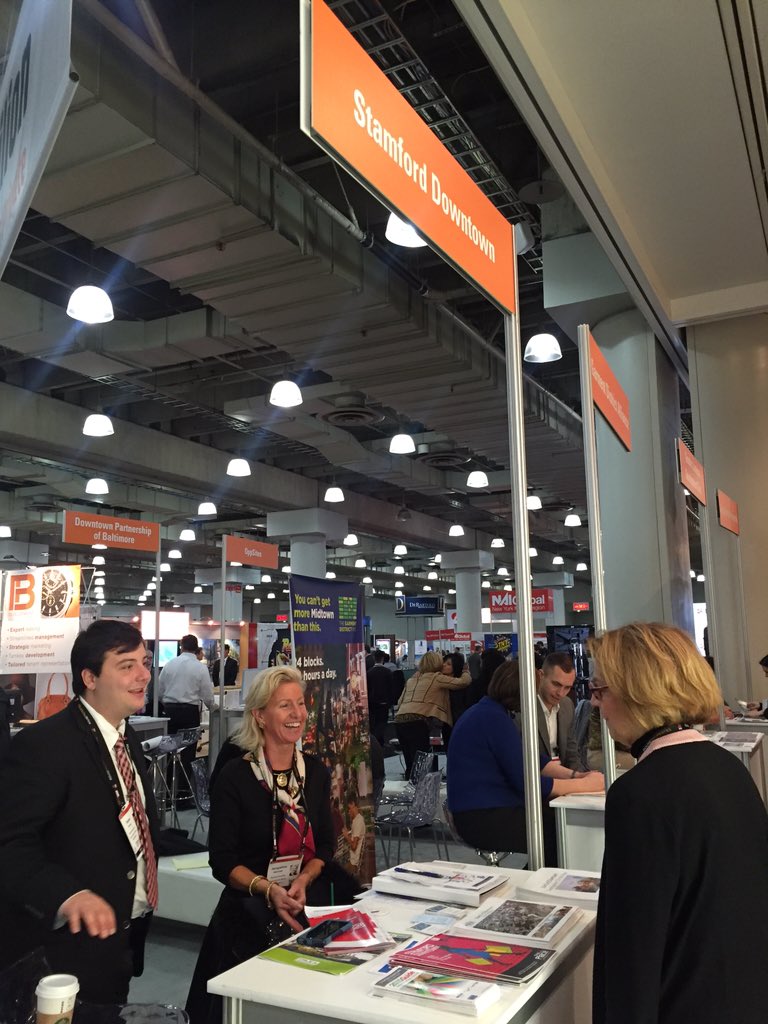
Getting a booth or kiosk can make a difference. 
This year ICSC made a concerted effort to enlist more non-profit and public municipalities with a discount entry option. I was proud to have been a part of that as Chair of the Municipalities subcommittee that helped plan this part of the show. Our client had never taken a kiosk before and this year they did, and I am happy to say that they raved about the experience. Being able to have a home base, conduct meetings in the shared P3 Pavilion retail space, and chat with drop ins made a real difference for them, and they plan to do it again next year. It is important to note that they made sure to man the booth at all times - and also had staff walking around attending meetings. Another thing to keep in mind is that this strategy needs to be part of a comprehensive approach to the show. Don't think that you can get a booth and people will automatically come to you. The location of the P3 pavilion at the New York show was pretty good. In Vegas however, the Cities of the World pavilion, as it is branded, is in a much more out of the way location. Some cities and non-profit orgs decide to take booths closer to the action, but at greater expense. Everything is a trade off.

On that note I enjoyed my conversation with Keith Sellers of the Washington DC Economic Partnership. They have been attending ICSC for over a decade, and graduated from a shared booth with a utility company to a 5,000+ sf booth in underwritten in part by the local developers. Their approach is so incredibly strategic and thoughtful, and I enjoyed hearing Keith talk about how far they had come.

Embedded image permalink

Social media DURING the show is important. You have to treat your booth or kiosk as a might a retail store. If you don't market it, you are missing opportunities to connect with potential customers. Same goes for a trade show. The good news is that ICSC helps with this. They had a hashtag (#NYnDM) and twitter handle (@ICSC) and would retweet things that were tweeted their way. We made sure to utilize this marketing support and it was a great way to drive traffic to the P3 pavilion and to individual booths.

A marketing brochure may not be the right approach for your district. To support our client's outreach, part of our task included developing new marketing material for them. In the past, their typical marketing strategy was a multi-page brochure with lots of words and tables of data. We knew from our work in the industry that marketing strategies are changing quickly, and that the multi-page brochure, while still making the rounds, can be hard to share digitally and doesn't always come across the same way when viewed on a computer. So we made a suggestion to do something a little different but much more in line with where the industry is going when it comes to marketing retail and site opportunities. Increasingly, developers and brokers are creating marketing decks - basically short slide shows that can be printed and distributed, but are more likely to be viewed  and distributed digitally. They rely less on verbage (that very few read anyway) and more on great info graphics to make a case. They are more straightforward to understand, can be used to tell a story, easier to refine, and easier mix and match on demand. Our client carried these around in bound booklets for reference, and then told the contacts they made that they would forward them the material after the conference. This strategy is a great way to continue contact and an excuse to follow up afterwards - which is the key to success. What I also found was that the decks were a good aide in keeping the presenter on message. And after the pitch, but during the meeting, they were easier to use. You could quickly go back to any slide that communicates the point you want to reinforce.


Overall I was so happy with the outcomes for the ICSC P3 effort as well as for our clients. We live tweeted quite a bit, so follow us @cdavisor if you want to keep up.

Here are some more pics for fun. 
Embedded image permalink
I felt like Oprah interviewing Mary Reda and Jim Diego at the #P3retail booth!
Embedded image permalink
Baltimore Downtown Partnership has a great location. 
Embedded image permalink
Being interviewed by Cindy Stewart of ICSC, together with Jason Claunch of Catalyst Commercial