At this years International Downtown Association (IDA) annual conference I had a chance to sit in on a session on recent IDA report on "High Performing Distict CEO's". The report is part of a deep dive research effort by IDA, DHR International (a national placement firm), and Somerville Partners, Inc. (a leadership consulting firm). I attended the session because I have seen the challenges associated with managing urban districts - and have seen how difficult it can be to find the right person to lead an organization whose job is to lead and manage change. Panelists David Smith and Martita Mestéy gave an excellent presentation on the qualities of a CEO - I noted that many people in the audience were furiously taking notes!
The report itself is a fascinating analysis of leading CEO's throughout the nation. Fifty leaders in downtown management were asked to participate in a detailed online self-assessment instrument designed to identify leadership styles. The analysis then looked at CEO's with different staffing levels, budget sizes and CEO experience. While the entire report is worth a read (click here to download), what I found quite interesting was the comparison between CEO's running large organizations and those running medium-sized organizations.
Does size matter?
In a nutshell, the answer is yes. Those running large organization's were more likely to collaborate with partners, rather than be the sole driver of major downtown initiatives. This made alot of sense to me, in part because the urban ecosystems associated with BIDs in large cities are likely more comlicated and therefore require partnerships to make progress. These CEO's were also more "distant" over friendly or "succoriant" - perhaps reflecting the need for a professional and distant demeanor in a big city environment. They were also more generally focsed on the "big picture" and more likely to delegate work than CEO's from smaller mid-sized organizations.
CEO from mid-sized organizations, on the other hand, were often more "free-wheeling", prefering to wing it over establishing order. My guess is that bigger budgets require more systems in place to manage funds and activities. It takes a different kind of person to keep these systems humming. Mid-sized CEO's were also less "traditional minded" and more into the details when implementing projects, perhaps because a smaller staff means less opportunities to delegate?
In both cases however, high performing CEO's were flexible and creative in their approaches. Downtown management after all is a challenging field, requiring partnerships with a variety of actors over whom the CEO has no control. Succeeding in this environment at any level requires an ability to main interpersonal relationships and stay focused on a goal with persistance.
The report is available for download free to IDA members and $75 for non-members.

Showing posts with label professional development. Show all posts
Showing posts with label professional development. Show all posts
Friday, September 23, 2016


Monday, November 23, 2015
LISC Chicago's Business District Leadership Program wins first place award

Larisa Ortiz Associates is proud to have played a supporting role, along with Coro New York Leadership Program, in developing the framework for the program. The Chicago program is based on the Coro Neighborhood Leadership program, now going on its fifth year. To date, over 100 New York based practitioners have participated in the program and it is still going strong. Both programs are funded in part by their respective cities.
 |
| The 2014 BDL cohort, including Dionne Baux (LISC), Kristen Illes (Coro) and myself to the far left. |
For more information on the Chicago LISC BDL program, click here. The deadline to apply for next year's program is Dec. 11! There is still time!
For more information on Coro Neighborhood Leadership, click here.
 |
| The opening retreat sets the stage for deep friendships and trust between peers, who later serve as critical springboards for advice and feedback. |
 |
| The opening retreat quote board...things that resonated with participants made it to this board. |
Thursday, October 1, 2015
The IDA Conference is in full swing...and we are sharing our insights!
This years annual conference of the International Downtown Association promises to be a good one. The energy is palpable - and it is always connect with old friends and make new ones. We will be sharing insights and tweeting throughout the conference, so be sure to follow us on twitter! @cdadvisor #IDASF
I was particularly excited to co-present a session sponsored by the International Council of Shopping Centers (ICSC) with David Greensfelder, of Greensfelder Commercial Realty. His firm is the preferred developer for CVS in the SF region and he was chock full of great insight into what drives the decision making of commodities retailers like grocery stores and drug stores. I really enjoyed seeing what goes on "inside the box" of these retailers, most of whom use sophisticated, data driven retail site selection strategies. I did not know, for example, that CVS site maps the incidence of AIDS cases in neighborhoods to determine the strength of a particular SF site. From a business perspective, this makes sense because it is one strong indicator of market potential.
 David made no apologies, telling the crowd "retail doesn't want to go in space just because it's there, it's got to be a good location that makes sense." For public sector officials and urban planners this is an important message. One example he shared from a downtown mixed-use project he developed demonstrated the importance of flexibility in use restrictions. In the example David showed, his project allowed for flexibility in ground floor uses - including shared office space and housing that could be turned into retail at a later date. The project next to his did not - it had traditional retail spaces on the ground floor. While his project has no vacancy on the ground floor, the project next to his was continually vacant. In this weak market context, requiring ground floor retail in an effort to activate the street clearly backfired. As a City Planning Commissioner for the City of New York, I am increasingly aware of how zoning regulations play a role in either supporting or undermining truly successful retail environments, so I particularly appreciated this example.
 Another major take away was the role that even minor inconveniences play in site selection. I have always known that coffee shops like to be on the "inbound" side of the street for instance. That is the side of the street that accommodates the traffic (automobile, pedestrian or otherwise) of people who are going to work. David mentioned again and again and again the importance of accessibility and convenience. He had us close our eyes and imagine sitting behind the wheel of a car that is low on gas. Do we make a left hand turn across two lanes of traffic on the way to work (and keep in mind we are already running late), or do we keep on driving on fumes to find a gas station on the right side of the street? Nearly everyone, myself included, indicated they would keep driving on fumes. The power of accessibility and convenience is a powerful message that those of us in the public sector - if we can create a district that is easy to get into and out of, easy to find through wayfinding and signage, easy and comfortable to get to not just by driving, but by biking and walking, we have helped create the conditions for successful retail, and made our districts a little more attractive to the retailers looking for good locations.
With that, I'm off to the IDA Board Meeting! I look forward to the rest of the conference and to sharing more of our insights from sessions!
I was particularly excited to co-present a session sponsored by the International Council of Shopping Centers (ICSC) with David Greensfelder, of Greensfelder Commercial Realty. His firm is the preferred developer for CVS in the SF region and he was chock full of great insight into what drives the decision making of commodities retailers like grocery stores and drug stores. I really enjoyed seeing what goes on "inside the box" of these retailers, most of whom use sophisticated, data driven retail site selection strategies. I did not know, for example, that CVS site maps the incidence of AIDS cases in neighborhoods to determine the strength of a particular SF site. From a business perspective, this makes sense because it is one strong indicator of market potential.

 Another major take away was the role that even minor inconveniences play in site selection. I have always known that coffee shops like to be on the "inbound" side of the street for instance. That is the side of the street that accommodates the traffic (automobile, pedestrian or otherwise) of people who are going to work. David mentioned again and again and again the importance of accessibility and convenience. He had us close our eyes and imagine sitting behind the wheel of a car that is low on gas. Do we make a left hand turn across two lanes of traffic on the way to work (and keep in mind we are already running late), or do we keep on driving on fumes to find a gas station on the right side of the street? Nearly everyone, myself included, indicated they would keep driving on fumes. The power of accessibility and convenience is a powerful message that those of us in the public sector - if we can create a district that is easy to get into and out of, easy to find through wayfinding and signage, easy and comfortable to get to not just by driving, but by biking and walking, we have helped create the conditions for successful retail, and made our districts a little more attractive to the retailers looking for good locations.
With that, I'm off to the IDA Board Meeting! I look forward to the rest of the conference and to sharing more of our insights from sessions!
Thursday, July 9, 2015
Professional Development Opportunity: Philadelphia, PA, Safe Commercial Corridor Program
For our Philly folks...some info. on what promises to be a good opportunity to learn about strategies to address public safety issues.
This event is presented by the Philadelphia Commerce Department and Philadelphia Police Department (PPD), with Philadelphia LISC (Local Initiatives Support Corporation) and AlterNation Consulting.
The event is free, and space is limited to the first 100 registrants. Click here to register.
LOCATION:
Monday, July 27 from 3:00 P.M. to 5:00 P.M.
PECO, Energy Hall, 2301 Market Street, Philadelphia, PA 19103
SESSION DESCRIPTION:
How can community collaboration and design enhance public safety?
This Information Session introduces a pilot initiative of the Philadelphia Commerce Department and PPD to address public safety along and around commercial corridors.
The July 27th event seeks to provide community members, police officers and leaders of city agencies and neighborhood organizations with tools and methods aimed at reducing crime, enhancing safety and strengthening those crucial relationships between the community and police that ensure safer neighborhoods.
This opening session will include: an overview of SafeGrowth® and Crime Prevention Through
Environmental Design (CPTED) led by internationally-recognized safety expert Gregory Saville,
presentations of successful anti-crime, pro-safety projects in West and Eastern North Philadelphia and the outline of a six (6) month pilot initiative to address public safety issues along selected commercial corridors through SafeGrowth® and CPTED.
SafeGrowth® is a proven method of organizing and training teams of diverse stakeholders, including
leaders in community development, design, planning, law enforcement and government, to positively impact real-life crime and safety issues. CPTED is also an anti-crime approach that focuses directly on the impact and the relationship between the physical environment and the incidence of crime.
While the Information Session is designed for managers and directors of community based organizations, police districts, and city agencies, all citizens concerned about community safety are
welcome.
This event is presented by the Philadelphia Commerce Department and Philadelphia Police Department (PPD), with Philadelphia LISC (Local Initiatives Support Corporation) and AlterNation Consulting.
The event is free, and space is limited to the first 100 registrants. Click here to register.
LOCATION:
Monday, July 27 from 3:00 P.M. to 5:00 P.M.
PECO, Energy Hall, 2301 Market Street, Philadelphia, PA 19103
SESSION DESCRIPTION:
How can community collaboration and design enhance public safety?
This Information Session introduces a pilot initiative of the Philadelphia Commerce Department and PPD to address public safety along and around commercial corridors.
The July 27th event seeks to provide community members, police officers and leaders of city agencies and neighborhood organizations with tools and methods aimed at reducing crime, enhancing safety and strengthening those crucial relationships between the community and police that ensure safer neighborhoods.
This opening session will include: an overview of SafeGrowth® and Crime Prevention Through
Environmental Design (CPTED) led by internationally-recognized safety expert Gregory Saville,
presentations of successful anti-crime, pro-safety projects in West and Eastern North Philadelphia and the outline of a six (6) month pilot initiative to address public safety issues along selected commercial corridors through SafeGrowth® and CPTED.
SafeGrowth® is a proven method of organizing and training teams of diverse stakeholders, including
leaders in community development, design, planning, law enforcement and government, to positively impact real-life crime and safety issues. CPTED is also an anti-crime approach that focuses directly on the impact and the relationship between the physical environment and the incidence of crime.
While the Information Session is designed for managers and directors of community based organizations, police districts, and city agencies, all citizens concerned about community safety are
welcome.
Saturday, February 28, 2015
Having trouble getting buy-in from your stakeholders?
I'm too excited about the Chicago Business District Leadership Program to limit this to one post. We are now in Day 3 of our opening retreat so here goes....
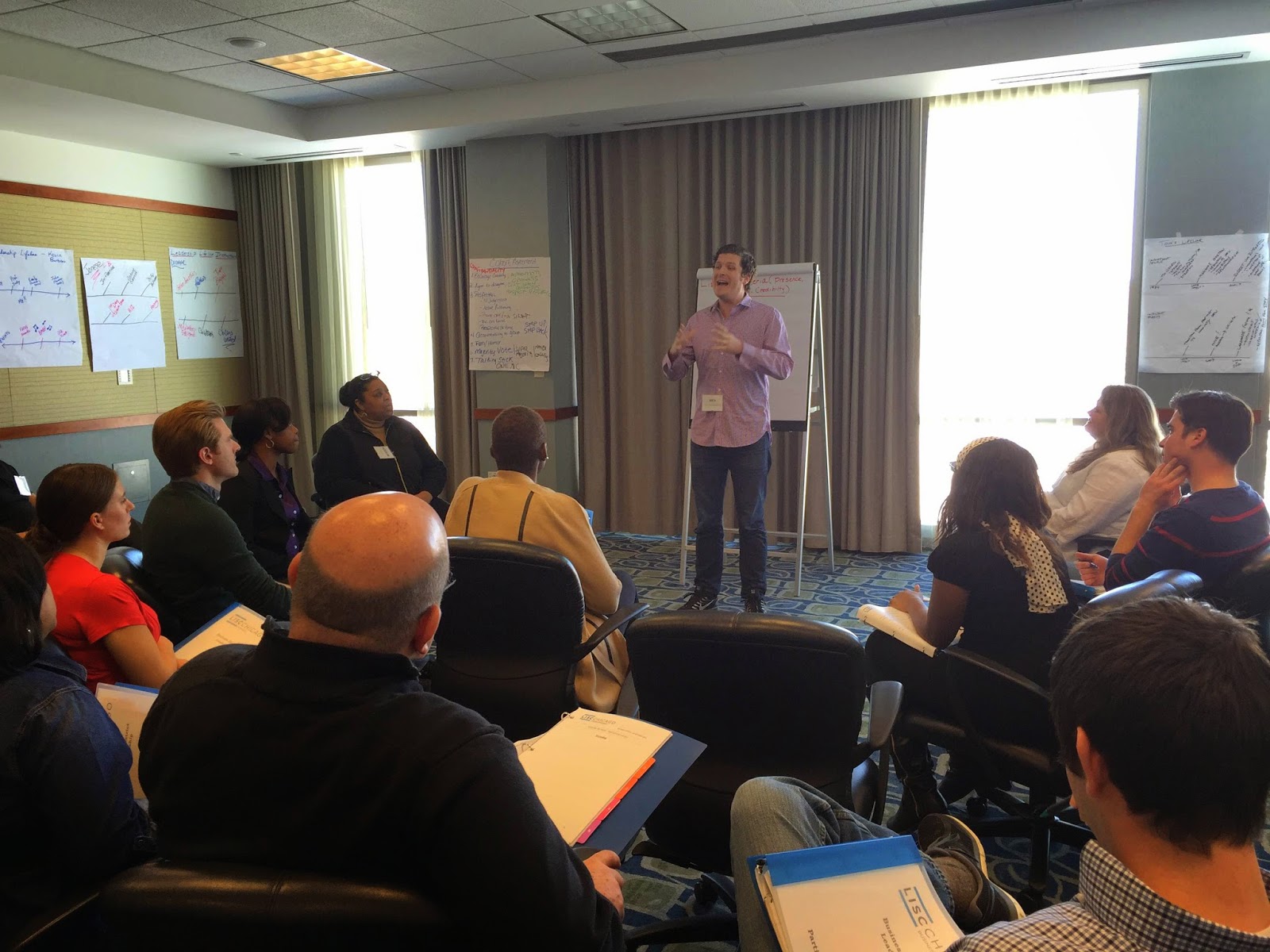 |
| A BDL participant sharing their vision stand |
How do you succinctly and effectively find partners and
champions to support you in your corridor revitalization efforts? For corridor
managers, the key to success hinges on the answer to this question.
For most, a one-on-one conversation is critical to engaging
and garnering support from key stakeholders. Think about it. Have you ever
gotten a big grant without a one-on-one pitch to a funder? Have you ever
convinced a business to come to your corridor without a one-on-one? My guess is
no.
This afternoon the LISC Chicago Business Leadership program
worked on this issue. We call them “Vision Stands”. What are those, you ask? At
its most basic, a vision stand is a clear and compelling picture of the future
you envision…in less than 2 min. Basically an elevator speech. And a darn good
one.
Why is a succinct pitch so important? Because the truth is
that attention span is short – most of the time you lose your audience to their own thought
processes long before you get to the so called important part of your pitch. Being
able to engage is critical to getting others to enroll and provide support for
your efforts.
So what makes for a good vision stand? In the BDL program, participants
are each given 2 minutes to present their visions to the whole group. They are
then provided feedback from one another on three key areas - presence, clarity
and credibility. They are pushed to make sure that their vision inspires, and
to do that, they need to make sure that they excel in those three key areas.
- Presence refers to how you show up in front of the group. The speakers quality of being and connection with the group and people’s experience of the speaker who is up in front of them.
- Clarity refers to an individual’s ability to explain their thoughts clearly and to leave the audience with an ability to summarize elements from their vision.
- Credibility is the toughest of the three. This refers to the ability of the speaker to offer the audience a sense that they can do what they said they were going to do. Is the speaker believable and do they have the capacity to pull it off? Are they believable? Do they exude confidence. Does their body language communicate self confidence in their work?
After the exercise, our facilitator Jose Acevedo shared with
us research conducted by Albert Mehrabian from UCLA. What Mehrabian found was
that three things contribute to how people perceive and feel about the speaker –
whether they like or dislike the speaker and message. What I found fascinating
is that people’s perception of you has very little to do with the content of
what you say. In fact, only 7% of their feelings are associated with the actual
words you say. 38% is related to voice dynamics and the WAY words are said. And finally, 55% of people’s perception of you
is related to your body language, specifically your facial expressions.
 |
| Receiving praise from participants after a Vision Stand |
Understanding this is powerful, because it tells us about
the importance of non-verbal communication in building credibility with our stakeholders. So step away from your email, and
make or the call, or better yet, set up a one-on-one with a potential new
partner and be prepared to share your vision. This is the first step in your ability
to convince others to contribute to your efforts – whether that be a
contribution of time (like attendance at meetings), money (contributions in the
form of membership, or grants or city funding), or expertise.
Good luck!
Tuesday, October 21, 2014
Building Strong Leaders in Commercial Revitalization
Commercial
District Advisors gladly supports Coro’s Neighborhood Leadership (NL) Program
and encourages those New York City-based practitioners in the commercial
revitalization field to apply for Coro’s 2015 six-month program beginning in
January.
Who is the NL program targeted for?
 |
| Image via coronewyork.org |
“For those
leading commercial revitalization efforts in their communities-whether working
in a Business Improvement District, Merchant Association, local development
corporation, Chamber of Commerce or other nonprofit organization- Coro's
Neighborhood Leadership (NL) program provides the city's top talent with the
resources they need to understand how to influence meaningful change and
address complex challenges within their neighborhoods.” In Coro’s NL program participants “are given
the opportunity to build leadership skills through intensive training and
peer-to-peer learning. Participants leave the program equipped with the
knowledge and skills to drive change in their own neighborhoods, and an
unparalleled network of engaged civic leaders from which to continue to build
and grow.”
What are the benefits of the program?
The Coro NL program notes key benefits
to this program:
- THE NETWORK: NL connects participants to an accomplished community of Coro NL alumni, City leaders and the broader Coro community, who are dedicated to supporting one another.
- THE KNOWLEDGE: NL deeply immerses participants in building individual and collaborative capacity for practicing leadership and bringing about change in their communities.
- THE SKILLS: NL uses the City of New York as a lab to explore, test and build effective commercial revitalization strategies to adapt and thrive in challenging environments. In particular, participants hone the skills needed to get things done in a multi-stakeholder environment.
 |
| Image via coronewyork.org |
Neighborhood
Leadership meets January through June
and requires a significant time commitment of attendance including: A
three-day overnight Opening Retreat, Saturday Leadership Retreat days (4),
Bimonthly Networking Evening Events ("Coronect" evenings), Tuesday
Strategy Day Sessions (5), Closing Session & Graduation (1), and one
Follow-Up Session in October. Click here
to view the NL 2015 program calendar.
Who are the participants?
Approximately
20 successful nonprofit management professionals whose work is focused on
commercial revitalization are competitively selected to participate each year.
Selected participants reflect the demographics of New York City with at least
half serving low to moderate income neighborhoods. Those selected have interest in joining the
Coro community and NL alumni network.
What is the cost?
The kicker
is that there is no tuition due to the generous support of the program’s
partner and funders.
Applications for NL 2015 can be found here. The application deadline is Saturday, November 15th.
Questions/comments, contact - Garrett Lucien, Program Director of Neighborhood Leadership, at 212 248-2935 ext. 308 or glucien@coronewyork.org.
Tuesday, July 15, 2014
Regional or Citywide BID Associations: Don't underestimate the value of a local BID support network.
Scant attention is paid to the non-profit member associations that serve Improvement Districts, so I was excited to see a news article on the Long Beach Council of Business Associations that was formed six years ago in Long Beach, California.
There are an increasing number of cities around the county that have a critical mass of Business Improvement Districts. These organizations have a strong rationale for coming together on a regular basis to network, learn from one another, and advocate for policy issues that affect them all.
Coming together with other BIDs is important because much of the work of a commercial district practitioner is inherently local in nature. From regulatory and permitting challenges to state specific grants and funding sources, knowing the local experts and resources available to get the job done can be critical to success. Moreover, receiving referrals for local marketing professionals, website developers, service providers, etc. can make the job easier.
In Long Beach, the gatherings were initially hosted by the City, but as time went on the organization became increasingly member-led. "Those who attended the meetings began to get to know one another personally and professionally and discovered that their neighborhoods and businesses often faced some of the same challenges. Working together, sharing their concerns with city staff, they are beginning to create change."
So, what has COBA done for its members? Besides the peer-to-peer learning and networking, the outcomes for COBA members were quite tangible. For example, COBA conducted city-wide surveys of business owners and compiled those results in 2012. The surveys helped to “give the city feedback from the ground level” and allowed members to push for a streamlined business licensing and permitting process at City Hall.
 # of BIDs in City: 69
Year Founded: 1995
# of Full Time Staff: None, this is an entirely volunteer led organization. The organization's budget is capped budget of $100k a year, and dues are pro-rated based on each BIDs budget.
Membership: Limited to BID Managers (effectively only the Executive Directors of each BID are members)
Mission: “The stated mission of the NY BID The mission of the Association is to COMMUNICATE, COORDINATE, and ADVOCATE. The Association communicates important information, ideas, and best practices among its members; coordinates interaction between BID directors and key contacts, elected officials, and City representatives; and advocates on behalf of its membership on important issues to support the work of and further the goals of BIDs citywide.”
Services offered: Much of the NY BID Managers Association is behind a members only wall, but we do know that their primary focus is on advocacy and that they bring members together on a regular basis to discuss key issues. These volunteer subcommittes are orgainzed around pressing issues such as street vendors. A few other services include:
 # of Full Time Staff: 1

There are an increasing number of cities around the county that have a critical mass of Business Improvement Districts. These organizations have a strong rationale for coming together on a regular basis to network, learn from one another, and advocate for policy issues that affect them all.
Coming together with other BIDs is important because much of the work of a commercial district practitioner is inherently local in nature. From regulatory and permitting challenges to state specific grants and funding sources, knowing the local experts and resources available to get the job done can be critical to success. Moreover, receiving referrals for local marketing professionals, website developers, service providers, etc. can make the job easier.
In Long Beach, the gatherings were initially hosted by the City, but as time went on the organization became increasingly member-led. "Those who attended the meetings began to get to know one another personally and professionally and discovered that their neighborhoods and businesses often faced some of the same challenges. Working together, sharing their concerns with city staff, they are beginning to create change."
So, what has COBA done for its members? Besides the peer-to-peer learning and networking, the outcomes for COBA members were quite tangible. For example, COBA conducted city-wide surveys of business owners and compiled those results in 2012. The surveys helped to “give the city feedback from the ground level” and allowed members to push for a streamlined business licensing and permitting process at City Hall.
What do other BID Associations do?
The models for BID Associations differ, so we offer three profiles
of associations. Advance warning. This overview is based almost entirely on what we could glean from
their websites…so keep in mind that the story may be somewhat incomplete, but at the very least it offers a good start for understanding the variety of models and services that are typically provided. We'd love to hear additional info about these and other organizations in the comments section.
New York BID Managers Association
Website: http://www.nycbidassociation.org/# of BIDs in City: 69Year Founded: 1995
# of Full Time Staff: None, this is an entirely volunteer led organization. The organization's budget is capped budget of $100k a year, and dues are pro-rated based on each BIDs budget.
Membership: Limited to BID Managers (effectively only the Executive Directors of each BID are members)
Mission: “The stated mission of the NY BID The mission of the Association is to COMMUNICATE, COORDINATE, and ADVOCATE. The Association communicates important information, ideas, and best practices among its members; coordinates interaction between BID directors and key contacts, elected officials, and City representatives; and advocates on behalf of its membership on important issues to support the work of and further the goals of BIDs citywide.”
Services offered: Much of the NY BID Managers Association is behind a members only wall, but we do know that their primary focus is on advocacy and that they bring members together on a regular basis to discuss key issues. These volunteer subcommittes are orgainzed around pressing issues such as street vendors. A few other services include:
- Maintain an internal listserve
- Host networking events for BID staff, host forums to identify best practices
- Host an annual meeting
Business Improvement District Council, San Diego, California
Website: http://bidcouncil.org/
# of BIDs in City: 17
# of BIDs in City: 17
Year Founded: 1989
# of Full Time Staff: 1
Mission: “The Business Improvement District Council (BID
Council) is an association of San Diego’s Business Improvement Districts (BIDs)
whose mission is to assist in the development and dissemination of information,
resources, and expertise to its member BIDs, and to improve the physical,
social, and economic environments of San Diego’s small businesses.”
Membership: Membership is open to both “property-based
special districts” and individual operators with 12 or fewer employers and who
hold a city-issued small business tax certificate.
Services offered:
- Calendar of events for City BIDs
- Legislative/Advocacy on behalf of system-wide initiatives or collaborated responses to system-wide issues
- Resources. The organization provides a one-stop shop for information about relevant resources and programs. For example, the website provides links to the City of San Diego’s Storefront Improvement Program, for instance.
- Networking/Relationship building – offers training sessions for members, most recently
Toronto Association of Business Improvement Areas, Toronto, Canada
Website: http://toronto-bia.com/
# of BIAs in City: 75 BIAs representing 35,000 business and property owners
# of BIAs in City: 75 BIAs representing 35,000 business and property owners
Year Founded: 1980
# of Staff: One Executive Director, an Office Manager, a
marketing consultant and a property tax consultant.
Membership: Limited to Business Improvement Areas
Objectives:
- To promote strong, successful and effective BIAs in the City of Toronto.
- To encourage joint initiatives and collaboration that are mutually beneficial to groups within the BIA on issues and projects, including studies and research in marketing.
- To encourage and facilitate the exchange of information, experiences and ideas among BIAs through such means as our website, newsletters, seminars, workshops for the benefit of the BIA and their individual members.
- To assist BIA's in pooling their resources to achieve the maximum benefit possible.
- To provide advocacy, to influence policies affecting BIAs, and to obtain support funds and services for BIAs from all levels of government, institutions, agencies and other organizations.
- To protect the interest of BIAs in government tourism policies and in the implementation of those policies.
Services offered:
- Calendar of events for City BIDs
- Monthly newsletter entitled “News & Views”
- Regular posts on current events and issues of interest on their website
- Advocacy on behalf of BIA’s with the City for things such as a simplified annual budgeting process and exemptions from city set fee structures related to banners in designated BIA areas. Coverage by the City of Toronto’s Public Liability Insurance…to name a few wins.
- Discounts on Liability insurance as required for BIA Boards.
- Education/Information for merchants and Boards. A local college now offers a four course program that is delivered directly to merchants on issues as diverse as theft reduction to marketing.
- Promotions – the TABIA has embarked on a number of Citywide Campaigns that offer BIAs the opportunity to promote themselves in the local media as a savings.
- Networking Opportunities – plans and executes a bi-annual National BIA Conference to share ideas and learn from the experience of other BIAS. TABIA also sponsors informal opportunities to network and invites speakers on a regular basis to speak to their members.
Tuesday, March 4, 2014
Event Announcement: Shopping Centers Today, LIVE!

On April 8th, 2014 I will be participating on a panel of accomplished government officials, developers and retailers as we discuss methods for fast tracking economic expansion. This event, hosted by Shopping Centers Today, is being held at the Chicago Marriott Downtown . If you are in Chicago, consider joining us part of the live studio audience. If you can't join us, you can live stream the event on your Iphone or smartphone and a podcast will be available after the event. To register and for more information click on these links for the program Brochure and Registration Page.
My perspective (as usual!) will be how non-profit intermediaries, like Business Improvement Districts, can (and often do) play a powerful role in supporting and expediting development in urban markets. My fellow panelists (see below) will have alot more to say about how retailers, developers and government can also expedite the process.
Executive Partner - Holland & Knight
Lawrence E. Kilduff, CRX, CDP, CSM
Senior Vice President, Retail Market Lead
Jones Lang LaSalle, Chicago, IL
Lyneir Richardson
Chief Executive Officer
Brick City Development
Newark, NJ
Sue Walker
Director, Economic Development
Richardson Economic Development Partnership
Richardson, TX
See you in Chicago!
- Larisa
Larisa Ortiz is Principal of Larisa Ortiz Associates, Commercial District Advisors.
Thursday, January 30, 2014
Shouldn't we be responding to a growing BID backlash?
Business Improvement Districts are a powerful economic
development tool. In 2009, a study by Econsult funded by LISC and the William Penn Foundation, considered a variety of interventions and their impact on the City of Philadelphia's commercial corridors. The findings were unequivocal, the “introduction of
Business/Neighborhood Improvement Districts…demonstrate a statistically significant,
positive relationship with the indicators of corridor performance”. Impact was measured by retail sales, retail sales same store growth, shopping trips and real estate values – measurements most would accept as fair barometers of a district’s economic well being.
Yet despite this powerful evidence (which quite frankly many do
not know about) detractors of individual BID efforts continue to successfully make their case, sometimes in court. Consider these examples:
- In Los Angeles, the Downtown Arts District was dissolved after a judge ruled on behalf of a small group of BID members who made the case that BID funds used for economic development of the district benefited the general public and therefore did not constitute “special benefits” for BID members. This apparent breach in state law was deemed sufficient to dissolve the BID.
- In Northhampton, Massachusetts, a group of property owners filed a federal lawsuit against the state, contending that mandatory BID fees are unconstitutional and an illegal tax.
- In Ashville, North Carolina, the committee spearheading a multi-year effor to form a downtown BID recently decided to go dormant after critics argued that the assessment was unnecessary in light of recent municipal tax increases.
The concerns range from lack of transparency, lack of clear demonstrated
impact, to a common and perhaps universal desire to avoid paying anything at
all (see “tragedy of the commons”).
The public realm, which is what is typically improved through BID services, is
a common resource. While individual property owners benefit by keeping a little extra money in
their pocket when they oppose a BID, the damage to the downtown environment is shared by all.
After the dissolution of the LA Arts District BID for instance, there was a dramatic increase in violent and property crime and the number of reported incidents jumped from 45 to 59,
a 31% spike. Grand theft auto increased from three to eight reported incidents,
a 166% increase, and thefts doubled from eight to 16.
This is a call to action. I would love to see the industry develop a strong response
to this growing backlash, starting at the very least with the following:
PROFESSIONAL CERTIFICATION: Industry-accepted professional
certification and training to ensure that those running BIDs are qualified and
have the skills and knowledge base necessary to do their jobs well. There are
some certification programs out there (i.e. Seth Grossman's efforts at Rutgers come to mind, as well as the City of New York's Coro Neighborhood Leadership Program which I helped develop.)
BID ACCREDITATION: We need clear standards and quality
management, at the national level, for the BID industry. In England, the
British BID council has developed an accreditation system. They actually go out
into the field and audit a BIDs management and supervisory systems. This level
of oversight offers BID stakeholders important assurances that the BID is well
run and having an impact on the district.
INDUSTRY RESEARCH. We desperately need better research
on the impact of BIDs at the national
level that would allow us all to be better advocates.
The real question here is where is the national leadership on this issue? I would love to see the national organizations, like the
International Downtown Association (IDA) or the International Economic
Development Council (IEDC) or even the American Planning Association (APA) begin
thinking along these lines. We really can't afford to ignore the backlash brewing in our midst for too much longer.
Thursday, January 2, 2014
Upcoming NY-NJ Professional Development Opportunity

I'm very excited to be co-teaching a two-day course (January 16th and 17th) on Neighborhood Development Strategies for the International Economic Development Council (IEDC). Professional development opportunities for neighborhood-based community development practitioners are few and far between and this is a wonderful opportunity to meet and network with practitioners from around the nation. My colleagues will be Melissa Kim, Director of Community Economic Development for the Village of Arts and Humanities and Diane Lupke, President of Lupke Associates. The course will be held at the Hilton Newark Penn Station, 1048 Raymond Boulevard, Newark, NJ.
This practitioner-driven course uses the case study method to complement current neighborhood development theory. Participants will learn how to identify the major neighborhood actors, their objectives, and strategies for redevelopment, in addition to understanding the process for creating a strategic economic development plan to meet the neighborhood development goals. Specifically, this course will examine social capital (e.g., linkages, networks, talent, etc.), environmental capital (e.g., stewardship, residual management, etc.) and economic capital (e.g., investment and reinvestment) facing distressed neighborhoods and offer solutions to address local needs.
For more information go to the www.iedconline.org website, or the page by clicking here.
Tuesday, November 12, 2013
Last Call for ICSC Westchester event! "Is your Downtown Retail Ready?"
 For those in the NYC area, this is the last call for early registration for what promises to be a very informative Westchester ICSC Alliance networking event and panel discussion. We pulled together a group of great retailers and developers who will tell us about what it REALLY takes to entice developers and retailers to invest in downtown.
Panelists include:
- Scott Auster, Managing Director of Grid Properties, Inc. Grid Properties is a real estate and investment firm recognized for it urban retail projects, including Harlem USA and DC USA.
- Jonathan Gordon, President of Admiral Real Estate Services (leasing broker for Peachwave Yogurt)
- Adam Ifshin, President & CEO of DLC Management Corporation and leasing rep for Walgreens Pharmacies)
Pre-Registration Recommended! Click here to register.
Date: Friday, November 15, 2013
Location: Registration @ Roosevelt Professional Building 11 West Prospect Ave, Mt. Vernon, NY
Time:
- 7:45 - 8:45 Registration
- 8:45 - 10:00 AM Panel Discussion
- 10:00 - 11:00 Development Opportunities Spotlight and Networking
Come join us!
Thursday, September 26, 2013
Professional Development Opportunity: "Identifying and Attracting the Appropriate Retailers and Developers"

I am very excited to be partnering with the International Council of Shopping Centers (ICSC) to offer an advanced retail leasing training at the upcoming International Downtown Association World Congress in New York (Oct. 6 - 9). The session is nearly sold out so be sure to register if you haven't already. Pre-Conference sessions are available to conference attendees and can be added your conference package when you register. Advance registration for the conference is closed, but you can register on-site. For more information click here.
Here is a session description. Hope to see you there!
Here is a session description. Hope to see you there!
*****
Identifying and Attracting the Appropriate Retailers and Developers
Date: Sunday, October 6
Location: Marriott Marquis, Jolson Room, 9th Floor, 1535 Broadway, New York, NY 10036
Time: 9:00 a.m. –12:00 p.m.
What does it take to get your community on a retailer's radar? What do retailers, both big and small, want to see before making investment decisions? This pre-conference workshop presents valuable information on how to assess the needs and desires of retailers and how to approach them; what consumer demographics should be highlighted; and what incentives and subsidies are likely to sweeten the deal and get them to sign on. Case studies will be presented of successful municipal retail attraction programs that have sparked investment at both the downtown and neighborhood levels.
You’ll also learn how to work collaboratively with your property owners and brokerage community to improve retail mix; what amenities help make your community more attractive to retailers, such as access, parking, lighting, safety, highway and road access, and retail competition; and practical tools and tips for getting the most out of retail trade shows and identifying regional or independent retailers that might be harder to find.
Attendees will each receive a complimentary ICSC textbook to accompany the course material: Retail Development Through Public-Private Partnerships, by David G. Wallace.
Presenters:
Larisa Ortiz, Principal, Larisa Ortiz Associates
Cynthia Stewart, Director, Community Relations, ICSC
Identifying and Attracting the Appropriate Retailers and Developers
Date: Sunday, October 6
Location: Marriott Marquis, Jolson Room, 9th Floor, 1535 Broadway, New York, NY 10036
Time: 9:00 a.m. –12:00 p.m.
What does it take to get your community on a retailer's radar? What do retailers, both big and small, want to see before making investment decisions? This pre-conference workshop presents valuable information on how to assess the needs and desires of retailers and how to approach them; what consumer demographics should be highlighted; and what incentives and subsidies are likely to sweeten the deal and get them to sign on. Case studies will be presented of successful municipal retail attraction programs that have sparked investment at both the downtown and neighborhood levels.
You’ll also learn how to work collaboratively with your property owners and brokerage community to improve retail mix; what amenities help make your community more attractive to retailers, such as access, parking, lighting, safety, highway and road access, and retail competition; and practical tools and tips for getting the most out of retail trade shows and identifying regional or independent retailers that might be harder to find.
Attendees will each receive a complimentary ICSC textbook to accompany the course material: Retail Development Through Public-Private Partnerships, by David G. Wallace.
Presenters:
Larisa Ortiz, Principal, Larisa Ortiz Associates
Cynthia Stewart, Director, Community Relations, ICSC
Tuesday, July 2, 2013
Top 10 Mistakes District Managers Make
1. Staying in the office
Relationships grease the wheels of successful commercial district management. If you don't go out and meet your business owners, property owners and customers, how in the world can you serve them? How will you know how to deploy your resources most effectively to address the concerns that they have?
2. Trying to be everything to everyone
If your district were a car, what kind of car would you be? A trendy mini coop or a practical Toyota Sentry? You need to think of your district like a brand and focus your energies on delivering to your target customer - the kind of customer that makes up 80% of your base. In some cases that target customer is somewhat trendy and young, but in others that target customer is a family with young kids who is not likely going out drinking and dancing on a weekly basis. Embrace your customer and find better ways to meet their needs. Don't try to be something that you aren't.
3. Performance benchmarks? What performance benchmarks?
Failure to measure performance undermines your long term ability to leverage resources and convince naysayers of the impact of your efforts. The more you can communicate tangible improvements in your district, the more you can advocate for additional resources. Start small, show impact, win more converts...get bigger, show more impact, win more converts...it's a cycle that can repeat itself infinitely.
4. Failure to cultivate local media friends
You may be doing a wonderful job - but if nobody knows it, you've got a problem on your hands. You are a sitting duck for those who oppose your activities and are in a position to undermine your support at every level.
5. Events that undermine, or fail to generate, retail sales
I once worked with a district that held most of its events at a very nice park...two blocks from the main retail district. Not only that, but the events were held when most stores were closed. I'm not sure how this helped the downtown merchants, in fact I'm pretty sure that it didn't.
6. Mailing list? List-serve? What are those?
The most powerful contribution that you can make as a district manager is to sell your district to shoppers. In order to do that effectively you need to cultivate lists. You need to make sure you have an excellent database of shoppers and then you need to use that list effectively. These days that means not just email, but social media including Facebook and Twitter.
7. District identity crisis. Lack of a consistent brand.
This goes along with "trying to be everything to everyone", you just can't. One major pet peeve of mine is a district that brands itself and a good place to "eat, work and play". That may be be true, but what distinguishes that from any other place.
8. A crappy, crappy website.
Consider your website your digital business card. If you handed someone a business card that was torn, dirty and with misspellings, would you expect someone to call you for business? Outdated market information about your district, difficulty finding who to contact for more information, failure to manage and post news and information about events and activities...all of these make a website irrelevant. Unfortunately, if a crappy website is not getting much traffic,this is precisely what makes district managers think that websites don't need to be any good, because really, who's looking? It's a self-fulling prophecy.
9. Social media usage that misses the mark
The right social media strategy depends on your district identify and your customer base. You don't need to tweet extensively if your district is a convenience district where folks come to get milk and a bagel on Saturdays. But if you are a nightlife or restaurant destination, popular with younger people, building a twitter following and tweeting information about special events, time sensitive sales, and activities might be the way to go. Think of your social media strategy as a way to reach your customer - before you invest time and energy in a strategy, understand your customer and how they get information. In one community we work in, a large international population with young children makes Twitter and Facebook less important, instead we recommended that the BID partner with a local school and send notices home with school children about family-oriented events, activities and sales at local children's stores. This can be a win-win for everyone.
10. Poor PR
If a tree falls in a forest, does it make a sound? Too often great work goes under the radar, which ultimately undermines local district promotional efforts. Good PR includes maintaining communication and sharing your successes, because success breeds success. For example, ribbon cuttings are a great way to generate PR, and also to communicate to other potential tenant prospects that your district is a great place to start a business.
I'm sure there are many more...feel free to share!
Relationships grease the wheels of successful commercial district management. If you don't go out and meet your business owners, property owners and customers, how in the world can you serve them? How will you know how to deploy your resources most effectively to address the concerns that they have?
2. Trying to be everything to everyone
If your district were a car, what kind of car would you be? A trendy mini coop or a practical Toyota Sentry? You need to think of your district like a brand and focus your energies on delivering to your target customer - the kind of customer that makes up 80% of your base. In some cases that target customer is somewhat trendy and young, but in others that target customer is a family with young kids who is not likely going out drinking and dancing on a weekly basis. Embrace your customer and find better ways to meet their needs. Don't try to be something that you aren't.
3. Performance benchmarks? What performance benchmarks?
Failure to measure performance undermines your long term ability to leverage resources and convince naysayers of the impact of your efforts. The more you can communicate tangible improvements in your district, the more you can advocate for additional resources. Start small, show impact, win more converts...get bigger, show more impact, win more converts...it's a cycle that can repeat itself infinitely.
4. Failure to cultivate local media friends
You may be doing a wonderful job - but if nobody knows it, you've got a problem on your hands. You are a sitting duck for those who oppose your activities and are in a position to undermine your support at every level.
5. Events that undermine, or fail to generate, retail sales
I once worked with a district that held most of its events at a very nice park...two blocks from the main retail district. Not only that, but the events were held when most stores were closed. I'm not sure how this helped the downtown merchants, in fact I'm pretty sure that it didn't.
6. Mailing list? List-serve? What are those?
The most powerful contribution that you can make as a district manager is to sell your district to shoppers. In order to do that effectively you need to cultivate lists. You need to make sure you have an excellent database of shoppers and then you need to use that list effectively. These days that means not just email, but social media including Facebook and Twitter.
7. District identity crisis. Lack of a consistent brand.
This goes along with "trying to be everything to everyone", you just can't. One major pet peeve of mine is a district that brands itself and a good place to "eat, work and play". That may be be true, but what distinguishes that from any other place.
8. A crappy, crappy website.
Consider your website your digital business card. If you handed someone a business card that was torn, dirty and with misspellings, would you expect someone to call you for business? Outdated market information about your district, difficulty finding who to contact for more information, failure to manage and post news and information about events and activities...all of these make a website irrelevant. Unfortunately, if a crappy website is not getting much traffic,this is precisely what makes district managers think that websites don't need to be any good, because really, who's looking? It's a self-fulling prophecy.
9. Social media usage that misses the mark
The right social media strategy depends on your district identify and your customer base. You don't need to tweet extensively if your district is a convenience district where folks come to get milk and a bagel on Saturdays. But if you are a nightlife or restaurant destination, popular with younger people, building a twitter following and tweeting information about special events, time sensitive sales, and activities might be the way to go. Think of your social media strategy as a way to reach your customer - before you invest time and energy in a strategy, understand your customer and how they get information. In one community we work in, a large international population with young children makes Twitter and Facebook less important, instead we recommended that the BID partner with a local school and send notices home with school children about family-oriented events, activities and sales at local children's stores. This can be a win-win for everyone.
10. Poor PR
If a tree falls in a forest, does it make a sound? Too often great work goes under the radar, which ultimately undermines local district promotional efforts. Good PR includes maintaining communication and sharing your successes, because success breeds success. For example, ribbon cuttings are a great way to generate PR, and also to communicate to other potential tenant prospects that your district is a great place to start a business.
I'm sure there are many more...feel free to share!
Tuesday, December 4, 2012
Professional Development Opportunities for Economic Development Professionals
Excited to share with my readers some upcoming training programs that I will be co-leading. If you are in the NYC or Philly markets, don't miss these great opportunities to gain new skills, expose yourself to best practices, and network with a fantastic group of colleagues.
| COURSE: NEIGHBORHOOD DEVELOPMENT STRATEGIES | |||||
International Economic Development Council
Date: January 17 - 18, 2013
Location: Sheraton, Brooklyn
 Course Highlights:
Registration Links:
For more information and to register, click here.
Course Instructors:
| |||||

Monday, November 14, 2011
Award-Winning BID Leadership Training Program Accepting Applications for Second Round
I am so pleased to announce that applications for the award-winning 2012 Coro Neighborhood Leadership program are now available on-line.
As the Program Director, I am proud to have had a strong hand in shaping the inaugural curriculum and in leading a truly accomplished cohort of 20 seasoned professionals through the five-month program. What these BID and CDC practitioners discovered was that professional and personal networks can be improved at any stage of professional development, and that key leadership skills (even the best of us need this!) are bred, not born. Becuase this is a field that attracts professionals from a variety of backgrounds - the process of bringing them together to share in dialogue and best practices is valuable not only for what they learned from the program, but perhaps even more so for what they learned from one another. The program also recieved a 2011 Downtown Merit Award by the International Downtown Association (IDA) for excellence in downtown leadership and management.
In announcing year two of the program as part of a comprehensive set of neighborhood retail initiatives, Mayor Bloomberg stated “small businesses are the backbone of our City’s economy and our neighborhood retail corridors are the driving force behind job creation and economic growth". The City's efforts will "provide local neighborhood retail districts with the tools they need to jump-start local economic activity, attract new retailers and reach a whole new range of consumers.” [See Oct. 27, 2011 Press Release]
And for those of you who like video...NY1 did a nice news piece, click here to take a peek: "Officials Work to Revitalize Lower East Side Businesses"
For all these wonderful accolades, the most significant feedback comes from participants. Blaise Backer, Executive Director of the Myrtle Avenue Brooklyn Partnership, and no stranger to accolades for his work turning Myrtle Avenue around ("Pratt Institute Takes an Interest in Making a Neighborhood Nicer", NYTimes, 2/11/11) offers this testimonial:
"Neighborhood Leadership was a huge benefit to my professional development and has helped me both on and off the job. As the director of a small non-profit, my busy workday rarely provides me the time to reflect on my leadership skills and work habits. This program provided me with a much needed opportunity to pause from work in order to develop my skills, assess my current challenges and develop strategies to overcome them, and to learn from my peers and Coro's excellent facilitators. I highly recommend the program for those working in the field of neighborhood and commercial revitalization."
The Coro Neighborhood Leadership Program is made possible by generous funding from the NYC Department of Small Business Services. Eligible participants include staff at nonprofit organizations that serve commercial districts in New York City and whose work focuses on commercial revitalization activities. A majority of participants selected will serve low to moderate income neighborhoods with a limited number of slots open for participants who do not fall within this category.
Click here for more information on eligibility and to download an application.
 |
| 2011 Coro Neighborhood Leadership Participants at Inaugural Retreat |
As the Program Director, I am proud to have had a strong hand in shaping the inaugural curriculum and in leading a truly accomplished cohort of 20 seasoned professionals through the five-month program. What these BID and CDC practitioners discovered was that professional and personal networks can be improved at any stage of professional development, and that key leadership skills (even the best of us need this!) are bred, not born. Becuase this is a field that attracts professionals from a variety of backgrounds - the process of bringing them together to share in dialogue and best practices is valuable not only for what they learned from the program, but perhaps even more so for what they learned from one another. The program also recieved a 2011 Downtown Merit Award by the International Downtown Association (IDA) for excellence in downtown leadership and management.
In announcing year two of the program as part of a comprehensive set of neighborhood retail initiatives, Mayor Bloomberg stated “small businesses are the backbone of our City’s economy and our neighborhood retail corridors are the driving force behind job creation and economic growth". The City's efforts will "provide local neighborhood retail districts with the tools they need to jump-start local economic activity, attract new retailers and reach a whole new range of consumers.” [See Oct. 27, 2011 Press Release]
And for those of you who like video...NY1 did a nice news piece, click here to take a peek: "Officials Work to Revitalize Lower East Side Businesses"
For all these wonderful accolades, the most significant feedback comes from participants. Blaise Backer, Executive Director of the Myrtle Avenue Brooklyn Partnership, and no stranger to accolades for his work turning Myrtle Avenue around ("Pratt Institute Takes an Interest in Making a Neighborhood Nicer", NYTimes, 2/11/11) offers this testimonial:
"Neighborhood Leadership was a huge benefit to my professional development and has helped me both on and off the job. As the director of a small non-profit, my busy workday rarely provides me the time to reflect on my leadership skills and work habits. This program provided me with a much needed opportunity to pause from work in order to develop my skills, assess my current challenges and develop strategies to overcome them, and to learn from my peers and Coro's excellent facilitators. I highly recommend the program for those working in the field of neighborhood and commercial revitalization."
The Coro Neighborhood Leadership Program is made possible by generous funding from the NYC Department of Small Business Services. Eligible participants include staff at nonprofit organizations that serve commercial districts in New York City and whose work focuses on commercial revitalization activities. A majority of participants selected will serve low to moderate income neighborhoods with a limited number of slots open for participants who do not fall within this category.
Click here for more information on eligibility and to download an application.
Monday, March 21, 2011
Take the CDA 2010 Professional Development Survey!
As a profession, the field of commercial district management is growing very quickly. Every month there are more Business Improvement District's created to add to the estimated 1,500+ that already exist. This doesn't even count the approximately 2,000 Main Street programs and hundreds of community development organizations that manage commercial revitalization activities. Between the staff, board members and volunteers at these organizations, there are thousands of individuals who require basic knowledge about commercial revitalization, yet often arrive at their first job without practical skills in the field.
Unfortunately, there are pitifully few places where folks can get practical training, and even less national consensus around what kind of skills are critical to success in the field. With untold billions of dollars being dedicated to improving downtown and neighborhood commercial districts throughout the country, ensuring that the professionals who are making strategic decisions about commercial revitalization are property trained is critical to ensuring that these funds are well spent.
In order to meet this growing need for professional development training, we have got to better understand the need. That starts with you. If you are a practitioner, volunteer or board member of an organization involved in commercial revitalization efforts in a downtown or neighborhood, please take this survey and help us understand what the training needs are.
Help us turn downtown and neighborhood revitalization into a discipline! CLICK HERE to take the survey now!
Unfortunately, there are pitifully few places where folks can get practical training, and even less national consensus around what kind of skills are critical to success in the field. With untold billions of dollars being dedicated to improving downtown and neighborhood commercial districts throughout the country, ensuring that the professionals who are making strategic decisions about commercial revitalization are property trained is critical to ensuring that these funds are well spent.
In order to meet this growing need for professional development training, we have got to better understand the need. That starts with you. If you are a practitioner, volunteer or board member of an organization involved in commercial revitalization efforts in a downtown or neighborhood, please take this survey and help us understand what the training needs are.
Help us turn downtown and neighborhood revitalization into a discipline! CLICK HERE to take the survey now!
Wednesday, September 22, 2010
Great Professional Development Resources (some free!) for Commercial Revitalization Newbies
There is no single path that leads to a career in commercial district revitalization. People end up in this field from a myriad of backgrounds. As a result, practitioners may come from marketing, communications, urban planning, or law, to name a few of the more common ones. So how do we make sure that these commercial district management professionals all speak the same language and have the tools and information necessary to achieve results? One of our goals at the Commercial District Advisor is to support the creation of a nationally recognized certification in commercial district management – but we recognize that is a long term goal. In the meantime, what do you do if you are a ‘newbie’ to the field. What are the best books and articles that can help you get started? I’ve compiled a few books below (some of which are available for free on-line) as a starting point. But readers should be sure to share their own favorite books. ..
These are some of my favorite, but I'd love to hear other suggestions from readers...
- LISC Commercial Markets Advisory Service, “Commercial Revitalization Planning Guide: A Toolkit for Community Based Organizations”. This is probably the best free resource out there. It is a basic “how-to” manual for practitioners based out of community development organizations. The manual includes practical step-by-step instructions and a good set of document templates for use.
- Fannie Mae Foundation, “Revitalizing Commerce for America’s City’s”. The author, Karl Siedman, is a professor/practitioner based at MIT. Karl is also my go-to guy on economic development policy for commercial revitalization. What I appreciate about this book is the recognition that a single framework for successful commercial district revitalization is elusive. Karl defines district revitalization efforts by four types of orientation: “development-oriented”, “retention-oriented”, “promotion-oriented” and “organization-oriented”. Knowing what kind of district you are can help you determine how to allocate resources more effectively.
- “Making Business Districts Work” Ed. Feehan, Feit This book is a very good summary of the set of skills and information that newbies need when they start work in this field. Feehan was the former president of the International Downtown Association. Available via Amazon.com and other on-line outlets.
- Larry Houston, "Business Improvement Districts". Larry Houston is one of the granddaddies of the field. While this book could stand some updating, it is a good basic read that withstands the test of time. Available via Amazon.com.
These are some of my favorite, but I'd love to hear other suggestions from readers...
Subscribe to:
Posts (Atom)