Showing posts with label Parking. Show all posts

Monday, April 2, 2018

The Real Impacts of Downtown Sporting Venues

Nur Asri is an Associate at Larisa Ortiz Associates.

The 2018 Major League Baseball season is upon us. Like every other major professional sport, the season reminds us of the vast impacts– both good and bad – that sport has on our cities and downtowns. Across the country, downtowns are becoming choice sites for sports arenas. In 2016, the Brookings Institution found that 45 stadiums and arenas for the four major professional sports — football, baseball, basketball, and hockey — were constructed/renovated in the United States from 2000 to 2014 with a large majority of these being built in urban centers.

This map shows a concentration of sports teams (and by extension, their stadiums) by city from 2012.

Communities around the country are often told by political leaders of the potential economic effects of building these stadia or arenas; however the reality is often a lot less rosy. Sure, these attractions are bringing in visitors downtown in large numbers like no other business might. Last year, the average attendance to any Major League Baseball game in the US was approximately 30,000. In 2016, the Yankee Stadium in the Bronx saw over 3.5 million spectators enter their doors.

As a result, local bars and restaurants might see hikes in foot traffic due to pre- and post- game crowds seeking replenishment. In Downtown Sacramento, pedestrian traffic in the immediate area of the NBA Kings stadium grew by 10%, according to the Downtown Sacramento Partnership. Many bars have even leveraged these pedestrian counts by hosting parties that coincide with game days and even hired special DJs or introduced sport-themed menu items to lure passing crowds. Unfortunately, the same impact is unlikely for retailers offering goods and services unrelated to entertainment, dining, or sports and wellness. So the jewelry store, hair salon or local book store aren’t naturally going to be the biggest fans of a stadium.

The No-Trickle Effect
In recent years, stadiums themselves have become increasingly mixed-use and entertainment-focused attractions. This means that the developments are inward-looking and offer amenities and attractions that responsive to what already exists in adjacent areas. In particular, the retail and food and beverage offerings found within stadiums are driving visitors with busier schedules to completely skip stopping by outside bars and restaurants before games and spending their dollars directly in these arenas.

In an anecdote from 2012, owner of the Yankee Tavern in the Bronx, Joe Bastone, stated that his business was not really making more money as a result of the new Yankee Stadium’s opening. He claimed that the stadium in fact killed local business because once inside, “visitors can choose from 444 souvenir shops, eateries and concession stands, nearly 50 percent more options than in the old stadium. From hot dogs to Cuban sandwiches and sushi, and from pennants to pinstriped jerseys, Yankees fans can find it all without setting foot outside the stadium.”
Photo: USA Today
Some stadiums have carefully curated concession stands to offer local fare and structured vendor deals with local restaurants. For example, the Barclays Center in the Prospect Heights neighborhood of Brooklyn, home to the Nets basketball team and Islanders hockey team, offers Brooklyn-based Williamsburg Pizza, Café Habana Cuban sandwiches, and of course Brooklyn Lager on tap. However, stadium and sports arena developments still have much more to do in terms of growing partnership with small businesses and downtown associations and to enhance cross-shopping opportunities outside the arenas to support adjacent economies.

Furthermore, having tens of thousands of bodies arrive all at once in a concentrated geography doesn’t always bode well for businesses and residents. The hordes of spectators entering and leaving the downtown can be noisy and disorganized, and will certainly impede the regular operations of a business. To mitigate the impacts of human and vehicular congestion on game days, downtown associations are taking a few precautionary measures:

Educating potential visitors on available parking options and street closures. Partner with local news outlets to publish day-of articles that include details on how to get to sporting venues by car or by public transit. This information helps visitors plan their trip ahead of time and reduces frustration on the day of the game.
Uber at Coors Fields, CO
Partnering with ride-share services to manage people and vehicle flow near the venue. Designated Uber pick-up and drop-off areas with clear signage and instructions should be made available to riders to reduce congestion near the stadium.

Detroit Tigers, for example, signed Uber as the official ride-sharing partner for Comerica Park in downtown Detroit. The partnership not only designates pick up areas but also offers first time riders promotional codes. The same deal was made with the Detroit Lions and Detroit Pistons.

Providing shuttle rides to and from transit stops or parking lots farther away. Nashville’s Bridgestone Arena partners with the Downtown Partnership to provide such a service during event days. Again, this helps reduce congestion near the arena and makes the experience downtown less stressful for visitors.
Photo: San Francisco Bicycle Coalition

Providing convenient, attended bike parking service. This strategy has in fact made driving to games the more inconvenient option for those in San Francisco. A regulation passed by the San Francisco Board of Supervisors in 1999 requires monitored bicycle parking if an event incurs a street closure and anticipates more than 2,000 participants. As a result, all San Francisco Giants games played at AT&T park now provide valet bike parking services to more than 200 spectators, thanks to an arrangement with local bike advocacy group, SF Bicycle Coalition.

So if you’re thinking of attracting a sports team to make its home downtown in a new arena to catalyze further investment in the area and attract visitors, think also about the potential impacts it will have on foot traffic diversion and vehicular congestion. Prepare small local businesses for game days and at the same time, make sure that the arena is responsive to and supportive of existing businesses in the area. 

Wednesday, March 7, 2018

Three Trends in Parking Management


Dan McCombie is a Research Associate at Larisa Ortiz Associates

I’ve noticed a couple of trends of late in regards to parking and how downtowns are trying to effectively manage the demand for it. It feels important to understand these trends because they all have implications for how customers access downtowns, as well as the toolbox of strategies and tactics we have as district managers. In any event, I would be curious to know if what I’ve observed tracks with what others have also seen. Here goes…

1.       Parking decks (as we know them) are experiencing incremental extinction


There was a Crain’s NY article recently talking about the challenges being faced by Manhattan parking garages. Operators say they’ve felt a lost demand over the past 18 months, citing a 10% drop in the number of “transient units” (cars that park by the day or hour). They attribute this trend to growing patronage of car-share (Car2Go) and ride-share (Lyft and Uber), but made all the worse by rising labor costs and recent rumblings by politicos about possible congestion pricing in Manhattan. Yet this is not unique to New York. Waning demand for structured parking is also being felt in cities like Chicago, Philadelphia, and Boston where competition from alternative transit choices and concerns over congestion are just as prevalent.

Uber has been unapologetic, responding that it’s all for the better those garages disappear if that creates more space for affordable housing and public parks. Sounds rosy, and there is some sense to it since affordable housing--typically exempt from parking minimum--presents a real option for infill development. But we’re also seeing cities like Philadelphia incrementally knock down their garages and replace them with luxury housing. In other cases, owners are getting creative and turning their underutilized parking structures into trendy food hall retrofits.

To be clear, parking structures are still being built, but increasingly with an eye towards a ten to fifteen year horizon where the use of that deck will likely be fundamentally different based on declines in car ownership and increases in autonomous vehicle use. That means designing for easier retrofitting to retail or other non-residential uses, usually by adding a few feet to ceiling heights. Or it means curbing costs and capitalizing on economies of scale by going fully automated with garages that don’t require human labor and can store more cars in a smaller footprint.

Regardless, in more and more places we’re seeing garages adapt based on the anticipation (or realization) of reduced demand.

Automated garage designed by BRN Architects in Izmir, Turkey
Photo: Inhabitat

2.       On-street parking is off-brand


The literature is rich in urbanist corners about the benefits of turning traffic lanes and on-street parking into bike lanes and larger sidewalks. A really good example of this is the NYC DOT’s report, The Economic Benefits of Sustainable Streets, commissioned during Janette Sadik-Khan’s time at the helm of the agency. The report is notable because it seeks to draw the connection between complete streets and economic development, and does so employing an objective methodological approach where local business sales were monitored before and after street renovations. Their change in sales was controlled against sales figures for other comparable commercial corridors within the same neighborhood. After conducting this research, the study conclusively found that complete streets provided benefits to businesses in all types of neighborhoods, “from the central business district to modest retail strips in residential areas.”

I bring this up because more and more people are recognizing the spending power of pedestrians while the notion of creating more space for cars feels counterintuitive and antiquated. So while we see reports and case studies that supports removing on-street parking to bring in a protected bike lane, the literature becomes much more scant on whether or not it makes sense to turn a traffic lane into on-street parking. I draw attention to this because complete streets means supporting as many competing uses as possible, but many streets simply don't have the capacity to do that. If you must choose, what is the argument for parking instead of bike lanes (if there is one)? Yes--I’m familiar with the oft-quoted fact that every on-street parking space is responsible for some $200-$300K in revenue for nearby businesses. I’ve seen this number quoted ad nauseam and out of its original context. That is not to say it’s wrong, but it glosses over many of the variables that are responsible for generating that value.

On-street parking can play a valuable role for commercial districts that goes well beyond providing direct storefront access for shoppers. Good flexible on-street parking can also provide commercial loading areas for vendors or serve as designated pick-up and drop-off points for ride-share services in an effort to ease congestion. It can also have a “teaser” effect in that it suggests to shoppers there is easy and available parking (thereby inducing more shopping trips), but actually increase the utilization of garages and decks as a substitute when curbside spots are at capacity. And at the end of the day, it also can calm traffic and reduce crossing distances which also serves the pedestrian environment. In short, flexible curbside parking has its benefits which may or may not make sense depending on the district.

Ninth Avenue street improvement project
Image: Economic Benefits of Sustainable Streets; NYC DOT


3.       “Smart Parking” is smarter thank you might think


A common refrain in many districts is that there is simply not enough parking to suit retail. And this assertion comes from all corners; not just customers but also property owners and merchants. But with the growth in alternative transit choices and with Millennials owning fewer cars, more often than not we’ve found it’s an issue with parking management and not supply. How do we address situations where one lot is at capacity while other lots are underutilized? There are several solutions, but I'm increasingly drawn to the growing number of apps that seek to address the parking management question. Here are a few examples:

·         ParkMobile – Perhaps one of the more ubiquitous options in the market right now, it provides seamless parking payments through an app, with the advantage of allowing the user to feed the meter remotely when their time runs out. The company also provides a Parkmobile.io website as a way to make reservations with parking garages and ensure a spot is waiting for you when you arrive at your destination.

·         ParkWhiz – Similarly allows users to reserve and pay for spaces seamlessly and allows parking operators to adjust prices and offer deals based on real-time demand data.

·         ParkBee – This UK/Netherlands based company created a partnership with ParkMobile that allows owners of private lots to advertise their spaces to the public (think Airbnb for parking).

The value proposition for many of these apps is not just based on convenience, but also an ability to offer competitive pricing. And they’re being embraced through ever more channels with some car manufacturers incorporating them into the on-board computers (e.g. BMW 2018 models use ParkMobile) and navigation services like WAZE thinking about how they can complement their existing platform.

And apps are only half of the picture. A growing number of parking data collection companies like Streetline and parking management platforms like NuPark are working in coordination with these apps to make getting from point A to point B as seamless and efficient as possible through tech that allows remote gate activation and license plate recognition.

One of several parking management services offered by NuPark
Source: NuPark.com


What do these trends mean for district managers?


Does your district still need a large supply of parking decks? Should it substitute curbside parking for a protected bike lane? If there is a strain on parking, is it based on management or supply? Different districts have different needs and there is no one size fits all strategy here.

As Kimley Horn stated in a report for their White Paper Series, parking guidelines developed by the Institute for Transportation Engineers and Urban Land Institute are “routinely applied in areas they should not be”, meaning that standards for standalone shopping centers are being used for downtown Main Streets. For that reason, any parking intervention should really be predicated on an accurate picture of existing conditions and we have a growing number of tools at our disposal to do that and to bring that picture into sharper relief. 

As mentioned, I’m wildly curious to know if others agree with these trends or have observed others that are as impactful.


Source Cited:
Parking Generation – Replacing Flawed Standards with the Custom Realities of Park+; Kimley Horn; May 2016

Thursday, March 1, 2018

How to mitigate construction in your downtown

Nur Asri is an Associate at Larisa Ortiz Associates

Downtowns and cities around the country are undergoing rapid physical transformations whether due to re-investment or adaptation to technological advancements. However, during the process of transformation, roads and sidewalks are often torn up and diverted, street furniture and public spaces are re-designed and replaced and the shopping environment is essentially disrupted.

Regardless of the length of time in which the disruptions occurs (two months or a whole year), customer traffic for retail businesses will be affected because downtowns appear to be less accessible by car and even more difficult to navigate on foot. Furthermore, construction often occurs during the day (and during peak visitation times!) and can be loud and dusty, resulting in an overall unpleasant shopping experience.

Downtown businesses associations and storeowners across the country are adopting a variety of strategies to mitigate the impacts of construction on their operations, sales and visitation.

Here are some steps that you can take to maintain business vitality during your downtown transformation: 

‘Still Open for Business’ Signage
These signs help increase visibility of stores to pedestrians and vehicles passing through your downtown. Customers often assume businesses are closed during construction and are therefore quick to make the decision to drive past and go somewhere else altogether so it is crucial that accurate information is relayed to customers through these signs. Include the names of businesses that are open and directions to any alternate business access, and make sure the signs are placed at key intersections and entry points to your downtown. Some cities have also gotten really creative with their signs:


In Arlington, MA, Capitol Square Business Association plays around with the regular text found on construction signs.

In the City of North Bend, where roads were being torn up for an infrastructure project to bury utility lines and replace the sidewalks and street trees, sign spinners were hired to sing, dance, and do cartwheels while holding out signs that say ‘Downtown Business are Open!’

Signs, however, are only one part of the solution. There are many more steps that need to be taken to ensure that downtown businesses aren’t severely impacted by the process of transformation.

Marketing/ Promotion
Many business associations have dedicated resources to organizing district-wide marketing campaigns to educate customers about construction work and businesses that still need their support during this time.

Pre- Construction
In Madison WI, marketing efforts began two years before construction occurred in order to inform locals that stores and restaurants would remain open throughout the process. The guerilla campaign was extensive and consisted of yard signs, community newsletters, local media coverage and even a Facebook page.

During Construction 

The Myrtle Avenue Brooklyn Partnership launched an ‘Eat Drink Shop [HERE]’ Campaign. The Partnership rolled out bright yellow signs and handouts that list all of the businesses that were open during construction. 


Meanwhile, in Bangor, Maine, (and also downtown Coral Gables) happy hour events ensured that customers were still coming downtown after dark despite the facelift it was undergoing. Bars affected by the construction zone participated in the ‘Hard Hat Happy Hours’ events, which took place weekly. Customers who attended were then rewarded with highly coveted downtown parking passes and gift certificates to local businesses to drive return visits. Similarly, many other downtowns have also handed out coupon books to entice customers to continue shopping thru the construction period.

Valet parking
When convenient on-street parking spaces are temporarily lost to construction activity, customers may be less than willing to patronize downtown stores if they have to park in parking garages/lots located farther away from the retail core. Every effort should be made to ease the driving customer’s journey (especially if the majority of your downtown customers are arriving by car!) and this might include a valet service.

In Birmingham, MI, where construction through the city center is expected to take about 4-5 years, the city’s promotional arm Birmingham Shopping District is planning to provide valet service that would allow customers to drive to the edge of the construction site to drop off their cars before hitting the rest of the downtown on foot.

Painted fences/barriers
Finally, there are creative ways to turn construction fencing and barriers into public art. Back in 2012, we featured Alliance for Downtown New York’s RE:Construction program. Since then many more downtowns and cities have also turned to art as a way to mask the eyesore of construction. In 2013, the Downtown Ithaca Alliance put out a call for artists to adopt 8x4 plywood panels that were put up as fencing around the reconstruction of the Commons public space. Selected artists were invited to paint directly on to the panels that stayed up throughout the construction period.

In downtown Seattle, WA mural artists and artist-teams have created 200-foot long murals now on view on the Civic Square construction fence. The site will be home to a mixed-use, high-rise tower and open space that will complete the city's Civic Center Campus.

While the above strategies aim to ease the impact of construction for customers, there are also steps that need to be taken to mitigate the impact on business operations.


Loading/Unloading
Even without the complications of construction downtown, loading and unloading of delivery trucks is already a common issue faced by business owners. Without a well-thought out contingency plan, your downtown may face heavy congestion as a result of trucks double-parking on narrow side streets.

To avoid this, pre-planned alternative delivery routes must be identified for affected drivers and relayed early on so that staff are alerted to the change of procedures. In addition, detour signs must be posted clearly to guide delivery drivers. Where possible, alleyways may be re-purposed for loading/unloading during construction phase.

Low-interest loans
With larger-scale construction projects, many cities such as Portland, OR and Salt Lake City, UT have set precedents for dedicating resources to offer low-interest loans to affected businesses. Salt Lake City’s Economic Development Office, for example, established a revolving loan program and set aside funding for light rail construction mitigation up to $20,000 at 3% interest per applicant. Successful applicants simply had to be within one block of construction and be able to demonstrate how they were being impacted.

Finally, with additional financial and technical assistance, business owners might even consider implementing another method to reach customers if they don’t already have one. Starting online delivery services can certainly nudge customers who are unable or unwilling to navigate through construction to continue to support downtown businesses.

Make sure your downtown transformation works for you
The menu of strategies offered here cost lots of time and money to plan and implement. (Note: Birmingham Shopping District set aside $100,000 just to carry out a promotional campaign including free valet parking and shopping coupons). Depending on the capacity and resources of your downtown, and also the scale of construction happening, you may elect strategies that work best for your businesses.

Most importantly, ensure that you start planning early and work very closely with local merchants to ensure their buy-in and support for your elected strategies.

Thursday, February 1, 2018

The obscure zoning regulations that might be undermining your downtown revival

We have all heard the news. Retailers are increasingly experimenting with new business formats that blur the lines between uses that have never previously existed side by side. Things like education/instruction, production and retail now regularly occur in the same facility, making it difficult for planners to categorize these uses and creating the need for businesses to apply for expensive discretionary zoning actions for combinations that planners never dreamed of decades ago. By making it harder and more costly for businesses, particularly smaller, mom-and-pop (and often less capitalized) to open, cities are diminishing their competitive advantages and making it more likely that these businesses will locate elsewhere. As retail footprints shrink, a trend unlikely to change in the near future, successful commercial districts will be those that aggregate a diverse, robust set of uses in one place. Cities can't afford to lose interesting and unique retailers if they want to remain relevant to shoppers who can easily purchase the same goods on-line.

Table of Uses and Use Group Designations
Most cities have tables or use group charts that define, with great precision, the kinds of businesses that are allowed or restricted in certain areas. This made sense when noxious manufacturing uses were not anything you wanted around residential communities, but we have come a long way since then. Consider "Maker Spaces" that allow people to collaborate, build and create products. Or consider the new Nike store along Broadway in Soho. The entire first floor is dedicated to building your own pair of sneakers. Zoning restrictions in some communities might have prevent one or both of these concepts - yet these are precisely the kind of uses that downtown managers are looking to as they try to fill vacant spaces.
The Nike Store along Broadway in Soho dedicates the entire
first floor to the production
of sneakers. Would this use be allowed in your downtown?

Other examples include things like gyms, yoga studios and artisan specialty food manufacturing and breweries, all downtown friendly uses that are blurring the line between retail, service and manufacturing and frankly causing havoc in the zoning world. This is because most zoning codes do not often recognize the nuances inherent in these business models and as a result businesses are often required to enter expensive legal processes for permitting their businesses.

Here are a few concrete examples from our work that highlight the challenges...

Gyms and Spas
Times Square in the 1970's was not a place for the weak of heart. The problem, according to many, included the many adult massage parlors that operated with impunity. To fix it, the City amended the Zoning Resolution to prohibit "Physical Culture Establishments" and to require that these businesses obtain special permits to operate. Many parlors operating as gyms or health spas were closed and many credit the permit process with speeding up improvements to Times Square.

Fast forward forty years and the well intention special permit now exists in an environment in which healthy living is an important part of the urban lifestyle. Uses that we now consider normal parts of our everyday lives, including gyms, spas, martial arts schools and yes, legitimate massage studios, must apply for a Physical Culture Establishment permit that takes many months and according to Crain's New York Business cost $50,000 or more in fees and legal costs. While the code was later amended to allow as-of-right, art, music, dance or theatrical uses under 1,500 sf, this still leaves alot of legitimate uses open to the vagaries of the discretionary permitting process.

It should also be noted that as brick-and-mortar retail shrinks its footprint, these kinds businesses are precisely the kinds of uses filling many of the vacant spaces left behind. Yet expensive roadblocks like these make it harder for property owners to fill vacancies. Instead the spaces lie fallow.

While your downtown may not have a permit restricting gyms, you may have other impediments to retail businesses that are interested in locating downtown but may be scared away by permitting or restrictions that will cost them significant time and money.

Breweries, Bakeries and Furniture Makers
Another area of contention are retailers that do light manufacturing of some kind on-site. One of the most common is the brewery. More and more downtown's are seeing breweries as a real opportunity for downtown revitalization. We recently did some work in Morganton, NC, where no less than three popular breweries have set the stage for a full-scale downtown revival.
Brown Mountain Bottleworks
is located in a historic building in
Morgtontown, NC.

However many downtown zoning codes do not allow for this use. This recently happened in the City of New Rochelle, NY.  According to a local councilman, in the past year alone at least three breweries considered opening locations in downtown and all have chosen other locations. Under the prevailing zoning at the time, breweries were relegated to certain industrial zones or in new buildings, which effectively prevented them from locating downtown, which is where many want to be. To remedy the situation, the City Council amended the zoning code to ease regulations for breweries and other artisan shops that also include elements of manufacturing, including jewelers, bakers, furniture makers and coffee roasters.

Educational Establishments
Many downtowns thrive off of the presence of educational institutions that attract students. "Educational" designations can increasingly be applied to retailers who also offer instruction in their stores. In fact, some storefronts are predominantly places for classes that support minor accessory retail, rather than the other way around. In Watkins Glen, NY where we are working on the New York State Downtown Revitalization Initiative, a collective of 19 local knitters purchased a downtown business whose owner was retiring and turned it into Fiber Arts in the Glen, a gathering space for knitting groups, classes, and to a lesser extent the purchase of yarn. In fact, someone who enters the store is often surprised to find that many of the lovely knitted goods are not for sale, they are simply samples to show off the yarn that is being sold.

In some places this is precisely this kind of use that triggers changes parking requirements. Practice Space, a small business in Inman Square found this out the hard way. During our work with the City of Cambridge, MA, we found that when an existing use changes and the new use is thought to increase the intensity of use, additional parking is sometimes required. Practice Space could function in its location as a retail establishment, but when they added classes they quickly found that their location in an older building along a traditional commercial corridor offered limited to no opportunities to add off-street parking. This kind of parking requirement assumes a suburban context and therefore it can effectively kill the kind of new retail concept that many retailers are exploring.

As on-line retail increasingly results in stiff competition for customer dollars, our responsibility to downtown is to make sure that zoning codes and regulations do not stand in the way of innovative retail concepts that will ensure businesses survive and thrive during these challenging times.

Tuesday, November 21, 2017

Planning for Boomers: Here is why it matters and what to do about it

This post is the first a series that will attempt to illuminate how major demographic shifts will drive downtown retail and urban planning design decisions for decades to come.

    Sidewalk benches provide respite for older shoppers. Photo Credit: LOA
Today we talk about the Baby Boomers – those who at the time of this writing are 53 or older. While Millennials grab most of the attention these days, the truth is that when it comes to disposable income, Boomers still have more purchasing clout. Younger Boomers are also still in their peak earning years and continue to lead active lifestyles. But change is coming. In ten years, these younger Boomers will be 63. While still active, many will begin to seek environments that accommodate their changing lifestyles – kids out of the house, retirement looming and more leisure time.

The good news is that Boomers, unlike Millennials, still prefer in-store shopping. According to Chain Store Age, a 2016 study found that 84% of Boomers still prefer to shop in-store. While we know on-line shopping habits are changing quickly, this demographic still retains loyalty to brick and mortar experiences. So ensuring downtown remains a viable and attractive location for Boomers to shop and spend their leisure time should be a no-brainer.

Simple things like awnings help shelter
older customers from the elements. Photo Credit: LOA

Yet as retail futurist and author of The Retail Revival, Doug Stephens states so plainly, “physical constraints are an inevitable part of aging.” He also makes clear that the old ways of doing business will need to adapt to the changing needs of this powerful demographic group. Unfortunately, many communities are willfully ignoring this trend. In one community we recently surveyed, a business owner dismissed the “busloads of older visitors to town” who “do nothing to help the local economy.” According to the business owner, these visitors walk around without spending money. His comment was in response to a suggestion that the town explore accommodating and transporting the more than 3,000 annual river cruise passengers up from the waterfront to downtown - an uphill walk unlikely to appeal to many passengers. Yet these are passengers who pay on average $400 - $500 per person, per night for their cruise experience. Downtown retailers can ill afford to so readily dismiss a group of individuals with significant discretionary resources.

Another planning theorist, Gil Penalosa has expressed this concern in a different way. His “8 to 80” concept offers up the idea that cities should be designed to accommodate people of all ages, from the ages of well, 8 to 80. In general the principles behind these design accommodations for older adults will ultimately make the downtown shopping experience more pleasurable for people of all ages. So this is not about designing something “special” for a small subset of the shopper base. As George Branyan at the District of Columbia’s Department of Transportation states, "If we can design for the most vulnerable street users and those with the most specific needs, then we’ve made streets safe for them and everything in between.”
This looks like a "do", but the small size,
hard to read font and high-placement
make it hard for drivers to see
. Photo credit: LOA 
    It comes down to this, downtown stands to grow its customer base if it addresses the needs of aging Boomers. One opportunity involves helping Boomers find environments that allow them to both downsize AND live in environments where they can be less car dependent without losing independence. Walkable downtown environments offer this opportunity – while also ensuring an ability to maintain an active lifestyle and take advantage of essential needs - even when things like driving at night become more and more of a challenge.

    Moving forward, downtown planners will have to address the basics – things like the size and visibility of signs and the fonts that are used, places to sit, and traffic lights timed for faster walkers. This will mean providing more time to cross wide streets and making sure curbs are not too steep between the sidewalk and street. A number of cities are pursuing what they call “Safe Senior” initiatives, including Portland and New York. These kinds of efforts will provide the foundation for the growing senior communities fueled by the Boomers.

    The co-location of businesses helps older
    customers who are unlikely to walk long distances. Photo Credit: LOA 
    Below are some practical strategies for simple, targeted safety improvements that downtowns should consider as they plan major capital improvements last will last the next 10-20 years.

    Ease of Access
    • Make downtown offerings more compact. Downtown stores should be co-located and allow for ease of shopping from one business to another.
    • Ease of navigation. Work to strengthen the proximity of offerings and reduce the “friction” between stores. This means making a street easier to cross (i.e. mid-block crossings). Older adults may be resistant to walking down a long street in order to cross safely at the corner – particularly when the weather is inclement.
    • Wayfinding signage that is easy to spot and read is critical to helping both visitors and older adults find their way around downtown. This is particularly true when downtown parking lots are located behind the stores. The only people who know the parking is back there are regulars.

    Accessibility
    • More downtown housing. As fewer and fewer baby boomers drive, downtown housing is a natural fit. It offers a mix of smaller units and density that allows them to take care of shopping needs without driving – which will become another reality as they age.
    • This walkway to rear downtown
      parking receives star treatment
      through murals that enliven the space. Photo credit: LOA 
    • Support for ridesharing options to help them get to and/from downtown. This is particularly important as downtown becomes a place to eat and dine. Older adults often have limited visibility at night, so safe rides, particularly after drinking, are important safety concern for all.

    Comfort

    • Benches for respite. Preferably facing the sidenot, or placed against a storefront
    • Trees that provide relief from hotter temperatures
    • Awnings to protect slow walkers from the elements
    Visibility
    • Lighting that allows older people to see where they are going – especially at night. Many downtown streets lack appropriate pedestrian lightings. Moreover, windows are either covered with grates or the display lights for windows are shut off in the evening.
    • Signs with larger font sizes. Also, these signs should not be placed too high. Seniors (and children!) have lower gazes.
    • Pedestrian signs (blade/banner signs in particular) to allow customers to see stores from a distance (and make decisions about whether they should walk further).
      Trees help provide shade and cool down a sidewalk,
      making for more comfortable walking environment. Photo Credit: LOA

    Pedestrian Safety
    • This walkway is the only connection between a parking area and
      the Main Street. Pedestrians are forced to
      walk on the street in conflict with car entering the lot. Photo Credit: LOA 
      Walkways to parking areas.
      In many traditional and historic downtowns, parking can be found behind the buildings. The walkways to those parking areas need to be well maintained and feel safe for pedestrians. Older shoppers in particular will likely have concerns over uneven asphalt or lack of a sidewalk for safe walking to/from their cars. 
    • Respite islands in the middle of the street to account for slower walking pace. Even if walking signals are timed to allow for a slower gait, some seniors may not be able to cross in time.
    • Maintenance of flat sidewalks – no bricks – to prevent falls. Maintenance of cracks to prevent falls.
    • Improved shoveling and ice removal to prevent falls
    • Opportunities and activities that encourage socialization – it’s not always about shopping. In fact, a visit downtown will rarely ever meet the majority of a family’s shopping needs.


    Tuesday, August 22, 2017

    Round Up: Buffalo's Architectural Heritage, Peoria's Parking Problem, Baltimore's New Zoning, NY's Small Towns, Rural and Urban America

    How Buffalo turned architectural heritage into an engine for reinvention

    Knowing their strengths, Buffalo has taken their many masterpieces, created by some of the biggest names in architecture history, and turned it into architectural tourism. Along with tax-credits and small-scale private urban planning, the city with such a past is seeing opportunity and a future.


    Peoria's Parking Problem

    Like many cities across America, there is an issue with overabundance of surface level parking. Peoria is one of those cities and is "so full of parking that the amount of land devoted to surface parking in the county actually surpasses the amount of land devoted to buildings." This continues the debate of paved space versus productive space.


    Baltimore’s New Zoning Hoped to Boost More Mixed-Use Development

    The new zoning code, unveiled in June 2017, has been in the works since 2012 and was the by-product of public debates and multiple revisions. While many of Baltimore's East-coast sister cities have either stabilized or grown, Baltimore has continued to lose population. The hope is that this new code will turn things around.


    Additional website of interest: Discover Baltimore City Neighborhoods

    For Oneonta’s Aging Downtown, a $10 Million Face-Lift

    New York State turns its attention beyond NYC and Great Lake adjacent cities to its small towns through the Downtown Revitalization Initiative. LOA was part of the DRI Oneonta consultant team and look forward to seeing what outcomes and future lie ahead for these often overlooked economies.


    The Divide Between Rural and Urban America, in 6 Charts

    Beyond the political divide - rural and urban America have other issues. While job growth is higher in urban areas, rural areas still lead the way in entrepreneurship and small business start-ups. Unfortunately, rural areas struggle with poverty and disabilities more so in comparison to their urban counterparts.  

    Wednesday, August 2, 2017

    Parking Lots to Public Spaces

    Nur is an associate at Larisa Ortiz Associates

    In recent months we've talked a lot about parking issues downtown - whether to keep your lots and garages, how to keep and maintain them, whether to lower parking minimums. I assure you our rants about parking lots and garages are well-founded. If you need to be reminded, there are about 500 million parking spaces throughout the country occupying about 3,590 square miles, as last reported in 2012. Furthermore, in some cities in the U.S., parking lots cover more than 30 percent of the local land area, according to Eran Ben-Joseph, a professor of urban planning at M.I.T. who wrote "ReThinking A Lot." Often, these parking lots downtown are owned and/ or managed by municipalities which means they are in fact public land that should be enjoyed by the public.

    Pike Place MarketFront (After)
    Many cities have become privy to this fact and are increasingly taking a more human-centric approach toward parking spaces and lots and are turning them into the rightful public spaces that they should be. Many of these strategies often start with smaller, guerrilla tactics such as weekly farmers markets in parking lots, or seasonal cultural events, before getting buy-in from local communities to structurally transform the lots into public plazas/ squares, and even light manufacturing spaces (as in the case of Seattle’s latest Pike Place MarketFront). Architects have also increasingly been introducing green design to parking lots for decades now to improve the pedestrian environment downtown. They are incorporating more flora and fauna, and natural permeable paving materials that mitigate storm water runoff and urban heat island effects common in downtowns with high density.

    Parklets are another common strategy being employed in major cities to reclaim parking spots for conversion into public spaces. This strategy, while helpful in building support among local businesses and residents to lower parking supply in downtowns, only manages to typically reclaim one or two parking spaces for a limited amount of time. When we start to think bigger, we are able to convert entire parking lots into larger public spaces such as public plazas and parks and we would be reclaiming on average 50-100 parking spaces in one fell swoop.

    Here are some examples of parking lots in downtown areas that have been strategically transformed into public spaces. Each case shows that there are incredible social and economic benefits to be reaped from reclaiming parking spaces.

    Fort Worth, TX– Sundance Square [Completed in 2013]

    Sundance Square (Before - 2007) PC: GoogleMaps
    Sundance Square (After - 2016) PC: GoogleMaps
    Sundance Square now occupies land that once was home to two separate parking lots (each with more than 60 spaces) across from each other along Main Street in downtown Fort Worth. The Plaza now offers residents, workers and visitors a large space for events, programs and individual use. Public workshops were facilitated by PPS throughout the planning process. "Through the open discussions, it became clear that people mostly thought of downtown Fort Worth as an area to pass through, but not a destination in itself..." and there was no gathering space sufficient enough for large downtown events, which the community felt was important. The community also felt that "the neighborhood could use more places for food and other necessities" so this was addressed by activating the edges of the plaza with more ground floor commercial establishments. The restaurants on the ground floor also feature outdoor seating fronting the plaza and encourage active surveillance of the public space. In addition, the plaza also features water fountains that are interactive and fitting for the warm climate in Texas. 


    Montreal, Canada – Joseph Venne Public Plaza [Completed in 2014]
    Joseph Venne Public Plaza (Before) PC: GoogleMaps
    The Joseph Venne Public Plaza is much smaller in size compared with Sundance Square. It only measures about 10,000 SF and was formerly the site of a parking lot with 20+ spaces. The parking lot's transformation was part of a larger neighborhood revitalization project in the Sainte-Marie neighborhood.

    Joseph Venne Public Plaza (After) PC: Steve Montpetit
    The site is located adjacent to historic buildings including the JTI-Macdonald Corp building, a well-known tobacco factory and also the CSDM, a French boarding school that was once used as a primary school for tobacco factory workers. The plaza therefore serves to connect the two historic buildings while providing an inviting space for students, workers and residents in the vicinity to gather outdoors in the warmer months. The space was also designed to be ecologically sustainable and today serves as a natural retreat for locals with its greenery, water fountain and wooden benches. 


    Pike Place MarketFront (After) PC: GoogleMaps
    Seattle, WA – Pike Place MarketFront [Completed in 2017]
    Most recently, Pike Place Marketfront has been unveiled as the latest parking lot transformation. Measuring about 39,500 SF, the site was formerly a parking lot with structural remnants of the Municipal Market building. The site now not only features a 30,000 SF public plaza with views of the Puget Sound and Mount Rainier, but it's also the site of new vendor spaces and low-income senior housing. The project was led by the City of Seattle and the Pike Place Market Preservation and Development Authority and also engaged in a community planning process. 

    Pacific Plaza Park (After)

    Dallas, TX – Pacific Plaza Park [In Progress]
    Finally, still in progress, is the Pacific Plaza Park in downtown Dallas. In March this year, Dallas City Council approved a development agreement to build the Pacific Plaza Park. The public space has been made possible through a partnership between the City of Dallas Park and Recreation Department, the Trust for Public Land and local non-profit Parks for Downtown Dallas. The park will site on the former site of a parking lot in downtown Dallas and will become the city's newest destination, bringing benefits to workers downtown seeking outdoor places to enjoy lunch, and also to nearby businesses by bringing in greater foot traffic.
    Pacific Plaza Park (Before)

    Thursday, June 29, 2017

    Round Up: Neighborhood Renaming Prohibition, India Retail Expansion, Urban Lifestyle Centers, "CityTrees", Too Much Parking

    New York Senator Wants Realtors to Stop Renaming Neighborhoods

    This Next City story questions the right of the real estate industry to change neighborhood names to their likely benefit. I remember the BoCoCa (Boerum Hill, Cobble Hill, Carroll Gardens) debacle a few years ago in South Brooklyn as residents vehemently resisted this name change. How enforceable could the Neighborhood Integrity Act be?

    Over 50 global retailers to enter India in 6 months, likely to open about 3,000 stores

    Small and mid-sized brands look to expand in India, now a very promising market on the rise with an "open retail policy and huge gap in the market for branded products." 


    Making the move from the regional mall to the urban lifestyle center

    The move marks an ongoing shift from enclosed regional mall or large suburban-style retail center to more urban lifestyle-focused mixed-use. National chains are adjusting to a smaller-format and community engagement.


    Moss-covered CityTree has the same air-purifying effect as 275 regular trees

    Not just good for the air we breath, but the CityTree could be a commercial corridor marketing tool. 


    Downtown Akron is one-third parking lots: Akron Downtown Vision & Redevelopment plan asks for ideas on challenges

    One-third is high but not unusual for the Midwest. Akron saw a high level of community engagement in response to an input seeking session and follows their Phase 1 session last year. 

    Friday, May 5, 2017

    WAIT! Before you Build that Downtown Parking Structure


    For any of you well versed in the concerns of downtown merchants, parking availability often looms large. It is rare that we do a downtown analysis where merchants don’t complain about parking. Over the years, many downtown communities have turned to structured parking as a solution to these real or perceived parking woes. Sometimes it has worked. Many times, it hasn’t. We are here to say please think twice before deploying this solution because structures are expensive, difficult to maintain adequately, and are not the panacea that merchants and others think they might be.

    Most of these structured lots were developed over the past two decades as a well-intentioned response to competition from malls and shopping centers, with their seemingly endless oceans of free parking. Now that we have had some time to see whether some of these structured lots have had the desired impact, the analysis lays bare the challenges associated with developing, managing and maintaining these structures so that they remain an amenity, not a disincentive, to downtown shopping. Here are a few common pitfalls.

    Parking garages sometimes exacerbate safety concerns, especially among infrequent downtown shoppers
    Did you know that infrequent downtown visitors are 30-50% more likely than frequent visitors to feel insecure when using downtown parking structures?

    The graffiti in this lot does not make users comfortable in this environment. 

    In our work we have surveyed residents in communities with downtown structured parking and have found stark difference in how downtown parking structure are perceived by those who shop downtown versus those who don’t. Two New York suburban downtown communities where we have conducted surveys, one in Westchester County and another in Long Island, offer similar lessons. In both communities, non-shoppers (those who visit downtown less than once a month) were nearly twice as likely as shoppers (those who visit downtown more than once a month) to feel insecure when using downtown parking garages. Also, non-shoppers were about 30-40% more likely to feel insecure when using downtown surface parking lots. As downtown's struggle to attract and retain new shoppers, we need to understand and overcome the hurdles that keep people from coming downtown in the first place. And the parking garages in these downtown communities aren't doing us any favors. 

    The other thing to keep in mind is that retailers know about these safety concerns and take them very seriously. In an industry where margins are increasingly affected by on-line shopping alternatives, even the slightest impediment to shopping undermines retail sales and makes it hard for businesses to make a profit.

    Location matters
    This one is simple. If the lot is not in the right location, don’t do it.  And by the “right” location I mean a spot immediately adjacent, or visible, to where the activity is. If that proves impossible, be absolutely sure that the path from parking structure to the “action” is well lit, nicely landscaped and feels safe for people to walk. In this case, it is the female customer that you have to keep in mind. I once had a very short conversation with a drugstore operator who looked at a site plan for a mixed-use affordable housing project with parking in the rear (done, of course, to maintain the street wall). The problem for the operator was that the parking did not provide a direct line of sight from someone’s parked car to the entrance of the drugstore, and two entrances was not an option for the operator given their prototypical layout. The CVS rep said point blank, my female customer wouldn't feel comfortable in that environment, so I can't even consider it. 

    Not all landscaping is made equally. This passage from Main Street to a rear structured parking lot has
    large bushes that might raise concerns - especially from a woman walking alone at night. 
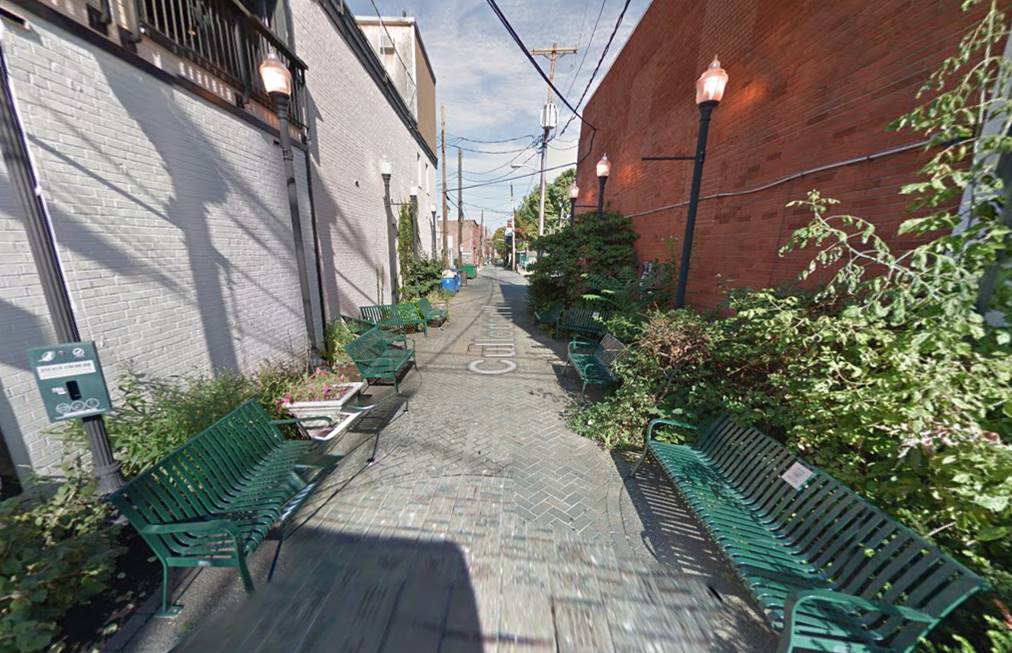
    A passage to rear surface parking that is a bit more welcoming. There is lighting, the shrubs have been trimmed and do not allow from lurking, and the benches mean that on any given day people might be sitting offering "eyes on the street"/
    This downtown structure in a small town in Puerto Rico is two long desolate blocks from the main Plaza. Most of the shopping activities occur on the other side of the Plaza, making this location not particularly appealing for shoppers who do not intend to spend alot of time downtown.  

    The two walk block from the Parking Structure to the main Plaza offers pedestrians very little engagement. 

    Maintenance and Operations matters
    For those of you who have worked in the public sector, you know the deep dart secret of capital funding. It is much easier to get something built than to maintain it. Maintenance requires an annual budget appropriation. Getting a one time infusion of capital to build something is often a lot easier. Keeping the elevators in these structures running, removing graffiti, making sure payment is simple and not too confusing for the first time user, all requires keeping track of the structure and making regular investments in maintenance and operations. To address this issue, many communities have resorted to creating parking authorities that ensure that the revenue from the parking structure is plowed back into an organization that manages and maintains the structure. Unfortunately, many communities see the line item for maintenance as an easy thing to cut in lean times.

    Infrequency of Use
    While this is mostly anecdotal, the utilization rates of many of garages we have seen is often a lot lower than anticipated. We often see many, many vacant spaces when visiting downtown parking garages. The cost of building these spaces is typically a significant public commitment, so the waste is really palpable.

    So when does downtown parking make sense?
    Yet despite all these concerns, sometimes downtown parking structures do make a lot of sense. For example, when you have a downtown anchor, such as a theater that is attracting large numbers of people at the same time, structured parking located in the immediate vicinity of the theater can making the experience much more palpable to the theater goer. New York City’s Theater District heavily depends on structured parking options for the many theater-goers for whom public transportation options are inadequate (not to mention less appealing way to get home for the many who have traveled quite some distance in fancy clothing and high heels).

    Attractive signage announces the walkways to the downtown
    surface parking areas behind the Main Street in South Orange, NJ
    Other alternatives include organizing and rationalizing downtown pocket parking lots. In South Orange, NJ the many small lots in downtown are managed by a parking entity. Moreover, connections to the small lots parking are visible from Main Street and maintained by the downtown BID. Another good example is Great Barrington, MA, where rear surface parking is comfortable, landscaped and walkable.

    We’d love to hear more about your downtown solutions. Please share them with us at info@larisaortizassociates.com.