
Our most recent projects have taken us to Bridgeport and
Trenton, two former industrial powerhouses, both now struggling with the
impact of industrial displacement, poverty and population decline. Yet there
remain residents in these communities for whom improvements are critical to
life outcomes. And in our opinion, we really don’t have much time to waste. As
Nathaniel Hendren, Harvard Economist and founder of The Equality of Opportunity Project was quoted in a recent New York Times piece, “where you grow up matters.” So simply put - and so true. His research has shown that for “every extra year a child spends in a
better environment – as measured by the outcomes of children already living in
that area” improvements to childhood outcomes can be demonstrated.
In our work we have found that addressing the corridor challenges
of the lowest income communities means thinking more creatively about how to address
anemic market conditions. So for practitioners working in these challenging and complicated environments, we share a few principles that we have come to deploy in
our work....
1. Support the creation of community retail nodes – rather than
dispersed retail. Businesses thrive in clusters, and the convenience of being able to patronize a few businesses at once will enhance the appeal of the district as a whole - benefiting all businesses by driving more traffic than each might on their own.
 |
| This existing node of retail may not look like much, but it serves the local community and is located at a well trafficked intersection. A district like this is in a better position to benefit from improvements than an area that is less visible and off the beaten path. |
2. Visibility, accessibility and convenience. Retail needs a good location to work. You can’t fabricate these fundamental market conditions if they don’t exist, so don’t try to create a district somewhere where the fundamentals aren’t in place. In some places, whether we like it or not, this means a place that can be easily accessed by car (with adequate parking). In other places, this means access to public transit, or an easy, direct walk by foot or bike. If you ignore this principle you are just setting yourself up for failure. So make sure you are working on retail concentrated in places that are
accessible and receive plenty of visibility. Think busy intersections rather than sleepy side streets (even if those side
streets once contained vibrant retail in days of yore).
And sometimes minor, seemingly inconsequential barriers to access will hurt sales. Making your customers walk any further than they have to can result in them hopping right into their cars to find a parking spot somewhere where they won't have to walk. Sad but true.
 |
| Great parking on one side. A great jazz club restaurant on the other. In between? A canal. So all those folks leaving work in the evening are ten times less likely to do anything but jump in their car and go elsewhere. |
3. Consider businesses that do not depend as heavily on
discretionary income, because if you don’t have enough residents with
discretionary income right now, it might be awhile before you have enough to
support new businesses. So instead think about uses that can be sustained through public funding or other income streams, such as publicly funded day care centers,
urgent care clinics, non-profit service providers, educational or workforce
training programs, etc. These kinds of businesses not only fill space, but they
also generate traffic can result in the added benefit of creating enough demand
to support a small amount of auxiliary businesses, from food related businesses
– a pizza shop or deli – to a pharmacy or convenience store.
 |
| Increasingly urgent care facilities are taking over ground floor retail space. These facilities can provide an extra level of medical service in communities that desperately need them. |
4. Build density – sometimes there is no way around it. In some communities, population figures are so anemic
that the only adequate response is to build housing. This is where Community
Development Corporations have excelled over the past few decades, using
important financing tools like the Low Income Housing Tax Credit or Section 202.
While these resources are unfortunately increasingly limited, they have proved
critical in turning neighobrhoods around and in creating the market demand over
time that can support small businesses.
 |
| A vacant lot of Southern Boulevard in the South Bronx |
 |
| The same vacant lot after local CDC WHEDCO developed the project into quality affordable housing. |
5. Focus on the physical environment – focus on improvements to
the physical environment that will address issues of safety. Think about graffiti clean up,
street clean ups, vacant lot clean ups – these kinds of activities can help
build neighborhood pride and in fact do have an impact on neighborhoods.
Research funded by LISC, one of the nation's largest community development intermediaries, found that the impact of Philadelphia's vacant lot program had a positive impact on the sales of local businesses, real estate values in the district and shopper preference. A win-win all around.
 |
| New Kensington CDC in Philadelphia was one of the early adopters of the vacant lot maintenance program, now called Philadelphia LandCare. At some point these lots may be developed, removing the "missing teeth" from the district. But for now the maintained lots have made a significant improvement along the corridor. |
6. Focus on helping small businesses address public safety and visibility issues. Sometimes small investments in physical improvements, such as lighting or signage, can help existing businesses capture more market
share. Moreover, these small investments can make a big difference in the perception of public safety. A transparent window, or well positioned lighting, can make a store that most didn't think twice about visiting more appealing.
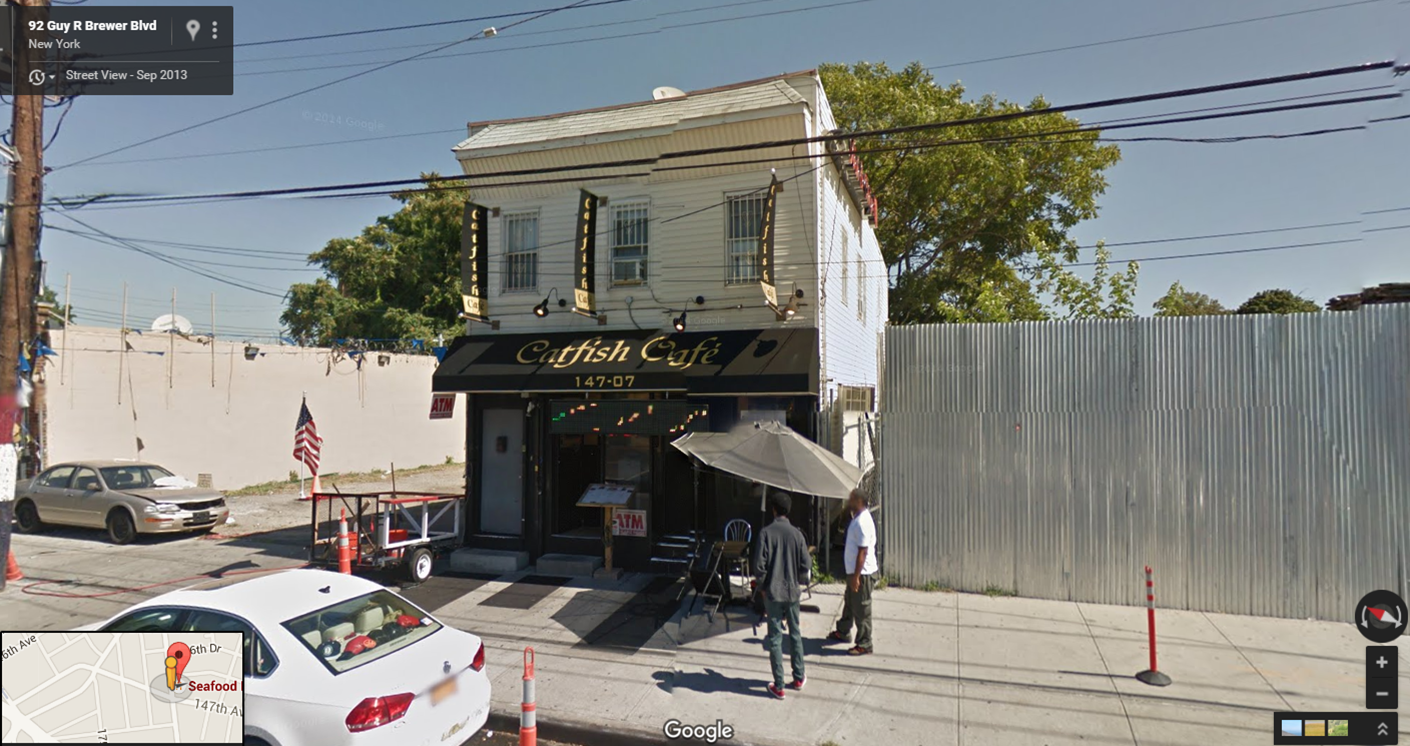 |
| This seafood restaurant in a lower income community in Queens is doing lots of things right. Transparent windows, outdoor seating, blade signs. |
The main take away is that a commercial district in a lower income community must find ways to ensure that every potential dollar that can be captured is in fact captured. There is little room for error. That means removing all possible hurdles that prevents customers from easily and conveniently patronizing local businesses. And in some cases, that means building the market to create more demand for retail - read new development. While that process can sometimes take a long time, with a strong road map and an understanding of the kind of market conditions necessary for business to thrive, I have seen time and again that neighborhoods can in fact change and improve, benefiting the residents that live there.


