At this years International Downtown Association (IDA) annual conference I had a chance to sit in on a session on recent IDA report on "High Performing Distict CEO's". The report is part of a deep dive research effort by IDA, DHR International (a national placement firm), and Somerville Partners, Inc. (a leadership consulting firm). I attended the session because I have seen the challenges associated with managing urban districts - and have seen how difficult it can be to find the right person to lead an organization whose job is to lead and manage change. Panelists David Smith and Martita Mestéy gave an excellent presentation on the qualities of a CEO - I noted that many people in the audience were furiously taking notes!
The report itself is a fascinating analysis of leading CEO's throughout the nation. Fifty leaders in downtown management were asked to participate in a detailed online self-assessment instrument designed to identify leadership styles. The analysis then looked at CEO's with different staffing levels, budget sizes and CEO experience. While the entire report is worth a read (click here to download), what I found quite interesting was the comparison between CEO's running large organizations and those running medium-sized organizations.
Does size matter?
In a nutshell, the answer is yes. Those running large organization's were more likely to collaborate with partners, rather than be the sole driver of major downtown initiatives. This made alot of sense to me, in part because the urban ecosystems associated with BIDs in large cities are likely more comlicated and therefore require partnerships to make progress. These CEO's were also more "distant" over friendly or "succoriant" - perhaps reflecting the need for a professional and distant demeanor in a big city environment. They were also more generally focsed on the "big picture" and more likely to delegate work than CEO's from smaller mid-sized organizations.
CEO from mid-sized organizations, on the other hand, were often more "free-wheeling", prefering to wing it over establishing order. My guess is that bigger budgets require more systems in place to manage funds and activities. It takes a different kind of person to keep these systems humming. Mid-sized CEO's were also less "traditional minded" and more into the details when implementing projects, perhaps because a smaller staff means less opportunities to delegate?
In both cases however, high performing CEO's were flexible and creative in their approaches. Downtown management after all is a challenging field, requiring partnerships with a variety of actors over whom the CEO has no control. Succeeding in this environment at any level requires an ability to main interpersonal relationships and stay focused on a goal with persistance.
The report is available for download free to IDA members and $75 for non-members.

Showing posts with label Leadership. Show all posts
Showing posts with label Leadership. Show all posts
Friday, September 23, 2016


Saturday, February 28, 2015
Having trouble getting buy-in from your stakeholders?
I'm too excited about the Chicago Business District Leadership Program to limit this to one post. We are now in Day 3 of our opening retreat so here goes....
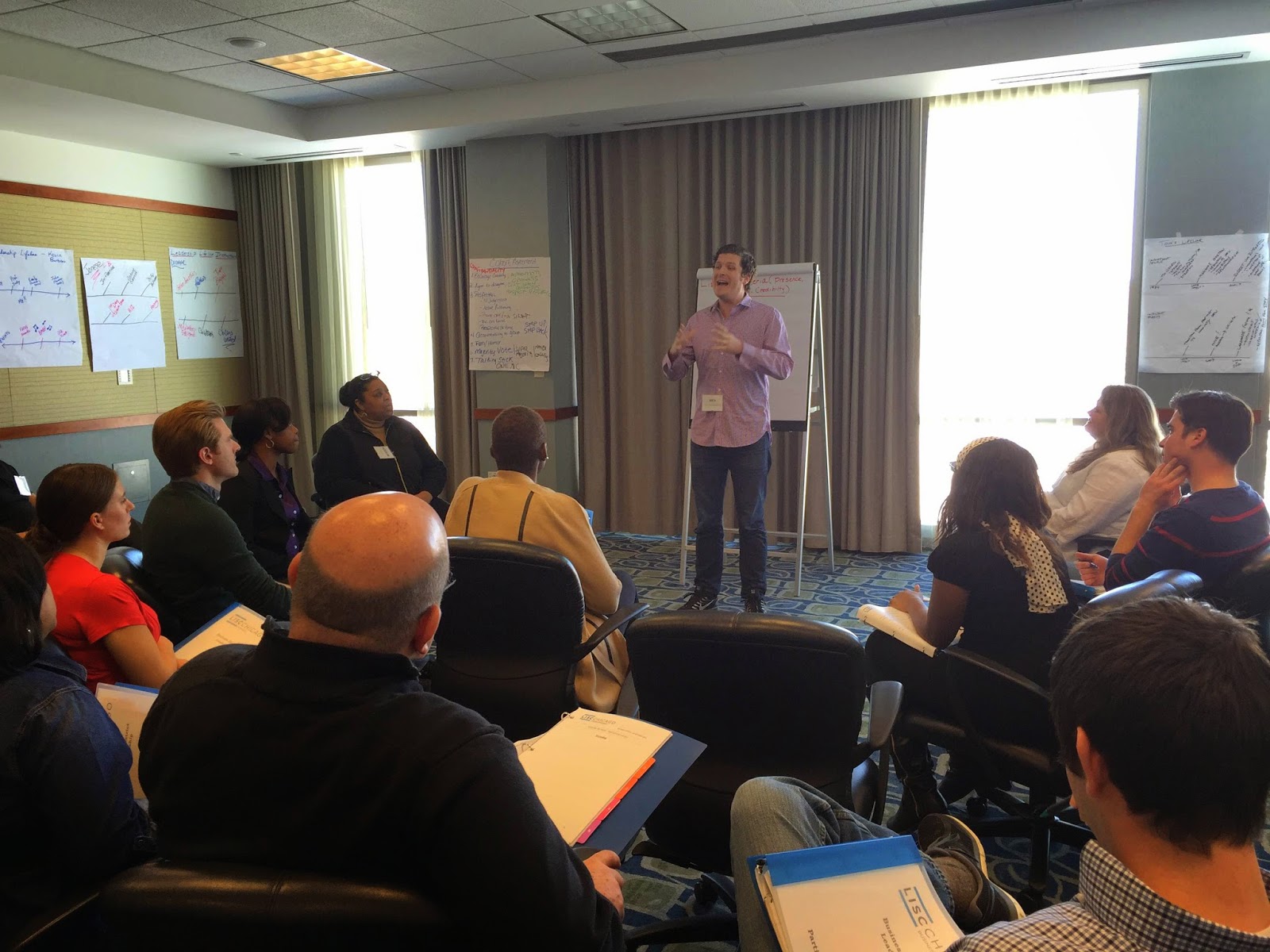 |
| A BDL participant sharing their vision stand |
How do you succinctly and effectively find partners and
champions to support you in your corridor revitalization efforts? For corridor
managers, the key to success hinges on the answer to this question.
For most, a one-on-one conversation is critical to engaging
and garnering support from key stakeholders. Think about it. Have you ever
gotten a big grant without a one-on-one pitch to a funder? Have you ever
convinced a business to come to your corridor without a one-on-one? My guess is
no.
This afternoon the LISC Chicago Business Leadership program
worked on this issue. We call them “Vision Stands”. What are those, you ask? At
its most basic, a vision stand is a clear and compelling picture of the future
you envision…in less than 2 min. Basically an elevator speech. And a darn good
one.
Why is a succinct pitch so important? Because the truth is
that attention span is short – most of the time you lose your audience to their own thought
processes long before you get to the so called important part of your pitch. Being
able to engage is critical to getting others to enroll and provide support for
your efforts.
So what makes for a good vision stand? In the BDL program, participants
are each given 2 minutes to present their visions to the whole group. They are
then provided feedback from one another on three key areas - presence, clarity
and credibility. They are pushed to make sure that their vision inspires, and
to do that, they need to make sure that they excel in those three key areas.
- Presence refers to how you show up in front of the group. The speakers quality of being and connection with the group and people’s experience of the speaker who is up in front of them.
- Clarity refers to an individual’s ability to explain their thoughts clearly and to leave the audience with an ability to summarize elements from their vision.
- Credibility is the toughest of the three. This refers to the ability of the speaker to offer the audience a sense that they can do what they said they were going to do. Is the speaker believable and do they have the capacity to pull it off? Are they believable? Do they exude confidence. Does their body language communicate self confidence in their work?
After the exercise, our facilitator Jose Acevedo shared with
us research conducted by Albert Mehrabian from UCLA. What Mehrabian found was
that three things contribute to how people perceive and feel about the speaker –
whether they like or dislike the speaker and message. What I found fascinating
is that people’s perception of you has very little to do with the content of
what you say. In fact, only 7% of their feelings are associated with the actual
words you say. 38% is related to voice dynamics and the WAY words are said. And finally, 55% of people’s perception of you
is related to your body language, specifically your facial expressions.
 |
| Receiving praise from participants after a Vision Stand |
Understanding this is powerful, because it tells us about
the importance of non-verbal communication in building credibility with our stakeholders. So step away from your email, and
make or the call, or better yet, set up a one-on-one with a potential new
partner and be prepared to share your vision. This is the first step in your ability
to convince others to contribute to your efforts – whether that be a
contribution of time (like attendance at meetings), money (contributions in the
form of membership, or grants or city funding), or expertise.
Good luck!
Friday, February 27, 2015
LISC Chicago Business District Leadership Program tackles “Active Listening”
 |
| An "Active Listening" exercise during the LISC Chicago Business District Leadership retreat |
Two years of planning is finally realized! The first LISC Chicago
Business District Leadership Retreat is well underway. This program is an
outgrowth of the Coro Neighborhood Leadership Program in New York – now in its fifth
year. These programs are truly groundbreaking - they seek to provide leadership
and skills training for a cohort of twenty commercial district practitioners
annually. This is not your typical training program folks. These individuals
were competitively selected and use the six month training program to hone the
skills that they need to make their work productive. Today we are tackling
active listening. When our masterful facilitator, Jose Acevedo, asked the
co-hort this morning “how many of you depend on people over whom you have no
authority to be successful at your job?” every hand shot up. That is inherent
in this work. The property owners, the business owners, the political leaders, the community leaders and the funders who are our partners are not staff. They are not
people who are paid by us and whose performance review is based on how well
they execute exactly what we want. How many of you have faced the challenge of
a recalcitrant property owner – someone who seems reticent to participate in
your commercial revitalization efforts – yet controls a critical and visible
property in your district? Or the business owners who bristle at your efforts
to improve the district and refuse to engage?
Jose made the powerful point that building relationships
with those individuals begin by actively listening to them. But what really is “active
listening”? This is the definition we are using here: “ATTENDING carefully to
what another person says, means, intends and feels and RESPONDING in a way that
lets them know they are heard and understood.” The key here is that active
listening requires two steps. First, listening. And next, talking to
demonstrate that you have an understanding of what the other person said. That
simple, very generous act builds the foundation for a relationship based on
mutual understanding.
So go ahead and active listen today!
Monday, November 17, 2014
Can you quantify the economic impact of your corridor?
 |
| Atlanta's historic Peachtree Corridor |
To counteract this problem, some communities are commissioning research that can demonstrate the value of the corridor to local and regional economic development. A study commissioned by three Community Improvement Districts (Atlanta Downtown ID, Midtown ID and Buckhead Community ID) three independent organizations that all service portions of Atlanta's 8.5 mile "Peachtree Corridor" is a good example of simple fiscal analysis that proves significant impact.
What they found should give leaders pause the next time investments in economic development are concerned. With only 3.7% of Atlanta's land, the corridor services 58% of all jobs (70% in the professional, science and technology sectors) and 37% of the City's total real estate values. Ensuring that the corridor remains strong and healthy is critical to ensuring that the City can continue to provide all of its residents with the vital services they need, from police to education to trash pickup. Making this connection crystal clear to community decision makers is a critical component of successful advocacy. With the report recently issued, local newspapers have picked up the story ("City Boosters to State: Peachtree is a vital artery", Atlanta Business Chronicle, Nov. 17, 2014). Here is another hint, it's not enough to write the report, you need to make sure the people know about - so don't skimp on the PR!
To see the report, click here.
Tuesday, October 21, 2014
Building Strong Leaders in Commercial Revitalization
Commercial
District Advisors gladly supports Coro’s Neighborhood Leadership (NL) Program
and encourages those New York City-based practitioners in the commercial
revitalization field to apply for Coro’s 2015 six-month program beginning in
January.
Who is the NL program targeted for?
 |
| Image via coronewyork.org |
“For those
leading commercial revitalization efforts in their communities-whether working
in a Business Improvement District, Merchant Association, local development
corporation, Chamber of Commerce or other nonprofit organization- Coro's
Neighborhood Leadership (NL) program provides the city's top talent with the
resources they need to understand how to influence meaningful change and
address complex challenges within their neighborhoods.” In Coro’s NL program participants “are given
the opportunity to build leadership skills through intensive training and
peer-to-peer learning. Participants leave the program equipped with the
knowledge and skills to drive change in their own neighborhoods, and an
unparalleled network of engaged civic leaders from which to continue to build
and grow.”
What are the benefits of the program?
The Coro NL program notes key benefits
to this program:
- THE NETWORK: NL connects participants to an accomplished community of Coro NL alumni, City leaders and the broader Coro community, who are dedicated to supporting one another.
- THE KNOWLEDGE: NL deeply immerses participants in building individual and collaborative capacity for practicing leadership and bringing about change in their communities.
- THE SKILLS: NL uses the City of New York as a lab to explore, test and build effective commercial revitalization strategies to adapt and thrive in challenging environments. In particular, participants hone the skills needed to get things done in a multi-stakeholder environment.
 |
| Image via coronewyork.org |
Neighborhood
Leadership meets January through June
and requires a significant time commitment of attendance including: A
three-day overnight Opening Retreat, Saturday Leadership Retreat days (4),
Bimonthly Networking Evening Events ("Coronect" evenings), Tuesday
Strategy Day Sessions (5), Closing Session & Graduation (1), and one
Follow-Up Session in October. Click here
to view the NL 2015 program calendar.
Who are the participants?
Approximately
20 successful nonprofit management professionals whose work is focused on
commercial revitalization are competitively selected to participate each year.
Selected participants reflect the demographics of New York City with at least
half serving low to moderate income neighborhoods. Those selected have interest in joining the
Coro community and NL alumni network.
What is the cost?
The kicker
is that there is no tuition due to the generous support of the program’s
partner and funders.
Applications for NL 2015 can be found here. The application deadline is Saturday, November 15th.
Questions/comments, contact - Garrett Lucien, Program Director of Neighborhood Leadership, at 212 248-2935 ext. 308 or glucien@coronewyork.org.
Subscribe to:
Posts (Atom)