Showing posts with label administrative management. Show all posts

Tuesday, June 5, 2018

For Upstate NY Practitioners: Small Scale Real Estate Development Workshop

If you plan to be in the Syracuse area on June 27th, this looks like a great day-long session designed to introduce the principles behind neighborhood based real estate development projects. Small scale development is a an important community development strategy - but it requires small developers!

The workshop is conducted by the Incremental Development Alliance, a national non-profit that works to build local wealth in neighborhoods through ground-up real estate development.

********

Small Scale Real Estate Development Workshop

WHEN: Wednesday, June 27, 2018 8a-5p
WHERE: Hotel Syracuse, 100 East Onondaga Street Syracuse, NY, 13202
COST:
  • Early Bird Registration Rate ($170) open until Friday, June 8 
  • Regular Registration Rate ($200) open until Monday, June 25 
  • Last Minute Registration Rate is ($230) 
Register today at http://www.incrementaldevelopment.org/events/syracuseworkshop

Apply for a scholarship here

The workshop offers specialized training about how to create small projects, like 1-3 story buildings with less than 20 units, which are residential, commercial or mixed in use and 1,000-12,000 sf in size. The course assumes you know a lot about where you live, but not necessarily much about the real estate process or building development.

Through presentations on finance, design and site selection, a hands-on practice exercise, and networking with local like-minded people, this workshop is the first step to becoming a small developer yourself or creating a supportive ecosystem for small development in your city.

Who Should Attend?
  • Individuals in construction, design, planning or real estate looking to either enhance their current practice or make career transition 
  • Volunteers or professionals in business associations, main streets associations, historic preservation groups and neighborhood improvement groups looking to champion incremental development in their communities 
  • Public sector professionals in city management, economic development, planning, and related agencies who are looking to make it easier for small development projects to occur in their town 
  • Professionals in non-profit development organizations, churches, and community development or housing development organizations who need new strategies for small lot development 
  • Private banking professionals specializing in mortgages, commercial real estate loans or SBA loans and professionals as at Community Development Financial Institutions and Community Foundations who want to become more effective investors 

Friday, June 9, 2017

Managing Homelessness Downtown

Our recent experience working with downtowns in the state of New York and in North Carolina this past year has brought to our attention a spike in stakeholder concerns over homelessness downtown. The homeless population is often referred to as the people who “lack a fixed, regular, and adequate nighttime residence". In downtowns, the homeless are often seen occupying public or private places that are not designed to be regular sleeping accommodation including parking lots and garages, storefront stoops, transit stations, vacant buildings/ lots etc. In addition to this group, there are also the homeless who live in substandard buildings that lack sanitation, cooking facilities or heat, who are often disregarded.

Trend

Seeing the rising concern over homelessness in our own projects led us to dig a little deeper into the trends happening elsewhere. As it turns out, homelessness is indeed spiking in cities all across the country, and particularly in downtowns. In San Diego, for example, tent cities have begun proliferating downtown near freeway on-ramps and commercial districts and homeless service centers. On a recent trip to Seattle, WA, I witnessed the same trend occurring under the on-ramp to I-90 by the CenturyLink Field and Chinatown District.

A myriad of factors contribute to the rising homeless population downtown but many leaders are increasingly placing blame on criminal justice reforms, which have downgraded some felonies to misdemeanors and therefore keeping some people out of prison or drug treatment and instead leaving them on the streets.

The more popular reason for the rise in homelessness downtown, however, remains the increasing cost of rents and disappearance of residential hotels. As more people look to live in convenient and vibrant downtowns across the nation, the high demand for downtown apartments and houses is slowly driving prices up for all housing stock. Meanwhile, homeless advocates are also pointing to the significant loss of single-room occupancy units, or SROs, as a key factor in the homelessness crisis. Many SRO units that still remain are unfortunately uninviting and unaffordable.

Why do homeless people gather downtown?

While those who can afford to live in downtowns are moving to these areas for comfort, convenience, and entertainment, homeless individuals on the other hand are coming in droves because downtown is often the best place to seek day service centers, social service centers, and basic amenities such as bathrooms and water fountains.  Downtown is also the place where homeless folks can get a meal, a shower or a shelter bed – resources that often cannot be found elsewhere.

During a stakeholder interview for our work in Middletown (NY), Director of the Thrall Library, Matt Pfisterer informed us that the homeless population there was particularly active around the library because they needed bathroom access in the day when they were not in shelters. Later in the afternoon, he reports, the homeless crowd migrates towards the soup kitchens and other downtown homeless service centers as they start to compete for safe and comfortable night time lodging. The Thrall Library, as do many other libraries across the nation, does its best to accommodate this group by ensuring bathrooms are monitored and maintained constantly throughout the day by staff and personnel to ensure that all library users can continue to use the bathrooms hassle-free.

Issues

Bathroom lines and litter are hardly issues when it comes to dealing with homelessness downtown. Many cities are facing harder problems such as drug use in public, rise in reported theft, and overall, a perceived lack of safety amongst residents and visitors. This overall unwelcoming atmosphere is not only discouraging some from living and investing in downtown, but also discouraging customers from shopping and visiting downtown. In our experience, we have heard from business owners and property owners that homelessness downtown has negatively impacted foot traffic and in turn, sales. In some cases, the homeless population has been driven to spend nights on storefront stoops and use back alleys as latrines, giving store employees additional work in the morning when they return to open and operate businesses.

Lower patronage downtown has even resulted in businesses closing in Portland, OR. A dance studio in downtown Portland, OR experienced dwindling class attendance from out-of-towners who felt scared walking to and from parking lots and dance class in the evenings as a result of the spike in the homeless population there.

Management Solutions

Whether perceived or real, this lack of safety experienced downtown can be managed by downtown organizations. The first step in managing homelessness downtown is counting, keeping track, and being aware of the current situation. After all, you cannot manage what you don’t know.  By keeping count of your homeless population, you will be able to determine the actual size and scope of the issue and at the same time identify hot spots with high concentrations of homeless folks and their peak visiting times during the day.

A common way to count the population is to use the ‘point-in-time’ method. This method requires that the count take place on one day every year across the city or downtown and therefore provides a Point-In-Time snapshot of the homeless population. This can be conducted by public or private sector volunteers including, of course, the downtown organization. This information can then even be registered with the US Department of Housing and Urban Development to become a part of a nationwide database for understanding homelessness across the country and will be required to be considered for federal funding to combat homelessness.

The limitation with this method, however, is that volunteers counting are only limited to what they can see by eye. In essence, they count the number of homeless people seen in cars, and on foot and if there are those who are hidden in tents, an assumption is made that there are two people per tent and may therefore be undercounting. Keeping a consistent counting method throughout the months and years is crucial for comparing data over time accurately and as long as this limitation is recognized, downtown organizations will be able to make informed decisions.

Downtown San Diego Partnership takes counting a step further by organizing a monthly survey instead of an annual one. Homeless outreach workers with the Downtown Partnership cover 275 city blocks between midnight and 5 a.m. on the last Thursday of every month and they have been counting since 2012. This has enabled them to see changes year-on-year and the data has helped the Partnership determine what actions need to be taken to manage the spike in homelessness and also to determine factors that may be affecting the numbers.

Taking Action

There are a number of actions that can be taken by downtowns to manage their homeless populations depending on size and scope.

First, developing a Vulnerability Index has been critical to many downtowns and cities in order for them to identify and prioritize the homeless population on the streets that should qualify for housing. A Vulnerability Index typically measures length of homelessness and mortality risk and is a practical application—a person-to-person survey—that is “revolutionizing the speed at which … chronically homeless population is placed into permanent housing”.

In some cities, non profits are stepping forward to create diverse housing stocks for the formerly homeless and low-income residents. Mixed-income permanent supportive housing is becoming a popular strategy to house the homeless population in larger cities such as DC and NYC.Often these buildings also feature community spaces such as rooftop terraces, gardens, lounges, gyms and laundry rooms that help the residents get out and engage with neighbors – a holistic environment for recovery from homelessness or any other dire situation.

While providing housing stock may be a longer term strategy, other short to medium-term strategies are also in place in many downtowns across the country. Libraries, as mentioned earlier, are becoming top community spaces that support the homeless population. The DC public library, for example, now provides an innovative outreach program for the homeless since its first hire of a Health and Human Services Coordinator. A Knight Foundation grant in 2015 enabled DC Public library to create an online interface of health and human services data  and train librarians in homelessness outreach so that when homeless folks come up to a librarian, he/she is able to direct them to the right service providers and give the correct referrals. This is a simple yet essential tool for supporting homeless folks and getting them back on track.

In other instances, business improvement districts have partnered with existing homeless-serving organizations to carry out supportive programs. In Los Angeles, CA, Downtown Center Business Improvement District  funds homeless outreach teams to contact, interview and assist homeless people living in the west side of downtown. Over $255,000 has been funneled from the BID to two social services agencies in order to hire staff to do this outreach work. PATH, or People Assisting the Homeless, is one of the organizations that provides services, including street outreach, shelter and housing construction. Chrysalis, a skid row program, then provides job preparation and temporary work experience, and also has been tasked with picking up litter in areas heavily-trafficked by homeless folks. In the first year of funding from the BID, outreach workers completed 196 assessments, and placed 36 people in permanent housing and enrolled 56 in PATH’s housing services.
Downtown San Diego Partnership, on the other hand, has set up a Clean and Safe Program and DowntownDC BID partnered with the city government and 20 local service providers in order to facilitate various efforts to end homelessness. This includes a partnership with Pathways to Housing DC that has deployed a 4-person, clinically-based outreach team that provides street-level intervention to move individuals beyond homelessness to independence. In addition, DowntownDC BID’s Safety/ Hospitality and Maintenance employees have 12 specially-trained members, known as the Homeless Outreach Service Team (HOST), who work closely with the Pathways to Housing DC Team and are trained to recognize and engage individuals with mental and addiction challenges. The smallest yet most impactful effort made by DowntownDC BID, however, remains the brown bag discussions that help educate the public on homelessness and raise awareness.

Installing public bathrooms is another potential strategy that might mitigate instances of public urination/ defecation. Although not all instances of this offence is carried out by the homeless, the compassionate approach rather than law enforcement approach has been widely praised by residents of the city of Denver, CO, where a pilot program of mobile public restrooms was established last year. These mobile facilities cost $12,000 per month to lease and are cleaned nightly and rotated regularly to different locations. Public bathrooms are basic amenities that should be made available to all users of downtown.
Given that vacant lots are often targeted for homeless camps to set up, downtown organizations may mitigate the situation by requiring or ensuring that private property owners have reliable property management companies in place to monitor compliance with zoning codes.

Finally, as downtown organizations plan ahead the annual schedule of events, they might start thinking about organizing events in partnership with homeless groups and shelters to accelerate and coordinate the move-in process. These processes normally take 60 days to happen but can be expedited in a single all-day event that serves as both outreach to homeless folks and also one that raises awareness amongst the general public.

Take a Comprehensive Approach

Overall, it is important to acknowledge that ignoring the homeless population downtown will not make it go away. A comprehensive approach must be taken by downtowns, in partnership with city, state or even federal agencies, and nonprofits and local community groups. Addressing the full range of issues faced by the homeless including housing/shelter, employment services, meals, and rehabilitation is crucial to managing the problem. It is also important to remember to count and measure the scale and scope of the issue first before taking any mitigating steps. This ensures that the response or strategies implemented directly serve those in need rather than simply blanket the problem.


Monday, March 6, 2017

Coworking Spaces, Should Corridors Seek Them Out?

Ranging from large spaces. Coco, Minneapolis/St. Paul. 
Although we generally think of the tech industry when we think of start-ups, a relatively
new start-up has been emerging for years without much noise in the industry. We are talking about co-working operators and spaces.  

It's really a quite simple business model. Operators are providing a service for those that need a space to work and for those that would benefit from co-habitating this space with others in the same or complementary industries. Operators provide varying levels of space to fit the need of their customer and can offer anything from whole offices to single desks but provide shared amenities such as wi-fi, conference rooms and meeting spaces, kitchens, coffee, in-house cafes, mail and package services, etc. Forbes notes, "The operator provides flexible terms allowing renters to move in and out and upgrade or downgrade with short notice periods. Perhaps the most important characteristic, the operator designs community building programs and events to create a strong business network among its renters."

Co-working operators are not however always seeing profit and have to make due with influxes of renters and cash flow. On the other side, co-working patrons may also deal with nuisances within their spaces such as consistent loud noise, hidden fees, a barrage of rules, dirty facilities, and competitors too close for comfort. 


To the more small and intimate. Central Working, UK.
Who's in the game?

WeWork is the largest co-working operator in the industry with spaces spread around the globe. They definitely enjoy more economies of scale while other small operators like Bathaus, a co-working space in Brooklyn, infuses other income sources into their revenue stream through event space rental and they also enjoy a small niche community feel.


Who needs a co-working space?

Typically those that need a co-working space are young entrepreneurs who need and want job control wherein they can work as much or as little as needed. It is for those that seek community and perhaps need a space outside of a home office to meet clients. "Freelancers, remote workers, and other independent professionals" also fit the bill according to Harvard Business Review. This is likely because they need the shared amenities and are not in the market for their own office just yet. The added benefit of increased networking and collaboration opportunities make co-working spaces appealing to entrepreneurs.

Why does it matter to commercial corridors?

Diversifying a corridor with co-working spaces can bring great results to visitation downtown, including daytime workers who are able to spend money on food and convenience items. Given that the average co-worker is a “college-educated professional within their mid-twenties and late-thirties, primarily working within the creative industries, such as web developing, graphic design and programming, or new media” (Foertsch 2015), there appears to be many similarities between them and Richard Florida's ‘creative class’. Retailers downtown who are expecting an influx of co-workers therefore need to recognize the lifestyle preferences and retail expectations of this customer. According to Richard Florida, the creative class enjoys high quality amenities and stimulating environments that will encourage their own creativity. This might take the form of a vibrant downtown cultural scene with late night and weekend events or mixed-use streets that enable co-workers to shop, work and play locally. 

A 2016 study of WeWork Dumbo and TEEM Harlem, co working spaces in NYC, showed that co-workers are indeed more likely to dine out for lunch or grab a meal locally after work even with food pantries and coffee bars provided within the work space. Food and drinking places therefore need to remain cognizant of the varied working hours of co-workers in order to maximize sales and complement the offerings already made available in the co working spaces.

Examples of coworking spaces:
Industry City
QNS Collective
GreenSpaces NYC
Parisian Coworking Space - Deskopolitan
List of others in NYC

From elegant. Crew Collective, Montreal, Canada.

To eclectic. Conde de Casal, Madrid, Spain.
Co-authored by Nur Asri and Scott Landfried.

Friday, September 23, 2016

Do you have what it takes to lead a commercial district or downtown organization?

At this years International Downtown Association (IDA) annual conference I had a chance to sit in on a session on recent IDA report on "High Performing Distict CEO's". The report is part of a deep dive research effort by IDA, DHR International (a national placement firm), and Somerville Partners, Inc. (a leadership consulting firm). I attended the session because I have seen the challenges associated with managing urban districts - and have seen how difficult it can be to find the right person to lead an organization whose job is to lead and manage change. Panelists David Smith and Martita Mestéy gave an excellent presentation on the qualities of a CEO - I noted that many people in the audience were furiously taking notes!

The report itself is a fascinating analysis of leading CEO's throughout the nation. Fifty leaders in downtown management were asked to participate in a detailed online self-assessment instrument designed to identify leadership styles. The analysis then looked at CEO's with different staffing levels, budget sizes and CEO experience. While the entire report is worth a read (click here to download), what I found quite interesting was the comparison between CEO's running large organizations and those running medium-sized organizations.

Does size matter? 
In a nutshell, the answer is yes. Those running large organization's were more likely to collaborate with partners, rather than be the sole driver of major downtown initiatives. This made alot of sense to me, in part because the urban ecosystems associated with BIDs in large cities are likely more comlicated and therefore require partnerships to make progress.  These CEO's were also more "distant" over friendly or "succoriant" - perhaps reflecting the need for a professional and distant demeanor in a big city environment. They were also more generally focsed on the "big picture" and more likely to delegate work than CEO's from smaller mid-sized organizations.

CEO from mid-sized organizations, on the other hand, were often more "free-wheeling", prefering to wing it over establishing order. My guess is that bigger budgets require more systems in place to manage funds and activities. It takes a different kind of person to keep these systems humming. Mid-sized CEO's were also less "traditional minded" and more into the details when implementing projects, perhaps because a smaller staff means less opportunities to delegate?

In both cases however, high performing CEO's were flexible and creative in their approaches. Downtown management after all is a challenging field, requiring partnerships with a variety of actors over whom the CEO has no control. Succeeding in this environment at any level requires an ability to main interpersonal relationships and stay focused on a goal with persistance.

The report is available for download free to IDA members and $75 for non-members.

Wednesday, February 10, 2016

Roundup: Queens Boulevard Transformation, Philly's Old City Makeover, NYC's 1 Million Trees, Walmart Pull Out

Transformation of Queens Boulevard

For years, Queens Boulevard in Queens, NY was tagged as the "Boulevard of Death" due to its chaotic nature, unfortunate fatalities, and high traffic of pedestrians, cyclists, and vehicles. The city of New York is transforming this thoroughfare with a complete streets makeover. Watch the video.

vimeo.com/153198048

After the Hangover: How Old City Finally Sobered up and Crafted a Grown-up Vision for Itself

Philadelphia's Old City District is turning over a new leaf and shedding its old thick skin by utilizing an organized administration that is engaged with the public in combination with nuisance fighting tactics to make the district desirable for businesses, patrons, and residents.


NYC Just Planted 1 Million Trees. Here's How They Did It.

The story behind how one group managed to succeed where many have failed. Three main reasons why one million trees have been planted in NYC since its inception eight years ago.


Can Cities Afford to Trust Walmart?

After a recent pull out of plans to build a store in underserved Ward 7 of Washington DC and the shuttering of 269 stores globally, some of which were only built within the last five years and inevitably caused smaller grocers or pharmacies to go out of business, city leaders are now becoming apprehensive about striking deals with Walmart.  A small shift with the giant retailer that could cause a ripple effect in the retail market.


Tuesday, December 29, 2015

Retail Attraction: One Small Business at a Time

Cutting the Ribbon at Grand Street, Brooklyn
Recently, one of our NYC clients, the Grand Street BID, shared with us the news about their first successfully attracted business: “Save On Grand” and we would like to congratulate them and share their experience with you.

First, the BID identified a community need for a general merchandise store through data provided by our Retail Market Study and also through a subsequent community retail needs survey that was distributed at local community meetings and events. The results indicated an overwhelming need for a general merchandise store that could fill the void from the recent loss of two anchor tenant general merchandise stores that had closed (GEM and Liberty).

The actual process of bringing Save on Grand, a discount household items store, to the street involved establishing a relationship with a local broker who represents two vacant spaces in their district. Through meetings and phone calls with the broker they were able to explain their retail needs and pair him and his client with a landlord acquainted with the BID and that knew the district’s need for general merchandise and affordable clothing. 


According to Homer Hill, the Director of Communications and Special Programs of the Grand Street BID, residents are supporting the store and Save on Grand’s presence is bringing positive benefits to other stores along the street. “This also supports current retailers,” he said. “As long as Grand Street can be a destination for neighborhood convenience-type goods, that’s better for all the businesses.”

Monday, November 23, 2015

LISC Chicago's Business District Leadership Program wins first place award

I could not be more thrilled to announce that the LISC Chicago Business District Leadership program just took home top honors at this years Chicago Business Development Center Awards! The awards are a recognition of LISC's efforts to train business district practitioners in the leadership skills and strategies necessary to make tremendous impact in their communities.

Larisa Ortiz Associates is proud to have played a supporting role, along with Coro New York Leadership Program, in developing the framework for the program. The Chicago program is based on the Coro Neighborhood Leadership program, now going on its fifth year. To date, over 100 New York based practitioners have participated in the program and it is still going strong. Both programs are funded in part by their respective cities.

The 2014 BDL cohort, including Dionne Baux (LISC),
Kristen Illes (Coro) and myself to the far left. 
I must say, being involved with this program has been one of the most fulfilling experiences of my career. It is truly an honor to see so many practitioners - now over 120 an counting! - gain tremendous insight into their lives, and then turn those insights into tools that make them so much more effective in their work. Being a leader in the field of commercial revitalization and community development is often about working with those over whom one has limited to no authority, about pushing those in positions of power, and about connecting with stakeholders and community partners to advance mutual interests and leverage shared resources. These are the skills that ultimately lead to real and sustainable neighborhood change over time.

For more information on the Chicago LISC BDL program, click here. The deadline to apply for next year's program is Dec. 11! There is still time!

For more information on Coro Neighborhood Leadership, click here
The opening retreat sets the stage for deep friendships and trust between
peers, who later serve as critical springboards for advice and feedback. 
The opening retreat quote board...things that
resonated with participants made it to this board. 

Wednesday, October 7, 2015

Growing a Business District one Rock-Climbing Gym at a Time

This nondescript building is home to the Cliffs at LIC, a 20,000 sf
facility that attracts hundreds of climbers a day.
Nearby businesses are starting to cater to these customers. 
The rock-climbing gym in Long Island City, Queens seems to be single-handedly changing the retail environment along a historically industrial stretch of this community, according to a recent article in Crain's. I was particularly interested in the take-away's from this article after a presentation we made last night to a small town of about 12,000 in Upstate New York. The community is looking for ways to drive pedestrian traffic to their small but interesting Main Street. Over the course of our lively discussion with City and County officials, business owners and residents, we agreed that events, activities and destination drivers are key to bringing people downtown to shop at the growing cluster of stores along Main Street. While there are many aspects to revitalization - one participant likened it to putting together a complicated puzzle - at least part of the revitalization effort will require supporting the businesses that have recently opened and making sure they succeed. In its most basic form, this will require getting more people in the door to shop and eat. That means putting on not only events - which we acknowledge can be challenging to manage and sustain, not to mention execute successfully - but also identifying opportunities to enhance the downtown experience through entertainment anchors. And this is where the rock-climbing gym in Long Island City comes in. The impact of this one business on the corridor - particularly with respect to driving demand for auxiliary businesses - has been tremendous and offers a few lessons learned.


  • Merchants communicated with one another and coordinated hours  in a way that benefited both. The owner of Cliffs at LIC personally approached Josh Bowen, the owner of John Brown's Smokehouse to tell him that his patrons, numbering about 500 on a typical weeknight, were often leaving their climbing sessions hungry and with no place to go. It is great that is happened in this community organically. What this speaks to is the need to create opportunities for merchants to communicate with one another on a regular basis to identify and act upon synergies. Do your merchants have a venue to do this? We worked in a community many years ago where the local restaurants and local theater were working at cross-purposes. The restaurateurs often didn't know when there was a show going on - and subsequently were understaffed and slammed with customers on nights when they didn't expect it. As a result, customers were often late for their shows. Do you think many people came back to recreate this harrowing experience? I think not. In this community, it became clear how important is was to create simple communication tools - monthly meetings of a newly formed hospitality committee (managed and staffed by the local Business Improvement District) and an on-line event calendar distributed via email to said hospitality committee were all ways to improve communication among businesses which in turn improved the experience for customers. Ultimately some of this comes down to the need to establish and cultivate administrative capacity to make sure these conversations happen, and that they happen frequently enough to troubleshoot issues that come up. 
  • The opportunity to build on the 'rock-climbing" retail micro-climate that is developing. By understanding what this niche market wants and needs, local business owners can capitalize on the spending potential of climbers. Whether this be food after a good session, or craft-beer, or coffee or a store selling climbing gear...all of these businesses can begin to form an ecosystem that is driven by the destination driver - in this case the gym.
  • The need to invest in experiential opportunities. I talk alot about the need to incorporate both impulse and ambient entertainment in our downtown environments. Think great public spaces that engage the user (one of my recent favorites is Campus Martius Park in downtown Detroit. Foosball, performers, music, basketball) these are all things that make going downtown more than just about buying goods. 

A foosball table at Campus Martius Park in
Downtown Detroit is a fun diversion that activates place. 
If we rely on downtown to be solely about the purchase - we are destined to lose the battle against retailers who offer wider selection at cheaper prices - either at the local big box shop or on-line. But experience is not just about what happens on the street, it also mean experiential retail, and the rock-climbing gym is a great example of this. In fact, a super-regional mall outside NYC recently revamped its interior courtyard with a ropes course. Even the big guys are internalizing these lessons. 

A rock-climbing gym is admittedly not for every community - but the concept of identifying a a unique offering or experience that drives pedestrian traffic, which in turn enhances the retail sales of nearby businesses, is a basic retail lesson for all of us.  

Tuesday, October 6, 2015

Making Commercial Districts Age-Friendly


Seniors comprise a growing segment of the population and can be great assets to businesses. As a BID manager pointed out during last week’s IDA panel Making Commercial Districts Age Friendly: “Seniors are the most loyal customers”.

In fact, as part of the Age-Friendly NYC, a citywide initiative promoted by the NY Academy of Medicine, NYC Office of the Mayor and New York City Council, a number of local BIDs began incorporating age-friendly measures to make their districts more welcoming to their increasing number of seniors. Three BIDs, Bed-Stuy Gateway, Westchester Square and Myrtle Avenue Brooklyn Partnership, shared their approaches with the audience including:

Discount for seniors, which can take many forms such as a percent discount just for this age group, or a percent discount on products and services targeted for them (which has shown to be a popular alternative in districts where older adults don’t want to be labeled as seniors).


Source: Myrtle Avenue Brooklyn Partnership


Installation of additional seating throughout the district to provide resting opportunities for seniors and people with walking difficulties.  The installation of benches in front of businesses had also a positive outcome to business owners: one dry-cleaner reported a 20% increase in sales after a bench was installed in front of its store.


Source: Myrtle Avenue Brooklyn Partnership 


A tour of new businesses: one district created a special tour to introduce local seniors to new business with targeted services and programming and was very successful.

Senior Resource Guide: includes a map showing businesses with services designed specifically for seniors, many of whom lack the computer skills to find this information online.

And many of these approaches were actually developed by local seniors themselves through a of series community engagement events, as in the case of Myrtle Avenue, Brooklyn.  

Finally,  it’s important to note that many of the measures to make districts friendlier to seniors are also great for other age-groups, including children and mothers with infants (that have to move around with baby carriers and strollers). So more points for this initiative: an age-friendly district is welcoming to seniors and other age groups alike.

Friday, October 2, 2015

Measuring Impact through Pedestrian Counts

Imagine if you went through school without a getting grades or even feedback on your work? How would you know when you needed to work harder, or smarter, to do better?

In the world of Business Improvement Districts, using data to measure and demonstrate impact is becoming more important than ever. That was why I really enjoyed Gemma Noble's presentation at IDA today. Gemma is with Springboard, a leading provider of visitor/pedestrian counts. Not every BID collects ped counts, and when they do, they hire a planning or transportation firm who puts a guy with clicker on a corner. As our world becomes more automated, this is increasingly an antiquated way to measure the impact of programming, and certainly less valuable than being able to measure pedestrian traffic on a 24-hour basis.

I enjoyed seeing the different ways in which ped counts were used...some of the more interesting examples included:
  • using the data to demonstrate to city officials that high ped counts during a major holiday warranted additional security. 
  • using the data to determine whether an event was successful or not - because you have the counts to prove it!
  • being able to measure the impact - before and after - of significant public realm improvements
  • being able to compare pedestrian counts against the sale of retailers in your district - and demonstrate to businesses the fact that your events and activities are directly correlated to their sales
Being able to tell the world you are doing a good job reinforces the value of your BID, supports your request for additional resources to make more impact, and helps build employee morale and motivation. A win-win for all.


Thursday, August 20, 2015

Spotlight: Online Business Directories for BIDs


We wanted to take a moment here at Commercial District Advisor to do a round up of various commercial district online business directories. Since many people take a look at what a district has to offer before or after they make a visit, or even during a visit via mobile device, it is important to explore the variety of directories districts are posting online. Here are a few:

Pittsburgh Downtown Partnership has an interactive website where you can browse businesses through categories like dine, shop, services, etc with an interactive map and lists of businesses.  Not only do they provide an impressive amount of information on each individual business listing page, but they go a step further to include lists of Nearby Parking, Services, and Dining.  I personally like the interactive map and the level of detail provided for each business, it does take a little bit of navigating to figure out that the business directory is within the various sections and not put together in one spot.

Downtown Albany's business directory is featured in their main menu and is interactive, meaning if you wanted to find coffee shops in the district you would first click "Dining Styles" and then click "Coffee Shops." You would then see all coffee shops in the district. Clicking one opens up an individual page with an impressive amount of information including shop description, location, hours, website, news about the store and sometimes pictures. This directory seems to filter your choices rather effortlessly and is easy to understand.


Downtown Madison's business directory is featured under their Shop & Dine section of the main menu. The directory gives a few options to "View Businesses by Type" - eat, shop, etc - or "View Businesses by Category" - book shops, government, jewelers, etc. You can also search for a business or view all the businesses in one list. When you click a business you get an individual page with business info and their location on a Google map.  This site has simplicity with additional subtle elements.


LA Fashion District integrated a map into their directory which adjusts to directory searches. Business categories in their directory include hotels, floral, bags, restaurants, etc. Businesses can be searched by keyword as well and can be filtered by retail or wholesale.  I enjoyed the neat visualization connecting the map with your search, the color consistency of their website and the customized map is a plus.


Myrtle Avenue Ridgewood Business Improvement District also features their Business Directory in their main menu of their website. Their directory is straightforward and lists many categories of businesses with the number of that type of business indicated beside the category. Clicking the category shows all the businesses and their information listed. You can also see all listings at once or do a search. This is a nice simple directory that is easy to find and easy to navigate.


Thursday, August 13, 2015

Top 10's Do and Don't when designing a retail attraction website


Executing a successful retail attraction program hinges on the details, and in particular the ability to communicate retail opportunities, build relationships, and maintain these connections overtime using consistent and regular outreach. That is why we often incorporate a heavy dose of feedback on an organization's "administrative capacity", i.e. the people, resources and tools necessary to get things done after a consultant engagement ends. One extremely important element of that strategy is a website (or other on-line presence - these days Facebook page is an increasingly popular alternative but one I'll speak to in another post).

So, with that in mind...here are a few do's and don'ts from our nearly 20 years of experience working in the field of commercial district management.
  1. DO have a dedicated landing page for retailers and investors interested in the district. It can be called any of the following: "Doing Business Downtown", "Do Business Here", "Bring you Business Here" - just so long as it is clear there is a dedicated spot to find information about your district. 
    In 2011 LOA worked with the Myrtle Avenue, Queens BID to develop marketing material, but found that the BID had an outdated website and no dedicated landing page for interested business owners. Their landing page now communicates front and center that they are an accessible and family-oriented community. No wonder that Carter's is a new tenant to the district! 
  2. DO use the website to tell your story and share your data. This is where people will land who have very little impression of your district. Use the opportunity to make a good first impression. This might include images, testimonials, icons, etc. that are visible right when you land on the page. 
    The Center City BID in Philly has taken their retail attraction efforts one step further and developed a dedicated website www.philadelphiaretail.com in collaboration with other partners. Michelle Shannon leads this effort on their behalf. 
  3. DO allow for the download of any retail attraction related materials that you have developed. Better yet, if people want to download your market data for free, have them sign up first before doing so This way you can add your real estate mailing list! On that note...
    Following LOA's engagement with the Myrtle Avenue Brooklyn BID (not to be confused with Myrtle Avenue Queens!), the BID launched a Quarterly Real Estate Report that is used to communicate the findings of their market study. All can be downloaded from their "Business Attraction" webpage
  4. DO use your website to build your real estate database. Be sure to provide an opportunity to sign up for real estate related emails (a newsletter, a quarterly real estate alert, etc) on the landing page. What is a real estate database? This should be a separate database of individuals who only want to hear about your real estate opportunities. These folks will include property owners, business owners, brokers, etc. They are not people who want to hear about your events and activities, in fact, if you do send them information on events and activities, they are likely to unsubscribe to your list. So bifurcate your list and be sure that anything you send this is useful, not spam. Oh - and don't tell them to sign up for a "newsletter"! Make the offer a bit more tempting by telling them the value of what they are signing up for. Consider asking them to "Sign up for up to date real estate information" or "Stay on top of district vacancies and real estate news by signing up here". 
  5. DO include testimonials from merchants. Testimonials are a great way to communicate retailer to retailer that a district is a good place to do business. 
    In 2013, LOA worked with the Seattle-Chinatown BID to develop a retail strategy. Their website and "Doing Business" brochure is a fantastic example of the use of testimonials. 
  6. DO take into account the power of images. Hire a professional to take shots of your district. This is especially important for communities that are looking to change perceptions of their district. Consider images of an iconic building or piece of public art. Or better yet, a new retailer who bucks the trend and has a fantastic storefront, or a long line of people waiting to get into a hot new restaurant. These tidbits can communicate quite a bit about what is happening in your district in the mere seconds it takes for a viewer to make a first impression. You know what they say...a picture is worth a thousand words. 
  7. DO consider including the logos of district businesses somewhere on your page - this could be on a map, or simply in a side bar. Logos are a great visual shortcut that helps cue retailers as to the kind of retail that is in  your district - and whether they would be successful or not. Because if they recognize a particular retailer and know they share similar customers, you have passed one threshold of within seconds of visiting your page. 
  8. DO share information about incentives and business resources that might be available (and that you can help them access!).
  9. DON'T assume people will visit your website. Brokers, property owners, retailers may stumble upon your website, but BIDs and commercial district management entities are not a particularly known quantity in the commercial real estate world, so they definitely aren't going out looking for your website, in case you were wondering. Therefore you must find ways to push your website into their realm, into their inboxes and through social media outlets. There are lots of ways to do this, but first and foremost is attending local real estate events and trade shows and collecting business cards. Use these cards to build your database and email folks regular communications materials (Did you just complete a market study - email the announcement and send a link to your website! Do you have new vacancies you want people to know about - email info about the listing and send them to your website! Is this sounding familiar?)
  10. DON'T let your real estate listings go stale!! Are your listings over three months old? That is an eternity in the retail leasing world. Stale listings are also the quickest way to ensure that someone will never return to your site again. Basically, you have just demonstrated your ability to waste a busy persons time...not a good first impression. One solution is to automatically provide monthly updates - with the month of the listings located in a prominent place on the material. Another is to simply avoid listing vacancies all together and include a phone and email address where they can reach out for more information on current listings. Not ideal, but much better than having them spend time looking at listings that are outdated. 

Saturday, February 28, 2015

Having trouble getting buy-in from your stakeholders?

I'm too excited about the Chicago Business District Leadership Program to limit this to one post. We are now in Day 3 of our opening retreat so here goes....

A BDL participant sharing their vision stand
How do you succinctly and effectively find partners and champions to support you in your corridor revitalization efforts? For corridor managers, the key to success hinges on the answer to this question.
For most, a one-on-one conversation is critical to engaging and garnering support from key stakeholders. Think about it. Have you ever gotten a big grant without a one-on-one pitch to a funder? Have you ever convinced a business to come to your corridor without a one-on-one? My guess is no.

This afternoon the LISC Chicago Business Leadership program worked on this issue. We call them “Vision Stands”. What are those, you ask? At its most basic, a vision stand is a clear and compelling picture of the future you envision…in less than 2 min. Basically an elevator speech. And a darn good one.

Why is a succinct pitch so important? Because the truth is that attention span is short – most of the time  you lose your audience to their own thought processes long before you get to the so called important part of your pitch. Being able to engage is critical to getting others to enroll and provide support for your efforts.

So what makes for a good vision stand? In the BDL program, participants are each given 2 minutes to present their visions to the whole group. They are then provided feedback from one another on three key areas - presence, clarity and credibility. They are pushed to make sure that their vision inspires, and to do that, they need to make sure that they excel in those three key areas.
  • Presence refers to how you show up in front of the group. The speakers quality of being and connection with the group and people’s experience of the speaker who is up in front of them.
  • Clarity refers to an individual’s ability to explain their thoughts clearly and to leave the audience with an ability to summarize elements from their vision.
  • Credibility is the toughest of the three. This refers to the ability of the speaker to offer the audience a sense that they can do what they said they were going to do. Is the speaker believable and do they have the capacity to pull it off? Are they believable? Do they exude confidence. Does their body language communicate self confidence in their work? 
It's not just about the speaker. The exercise is as critical for those providing feedback as it is for the recipient. Offering constructive feedback is so important to effective leadership. Managing people, whether they are your staff or your partners, means having honest discussions about what is working and what isn't. So the exercise really goes both ways and helps all participants.

After the exercise, our facilitator Jose Acevedo shared with us research conducted by Albert Mehrabian from UCLA. What Mehrabian found was that three things contribute to how people perceive and feel about the speaker – whether they like or dislike the speaker and message. What I found fascinating is that people’s perception of you has very little to do with the content of what you say. In fact, only 7% of their feelings are associated with the actual words you say. 38% is related to voice dynamics and the WAY words are said.  And finally, 55% of people’s perception of you is related to your body language, specifically your facial expressions.
Receiving praise from participants after a Vision Stand

Understanding this is powerful, because it tells us about the importance of non-verbal communication in building credibility with our stakeholders. So step away from your email, and make or the call, or better yet, set up a one-on-one with a potential new partner and be prepared to share your vision. This is the first step in your ability to convince others to contribute to your efforts – whether that be a contribution of time (like attendance at meetings), money (contributions in the form of membership, or grants or city funding), or expertise.

Good luck!


Friday, February 27, 2015

LISC Chicago Business District Leadership Program tackles “Active Listening”

An "Active Listening" exercise during the LISC Chicago
Business District Leadership retreat
Two years of planning is finally realized! The first LISC Chicago Business District Leadership Retreat is well underway. This program is an outgrowth of the Coro Neighborhood Leadership Program in New York – now in its fifth year. These programs are truly groundbreaking - they seek to provide leadership and skills training for a cohort of twenty commercial district practitioners annually. This is not your typical training program folks. These individuals were competitively selected and use the six month training program to hone the skills that they need to make their work productive. Today we are tackling active listening. When our masterful facilitator, Jose Acevedo, asked the co-hort this morning “how many of you depend on people over whom you have no authority to be successful at your job?” every hand shot up. That is inherent in this work. The property owners, the business owners, the political leaders, the community leaders and the funders who are our partners are not staff. They are not people who are paid by us and whose performance review is based on how well they execute exactly what we want. How many of you have faced the challenge of a recalcitrant property owner – someone who seems reticent to participate in your commercial revitalization efforts – yet controls a critical and visible property in your district? Or the business owners who bristle at your efforts to improve the district and refuse to engage?

Jose made the powerful point that building relationships with those individuals begin by actively listening to them. But what really is “active listening”? This is the definition we are using here: “ATTENDING carefully to what another person says, means, intends and feels and RESPONDING in a way that lets them know they are heard and understood.” The key here is that active listening requires two steps. First, listening. And next, talking to demonstrate that you have an understanding of what the other person said. That simple, very generous act builds the foundation for a relationship based on mutual understanding.
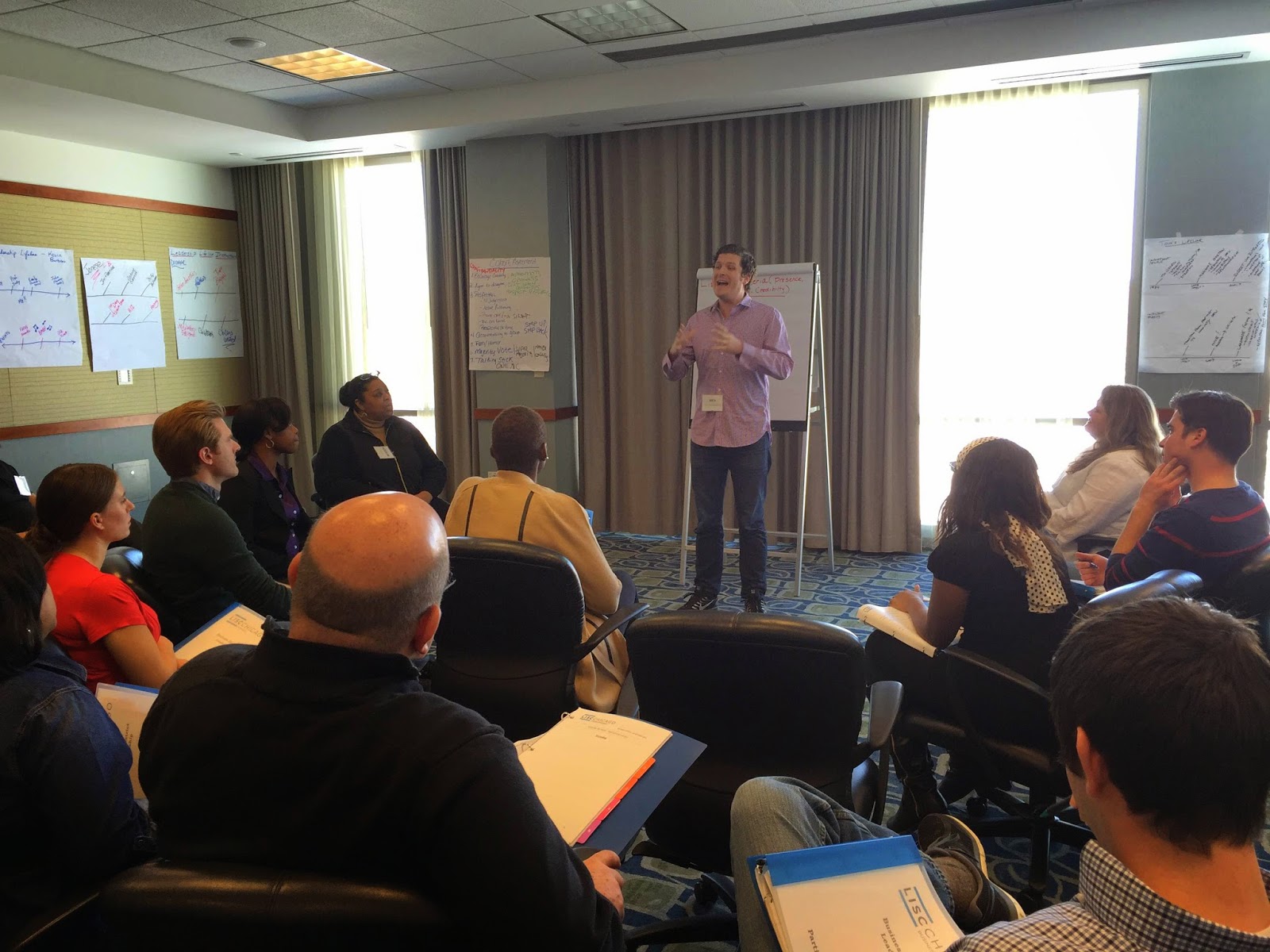
So go ahead and active listen today! 

Tuesday, October 21, 2014

Building Strong Leaders in Commercial Revitalization

Commercial District Advisors gladly supports Coro’s Neighborhood Leadership (NL) Program and encourages those New York City-based practitioners in the commercial revitalization field to apply for Coro’s 2015 six-month program beginning in January. 

Image via coronewyork.org
Who is the NL program targeted for?
“For those leading commercial revitalization efforts in their communities-whether working in a Business Improvement District, Merchant Association, local development corporation, Chamber of Commerce or other nonprofit organization- Coro's Neighborhood Leadership (NL) program provides the city's top talent with the resources they need to understand how to influence meaningful change and address complex challenges within their neighborhoods.”  In Coro’s NL program participants “are given the opportunity to build leadership skills through intensive training and peer-to-peer learning. Participants leave the program equipped with the knowledge and skills to drive change in their own neighborhoods, and an unparalleled network of engaged civic leaders from which to continue to build and grow.”

What are the benefits of the program?
The Coro NL program notes key benefits to this program:

  • THE NETWORK: NL connects participants to an accomplished community of Coro NL alumni, City leaders and the broader Coro community, who are dedicated to supporting one another.
  • THE KNOWLEDGE: NL deeply immerses participants in building individual and collaborative capacity for practicing leadership and bringing about change in their communities.
  • THE SKILLS: NL uses the City of New York as a lab to explore, test and build effective commercial revitalization strategies to adapt and thrive in challenging environments. In particular, participants hone the skills needed to get things done in a multi-stakeholder environment.
Image via coronewyork.org
What is the time commitment?
Neighborhood Leadership meets January through June  and requires a significant time commitment of attendance including: A three-day overnight Opening Retreat, Saturday Leadership Retreat days (4), Bimonthly Networking Evening Events ("Coronect" evenings), Tuesday Strategy Day Sessions (5), Closing Session & Graduation (1), and one Follow-Up Session in October.  Click here to view the NL 2015 program calendar.

Who are the participants?
Approximately 20 successful nonprofit management professionals whose work is focused on commercial revitalization are competitively selected to participate each year. Selected participants reflect the demographics of New York City with at least half serving low to moderate income neighborhoods.  Those selected have interest in joining the Coro community and NL alumni network.

What is the cost?
The kicker is that there is no tuition due to the generous support of the program’s partner and funders. 

Applications for NL 2015 can be found here. The application deadline is Saturday, November 15th.

Questions/comments, contact - Garrett Lucien, Program Director of Neighborhood Leadership, at 212 248-2935 ext. 308 or glucien@coronewyork.org.