Showing posts with label Technology. Show all posts

Monday, January 29, 2018

Good apps are hard to find

Capital Riverfront BID, Washington DC
Are you considering developing an app for your downtown to promote local businesses and events? If so, it might be a good idea to take a moment to think through the pros and cons. Today we talked with Jim Blakeslee of Geocentric, a web software and interactive services firm in Bethesda, MD that works with over 30 downtown districts.  We discussed website development versus app development for downtown business directories and events marketing – his firm does both with their Citylight product, a web-based and data-driven system that tracks and maps all kinds of data within downtown boundaries. Below are some highlights from our conversation that might make the app decision easier to make.

Why you might want to pause before developing a native app
Jim cautions BIDs to think twice before developing an app for the following reasons…

Cherry Creek North BID, Denver CO.
  • Apps can be duplicative of a good website. Geocentric already finds over 50% of the web traffic to downtown district websites is coming through mobile devices. Therefore, your downtown website already needs to be optimized for a phone anyway. There is limited value to creating an app that just duplicates what is already visible in browser without adding additional value.
  • Many customers start their journey of information-gathering on the web. Geocentric notes that up to 75% of web traffic to district websites comes directly from Google search. Unlike websites that live on the Internet, apps are a closed system, making it more difficult for people to find the information tucked within an app. In addition, apps need to be downloaded by users before being of use to anyone – this is yet another hurdle for customers to get simple information such as what’s happening downtown this evening.  Geocentric has found that more than half of all pageviews on their clients’ downtown websites go directly to business directory and events calendar pages.
  • Apps are a lot of trouble and more expensive to maintain. Native apps can be expensive. Jim quoted estimates in the range of $20-40k for a native app, compared to $10-20k for a good website. Keep in mind these estimates reflect an average range, there are apps that can cost up to $100k, and websites that can cost as little as $5k. Either way, the additional cost and time associated with developing and updating/ maintaining an app is significant. Remember, the Google Play and Apple App Stores often require apps to go through an approvals process before being made available in stores.

If you do decide to go with an app. Here are a few tips to keep in mind:
Midtown Alliance, Atlanta GA
  • Make sure you have a good website first. A good app starts with a good website, one that feeds information into the app and prevents the need for double entry of importation information.
  • Integrate supportive tech infrastructure downtown. Take a tip from the shopping center industry and offer free public Wifi downtown. Once the customer has signed in or connected to free Wifi, download prompts for your downtown app on the Wifi landing page can easily be created.
  • Make sure the app offers something above and beyond what your website does. Apps do have the capability to do more than simply duplicate the information found on a good website, so if you are going to use it make sure you enhance its functionality by allowing for push marketing and offers/deals. This is what will help make the app useful and more appealing to download.
  • Marketing is key. An app that is not promoted properly is like a tree that falls in a forest. Does it make a sound? Not if no one hears it. Make sure every business in town is actively marketing the app – one of our clients has given window clings to every business to promote the app and raises awareness of its existence.
  • Measure success. According to Jim, positive growth trends in app usage and downloads is a good indicator that your downtown app is doing well. Of course, like websites, it all depends on the level of competition for news and information in your locality.  

Thursday, October 5, 2017

What does Amazon's search for a new HQ mean for downtown?

Larisa Ortiz is Founder and Principal of Larisa Ortiz Associates

People are talking alot about Amazon today. If Wikipedia is to be believed, at least 118 cities in both Canada and the United States have expressed an interest in being the place where Amazon ends up putting its headquarters. The company's search, and more specifically their search criterion, has broader implications for what the next wave of business growth will require from our cities.

According to Citylab, the Amazon search is creating a "transit reckoning" for our cities. This is because Amazon has mentioned access to "rail, train, subway and bus routes" as among a few key site selection criterion. For many cities with limited mass transit options, this one requirement really puts a damper on their bid to bring Amazon to town. Atlanta, for example, seems to check all the boxes except for the unified transit system. When Atlanta officials took a look at the criterion, there was an call among many stakeholders for "real" solutions to the traffic congestion that plagues the City. Yet those solutions, as we all know, can only involve alternatives to the automobile. More cars and more roads won't help congestion, only transit of the "mass" kind can do that. Furthermore, mass transit without masses don't work - so density will be required. Cities looking to attract the businesses of the future would do well to heed this clarion call. Density and mass transit don't occur by happenstance. We need a few things to make this happen, including:

  • zoning codes that allow for higher densities as-of-right 
  • sufficient SF for the growth of commercial and/or industrial uses
  • meaningful funding for alternative modes of transit that get residents to and from their jobs easily and efficiently
  • investments walkable pedestrian environments and quality open space


In fact, some communities are already ahead of the curve on these issues, including the Brooklyn Tech Triangle, a planning effort led by three major stakeholders in downtown Brooklyn, New York: The Downtown Brooklyn Partnership, the Brooklyn Navy Yard and the DUMBO Improvement District. The plan sought to corral city investment towards improvements that would position downtown Brooklyn as a tech destination and ensure that the district included many of the amenities required by industry businesses. The plan included recommendations with significant emphasis on transportation (which is already the envy of many communities), improved waterfront connections (the City recently invested in an entire fleet of new ferry's and started a frequent and very popular ferry service), enhanced bike share, as well as connections to other growing tech destinations (such as Industry City in Sunset Park). The plan is a great starting point for other communities looking to pursue similar initiatives. In the end, this is all good news for transit connected, dense downtown environments. 


Thursday, September 21, 2017

Technology in Retail

Nur Asri is an associate at Larisa Ortiz Associates.

As we continue to move forward in this digital age, consumers are expecting simpler and seamless processes at home, at work, and at the retail store. As a result, retailers are making significant investments in technology in- stores to meet these consumer demands for a connected and convenient shopping experience. Here are some ways that retailers and brands are using technology to enhance consumer experience but also personalize marketing, improve logistics and customer service in brick-and-mortar stores.

1. Data Integration: Understanding consumer preferences, personalized marketing

Connecting data from smart appliances, mobile phones and other portable devices to digital systems helps businesses understand how customers actually use products and services, and which ones are preferred. To take advantage of this data and metrics, retailers can begin using devices to facilitate a more seamless retail experience in the store, and at home, to integrate products and services.
Retailers can use “customer genomes” to create highly personalized offers, promotions and experiences.

Source: Let's Talk Payments.Com
Macy’s and Apple are using in-store beacons to provide personalized offers directly to customers via mobile devices. House of Fraser, another department store in the UK, inserted beacons into mannequins for a proximity marketing campaign. When shoppers download an app and browse in- store, they receive information about the clothes on display. In other bigger retail stores, in-store shopper tracking systems have been installed to pinpoint a customer’s location. Retailers can then send targeted messages to customers (via smartphones) about nearby items.

Hugo Boss Heat Sensor in Regent Street store.
Source: Bloomberg
In London UK, Hugo Boss uses heat sensors to track customer traffic in its clothing stores, which helps store managers organize priority merchandise in high-traffic areas.

Monsoon Accessorize uses multichannel data sources from in-store and online customers to deliver unique personalized offers via emailed receipts. Similarly, UK department store John Lewis is partnering with an omnichannel personalization company to customize product recommendations for each individual shopper.

Walmart Media Exchange is using data collected from store sales, social-media platforms and third parties to supplement data from its Savings Catcher loyalty program. From the data, Walmart plans to create customer segments, and eventually individual customer profiles, to make better offers, as well as to improve targeted marketing.

2. Building brand/ product awareness: Educating consumers on what’s available on offer, sharing products through social media

Photo: Fashion Network.Com
Sephora has installed display screens showing latest trends, make-up tutorials, and new Made in Sephora exclusive offerings updated by theme each month. The screen greets customers as they enter the store, much like a mall directory screen. In addition, Sephora also has Beauty Boards. These are physical social media platforms to like a look, tag products used and share with the Sephora beauty community. Finally, Sephora’s snapchat geofilters feature highlighted products in-store and are designed to engage everyone within a mile of a store.

3. Product Testing: Allowing consumers to test products digitally or via augmented reality

Again, at Sephora, the Beauty Hub is a virtual look book which provides a catalog of beauty inspiration while the Virtual Artist service enables customers to test looks on an iPad or connected mirror. Developed with Pantone, the Color Profile application helps choose the right foundation shade with almost scientific precision. Recommendations are then made from all the complexion products available at in-store.  

Marie Claire’s pop-up store in NYC SoHo, called “The Next Big Thing Concept Shop”  has dressing rooms with interactive mirrors from Oak Labs that recommend accessories for outfits being worn. Similarly, Clarins beauty stores now feature Sensor Mirror Pro virtual skincare mirrors developed by MemoMi to educate consumers about their skin types so they are able to select the most suitable skincare products.
Photo: Connected-store.Com


Finally, fashion retailer Uniqlo has also piloted a “Magic Mirror” technology from Sharp that allows customers to virtually change the colors of clothing they’re trying on while standing in front of the mirror.

Photo: Ikea
Even when consumers aren’t physically in stores, they are now able to test products thanks to advanced technology. Ikea will soon enable shoppers to virtually test drive merchandise before making a purchase via an augmented reality app called Ikea Place. The app will allow customers to virtually place any Ikea furniture in any space and share the images with friends. The app will automatically scale furniture with 98% accuracy. This enables customers to experience how light and shadows will render on furniture within the space, and is intended to make buying decisions easier and inspire customers ahead of purchasing products. Other furniture retailers such as Wayfair and Ashley Furniture are similarly preparing to launch such initiatives with their products and brand.


Ashley Furniture will take technology a step further and feature in-store virtual reality tech bars that will combine a guided iPad-based space configuration experience with VR headset visualization, allowing shoppers to design and visualize their own homes.

4. Payment Processing: Easy and seamless payment methods

With a smartphone in every pocket and imaging technologies now available for scanning products, faster alternative checkout methods will continue to grow across the retail industry, predicts Tony Rodriguez, CTO of digital identification solutions provider Digimarc.

Self-service checkouts have gotten more sophisticated in grocery stores and moved into other retail sub-segments, such as home improvement, fashion and electronics stores. Tesco, a grocery store in the UK for example, is testing a high-speed checkout solution that automatically scans products placed on conveyor belts. The system can process up to three customers at a time.

Apple Pay at Whole Foods. Photo: Eric Risberg
Integrated mobile apps and “contactless” mobile payments now also enable visitors to make seamless cashless transactions, supported by MasterCard and Apple Pay, from anywhere within the store, including via fitting room mirrors. The Sephora store at Newbury Street, Boston, for example, has no cash registers because staff associates can process payments digitally, on their phones from anywhere on the floor of the store.


Since Apple’s launch of its Apple Pay solution, retailers including Staples and Whole Foods have announced plans to accept Apple Pay at their retail locations, adding to an impressive list of other major brands such as Bank of America, Disney and McDonald’s.

5. Customer service: Efficient appointment bookings, improve staff efficiency, deliveries

Many stores now enable customers to use an integrated mobile app to book one-on-one appointments with fashion stylists, and sign up for a variety of in-store events and activities. Neiman Marcus, for example, has already piloted this at their pop-up store in SoHo.

To free up store employees’ time, Lowe’s has also begun rolling out customer-helping robots into the aisles of 11 stores in the San Francisco Bay Area. Lowe’s Innovation Labs unit worked with Silicon Valley start-up Fellow Robots on the LoweBot. The robots allow store associates to devote their attention to customers that need more thoughtful advice and personalized service. Likewise, Safeway grocery store helps customers locate stock and obtain product information through its Just for U service app. The app also goes a step further by helping shoppers create and sort their shopping list by store aisles.

Wearables, or ‘smart glasses and other connected devices intended to be worn on the body’, are another productivity booster. Tesco distribution center workers wear armbands that track the goods they are gathering. The band also assigns tasks to the wearer, forecasts task completion time, and quantifies precise movements among the facility’s shelving and loading bays.


The advancement of such technology amongst retailers will serve to deliver a seamless shopping experience for customers. However, even with all of these gadgets, customers still walk into brick-and-mortar stores to get the personable experience of getting expert advice from a staff person who’s tried and tested products for themselves. From 2015 report on Navigating the New Digital Divide, Deloitte noted that “one in three customers still prefer to consult store associates for assistance when selecting and validating products.” Retailers must therefore adapt and learn to balance both the human experience and technological convenience in stores to attract consumers in the digital age. 

Friday, September 15, 2017

Saving bodegas, saving third spaces!

Nur Asri is an associate at Larisa Ortiz Associates

This week, two ex-Googlers announced their recent innovation, “BODEGA”, a vending machine, or five-foot-wide pantry box, slated to become the next big convenience stop or amenity in cities across the country. A convenience that is in fact already being provided by already existing bodegas (as they are known here in NYC), or corner stores. These stores, typically run by immigrants, are “frills-free symbols of consumer access and gritty mini-embodiments of the city’s diversity and 24/7 ethos”, and have become more than just a convenient neighborhood retailer. They are ‘third spaces’, extensions of many residents’ homes, and locations where ideas are exchanged and relationships are built. Most importantly, bodegas represent the livelihoods of thousands of immigrants in cities across the country.

Needless to say, “BODEGA” was faced with a great amount of backlash the day it was announced. And we won’t sit quietly either so here’s a quick summary of why “BODEGA” won’t be filling a market gap here, or in most other cities, and will never match up as the amenity that a real bodega is.  
1.       Bodegas are already convenient in most neighborhoods, particularly ones that are not well- served by full-service grocery stores

I did a quick search of NAICS-code defined ‘Food and Beverage stores’ (NAICS: 445) that only had 10 or fewer employees and had annual sales of less than $1 million (Admittedly, these are just some of many characteristics that are presumed to be typical of small family-owned bodegas in New York City but it was the quickest way I could get an estimate of where bodegas or corner stores are already located in a locality) to look at just how convenient they are location-wise.

Estimate location of corner stores and bodegas in North Brooklyn, NY (Source: LOA; ESRI Business Analyst Online)
In North Brooklyn, just by eyeballing, there appears to be at least 1 bodega or corner store every 0.2 mile (mostly! – note the bodega deserts by the Gowanus canal and in Prospect Park). Given that most people are only willing to walk 0.25 mile as part of a commute or to access amenities like parks and public spaces, we can safely say that bodegas here are within the realm of  being convenient and of ‘walking distance’.

Likewise in Lower Manhattan, bodegas and corner stores are everywhere, safe for along the East River but remember, this part of Manhattan is better-served by full-service grocery stores anyway.
Estimate location of corner stores and bodegas in Lower Manhattan and Williamsburg, NY (Source: LOA; ESRI Business Analyst Online)
Operation hours-wise, bodegas are typically open between 16-18 hours per day (if not 24/7), making it accessible to almost everyone returning home at all hours of the day. Furthermore, for some people in NYC, where apartments are shoe-box sized, the lack of a full fridge means that the bodega is also the convenient extended freezer. So you know where you’re going to get that tub of ice cream in the middle of the night when you’re craving a treat.

2.       Bodegas are increasingly offering a wide range of products
A wide selection of fresh fruit at a corner store
in Bedford-Stuyvesant Brooklyn, NY

From non-perishables to fresh produce and beers, the bodega has it! Unlike “BODEGA” that can only carry non-perishable goods (because you know, it’s essentially a vending machine), the bodegas we already have in our neighborhoods can carry almost anything and everything and are therefore more useful to households in the long run. I buy cheese, milk and eggs every other Saturday when I’m finally itching to make an omelet for a leisurely breakfast and I doubt “BODEGA” will ever be able to meet this need. Other residents in Brooklyn today are a little more fortunate and have local bodegas that carry really high quality fresh produce.


3.       Many bodegas are already ‘smart’

Both bodegas that I frequent in my neighborhood have ‘feedback boards’ that enable customers to write the names of products that they wish to see in the store. It’s a simple solution that involves a small cork board, Post-Its and Sharpies, yet owners are able to get more information than “BODEGA” will ever get from its cameras. The cameras in “BODEGA” will apparently track what items are being removed from the machine before sending this data back to main offices to restock the item.

Another thing we need to remember – bodegas also have real people manning the counters, the aisles, the sandwich counters. These people constantly chat with customers to find out if there are any products their customers wanted to see in store. “BODEGA” claims it will have motion sensors to track what products are more popular, and for whom, but I think it’s much easier when I can just express this same information to a person who owns/ manages the store in real-time, don’t you?

4.       Bodegas are hyper locally-sensitive and have personalities

To add on to the earlier argument about the humanness of bodegas, as neighborhoods rapidly change in cities, one block may be extremely different than the next one which also means that bodegas are now stocking almost entirely different products on a block-by-block basis. They are often responding to socio- economic demographics at a block-level and “BODEGA” hasn’t indicated the same capability.

As Adam Chandler wrote in the NYTimes, each bodega is “oddly curated” and no algorithm is clever enough to come up with these eccentricities (at least, not yet). From the Polish specialty foods to Colombian snacks, each bodega has its own specialty treats and delicacies.

5.       Bodegas are third spaces

Franklin Deli Bodega in Greenpoint, Brooklyn NY.
 Photo: Shawn Hoke via Flickr
A relationship with your bodega means you could get a sandwich hook up at an odd hour of the day. More importantly, bodegas are your literal neighbors. They are located below your apartment or next to your building or across from you and are operated by the same people day in and day out. You can chat about the English soccer game happening at the moment, or you can chat about the fact that it’s been a little loud on the street this past weekend, and they’re more than likely to share an opinion about the topic. In one instance, I had a full-blown conversation with the guy at my bodega about how much tastier Pepsi Light was compared to regular Pepsi and the kids in line behind me were more than excited to chime in.

Whether these interactions and relationships are forced or not, they are bound to occur in the small spaces of bodegas, making them vital community spaces for residents in cities across the country.


6.       Bodegas are natural surveillance systems for the neighborhood.

As mentioned earlier, bodegas are open 16-18 hours of the day and in some cases open 24/7, which means bodega employees and customers walking in and out thru late hours of the night serve as ‘eyes on the street’ and round-the-clock surveillance.

7.       Bodegas are employment centers for immigrants

Finally, bodegas are a large employer of immigrants. A Fiscal Policy Institute study published in 2011 found that more than 48% of NYC businesses owners are foreign-born, and in particular, they dominate certain lines of businesses such as dry cleaning, taxi services, and grocery stores (of which bodegas and corner stores make up a reasonable share of this category).

In NYC, retail trade is the broad industry with the largest number of immigrant small business owners. While a full 90 percent of the city’s dry cleaning and taxi service owners are immigrants, a close 84 percent of grocery store owners are also immigrants.

These immigrant business owners already face numerous obstacles in running their businesses, most commonly lack of access to capital (which, apparently “BODEGA” has not been short of) and inability to comply with city business regulations. For now, it seems “BODEGA” will only serve to add problems by becoming a new source of competition for our bodegas, if it does get rolled out in cities like New York, where corner stores and bodegas are already popular.

Like everyone else we'll be paying close attention to where “BODEGA” gets expanded to see if its co-founder, Hunter Walk, keeps his word on “not disrupt[ing] or replace[ing] the urban corner store… the bodega”. 

Monday, December 12, 2016

The Double-Edged Sword of Crowd Sourced Reviews


This holiday season many of us are taking vacations on small remote islands or even upstate just for a weekend in a quaint and undiscovered town. Wherever you end up in the world this month, you are bound to run into a local business owner selling you beautiful handmade souvenirs, delicious cocktails, or an authentic meal and they’re all going to plead that you write them a review. Whether it’s TripAdvisor or Yelp, small business owners are increasingly relying on this new ‘word of mouth’ to earn a good reputation and build a following in this digital age. While we still occasionally rely on the acclaimed critic’s write-up of a restaurant or merchandise, crowd sourced reviews are fast becoming more and more relied upon as a source of information for various goods and services. They are often the first stop for recommendations on everything from restaurants and bars to drycleaners and pet sitters. Sure, crowd sourced reviews might just be an ad populum fallacy but hey, how bad can the fried chicken place be if 2,163 other people gave it a 4-star rating, right?

In 2009, Yelp.com took crowd-sourced reviews to the next level by covering far more restaurants in Seattle than any local publication, including Seattle Times. That year about 70% of all restaurants were listed on Yelp versus a mere 5% by Seattle Times. Unfortunately, this growth of crowd sourced reviews also means that some businesses’ reputations, whether deserving or not, can get easily tarnished with just a click of a button. So before you make vacation plans based on crowd sourced reviews of local bed and breakfasts or restaurants, or in turn write some reviews on your travels, here are some things you should keep in mind about the impacts these reviews have on small, local businesses:
Why Crowd Sourced Reviews May Be Good 

1. Fills information gaps for consumers
Crowd sourcing necessarily means more people providing input. Theoretically, this means gaps in information can more easily be filled by the hundreds and thousands of people who have entered a store, or purchased a product. This might be especially useful for small businesses that have less capability in attracting major media outlets to write thorough reviews of their products and services – so really, it’s free content marketing for them. Of course, the underlying assumption here is that the reviews businesses get are positive and, more importantly, truthful.

2. Good Yelp reviews bring in more business 

Thanks to the ad populum fallacy, positive crowd sourced reviews rake in business. In a recent study by Michael Luca of the Harvard Business School, reviews from the website Yelp.com was combined with public restaurant data to determine whether online consumer reviews really did influence the way that reputation was formed. Indeed the study found that each ratings star added on a Yelp review translated to anywhere between a 5% to 9% effect on revenues of an independent restaurant’s revenue. A report from the Boston Consulting Group also concluded that small businesses that use Yelp saw annual revenue increase by $8,000, based on a survey of 4,800 business owners.

Why Crowd Sourced Reviews may be bad

1. Complex algorithms 

A common criticism of crowd-sourced reviews is the sites’ automatic filtering systems. While arguably these filters hide suspicious reviews, there are also potentially good reviews that get buried as a result and this lowers a businesses’ rating given that hidden reviews do not count toward overall ratings.


2. Gaming or non representative reviews

More recently, business owners have been voicing concerns over other businesses ‘gaming’ the system by unfairly getting friends and family to leave perhaps slightly biased reviews. As a result of this, real customers doing research online may fall prey to the popularity contest and pick these ‘gaming’ businesses to patron over others.

Non representative reviews that are a result of vengeance, although less common, are also becoming a major concern among business owners. One simple yet bad review can negatively affect small businesses especially when it has overall few reviews to begin with. In fact, marketing firm Cone Communications found that 80 percent of customers changed their mind about purchasing a product after reading negative information online.

Worse still, in either scenarios, businesses are unable to remove these false reviews resulting in overall unreliable product information. The best thing that businesses can do when met with bad false reviews, is to flag or report it to Yelp using a simple form, or work harder at increasing the total number of reviews with at least decent ones. While Yelp has taken some steps in holding users accountable for their reviews, other crowd source review sites like TripAdvisor are still very easily abused by the public.

3. Leveling playing field for small businesses spells trouble for big boys

Unfortunately, bigger and national chain eateries with multiple locations and common menu items are not benefitting as much from crowd sourced review sites. Research suggests that smaller, local eateries are starting to get better shares of customers because these crowd sourced review sites are essentially leveling the playing field by allowing customers to learn as much about local restaurants as they know about the chains. The competitive edge that these large chain eateries had in being safe bets for diners in terms of quality, menu offerings, and price points no longer applies when local eateries also have this type of information available online on crowd sourced review sites.


Whether businesses like it or not, crowd sourced review sites are fast becoming substitutes for traditional ‘word-of-mouth’ and are also closing the information divide as go-to information platforms for customers doing research—from where to go on vacation and where to stay to who makes the best mojito in all of the city. So wherever you end up this holiday season, and whatever you end up doing, remember to leave a truthful review for the business owner and at the same time one that provides a potential customer with useful product and service information.

Thursday, August 20, 2015

Spotlight: Online Business Directories for BIDs


We wanted to take a moment here at Commercial District Advisor to do a round up of various commercial district online business directories. Since many people take a look at what a district has to offer before or after they make a visit, or even during a visit via mobile device, it is important to explore the variety of directories districts are posting online. Here are a few:

Pittsburgh Downtown Partnership has an interactive website where you can browse businesses through categories like dine, shop, services, etc with an interactive map and lists of businesses.  Not only do they provide an impressive amount of information on each individual business listing page, but they go a step further to include lists of Nearby Parking, Services, and Dining.  I personally like the interactive map and the level of detail provided for each business, it does take a little bit of navigating to figure out that the business directory is within the various sections and not put together in one spot.

Downtown Albany's business directory is featured in their main menu and is interactive, meaning if you wanted to find coffee shops in the district you would first click "Dining Styles" and then click "Coffee Shops." You would then see all coffee shops in the district. Clicking one opens up an individual page with an impressive amount of information including shop description, location, hours, website, news about the store and sometimes pictures. This directory seems to filter your choices rather effortlessly and is easy to understand.


Downtown Madison's business directory is featured under their Shop & Dine section of the main menu. The directory gives a few options to "View Businesses by Type" - eat, shop, etc - or "View Businesses by Category" - book shops, government, jewelers, etc. You can also search for a business or view all the businesses in one list. When you click a business you get an individual page with business info and their location on a Google map.  This site has simplicity with additional subtle elements.


LA Fashion District integrated a map into their directory which adjusts to directory searches. Business categories in their directory include hotels, floral, bags, restaurants, etc. Businesses can be searched by keyword as well and can be filtered by retail or wholesale.  I enjoyed the neat visualization connecting the map with your search, the color consistency of their website and the customized map is a plus.


Myrtle Avenue Ridgewood Business Improvement District also features their Business Directory in their main menu of their website. Their directory is straightforward and lists many categories of businesses with the number of that type of business indicated beside the category. Clicking the category shows all the businesses and their information listed. You can also see all listings at once or do a search. This is a nice simple directory that is easy to find and easy to navigate.


Friday, February 28, 2014

Help 'em Yelp it! Six ways to help small business owners make the most of Yelp

According to a recent Fox Business news article small business fail to understand the importance of on-line reviews, and I might agree. But what can you, as a commercial district manager, do to help? (For a link to the article, click here: “Survey: Small Businesses Underestimating Online Reviews" )

What is “On-Line Optimization”?
This is a term we coined a few years ago while working with the New Rochelle Business Improvement District (see “Putting Your District’s Best Foot Forward” ). It simply refers to a process by which a 
Many small businesses use review sites like Yelp
and Foursquare as marketing tools.
Your business should be doing the same.
commercial district manager can actively help local businesses build a positive online presence that generates additional customers and sales. While Google is by far one of the most important search engines, Yelp is nearly as important for small businesses looking for exposure. With an average of 120 million MONTHLY unique visitors, and one of the most downloaded review apps in the nation, being on Yelp assures a business that they will be seen when someone is looking for a place to go, whether on their mobile phone or at their desktop.

But commercial district managers face some challenges in harnessing Yelp as a tool, in part because businesses need to claim ownership of their Yelp page to do basic things, like make sure the business profile is complete, including the name and category of business, detailed contact information, links to website and a menu (if a restaurant). In some communities, mom and pops don’t even have email addresses…so asking them to manage an on-line presence can be near impossible.

That said, many businesses owners do know the power of the internet, but just don’t know where to start. The good news is that you can do something to help them. Below are a few waysyou can play an effective role as an intermediary to help your local businesses use Yelp to attract customers. 

1. Make sure their business pages have great photos. This is really important. People REALLY like photos. In fact, research shows that people are more likely to visit a restaurant or store for the first time if they can check it out first. Consider hiring a professional photographer to take attractive pictures of your district and local businesses. If restaurants are included, be sure to take photos of a variety of dishes. Fortunately, anyone can upload photos to a business page so this is something that you do directly on behalf of your businesses.

2. Building awareness of a business’s Yelp page with check inserts, stickers and tent cards. Did you know that only 13% of businesses owners are approaching customers about posting reviews online? While Yelp actively discourages soliciting reviews and will downgrade reviews that they perceive as solicited, they do encourage businesses to let customers know they are on Yelp. Consider printing small index cards for your businesses that they can include with the bill that say something like, “Hey, check us out on Yelp!” with a link to the business listing. With this you are creating awareness that the business is listed, which in turn will help them get reviews.

You might also consider printing transparent stickers and giving them to local businesses who have a presence on Yelp. These “Find us on Yelp” stickers are different than the “People love us on Yelp” stickers (which are issued twice a year based on having a greater than 3.5 star rating from a certain number of reviews). You can also have table tent cards printed, this might be a better alternative for a business that wants to put this on their counter or by the register. “Find us on Yelp” signs and tent cards can be found on the Yelp Flicker stream

3. Making sure your restaurants have their menus on Yelp. Help your restaurants by making sure their menu and price list is displayed on the businesses page. Send a copy of your current menu directly to Yelp via their contact form. You could also consider having your photographer takes a picture of a menu page for you to post as an image.

4. Unfortunately, sometimes it just comes down to better management. Ultimately, reviews are a reflection of the level business goods and quality of service they provide. The reviews – both good and bad – offer important feedback that an owner ignores at their peril. Don’t let your business owners rationalize away negative reviews and low ratings. If they do, they are killing their own business. According to a study by Michale Luca, a professor at Harvard Business School, there is a correlation between high Yelp rankings and revenues. There is a 5-9% jump in revenues for every star in a review. Considered another way, every loss of a star means loss of revenue. So if worse comes to worse you'll need to do some direct business technical assistance. Which leads us to the next suggestion...

5. Hold a business seminar about managing on-line listings. Since most of what a business needs to do is manage their own page, consider inviting a specialist to offer a workshop to your business owners. A few things they should cover include:
  • How to “claim” your Yelp business page. It is free and allows the businesses to make sure their business information is up to date and allows them to add photos (which you can do too) and respond publically to reviews (although they should do this very cautiously as it can easily backfire if not handled correctly)
  • How to respond (or not) to negative reviews. 
  • An overview of the various business platforms that exist that allow business owners to manage multiple social media sites, including Locu by Go Daddy (Costs range from $4.49/month to $26.99/month) and Singleplatform by Constant (Pricing is $79/month). 
  • The impact of reviews on sales
6. And finally...measure the impact of your effort! Why? Because you are in the business of showing that an investment in your effort and the work of your organization is an investment in a business's bottom line. The straighter the line you can draw between your efforts and a business' sales, the better poised you will be to ask for and receive more resources that have an even greater impact. In this case, you will want to know whether your businesses are seeing an uptick in sales as a result of your efforts. You can do that by surveying them within a month of the effort taking off. And then an a bi-annual or annual basis thereafter. Another option is to ask them for their Yelp metrics. Every business that claims their Yelp page has the ability to track metrics, including the number of monthly visitors and user views to their page. See if participating businesses will share this information with you for your records. Better yet, require it as a condition for helping them.


Tuesday, February 4, 2014

Chattanooga Proves the Power of Economic Development Planning

Author Larisa Ortiz is Principal at Larisa Ortiz Associates. 

Great article today in the New York Times ("Fast Internet is Chattanooga's New Locomotive") on the power of “The Gig”, a city-owned high-speed fiber optic connection that is helping to transform downtown Chattanooga into a destination for high-tech firms. More than anything, it speaks to the power of economic development planning. When stimulus money was available in 2009, the City already had a plan in place with elements that needed funding. The impact of the investment on downtown was felt fairly quickly. “Since the fiber-optic network switched on four years ago, the signs of growth in Chattanooga are unmistakable. Former factory buildings on Main Street and Warehouse Row on Market Street have been converted to loft apartments, open-space offices, restaurants and shops. The city has welcomed a new population of computer programmers, entrepreneurs and investors. Lengthy sideburns and scruffy hipster beards — not the norm in eastern Tennessee — are de rigueur for the under-30 set.”

The River City Company, Chattanooga's economic development agency,
has also commissioned marketing material to help attract retailers downtown.
This piece was developed by Stevaker, a Chattanooga based graphic design firm. 

This is Why Economic Development Planning Matters
The high tech development plan was part of an economic development initiative that really took off when the city received a $111 million federal grant in 2009. While the stimulus money – and leveraged private investment was critical – without a ready to go plan in place it’s likely that those funds would have gone elsewhere.

Additional Economic Development Tactics Also Played a Role
If economic development is about creating a positive business environment. the City of Chattanooga seems to be ahead of the curve. But the high speed internet connection is not the only tool in the Chattanooga’s Economic Development toolbox. According to the Times the city has “cleaned its air, rebuilt its waterfront, added an aquarium and become a hub for arts in in eastern Tennessee.”

Another important component is that the network is municipally owned – a powerful commentary on the need for public investment in large infrastructure. (Although the article does state that Google is building similar networks in Kansas City - both MO and KC - and Austin, Texas)

The City has also leveraged partners in its efforts to spearhead the tech sector. One successful tactic is an entrepreneurial contest that came with a $100,000 prize by The Company Lab, a non-profit that conducts programs and events to support start ups and entrepreneurs in Chattanooga. The contest helps to raise the profile of Chattanooga among start ups – and the winner of the contest was Baynan, a firm that relocated to the City in 2013.

The economic renaissance that seems to be taking hold in Chattanooga is a powerful testament to the needs for thoughtful public investment - what I call "outside the store" investment - by the public sectors. It is also about being prepared so that when opportunities and investment opportunities arise, your community is prepared and ready to take advantage of them.

Additional Useful Links
The River City Company, Downtown Chattanooga's economic development agency has links to a number of studies they have commissioned. This site is geared toward the investor and real estate community.

Downtown Chattanooga's  website is a great place to go to find out about events and going's on. This site is geared toward the casual visitor who wants to know about events downtown, as well as folks who might be considering moving to Chattanooga. 


Monday, January 6, 2014

Will 2014 be the year that the independently-owned film theater dies?

2014 is a year that will change the dynamics of downtown forever. From here on out, first-run films will only be distributed via digital cinema projection, or DCP. So if your local theater does not have digital capability, which according to a recent NYTimes article ["Small Theaters in Adirondacks Face Choice in Switch to Digital: Pay or Perish",12/25/13] costs $65,000 per screen, staying in business will be nearly impossible.
The Central Cinema in Seattle successfully launched a Kickstarter campaign
and raised over $60,000 from over 1,000 backers. 

Economic Impact on Downtown's
Simply put, if a theater does not make the transition, they will not be able to show films. And without films, there is no potential for revenue. As one crowdsource campaign to fund digital projection for the Rialto Theatre in Grayling, MI put it, "We have a simple choice: convert to digital projection or close."
These closures can be the death knell of a local commercial district. These theaters not only show films, they are also important community gathering places, hosting many community events and activities year round. Yet changes the change in film distribution will affect many independently-owned theaters, but the statistics are not in yet and so still don't know how many theaters will close as a result of this change. A 2010 study by the American for the Arts of the impact of this requirement in the Adirondacks found that that 60 percent of commercial chain theaters have made the switch, but 100 percent of Adirondack theaters (13) are independent and cannot afford to upgrade. The study also analyzed the overall impact on the Adirondack economy and found the following:

Economic Impact of Theater Closures on the Adirondack, NY Economy*
  • Loss of over 110 jobs 
  • Loss of over $11.4 million* spent above and beyond ticket purchases in communities (at restaurants, taverns, etc.) by the nearly half million attendees 
  • Loss of community gathering venues, affordable entertainment for families and people on fixed incomes, loss of indoor activities for resident and visitor populations when the weather is inclement, loss of community events often donated by the theaters 
* based on American for the Arts 2010 Arts & Prosperity Study


How will Theater's Raise Funds? 
Distributors are offering financing packages (covering approximately 50 percent of the cost of the projectors), but theaters will lose control content and will be required to pay a monthly projector maintenance fee ($4,000 per projector per month). They will also still be required to cover the costs upfront and get paid back over time based on distributor savings in shipping.
What about the banks? There is always the bank...right? Well, not really. We are doing some work in the Central District in Seattle and the Central Cinema, a local movie house that recently succeeded in raising $60,000 for their DCP upgrade, and they outlined the lending situation quite well:
"If we do not make our funding goal then we will have to find another way of making the DCP conversion happen. In the current economy the banks are still quite hard to work with and equipment lease deals are approaching usury. An upgrade of this size is too large to put on our line of credit and credit card rates are out of the question. We may be able to work out a loan arrangement eventually but the best option is still to have the fans of the Cinema help us with this Kickstarter."
So increasingly many are turning to crowdsource funding, and one of the most popular options is Kickstarter.com. A search for "digital projection" on Kickstarter yields 211 projects, 5 of them currently live. Turning to the community is sometimes the only way to go, especially as bank lending remains tight. In the Adirondacks in New York, a non-profit created a "Go Digital or Go Dark" campaign that allows contributors to donate to theater of their choice in one of then communities. The goal, to raise $2.18 million to support the conversation of dozens of community theaters to DCP.

To App or Not to App?

Author Kristen Wilke is a Project Manager at Larisa Ortiz Associates

It is hard for me to imagine figuring out what to do and where to shop in a new city without the help of my iPhone. I choose my hotel based on proximity to restaurants that get good reviews, and pick my routes with the help of apps that will tell me which streets have nice shops with local character (because gifts from the airport just don't cut it). If there's a neighborhood where businesses aren't on Google Maps and restaurants aren't listed on Yelp, chances are I won't know to go there.

Some cities and commercial district organizations have developed their own Apps to highlight their local businesses and help visitors get around. But this can be resource-intensive, and puts you on the hook for updating content regularly. If you're considering creating an App for your community, first take a look at what is already out there that could save you from doing the work yourself. (And if you have created an App in your community that supports local businesses, let us know about your experience!)


Yelp:
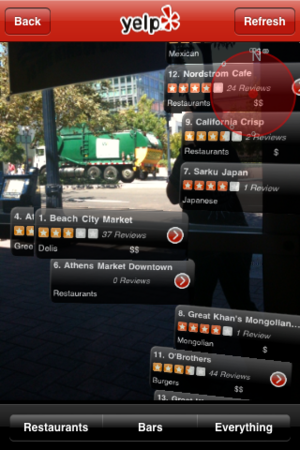
Yelp Monocle. Screenshot via mashable.com
Looking for a burrito joint open now? An Irish pub nearby? A gas station you can drive to before your tank hits empty? Yelp for your iPhone or iPad is here to help. Use us to search for places to eat, shop, drink, relax and play then read reviews from an active community of locals in the know. 

My thoughts: According to their most recent stats an average of 11.2 million mobile devices use the Yelp app each month. That means there is a pretty good chance that if people are visiting your city and using their smart phone to get around, they are doing it with the help of the Yelp app. Working with local businesses to get on Yelp and build their positive reviews is an easy way to get on visitors' radar. We wrote more about this a few months back. Also, Yelp has a great track record of working with municipalities. Recently, they've partnered with a number of cities to include Department of Health ratings for restaurants' hygiene scores. This is a good sign that the company would be interested in building new partnerships to support local business communities.

Google Maps: Find the best spots in town and the information you need to get there.
My thoughts: One of the first things you see when you go to maps.google.com is a link that says "Put your business on Google Maps". Having local businesses on Google Maps is an easy way to attract customers who are using the app to get around a notice a cluster of businesses in their area, whether or not they are specifically searching for places to shop or dine.

AroundMe quickly identifies your position and allows you to choose the nearest Bank, Bar, Gas Station, Hospital, Hotel, Movie Theatre, Restaurant, Supermarket, Theatre and Taxi. AroundMe shows you a complete list of all the businesses in the category you have tapped on along with the distance from where you are.

My thoughts: Though I hadn't heard of it until today, AroundMe and Yelp are nearly tied for users. There are some differences - AroundMe doesn't have the reviewing element, instead they differentiate themselves by providing information like current movies playing nearby, and making reservations through OpenTable. If it seems like Yelp isn't big in your area, check to see if businesses have made it here. Another similar app is NearMe - but, based in London, some of their terminology (i.e. Petrol Stations and Pubs) takes some getting used to.

Shopikon: As chain stores fill the streetscape the world over, this project is a celebration of the independent retailer. All stores featured on Shopikon have been hand-picked by our editors who have visited thousands of stores, and only the best of the bunch make it into our guide. We evaluate stores based on product selection, atmosphere, dedication to their specialty, and overall shopping experience, making sure that they are all worth your trip!

My thoughts: Great concept, but only available in seven cities (NYC, SF are the only ones in the US). I'm excited to see if they pop up in other US cities. For now, when I want to do this kind of shopping I typically search on Yelp or search for "Best of" listings in local independent papers.

Now is a free iPhone app that lets you see what is hot and happening in your city based on crowd
Now. Photo via techcrunch.com/2013/01/11/now-app/
sourced photos. It's a public platform where users can stand as city journalists and share their best experiences happening in their city and see how popular they are.


My thoughts: Now tracks Instagram hashtags by location to show what is happening nearby. For a visitor, this could be a great tool for finding out about local events, sales, and store openings. The app is still young so user numbers are low and it is only available for iPhones.


Other things to consider

  • If you do create an App, how will visitors find out about it? Will they have to see it on a printed guide, or in an ad on a local website? Then it may be unlikely that they find out about it while they're planning their trip. 
  • Go to the App store for your device and type in the name of your city. What results do you get back? Chances are they are from various travel companies you haven't heard of or local sports teams.  Do they have stellar ratings? Probably not. If you're going to spend time designing an App, have a strategy in place to stand out from the crowd.
  • In a (highly unscientific) poll I just conducted among friends, many people stated that they would only download an App if they knew they were going to use it repeatedly. If that isn't the case, they will visit a website that can give the information they are looking for. Think about your target audience - if it is locals, maybe an app is the way to go, but if it is visitors who will only be in town briefly, perhaps a mobile-friendly website is more appropriate. 

Bonus:
For the Top 35 Restaurant Apps, take a look at this infographic from fastcasual.com.


Tuesday, July 2, 2013

When Census Data Doesn't Cut It: 5 (Fun) Alternative Sources for Understanding Neighborhood Change

When you work in neighborhoods undergoing significant, rapid change, it helps to get a little creative with your research and data sources, especially as we move further away from the last census.

Here are some of our favorite (and fun!) tools that we use to understand what’s been happening in the communities where we work. Let us know in the comments what tools you use to understand neighborhood change.

Tracking Buzz

Yelp Wordmap
Yelp’s new Wordmap (launched yesterday!) shows density of keywords used in Yelp reviews around different cities. These maps are helpful in understanding characteristics and mix of local businesses, and the consumers in each of these neighborhoods. They may also prove useful if you’re searching for prospective retailers to bring to your community, or for businesses that are considering expanding into new markets.

They also reveal some subtle differences in clientele (Williamsburg has a density of Hipster businesses, while Park Slope and Prospect Heights are more appealing to Yuppies) and regional differences (Yelpers like to eat/review Biscuits in Portland, OR, Hoagies in Philadelphia, Dim Sum in San Francisco, Poutine in Toronto, and Bacon just about everywhere.) We hope they’ll add in a timeline feature so we can see how these clusters change over time!

Yelp Reviews that Mention "Hipster" in NYC


Google Trends
Google Trends allows you to see how, when, and how often people have been Googling different terms (since 2005). We use this to evaluate any “buzz” around a neighborhood, and to see how communities stack up against one another in terms of search popularity. See below how NYC’s five boroughs have trended over the past eight years.

(Just for fun - try putting in different parks and beaches to see how the trend lines change with the seasons.)

Understanding New Customers

LOA Lifestyle Matrix
Inspired by retail guru John Williams approach to tenant mix analysis, we’ve created the LOA Lifestyle Matrix that we use to plot both customers (using psychographic data) and retailers in a particular commercial district by Income/Price and Lifestyle. By overlaying these two data points, we can visualize fairly quickly how well stores in a particular place are meeting the needs of their community, and what consumers want (do they want an expensive trendy store like Opening Ceremony, or one that is trendy but inexpensive like Rainbow? Is this a J. Crew shopping district or a Talbot’s kind of market?). We can then identify any mismatch between offerings and customers, and use that insight to both attract the right mix of new retail, while also helping retailers adapt to neighborhood change. Even if you don’t have access to psychographic data, try creating your own matrix with census data, Yelp reviews, and other free sources.


Impact of Transit on Neighborhood Change

Annual Subway Ridership
So much of urban development is influenced by access and proximity to transit. In New York, the MTA collects annual ridership by station. Using this data, we can see where the most significant increases in ridership are happening, which can help us understand where new activity and investment is taking place and project what neighborhoods might be next.

Tracking Recent Investment and Growth

Property Shark Maps: Home Price Changes by Neighborhood (2012 vs 2004)

Property Shark maps the change in price per square foot of residential properties by neighborhood. This helps to illustrate where new investments are being made, and what neighborhoods are struggling, stagnant or soaring.

Brooklyn Price/ SqFt Changes 2012 vs 2004