Showing posts with label On-Line Marketing. Show all posts

Friday, February 2, 2018

The Age of the Selfie


Greetings from Austin Mural, TX. Photo: Yelp
Nur Asri is an Associate at Larisa Ortiz Associates.

Whether we care to admit or not, we’ve all taken one or been forced to take one. I'm talking about selfies. Selfies are digital self-portraits that began to really take off when smart phones became equipped with the forward-facing camera. The photos themselves haven’t radically changed retail or downtowns – believe me, people were taking self-portraits even when they had film cameras. However, when the digital self-portraits are uploaded to social media platforms and tagged and shared by users across the world, that’s when it starts to have an impact on the brand and identity of a retailer or an entire downtown.

The selfie is now a common tool that people – young and old – use to share their individual experiences with others and to self-brand. The marketing power of the selfie cannot be understated. A HTC survey in 2013 of more than 2,000 mobile phone users in the UK found that about 51% of the UK had taken a selfie, creating about 35 million photos every month. Although a greater share of those aged 18-24 had taken a selfie, almost a third of those aged 65 and older had also taken one, indicating that the selfie can work on a wide range of customer segments.

Just to understand the magnitude of selfie-taking, we took a look at the number of selfies taken on Instagram.

Sure, selfies are often criticized for being associated with vanity or narcissism but selfies are often the first and last step a customer takes in their purchasing journey. Selfies provide inspiration for those seeking to make purchases and selfies provide validation for those who have already bought products – it’s a near instant feedback loop for customers. Selfies have indeed increased sharing of product information and resulted in more educated and conscious consumers. Today, customers search for authentic peer recommendations for a range of products and even for travel decisions so information shared on social media has in many ways surpassed the influence of magazines and newspapers. A 2016 TopDeck Travel Survey in 2016 found that in choosing where to travel, 76% of Millennials surveyed said that friends’ recommendations…and social media came far ahead of travel-agent advice.

How are retailers making use of selfies?
Retailers in a wide range of categories have used selfies as a leverage to raise brand and product awareness, and also boost in-store traffic.
1. Drug stores/ Beauty
Interactive mirrors placed in UK drug store, Superdrug Beauty Studio, allow customers to experiment with hair colors virtually and take selfies after getting hair or make-up done. This helps the store’s customers to share the quality of services being offered in-store while also providing free marketing. To make the sharing of the selfie easier, the store features iPads that enable customers to send the selfie to Facebook or Twitter with the official campaign hashtag, #TreatYourSelfie.

2. Apparel
Many apparel stores from Victoria’s Secret to French Connection and Ted Baker have used selfies as part of their marketing campaigns. These stores encourage shoppers to take photos in-store by creating a perfect backdrop or setting for taking selfies. These include special installations, interactive selfie booths and attractive storefront displays. The stores then encourage shoppers to share the selfies on their personal Twitter and Instagram profiles using official campaign hashtags by providing incentives like free gifts for anyone that uploads the photo to social media or by displaying the selfies on a public screen or storefront window.

By displaying the selfies publicly, passersby became very engaged with the store. They were able to vote for favorite selfies using hand sensors and were then more likely to walk into the store.  


3. Food
Even with food, selfies can happen. The phenomenon known as foodstagramming is the act of taking photos of one’s food and posting them on social media. Restaurants are certainly taking advantage of it because it can be free advertising (depending on the photographer’s comments!).

How can downtowns use selfies?
Speaking of food, this week is Restaurant Week across New York City and sure enough many business improvement districts are using food selfies as a way to raise awareness of the district events and drive greater traffic to the restaurants in these areas post-event. Grand Street BID in Brooklyn, for example, is offering foodstagrammers a chance to win $50 to their favorite Grand Street Restaurant if they upload a picture of their Restaurant Week meal with the hashtag #DineOnGrand and tag the BID in the photos.  

Beyond food selfies, commercial districts can also use iconic art and signage and interactive sculptures to encourage selfies by visitors and to reinforce their identities. In the past, we’ve featured the I Amsterdam sign as one example of a way that signage can drive popular images posted on social media. Many other downtowns have driven high visitation rates with iconic selfie spots. Here are some examples:

In Austin, murals across the city have become destinations in themselves and visitors are taking selfies in front of them and sharing images on social media with hashtags #Austin #ATX

In San Diego, the gateway signage to the Gaslamp Quarter has also become very iconic as a selfie spot for visitors to the area.

Creating a selfie moment in your downtown, like in a retail store, can do wonders in attracting more visitors and customers. The rapid sharing and outsourcing of opinions amongst consumers today can either make or break your downtown so make sure you provide positive moments for visitors to snap a quick and pretty selfie.

How to create a successful selfie moment downtown

First, remember to create a backdrop for the selfie to happen. This means good lighting, mirrors and attractive or significant art. Holiday lighting displays are often great backdrops, as are large sculptures, murals and gateway signs. The backdrop should also reflect the identity and brand of the downtown in order for the retweets and sharing of social media posts to be fully effective in driving interest and traffic to your downtown.

Second, make uploading the selfie easy. While stores and retailers can easily provide ipads and devices to customers, downtowns should instead think about providing free public wifi. From personal experience, I’m always more likely to upload and share content when I can easily get online. If I’m not able to instantly upload images after taking them, I’m likely to forget doing so later.

Third, provide incentives for visitors to take the selfies. With some visitors, you’ll need to nudge. Offer a chance to win a shopping trip or discounts at downtown stores if someone takes a selfie in the area and uploads it to social media. Featuring selfies taken downtown on outdoor advertisements and interactive platforms may also nudge some visitors to take photos. It’s always fun to see a photo you’ve taken up on a public platform!

Finally, make sure you aggregate the selfies and build your downtown brand through a common hashtag or downtown social media account that visitors can tag in their posts. This can help you drive traffic to your downtown website or even directly downtown! Make sure everyone on social media ‘liking’ or ‘retweeting’ posts is able to connect the selfie to your downtown.

Monday, January 23, 2017

Macy's stores are closing. Now what?! Eight strategies for downtown practitioners facing new retail realities

Macy's recent announcement that it will close approximately 100 stores over the next few years came on the heels of announcements that Sears and K Mart will close 150 more stores (they closed 78 stores last year). Other stores like Kohl's posted disappointing holiday results. These general merchandise anchors have struggled in recent years to remain profitable, and the closures are intended to focus their resources on more profitable stores. So what do these trends mean for Main Street? We think the news offers challenges and opportunities for downtown business districts. Here are a few ways we think our downtown communities will be affected in the coming years...

More competitive leasing environment. With more and more SF on the market, malls in lackluster markets will struggle to lease space, and in some cases they will be competing for retailers who might also be considering a downtown retail space. This means that you have to be more aggressive in your leasing efforts, and get better at communicating the value add of a downtown location. You should ask yourself a few questions. Are your downtown vacancies easily found on on-line listing services? If not, are you working actively with your property owners to ensure their properties are listed and available for easy viewing? Do you maintain demographic and market data for retailers who are considering your market? There are a myriad of ways - some that require more investment than others - to ensure your district's vacancies are on a retailers radar. But either way, supporting retail leasing efforts will take some concerted effort and investment. On that note, don't forget to downtown our book, "Improving Tenant Mix: A Guide for Commercial District Practitioners" for free from ICSC's website for ways to take a more hands on approach to your district's leasing efforts. 

Omni-channel retailing will become more and more the norm as mainstream retailers invest in their on-line presence. Main Street retailers will need to find a way to follow suit. Yet asking small retailers to carve out resources for a robust on-line presence is a lot to ask many of them. As a result, communities and BIDs may have to step up their efforts to educate businesses on the strategies the tools they have available to them to ensure survival. Many businesses, particularly those that make their own products, may not be aware that they can sell on platforms like Amazon, Zappo's or Rue La La. We recently met a business owner who gave us the skinny on her on-line selling strategy, telling us she had abandoned Amazon because their requirements were "too much of a pain", but that she has had a great experience with Zappo's. This kind of intelligence will be useful to share with your local business community. And for those interested in selling directly to customers through an on-line platform, there are more and more options for them out there. (Read our recent post "On-Line Selling - An Option for Smaller Businesses" for more info.)
A retail website powered by Shopify, one of a number
of  on-line platforms that makes on-line selling
accessible to small businesses.

Programming and creative usage of public space (i.e "place based strategies") will increase. Commercial districts, like malls, are increasingly trying to offer distinctive experiences that cannot be found so easily on-line. Cooking demos, craft classes, exercise classes, etc. will all become more critical to engaging with customers. In downtown, that means activating and programming public space in a way that will drive downtown visitation. Consider the Meatpacking District's free outdoor yoga program. They teamed up with a local store to offer programs on the street during the summer. This is a great way to highlight a local business while also bringing activity to open spaces. These activities also reinforce a well thought out strategic position for this market based on the segment of the businesses that are there - a place where young, active people congregate. We love it.

The Meatpacking District BID in NYC
sponsors "Downward Dog Yoga Days" in the Summer
in partnership with a local business. 

Food will continue to drive leasing in many downtown environments. When food is in the mix, shoppers increase their dwell time, which increases the amount of money they are likely to spend in the district. A panel on Urban Retailing at last year's ICSC Recon emphasized this trend. Restoration Hardware Executive David Stanchak was on hand to discuss RH's recently opened new store in Downtown Chicago that includes a food operation - The RH Chicago Three Arts Club Cafe. According to Stanchak, "for every dollar we do on food-and-beverage sales, we're generating $2 on increased gallery sales."  The good news is that downtown environments already do food quite well, but will need to begin to find better synergies between food and shopping. In some communities, the hours that retailers are open do not necessarily overlap with the hours that restaurants are open, which diminishes opportunities for cross-patronage. Correcting this misalignment, perhaps through a well-promoted once a month late night effort could help address this issue. That said, care should be taken not to overtax small business owners who often have limited staff capacity to do this on a regular basis. Promoting the event sufficiently, and to the right customer audience, is key to ensuring the success of late night shopping strategies.
The 3 Arts Club Cafe, a food concept within
Restoration Hardware's new downtown Chicago location.

Food kiosks, food trucks, and seasonal food offerings will also continue to grow. Some communities might not be able to support a full time bricks-and-mortar food retailer, but can instead focus on developing a temporary set of offerings that may be associated with an event. We are working in a community in Long Island right now that has a small municipal beach. Last year they started a very successful food truck and movie night. It probably shouldn't come as a surprise that they sold many, many more beach passes over previous years - adding to the town coffers while also building community. These investments clearly also pay dividends.
Downtown Raleigh BID puts on the Food Truck Rodeo
over a weekend in the early Spring with more than 50 food trucks. 

Leasing to specialty businesses will rise. The downtown environment has an element of authenticity and interest that makes is a great place for some of these more interesting retail concepts. In some cases, lower rents and a lower hurdle to entry make downtown storefronts an enticing alternative to malls. Consider Muse Paintbar in Providence, RI, a business that bills itself as "the premier art and wine experience". Located on Main Street in a historic building, Muse Paintbar offers a wide array of classes for adults and families too.


Property owners and merchants will request higher transparency around BID spending. In the mall world, payments by retailers to cover common area maintenance (CAM) are critical to ensuring shared spaces are well maintained. The International Council of Shopping Centers recently posited that 2017 will see a more "widespread effort by retail tenants...to rein in or set limits on CAM costs." We believe that the same economic forces driving retailers to second guess CAM charges are not limited to businesses that lease storefronts in malls. As many of you know, in a downtown environment, the equivalent of CAM charges are BID assessments, which in a similar manner to CAM charges are obligatory contributions by property owners and/or merchants that support the enhanced maintenance of shared public spaces and help to advance long term district improvements. While getting a BID off the ground may become more challenging as businesses and property owners double down on keeping costs down, we do believe that existing BIDs will have to make sure their members understand the value they are getting for their investment. This means getting much better at bench-marking impact with measurement tools like pedestrian counts. And while BID members may balk at increasing BID budgets, doing away with these additional charges is not an option either. As one analyst indicated, it "costs money to create experience". And given how important experience is going to be to shoppers in the future, downtown's with BIDs are going to be better positioned to weather competition from on-line retailers than those that don't have the resources to program and maintain the downtown environment. 

Retailers, especially at the high end, are open to thinking outside of the box and customizing their stores to unique urban spaces. According to Richard Johnson, a senior real estate specialist who spoke at Recon in May, urban locations are appealing despite the higher costs, "“There is always a lot more cost, and we do more work for urban locations,” he said. “You want to give your best face to your best clients, and urban does that. The goal is to create something unique that has our customers coming back time and time again.” 

Overall, we think downtown is well positioned to compete in the coming years. As people look for authentic experiences, the kind of things that simply cannot be done on-line, we are confident that many downtown's can and will rise to the challenge.

Monday, December 12, 2016

The Double-Edged Sword of Crowd Sourced Reviews


This holiday season many of us are taking vacations on small remote islands or even upstate just for a weekend in a quaint and undiscovered town. Wherever you end up in the world this month, you are bound to run into a local business owner selling you beautiful handmade souvenirs, delicious cocktails, or an authentic meal and they’re all going to plead that you write them a review. Whether it’s TripAdvisor or Yelp, small business owners are increasingly relying on this new ‘word of mouth’ to earn a good reputation and build a following in this digital age. While we still occasionally rely on the acclaimed critic’s write-up of a restaurant or merchandise, crowd sourced reviews are fast becoming more and more relied upon as a source of information for various goods and services. They are often the first stop for recommendations on everything from restaurants and bars to drycleaners and pet sitters. Sure, crowd sourced reviews might just be an ad populum fallacy but hey, how bad can the fried chicken place be if 2,163 other people gave it a 4-star rating, right?

In 2009, Yelp.com took crowd-sourced reviews to the next level by covering far more restaurants in Seattle than any local publication, including Seattle Times. That year about 70% of all restaurants were listed on Yelp versus a mere 5% by Seattle Times. Unfortunately, this growth of crowd sourced reviews also means that some businesses’ reputations, whether deserving or not, can get easily tarnished with just a click of a button. So before you make vacation plans based on crowd sourced reviews of local bed and breakfasts or restaurants, or in turn write some reviews on your travels, here are some things you should keep in mind about the impacts these reviews have on small, local businesses:
Why Crowd Sourced Reviews May Be Good 

1. Fills information gaps for consumers
Crowd sourcing necessarily means more people providing input. Theoretically, this means gaps in information can more easily be filled by the hundreds and thousands of people who have entered a store, or purchased a product. This might be especially useful for small businesses that have less capability in attracting major media outlets to write thorough reviews of their products and services – so really, it’s free content marketing for them. Of course, the underlying assumption here is that the reviews businesses get are positive and, more importantly, truthful.

2. Good Yelp reviews bring in more business 

Thanks to the ad populum fallacy, positive crowd sourced reviews rake in business. In a recent study by Michael Luca of the Harvard Business School, reviews from the website Yelp.com was combined with public restaurant data to determine whether online consumer reviews really did influence the way that reputation was formed. Indeed the study found that each ratings star added on a Yelp review translated to anywhere between a 5% to 9% effect on revenues of an independent restaurant’s revenue. A report from the Boston Consulting Group also concluded that small businesses that use Yelp saw annual revenue increase by $8,000, based on a survey of 4,800 business owners.

Why Crowd Sourced Reviews may be bad

1. Complex algorithms 

A common criticism of crowd-sourced reviews is the sites’ automatic filtering systems. While arguably these filters hide suspicious reviews, there are also potentially good reviews that get buried as a result and this lowers a businesses’ rating given that hidden reviews do not count toward overall ratings.


2. Gaming or non representative reviews

More recently, business owners have been voicing concerns over other businesses ‘gaming’ the system by unfairly getting friends and family to leave perhaps slightly biased reviews. As a result of this, real customers doing research online may fall prey to the popularity contest and pick these ‘gaming’ businesses to patron over others.

Non representative reviews that are a result of vengeance, although less common, are also becoming a major concern among business owners. One simple yet bad review can negatively affect small businesses especially when it has overall few reviews to begin with. In fact, marketing firm Cone Communications found that 80 percent of customers changed their mind about purchasing a product after reading negative information online.

Worse still, in either scenarios, businesses are unable to remove these false reviews resulting in overall unreliable product information. The best thing that businesses can do when met with bad false reviews, is to flag or report it to Yelp using a simple form, or work harder at increasing the total number of reviews with at least decent ones. While Yelp has taken some steps in holding users accountable for their reviews, other crowd source review sites like TripAdvisor are still very easily abused by the public.

3. Leveling playing field for small businesses spells trouble for big boys

Unfortunately, bigger and national chain eateries with multiple locations and common menu items are not benefitting as much from crowd sourced review sites. Research suggests that smaller, local eateries are starting to get better shares of customers because these crowd sourced review sites are essentially leveling the playing field by allowing customers to learn as much about local restaurants as they know about the chains. The competitive edge that these large chain eateries had in being safe bets for diners in terms of quality, menu offerings, and price points no longer applies when local eateries also have this type of information available online on crowd sourced review sites.


Whether businesses like it or not, crowd sourced review sites are fast becoming substitutes for traditional ‘word-of-mouth’ and are also closing the information divide as go-to information platforms for customers doing research—from where to go on vacation and where to stay to who makes the best mojito in all of the city. So wherever you end up this holiday season, and whatever you end up doing, remember to leave a truthful review for the business owner and at the same time one that provides a potential customer with useful product and service information.

Wednesday, December 9, 2015

Five highlights and lessons learned from another successful ICSC Deal Making trade show...

This year's New York ICSC Deal Making just finished, and it was a jam packed two days with lots of great conversations and new relationships forged for both us and our clients.The real work of follow up begins now! I learn something new everytime I attend (nearly seven years and counting!) and this year was no different. So here is my run down of what I took away from the show...

A rebranded P3 Retail Program! As the ICSC Eastern Division Co-Chair for the now rebranded P3 Retail Program (P3 stands for "Public Private Partnerships"), it was a thrill to see the launch in action. The ICSC team, including Cynthia Stewart, Michael Cowden and Jazmen Johnson had videographers ready to go. They had some of their members conduct interviews with ICSC members about their experiences and insight. I'll be very excited to see the final results when it is all done. I was interviewed, and also had the chance to interview Keith Sellars of the Washington D.C. Economic Partnership as well as Mary Reda and Jim Diego of Greater Jamaica Development Corporation. I really enjoyed hearing their insights and learning from their experiences.

Prep work is what it takes to have a great outcome. This year, we we thrilled to work closely on ICSC prep for a large community development corporation here in one of New York's largest outer Borough downtown districts. While the team has been attending ICSC for over five years, they were looking to refocus and refine their efforts and asked us to help. We began by defining their merchandising strategy based on consumer market data and existing business mix. We used this data-driven approach to identify "like districts" that shared similar demographics and retailers. We then combed those districts to identify retailers who were already located in similar markets and with similar co-tenants, but not yet in the district. We also had to make sure that these prospects could be accommodated in available spaces within the district, based an opportunity site list we developed with the client, and that they were the right price points and "lifestyle" fit for the area.  Finally, we did research into whether those prospects were growing in the region. Once we drilled down on prospects that made the final cut, we worked with our client to identify contacts for each - that included who they already knew, who we knew through our industry relationships, and who we could find through our access to the ICSC database and Deal Making attendance list. Once that happened, the client was ready to make calls and set up appointments at the show. 

Getting a booth or kiosk can make a difference. 
This year ICSC made a concerted effort to enlist more non-profit and public municipalities with a discount entry option. I was proud to have been a part of that as Chair of the Municipalities subcommittee that helped plan this part of the show. Our client had never taken a kiosk before and this year they did, and I am happy to say that they raved about the experience. Being able to have a home base, conduct meetings in the shared P3 Pavilion retail space, and chat with drop ins made a real difference for them, and they plan to do it again next year. It is important to note that they made sure to man the booth at all times - and also had staff walking around attending meetings. Another thing to keep in mind is that this strategy needs to be part of a comprehensive approach to the show. Don't think that you can get a booth and people will automatically come to you. The location of the P3 pavilion at the New York show was pretty good. In Vegas however, the Cities of the World pavilion, as it is branded, is in a much more out of the way location. Some cities and non-profit orgs decide to take booths closer to the action, but at greater expense. Everything is a trade off.

On that note I enjoyed my conversation with Keith Sellers of the Washington DC Economic Partnership. They have been attending ICSC for over a decade, and graduated from a shared booth with a utility company to a 5,000+ sf booth in underwritten in part by the local developers. Their approach is so incredibly strategic and thoughtful, and I enjoyed hearing Keith talk about how far they had come.

Embedded image permalink

Social media DURING the show is important. You have to treat your booth or kiosk as a might a retail store. If you don't market it, you are missing opportunities to connect with potential customers. Same goes for a trade show. The good news is that ICSC helps with this. They had a hashtag (#NYnDM) and twitter handle (@ICSC) and would retweet things that were tweeted their way. We made sure to utilize this marketing support and it was a great way to drive traffic to the P3 pavilion and to individual booths.

A marketing brochure may not be the right approach for your district. To support our client's outreach, part of our task included developing new marketing material for them. In the past, their typical marketing strategy was a multi-page brochure with lots of words and tables of data. We knew from our work in the industry that marketing strategies are changing quickly, and that the multi-page brochure, while still making the rounds, can be hard to share digitally and doesn't always come across the same way when viewed on a computer. So we made a suggestion to do something a little different but much more in line with where the industry is going when it comes to marketing retail and site opportunities. Increasingly, developers and brokers are creating marketing decks - basically short slide shows that can be printed and distributed, but are more likely to be viewed  and distributed digitally. They rely less on verbage (that very few read anyway) and more on great info graphics to make a case. They are more straightforward to understand, can be used to tell a story, easier to refine, and easier mix and match on demand. Our client carried these around in bound booklets for reference, and then told the contacts they made that they would forward them the material after the conference. This strategy is a great way to continue contact and an excuse to follow up afterwards - which is the key to success. What I also found was that the decks were a good aide in keeping the presenter on message. And after the pitch, but during the meeting, they were easier to use. You could quickly go back to any slide that communicates the point you want to reinforce.


Overall I was so happy with the outcomes for the ICSC P3 effort as well as for our clients. We live tweeted quite a bit, so follow us @cdavisor if you want to keep up.

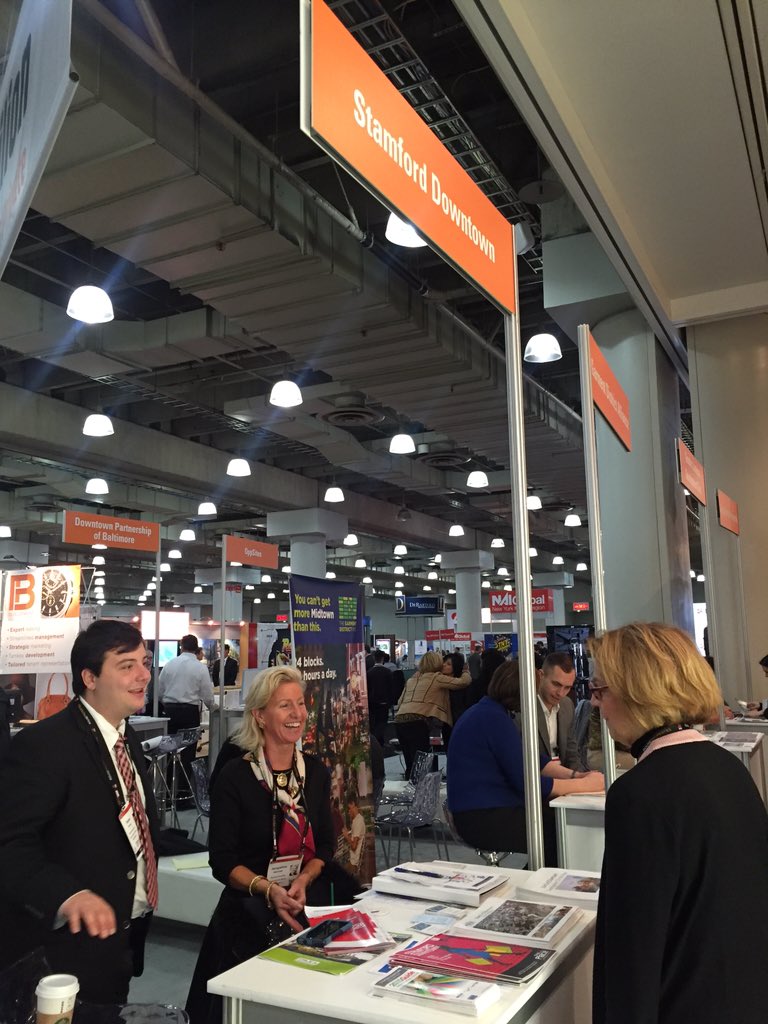
Here are some more pics for fun. 
Embedded image permalink
I felt like Oprah interviewing Mary Reda and Jim Diego at the #P3retail booth!
Embedded image permalink
Baltimore Downtown Partnership has a great location. 
Embedded image permalink
Being interviewed by Cindy Stewart of ICSC, together with Jason Claunch of Catalyst Commercial 

Tuesday, October 6, 2015

NoHo BID leads the pack with a .BID Domain

Last night I had the pleasure of welcoming Seth Taylor, Executive Director of the NoHo BID, as a guest speaker to my Downtown Economic Development class (which is offered through the Department of City and Regional Planning at Pratt Institute in Brooklyn). Seth spoke about his organization's efforts to rebrand and reposition the area known as NoHo - for North of Houston Street in lower Manhattan. If you are more familiar with SoHo, well this is its northern cousin.

After issuing an RFP for a design firm to help develop a new brand, logo and website, the BID settled on Box Creative, a SoHo-based graphic design firm. The new logo was evocative of the great architecture and high-end design aesthetic increasingly found among the district's businesses.

Another exciting element of the branding effort was the website. The brothers who run Box Creative suggested to Seth that he consider a .BID domain to maintain consistent branding across all platforms. Seth didn't realize that you could select a .BID domain over a .COM domain - and neither did I! He explained to the class that the .BID domain was developed for auction sites, but of course works perfectly for Business Improvement Districts. He went with NoHo.BID as his website address and never looked back. The domain name is streamlined and clean, just like his newly designed logo and website. Take a look!


I thought this was too good not to share. With 2,500+ BIDs across the country, this is an idea whose time might have come!


Monday, August 24, 2015

Strategies for Retail Niche Building

Competition is not always a bad things. Depending on the retail industry, competition and multiple retail offerings can drive even more people to your district. The research is clear on this point, one critical factor in the success of urban retail districts is "store density." Why? Because being able to accomplish multiple shopping tasks in one trip makes a district convenient. And simply put, people will travel further for that level of convenience. [LISC, New and Definitive Evidence on What Works to Revitalize Urban Commercial Corridors, 2011]

Certain retail categories in particular benefit from what economists call "agglomeration economies" - clusters of businesses that benefit from co-location. Together these firms attract more customers than they could alone. That is often why you will find restaurants clustered together. Another fairly typical example are furniture stores. In some places a "Diamond District" or "Flower District" are good examples of industries that benefit from the ability to draw both suppliers and customers. 

I recently came across another example while walking in Manhattan the other day. I had about an hour to kill and went to Yelp to see where I could accomplish some "retail therapy". What immediately became apparent to me was that I was adjacent to a cluster of vintage stores. For those unfamiliar with New York, the Gramercy neighborhood is also a very high-end community, so I had no doubt that these stores would have a very nice selection of merchandise. Without a moments hesitation, I set out to explore.
I wasn't disappointed. $30 later, I had three shirts and a dress to show for my excursion! I have been living in New York now for longer than I care to admit...so how did this great retail niche get by me? I began to think about how these businesses could improve upon their market position and start attracting more people.

If your district has a niche of some kind, here are a few ways in which you can support their marketing efforts.

1. On-Line Listing and Categorization. Ensure that these businesses are listed on the most common search engines and they share similar categorizations. For example, each of these stores popped up when I searched "vintage". (Admittedly I started by search looking for "apparel" and then realized how many stores were of the vintage variety")

2.  Organize! Get your niche firms together and see if they want to take out a joint advertisement in a local media outlet. They will benefit from coming together on a regular basis and discussing opportunities to further enhance their visibility and marketing efforts.

3. Business directory. Consider developing a directory of your niche stores

4. Event marketing. Hold events that highlight the niche. How about an "evening vintage store crawl" with wine at every stop? You could even develop a hashtag - #vintagestroll anyone?

5. Branding. Consider branding the district. "Vintage Alley" has a nice ring to it...

6. Tenant Recruitment. Consider growing the niche by recruiting additional businesses in the category. Together with a strong marketing campaign this can help enhance the regional appeal of your district and grow the customer base.

The ideas are endless!

Below are the images of the four local thrift stores - what I find interesting is that they vary tremendously in quality. Vintage Thrift and Housing Works are much more high-end in their displays. The Salvation Army and City Opera were less concerned about the aesthetic appearance of their stores. But all had great merchandise. I know at least one person who will be returning

Vintage Thrift has a high-end look and feel. Too bad it was closed on Saturday when I stopped by. The store is run by a Jewish Organization and they were closed for the Jewish holiday. 

Housing Works is one of the premier thrift stores in New York. The proceeds go to AIDS prevention.  

The Salvation Army has the largest retail spot of the bunch - and also had the lowest end look and feel. 

The smallest store by far...but nicer things and from what I could tell, a higher price point than the others. 

Tuesday, December 23, 2014

Mobile Marketing: Are your businesses on the map?

Customers are increasingly using on-line platforms to find local businesses in real time. I know I do it all the time.  Just the other night I was out with a friend and we had planned to meet at a restaurant in Soho. When we got there it was packed. What did we do? On a cold winters night in New York there was only one option. We stood in the heated vestibule and searched Yelp for an alternative. We found a great restaurant with a two block walk that had good reviews, a decent price range, and no wait. We liked it so much that we will undoubtedly go back. And honestly, I can't even tell you the name of the first place we tried. Clearly, Yelp helped at least one business gain a customer they otherwise would never have seen.

On-line profiles definitely help, yet most businesses do very little to manage them. In 2013, the Boston Consulting Group surveyed 4,800 local businesses and found that those businesses that claimed their FREE Yelp profile reported "incremental revenues of $8,000 annually". This is not paid advertising, mind you. Yet only 15% of small business owners know that they can get a free Yelp profile, and only 11% claimed it.

Below is a quick summary of some of the most popular on-line platforms and some basic instructions on how to use them. In each case, the instructions are somewhat similar, a business goes to the search engine and verifies their identify. They are given an account and go easily go about managing their identity. In some cases you as a commercial district manager can actively help (for example, a business using Google can add you as a "Manager"), in others, only the business owner can verify and manage their on-line identity.

Keeping with the Soho theme, I went ahead and tested business listings for Soho using four listing engines...

Bing "Venue" Maps
Bing is increasingly creating opportunities for "venue" maps. They started in 2010 by adding maps of malls, but it seems that more and more commercial districts are getting into the business. Check out the image below for a map of Soho with nearly every business listed. If you roll over the map, the businesses are linked back to a profile that includes the company website and hours of operation. When you compare it to the Google map below, it is clearly easier to navigate and understand. The map has the look and feel of a mall directory. How commercial districts can get onto Bing is not quite clear...but we have a request in to find out and will share with you when we know.


Google Maps
Google is the 6th most popular mobile app, and the first most popular mapping engine in the world, so getting businesses on the Google map should be a no brainer.

Direct your business owners to http://www.google.com/business/#befound to get started. Once a business has claimed an add, they can do things like set up a Google Adwords campaign much more easily. Remind them that additional managers can be added under Settings>Managers.

You should also know that you can list your commercial district management entity to the Google Map directory as well. Your district entity can then take the lead on setting up Adwords campaign for the entire district, which can be used to market events and actitivies as well. We worked with a community a few years ago on a restaurant marketing campaign that used Google Adwords and we were thrilled that it resulted in significant increased sales for participating local businesses.

Yelp
What sets Yelp apart is really its rating and filtering function. The site gets over 100 million unique click a month so clearly something is working. Like on Google, the first step is to Claim and Verify your Business (https://biz.yelp.com/claiming)

It should be noted that many businesses loathe Yelp. The issue here is that some businesses think that Yelp unfairly filters positive reviews (in an effort to prevent an owner from soliciting reviews from customers) and therefore highlights negative reviews. Not sure where I stand on that, but the truth is that a Yelp listing can drive traffic. Business owners can help increase the number of reviews - and good business will undoubtedly receive more positive reviews than negative ones - by adding badges to their websites or putting "Find us on Yelp" signs in the window or on the front counter.

FourSquare
With 45 million registered users (up from 30 million in January 2013), FourSquare is a force to be reckoned with (although not nearly as popular as Facebook or Twitter as a social networking app). Business looking to claim their profile can do so at: http://business.foursquare.com/


Friday, February 28, 2014

Help 'em Yelp it! Six ways to help small business owners make the most of Yelp

According to a recent Fox Business news article small business fail to understand the importance of on-line reviews, and I might agree. But what can you, as a commercial district manager, do to help? (For a link to the article, click here: “Survey: Small Businesses Underestimating Online Reviews" )

What is “On-Line Optimization”?
This is a term we coined a few years ago while working with the New Rochelle Business Improvement District (see “Putting Your District’s Best Foot Forward” ). It simply refers to a process by which a 
Many small businesses use review sites like Yelp
and Foursquare as marketing tools.
Your business should be doing the same.
commercial district manager can actively help local businesses build a positive online presence that generates additional customers and sales. While Google is by far one of the most important search engines, Yelp is nearly as important for small businesses looking for exposure. With an average of 120 million MONTHLY unique visitors, and one of the most downloaded review apps in the nation, being on Yelp assures a business that they will be seen when someone is looking for a place to go, whether on their mobile phone or at their desktop.

But commercial district managers face some challenges in harnessing Yelp as a tool, in part because businesses need to claim ownership of their Yelp page to do basic things, like make sure the business profile is complete, including the name and category of business, detailed contact information, links to website and a menu (if a restaurant). In some communities, mom and pops don’t even have email addresses…so asking them to manage an on-line presence can be near impossible.

That said, many businesses owners do know the power of the internet, but just don’t know where to start. The good news is that you can do something to help them. Below are a few waysyou can play an effective role as an intermediary to help your local businesses use Yelp to attract customers. 

1. Make sure their business pages have great photos. This is really important. People REALLY like photos. In fact, research shows that people are more likely to visit a restaurant or store for the first time if they can check it out first. Consider hiring a professional photographer to take attractive pictures of your district and local businesses. If restaurants are included, be sure to take photos of a variety of dishes. Fortunately, anyone can upload photos to a business page so this is something that you do directly on behalf of your businesses.

2. Building awareness of a business’s Yelp page with check inserts, stickers and tent cards. Did you know that only 13% of businesses owners are approaching customers about posting reviews online? While Yelp actively discourages soliciting reviews and will downgrade reviews that they perceive as solicited, they do encourage businesses to let customers know they are on Yelp. Consider printing small index cards for your businesses that they can include with the bill that say something like, “Hey, check us out on Yelp!” with a link to the business listing. With this you are creating awareness that the business is listed, which in turn will help them get reviews.

You might also consider printing transparent stickers and giving them to local businesses who have a presence on Yelp. These “Find us on Yelp” stickers are different than the “People love us on Yelp” stickers (which are issued twice a year based on having a greater than 3.5 star rating from a certain number of reviews). You can also have table tent cards printed, this might be a better alternative for a business that wants to put this on their counter or by the register. “Find us on Yelp” signs and tent cards can be found on the Yelp Flicker stream

3. Making sure your restaurants have their menus on Yelp. Help your restaurants by making sure their menu and price list is displayed on the businesses page. Send a copy of your current menu directly to Yelp via their contact form. You could also consider having your photographer takes a picture of a menu page for you to post as an image.

4. Unfortunately, sometimes it just comes down to better management. Ultimately, reviews are a reflection of the level business goods and quality of service they provide. The reviews – both good and bad – offer important feedback that an owner ignores at their peril. Don’t let your business owners rationalize away negative reviews and low ratings. If they do, they are killing their own business. According to a study by Michale Luca, a professor at Harvard Business School, there is a correlation between high Yelp rankings and revenues. There is a 5-9% jump in revenues for every star in a review. Considered another way, every loss of a star means loss of revenue. So if worse comes to worse you'll need to do some direct business technical assistance. Which leads us to the next suggestion...

5. Hold a business seminar about managing on-line listings. Since most of what a business needs to do is manage their own page, consider inviting a specialist to offer a workshop to your business owners. A few things they should cover include:
  • How to “claim” your Yelp business page. It is free and allows the businesses to make sure their business information is up to date and allows them to add photos (which you can do too) and respond publically to reviews (although they should do this very cautiously as it can easily backfire if not handled correctly)
  • How to respond (or not) to negative reviews. 
  • An overview of the various business platforms that exist that allow business owners to manage multiple social media sites, including Locu by Go Daddy (Costs range from $4.49/month to $26.99/month) and Singleplatform by Constant (Pricing is $79/month). 
  • The impact of reviews on sales
6. And finally...measure the impact of your effort! Why? Because you are in the business of showing that an investment in your effort and the work of your organization is an investment in a business's bottom line. The straighter the line you can draw between your efforts and a business' sales, the better poised you will be to ask for and receive more resources that have an even greater impact. In this case, you will want to know whether your businesses are seeing an uptick in sales as a result of your efforts. You can do that by surveying them within a month of the effort taking off. And then an a bi-annual or annual basis thereafter. Another option is to ask them for their Yelp metrics. Every business that claims their Yelp page has the ability to track metrics, including the number of monthly visitors and user views to their page. See if participating businesses will share this information with you for your records. Better yet, require it as a condition for helping them.


Monday, January 6, 2014

To App or Not to App?

Author Kristen Wilke is a Project Manager at Larisa Ortiz Associates

It is hard for me to imagine figuring out what to do and where to shop in a new city without the help of my iPhone. I choose my hotel based on proximity to restaurants that get good reviews, and pick my routes with the help of apps that will tell me which streets have nice shops with local character (because gifts from the airport just don't cut it). If there's a neighborhood where businesses aren't on Google Maps and restaurants aren't listed on Yelp, chances are I won't know to go there.

Some cities and commercial district organizations have developed their own Apps to highlight their local businesses and help visitors get around. But this can be resource-intensive, and puts you on the hook for updating content regularly. If you're considering creating an App for your community, first take a look at what is already out there that could save you from doing the work yourself. (And if you have created an App in your community that supports local businesses, let us know about your experience!)


Yelp:
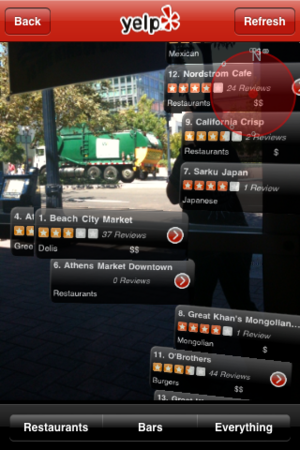
Yelp Monocle. Screenshot via mashable.com
Looking for a burrito joint open now? An Irish pub nearby? A gas station you can drive to before your tank hits empty? Yelp for your iPhone or iPad is here to help. Use us to search for places to eat, shop, drink, relax and play then read reviews from an active community of locals in the know. 

My thoughts: According to their most recent stats an average of 11.2 million mobile devices use the Yelp app each month. That means there is a pretty good chance that if people are visiting your city and using their smart phone to get around, they are doing it with the help of the Yelp app. Working with local businesses to get on Yelp and build their positive reviews is an easy way to get on visitors' radar. We wrote more about this a few months back. Also, Yelp has a great track record of working with municipalities. Recently, they've partnered with a number of cities to include Department of Health ratings for restaurants' hygiene scores. This is a good sign that the company would be interested in building new partnerships to support local business communities.

Google Maps: Find the best spots in town and the information you need to get there.
My thoughts: One of the first things you see when you go to maps.google.com is a link that says "Put your business on Google Maps". Having local businesses on Google Maps is an easy way to attract customers who are using the app to get around a notice a cluster of businesses in their area, whether or not they are specifically searching for places to shop or dine.

AroundMe quickly identifies your position and allows you to choose the nearest Bank, Bar, Gas Station, Hospital, Hotel, Movie Theatre, Restaurant, Supermarket, Theatre and Taxi. AroundMe shows you a complete list of all the businesses in the category you have tapped on along with the distance from where you are.

My thoughts: Though I hadn't heard of it until today, AroundMe and Yelp are nearly tied for users. There are some differences - AroundMe doesn't have the reviewing element, instead they differentiate themselves by providing information like current movies playing nearby, and making reservations through OpenTable. If it seems like Yelp isn't big in your area, check to see if businesses have made it here. Another similar app is NearMe - but, based in London, some of their terminology (i.e. Petrol Stations and Pubs) takes some getting used to.

Shopikon: As chain stores fill the streetscape the world over, this project is a celebration of the independent retailer. All stores featured on Shopikon have been hand-picked by our editors who have visited thousands of stores, and only the best of the bunch make it into our guide. We evaluate stores based on product selection, atmosphere, dedication to their specialty, and overall shopping experience, making sure that they are all worth your trip!

My thoughts: Great concept, but only available in seven cities (NYC, SF are the only ones in the US). I'm excited to see if they pop up in other US cities. For now, when I want to do this kind of shopping I typically search on Yelp or search for "Best of" listings in local independent papers.

Now is a free iPhone app that lets you see what is hot and happening in your city based on crowd
Now. Photo via techcrunch.com/2013/01/11/now-app/
sourced photos. It's a public platform where users can stand as city journalists and share their best experiences happening in their city and see how popular they are.


My thoughts: Now tracks Instagram hashtags by location to show what is happening nearby. For a visitor, this could be a great tool for finding out about local events, sales, and store openings. The app is still young so user numbers are low and it is only available for iPhones.


Other things to consider

  • If you do create an App, how will visitors find out about it? Will they have to see it on a printed guide, or in an ad on a local website? Then it may be unlikely that they find out about it while they're planning their trip. 
  • Go to the App store for your device and type in the name of your city. What results do you get back? Chances are they are from various travel companies you haven't heard of or local sports teams.  Do they have stellar ratings? Probably not. If you're going to spend time designing an App, have a strategy in place to stand out from the crowd.
  • In a (highly unscientific) poll I just conducted among friends, many people stated that they would only download an App if they knew they were going to use it repeatedly. If that isn't the case, they will visit a website that can give the information they are looking for. Think about your target audience - if it is locals, maybe an app is the way to go, but if it is visitors who will only be in town briefly, perhaps a mobile-friendly website is more appropriate. 

Bonus:
For the Top 35 Restaurant Apps, take a look at this infographic from fastcasual.com.


Tuesday, January 15, 2013

How can downtown remain competitive in the face of online shopping?

It should come as no surprise that we continue to see the rapid growth of on-line shopping. Virtual and mobile sales now account for 10% of all sales, and experts suggest that number will grow to 20% before long. So how do downtown and neighborhood commercial districts compete? Rest assured, the retail industry is not taking the threat of on-line shopping lightly. There are a few things that we can learn from how the retail industry is responding to the changing nature of consumer shopping habits...

Multichannel retailing – not just for the big guys
Many retailers reported a lackluster holiday season, but Macy’s was not among them [“Macy’s shows it can make big bucks online”, Crain’s New York, 1/13]. Admittedly, Macy’s is closing downtown department stores in under performing markets. On the flip side, the storied department store has figured out a way to turn the threat of online shopping into an opportunity. This year alone the department store has seen a 52% increase in online sales.

Being able to search and buy on-line – even when in the store – effectively allows Macy's to offer more inventory with less space, and move overflow items out of some stores and into shoppers hands before the need to discount. While the future of the downtown department store remains unknown, the ability to turn on-line shopping into an opportunity to grow market share is still a critical play in the downtown revitalization playbook.


For downtown merchants, here are a few options for selling on-line:
  • Create a "downtown" website. Some downtown organizations are helping small businesses by creating destination shopping websites. When retailers combine forces, they can build an on-line identity that plays on people’s desires to buy local. In Oakland, California, the City of Oakland has spearheaded a “Shop Oakland” website that focuses on listing local businesses and highlights their on-line offerings.
  • Creating new venues for on-line sales...it's not just about a website. The term F-Commerce is not yet widely known, but will be soon. Some small businesses are gaining traction selling via Facebook using services like Payvment that provide support for Facebook transactions.
  • Use existing, well known channels for selling. Etsy is another way to build an on-line presence, especially for specialty retailers. 

Offer an Experience, Not Just a Place to Shop
A ropes course at the Palisades Mall in
New City, NY keeps
kids busy while parents shop. 
On-line shopping has also changed the way shopping centers and districts think about their overall tenant mix and offerings. Many shopping centers now try to offer an experience that cannot be rivaled by the comfort of one’s home. On a recent trip to Palisades Mall, a super-regional mall outside of New York City, I noted a new ropes course in the middle of the atrium. Shopping is clearly not the only thing that drives visitors to this mall. According to a recent WSJ article, this trend is growing. Mall owners are adding more “restaurants, upscale movie theatres, supermarkets and other tenants that offer goods and experiences that can’t be found on-line.” Downtowns can and should be thinking about doing the same. 

Make it Convenient
Malls are not stopping at creating experiences either. In an attempt to capture the shopper on the other end of the spectrum, some malls are “reconfiguring more stores to have direct access to parking lots, so shoppers can dash in and out for quick service rather than having to traverse the entire shopping center.”  

So what does all of this mean for the downtown shopping district? First, it means that we have to recognize the need to compete for shoppers on two fronts – first by offering an unrivaled experience that compels visitors to leaves the confines of their home, and second by ensuring that the shopping experience is convenient and easy. That means convincing shoppers that visiting your district will save them time if they only needs the basics, but should they decide to stay, there is an experience to be had. Urban commercial districts are taking the leap, many are ramping up their entertainment offerings in creative ways - encouraging ambient entertainment offerings like musicians, magicians, artists, etc. as well as impulse entertainment offerings, like Jane's Carousel in the Dumbo neighborhood of Brooklyn. 

Spruce up to Remain Competitive
With so little new inventory and construction underway, some of the most well located shopping centers are taking the opportunity to overhaul and reposition their existing asset. "After decades of retail construction...much of the country is overbuilt, and online shopping has crimped many retailers' store-opening plans. In an attempt to keep shoppers coming...mall owners and retailers are shifting to renovations. ["Malls Get Facelift to Pull in Shoppers", WSJ, 12/18].  If competitive shopping districts are upgrading, you need to make sure that you remain competitive by keeping your district clean, neat and well managed.


Tuesday, August 16, 2011

Online Videos for Mom-and-Pops Bring New Customers

Great idea! A promotional video paid for by a grant from the Downtown West Orange (NJ) Alliance is helping to attract new customers to the town's oldest and most storied mom-and-pop hardware store. For more details check out the article [West Orange's Oldest Retail Store Goes Digital, West Orange Patch] or watch the video here:

Wednesday, March 16, 2011

AOL's new site, Patch, covering topics of interest to commercial district managers

I have begun to notice a trend. As I search for news for this blog, I have noticed that Patch, a 'community-specific news and information platform' has been the source of more and more articles related to commercial districts. AOL sponsors Patch, and has invested heavily in content by hiring 800 local writers and thousands more freelancers to cover hyper-local news stories. Each Patch site, there are 100+ so far, is branded by the community it serves, and allows locals to keep up with local news, local business listings, and community events via a populated calender. Patch is yet another resource for promoting your businesses and your district. It can be used to find volunteers as well. Each site is run by professional editors and writers who live in or near the communities covered. Local businesses can request to be listed as well. You can also sign up for a newsletter that sends news, events, and business promotions directly to your email in-box. As the site grows, it will be an increasingly powerful platform for commercial district managers to get the word out about promotions and events.

The verdict is still out about Patch, but it is an intriguing effort that seems to be getting some traction, particularly given all the coverage I have seen on smaller community revitalization efforts - efforts that don't often get media coverage.

Friday, December 17, 2010

Are you using social media to drive "real" traffic to your downtown?

Your position as a commercial district manager is about utilizing economies of scale. District management entities are in an excellent position to serve as the portal for social media - serving business owners who don't want to have to deal with learning how to effectively use and maintain relavent social media context. I came across a recent news article [Read more: How Eight Major Franchises Are Using Social Media For Customer Service] about how franchises are using social media for customer service. The same concept can and should be applied to commercial district managers in their social media efforts. Franchisees pay franchise operators for the marketing support they provide - making it easy for individual franchise owners to particate and benefit from the social media strategy that their corporate parents manage and maintain on their behalf. There is no reason that these strategies can't work for commercial district managers.

Some examples that are particularly appropriate include:
  • Tasti D-lite offers "treatcards" that allow customers to accumlate points that can be redeemed at the store. This is linked to Foursquare and Twitter. Customers who register their card get extra points with every purchase.
  • Dunkin Donuts offers occational specials and free items via it's Twitter account
  • Church's Chicken launced a Twitter account. Customers who signed up were matched by a $1 donation to a pledge fund. This sounds like a great way to build a Twitter account quickly, and give to a local cause at the same time. I'm sure this could be leveraged to get some good local PR as well.
In general, these franchise operators are using Twitter and Facebook to send out marketing information, specials and other benefits on behalf of their many franchisees. The same concept can be applied to a commercial district social media strategy on behalf of its many businesses. Here are a few downtown's that have Twitter accounts for some ideas...
Go ahead and post a link to your downtown twitter account for others to view!